


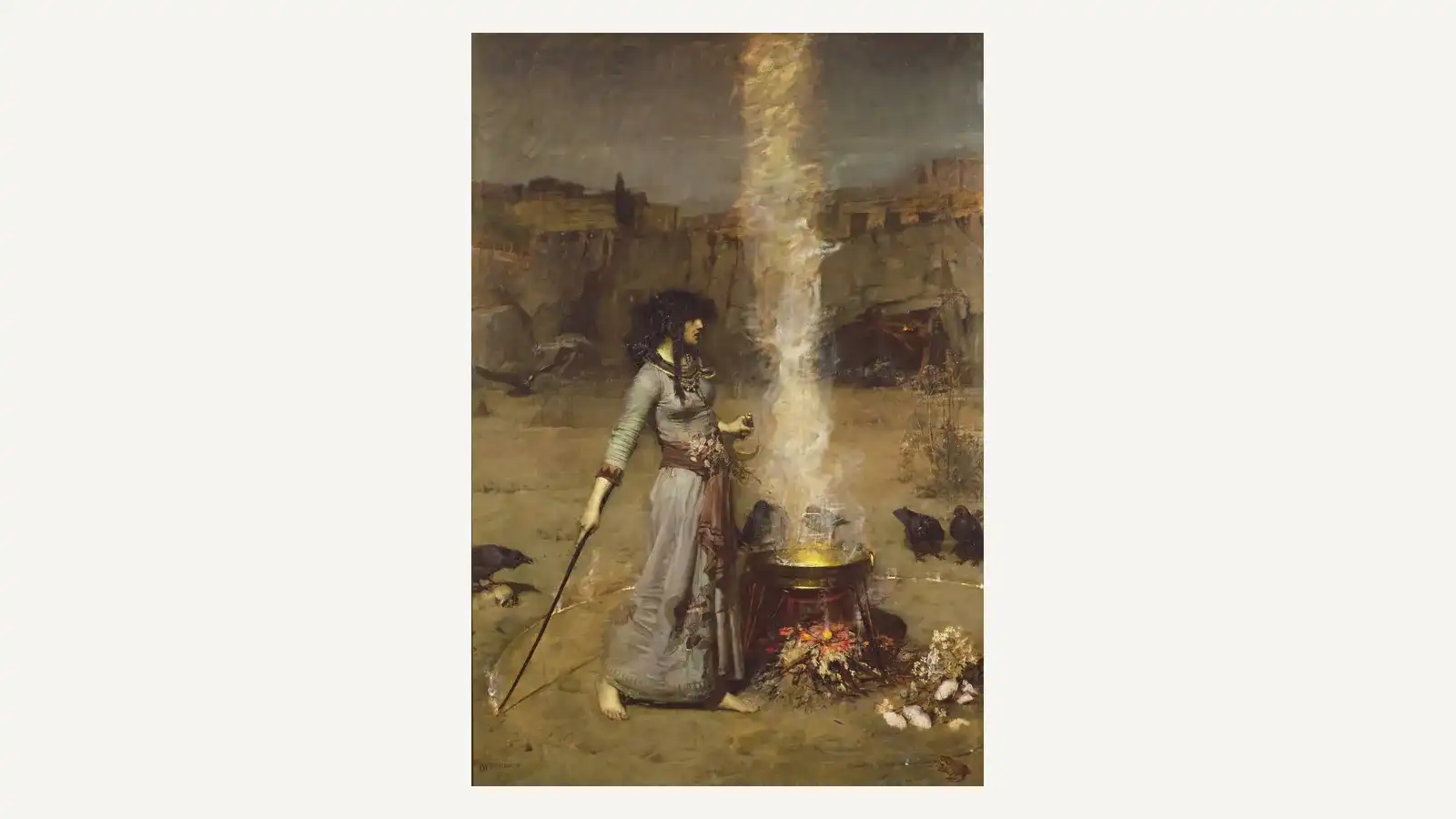
Two small habits teach more than any spell book: watching the moon every night for a month, and getting to know a few herbs properly. In this lesson you start both. The moon journal shows you your own rhythms. The herb cards teach you to check where a correspondence comes from before you use it. Both live in your Book of Shadows.
Why the moon and why the kitchen
Historical People have used the moon as a calendar for thousands of years, for farming, festivals and counting months. Herbs were food, medicine and, in folk belief, protection long before anyone wrote correspondence tables.
Modern The magical “meanings” of each moon phase are a modern agreement among witches, not ancient law. Many herb correspondences in today’s books come from twentieth-century writers who gathered folklore and added their own ideas. That is fine, as long as we know it. Your own notes will soon be your most trusted correspondence table.
The moon journal, step by step
What you need: a notebook or a page in your Book of Shadows, a pen, a moon phase calendar from an almanac or a weather site, and five minutes each evening for one lunar month, about 29 or 30 days. For the herb cards: three food herbs you already have, such as rosemary, thyme and basil, and three index cards.
- Each evening write the date and the moon phase, and look at the moon if you can see it.
- Rate your mood, sleep and energy from 1 to 5.
- Add one line about your day.
- After a full month, look for patterns, and remember that one month is a hint, not proof.
- For each herb, write its common and botanical name at the top of a card, such as rosemary, Salvia rosmarinus.
- Write how you cook with it.
- Add one historical mention and one modern witchcraft source, and mark which is which.
- Use your herbs only in food, as a fresh scent or dried in a sealed sachet.
Journal prompts: Did your mood or sleep seem to follow the moon, or your week, or something else entirely? Which herb correspondence had a clear old source, and which could you not trace? How does your practice change when you know a meaning is modern?
Moon timing in old almanacs
Historical Watching the moon for practical timing is an old habit. Farmers and gardeners in early modern Europe followed advice in almanacs, cheap yearly books that listed moon phases, saints’ days, weather sayings and astrological notes. The English poet and farmer Thomas Tusser wrote in his Five Hundred Points of Good Husbandry (1573) that peas and beans should be sown “in the wane of the moon”. Many folk calendars in Finland and Scandinavia also gave moon advice for cutting timber, cutting hair or slaughtering animals. These customs show how deeply people wove the moon into everyday tasks.
Modern Science has tested some of these ideas. Studies on lunar gardening have not shown reliable effects on crops. On sleep, a few small studies have found modest links between the lunar cycle and sleep, for example a 2021 study in Science Advances by Leandro Casiraghi and colleagues, which found people slept later and less in the days before the full moon. Other studies found no link. So the honest answer is: maybe a small effect for some people, and your own journal is a good way to see whether you notice anything.
How to write a good herb card
Historical Botanists name plants with two Latin words, a system popularized by the Swedish botanist Carl Linnaeus in Species Plantarum (1753). Using the Latin name avoids confusion, because one common name can refer to several different plants. “Marigold”, for example, may mean pot marigold (Calendula officinalis), which is edible, or French marigold (Tagetes), which is a different plant.
A full herb card has a few parts written as short lines. At the top, write the common name and the Latin name. Then write how you use it in the kitchen, any safety notes such as allergies, pregnancy cautions or interactions with medicines, and then the folklore, each piece with its source and an honest note if you could not trace it. Last, add your own experience: how it smells, what you cooked, how you felt.
A worked card for calendula. Common name: pot marigold. Latin: Calendula officinalis. Kitchen: the petals add color to salads and rice. Safety: people allergic to daisies may react to it. Folklore: Culpeper (1653) linked it to the Sun; its Latin name refers to the calends, the first day of the Roman month, because it was said to bloom at the start of each month. Personal note: bright, peppery smell, cheerful in a salad in July.
Variations for different lives
If you have no garden, use herbs from the supermarket or a pot on the windowsill. If you cannot see the moon because of clouds, city light or night shifts, use a moon phase app and note the sky when you can. If you have a busy family life, involve a child: they can draw the moon each night while you write the date.
The oldest moon calendar in Greek poetry
Historical One of the oldest written moon calendars in Europe sits at the end of Hesiod’s Works and Days, a Greek poem from around 700 BCE. Its closing section, called the “Days”, lists which days of the month are good or bad for farm work. Some scholars think this part was added later, but it is still very old.
Hesiod splits the month into three parts, the waxing, the middle and the waning, which follow the phases of the moon. In Hugh G. Evelyn-White’s public domain translation of 1914, he advises: “Avoid the thirteenth of the waxing month for beginning to sow: yet it is the best day for setting plants.” He also says “the thirtieth day of the month is best for one to look over the work and to deal out supplies.”
I love that second line for a moon journal. The end of the month, the dark of the moon, is a day for looking back over the work. That is exactly what you do when you read back over a month of notes. You do not need to believe Hesiod’s lucky and unlucky days to borrow his habit of review.
Reading your month: a gentle method
When your month is over, lay the pages side by side. First, circle every day you rated your sleep at 1 or 2. Then circle every day your energy was a 4 or 5. Now look at what was written beside those days. Was it a phase of the moon, a day of the week, a deadline, a late night, a visit from friends, your menstrual cycle if you have one, or the weather? Write the three strongest patterns on a fresh page.
Next, put a question mark beside any pattern that only appeared once or twice. One month is a small sample, so a pattern that shows up twice may be chance. If you want to know more, keep a second month and see whether the same patterns return. This is the same habit a good researcher uses: notice, doubt a little, test again.
Three more herb cards to try
Once your first three cards are done, here are three more common food herbs that make good practice cards, each with an easy kitchen use.
Thyme (Thymus vulgaris). Kitchen: stews, roast vegetables, soups. For the folklore line, look for an older source and a modern one, and see whether they agree. Mark anything you cannot trace as “untraced”.
Mint (Mentha species). Kitchen: fresh tea from a few leaves, salads, yogurt sauces. Safety: mint spreads fast in a garden, so a pot is wiser, and peppermint oil is strong and should never be swallowed neat.
Bay (Laurus nobilis). Kitchen: one leaf in a soup or stew, removed before serving. History: in ancient Greece the bay laurel was sacred to Apollo, and wreaths of laurel crowned the winners at the Pythian Games at Delphi. Safety: always take the leaf out, because the whole dried leaf is hard and sharp.
A note on names: rosemary was long called Rosmarinus officinalis. In 2017 botanists moved it into the sage genus, so its current name is Salvia rosmarinus. Older books will use the old name. Writing both on your card is a small lesson in how knowledge changes.
A worked example
A learner makes a rosemary card. Under cooking she writes “roast potatoes, bread”. Her historical mention is Ophelia’s line in Hamlet: “There’s rosemary, that’s for remembrance.” Her modern source is a twentieth-century herb book that links rosemary with protection, and she marks it “modern”. At the end of her moon month she notices that her energy dipped in the same week as a busy deadline, not a particular phase, and she writes: “The moon is my calendar. My week is my weather.”
Questions beginners ask
Beginners often ask whether they should plant by the moon. You can, as a way to connect with the season and old customs. Just know the evidence for better crops is weak, and good soil, water and timing with the weather matter far more.
Another common question is how many herb cards to make. Start with three herbs you already use. Quality matters more than quantity, and adding one card a month makes a lovely collection over a year.
People also ask what to do if the moon journal shows no pattern at all. That is a real result. Many people find their week or their work schedule shapes their mood far more than the moon, and that knowledge is useful.
Myths to drop: The full moon does not make people mad, despite the word “lunatic”. Correspondences on herb cards are not medical advice. And you do not need rare or expensive herbs; a kitchen shelf is enough.
Try this
Start your moon journal tonight: write the date, the moon phase, and your mood, sleep and energy on a scale of 1 to 5. Then make your first herb card for one food herb you already have in the kitchen.
A beginner’s worry, answered. “I missed four nights of my moon journal.” That is fine. Leave the days blank rather than filling them in from memory, because guessed entries can fool you later. A month with a few gaps still teaches you a great deal.
A variation for the senses. If writing every night feels hard, try a “one word and one smell” journal: one word for your day and one herb you smelled or cooked with. It links the two halves of this lesson in a single line, and many people find it easier to keep.
Recap
A month of moon journaling shows your own rhythms and gives you a calendar for practice. Herb cards with names, cooking uses and marked sources teach you to tell old folklore from modern correspondences. Food herbs only, used in safe ways.
What next
Press “Mark as done” and continue with Your first year of practice. My moon guide and kitchen witchcraft pages have more ideas.
Further reading: Leandro Casiraghi et al., “Moonstruck sleep”, Science Advances 7 (2021). Carl Linnaeus, Species Plantarum (1753), digitized by the Biodiversity Heritage Library.
Sources
- William Shakespeare, Hamlet, act 4, scene 5 (written around 1600).
- Lauri Mukkala, The Novice’s Guide to Witchcraft, chapters on herbs and moon magic.
Quick check
Go deeper: the witchcraft pages on this site, and The Novice's Guide to Witchcraft
Get the free Mini-Grimoire
A short printable starter guide to tarot and everyday witchcraft, plus my newsletter. Unsubscribe any time.
Opens Substack in a new tab to confirm. More about the newsletter · Privacy
Comments
Questions and notes from readers. Anyone with a free account can comment, and I reply when I can. Please read the community guidelines.
Comments load from Google Firebase (EU) when you ask for them. Nothing is stored on your device. Privacy