


How to read the labels Historical what the old sources say. Later tradition what later writers added. Modern modern practice and my own notes.
Abstract Expressionism is the movement of large, non-figurative paintings made in New York from the mid-1940s to the late 1950s. Its artists, including Jackson Pollock, Lee Krasner, Willem de Kooning, Mark Rothko and Helen Frankenthaler, wanted paint itself to carry emotion, energy and even a sense of the sacred. It was the first American movement to change art across the world.
Many of these painters were refugees or children of immigrants. They had read Jung, studied myths and watched the Surrealists in exile, and after a war that had shown the worst of humanity they wanted painting to reach something deep, even sacred.
Key dates
| When | What happened |
|---|---|
| 1943 | Peggy Guggenheim gives Jackson Pollock his first solo show; Rothko and Gottlieb write about myth in a letter to The New York Times. |
| 1947 | Pollock begins his poured paintings. |
| 1951 | Life magazine publishes the photograph of “the Irascibles”. |
| 1952 | Harold Rosenberg names “action painting”. |
| 1971 | The Rothko Chapel opens in Houston. |
What is Abstract Expressionism?
Abstract Expressionism is New York painting after 1945 that uses gesture and colour, not pictures of things, to express inner life. It has two main currents, action painting and colour field.
Throughout this page I mark three layers. Historical What the works and records show. Later tradition The myths. Modern How we see it now.
Historical Myths and the unconscious. In the early 1940s, Pollock, Rothko and others painted “mythic” pictures of totems, ancient gods and signs, influenced by Surrealist automatism and by Carl Jung’s ideas about a collective unconscious.
Pollock went into Jungian therapy around 1939 and brought drawings to his sessions. The Surrealists in exile in New York, including Max Ernst, showed them how to start from chance.
Historical Pollock and action painting. By 1947 Jackson Pollock (1912 to 1956) laid his canvases on the floor and dripped and poured paint from sticks and cans, moving around them like a dancer. Autumn Rhythm (Number 30) (1950), at the Met, is over five meters wide, a web of black, white and brown.
In 1952 the critic Harold Rosenberg wrote that the canvas had become “an arena in which to act”. In 1999 the physicist Richard Taylor and colleagues argued in Nature that the drip paintings contain fractal patterns.
In 2006 the physicists Katherine Jones-Smith and Harsh Mathur replied in the same journal that the patterns are fractal over too small a range to count. The question is still disputed.
Historical Krasner, Frankenthaler, Mitchell, Lewis. Lee Krasner (1908 to 1984), married to Pollock, was a powerful painter in her own right, and her reputation grew enormously after his death. Helen Frankenthaler poured thinned paint into raw canvas in Mountains and Sea (1952), opening the way to color field painting.
Joan Mitchell painted lakes and sunflowers as storms of brushstrokes. Norman Lewis, a Black painter in the group, made shimmering abstractions and also paintings about the civil rights struggle, and was long left out of the history.
Historical Rothko’s chapel. Mark Rothko (1903 to 1970) painted soft-edged rectangles of color floating on large canvases. He said people who wept before his pictures were having the same religious experience he had while painting them.
His final great project, a chapel in Houston with fourteen dark paintings, opened in 1971, a year after his death. It is open to all faiths and none.
Historical Not only New York. Gestural abstraction appeared around the world. In 1954 the painter Jirō Yoshihara founded the Gutai group in Ashiya, Japan. Kazuo Shiraga painted with his feet while hanging from a rope, and Saburō Murakami burst through paper screens. In Paris, painters of Art Informel worked in parallel. New York did not own the idea.
Key artists
| Artist | Lived | Why they matter |
|---|---|---|
| Jackson Pollock | 1912 to 1956 | The painter who poured and dripped paint on canvas laid on the floor. |
| Lee Krasner | 1908 to 1984 | Painter of rhythmic, glyph-like abstractions. |
| Mark Rothko | 1903 to 1970 | The painter of glowing, hovering color fields. |
| Arshile Gorky | 1904 to 1948 | The Armenian-born bridge between Surrealism and abstraction. |
| Helen Frankenthaler | 1928 to 2011 | Inventor of soak-stain painting. |
| Norman Lewis | 1909 to 1979 | The Black American abstract painter of the movement. |
How do you recognise Abstract Expressionism?
Look for very large canvases, gestural brushwork or poured paint, or wide fields of color that seem to breathe. There is no subject in the old sense. Painters spoke of myth, the unconscious and the sublime.
Common misconceptions. “A child could do that” is the most common one. Pollock’s poured lines are controlled by years of practice, and Rothko planned the edges and layers of his colour fields with great care.
Another is that the movement was a club of men. Lee Krasner, Elaine de Kooning, Joan Mitchell, Grace Hartigan and Helen Frankenthaler were central to it, even if critics of the 1950s wrote mostly about their husbands and friends. A third is that the paintings have no meaning. Many of the artists read Jung and studied myth, and Rothko said he was interested in expressing basic human emotions such as tragedy and ecstasy.
Esoteric themes
Historical This was not a Theosophical movement like early abstraction, but its painters spoke openly of myth, the unconscious, the sublime and the sacred. Barnett Newman titled his works after Genesis, the Kabbalah and the Stations of the Cross.
Later tradition During the Cold War, the Congress for Cultural Freedom, secretly funded by the CIA, supported some exhibitions of American art abroad. How much this shaped the movement’s fame is debated.
Modern The Rothko Chapel is still one of the few places where modern art and silence meet.
Works to see
| Work | Artist | Date | Where to see it |
|---|---|---|---|
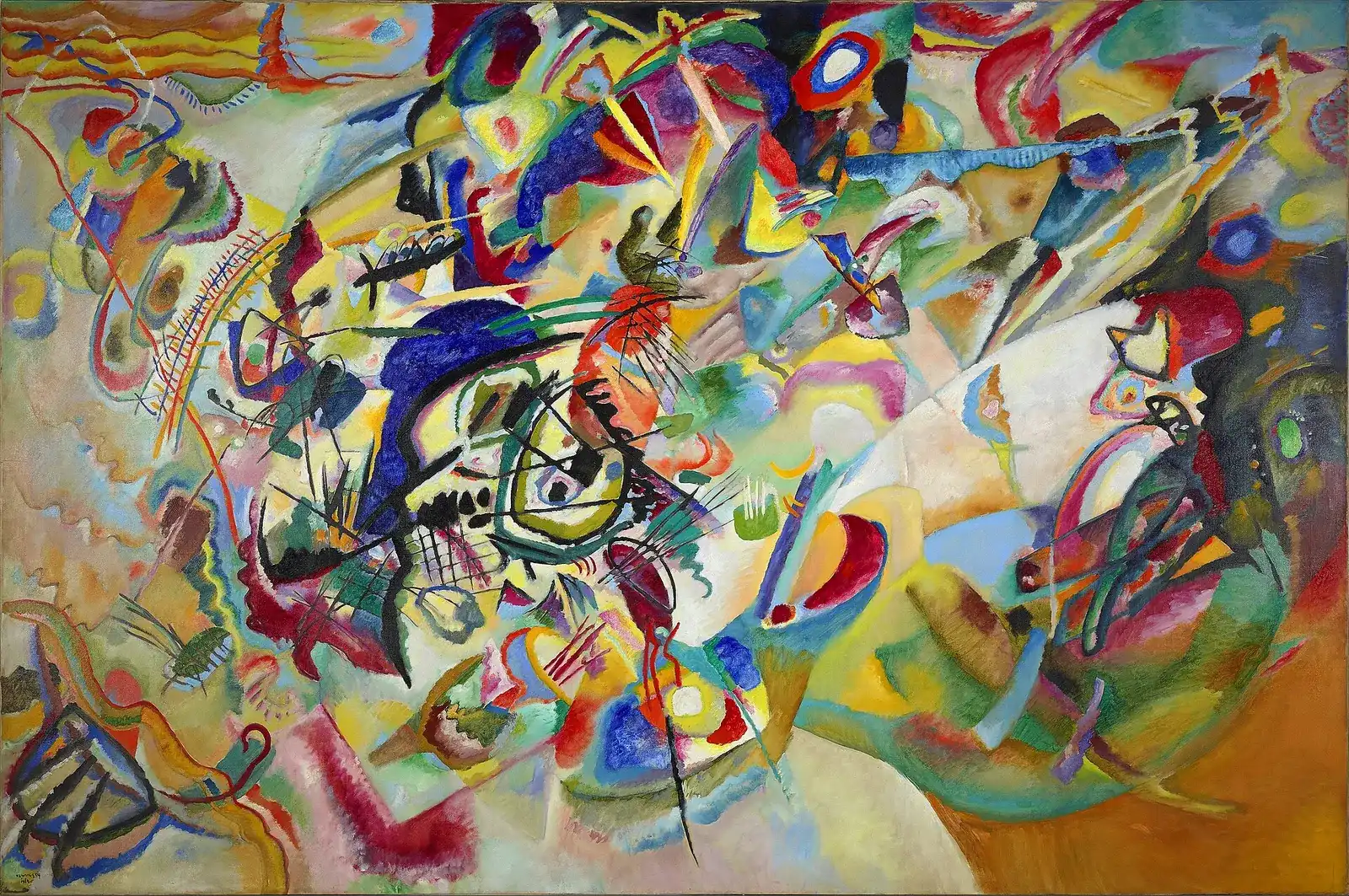
| Composition VII (a precursor) | Wassily Kandinsky | 1913 | State Tretyakov Gallery, Moscow |
| Water Lilies (a precursor) | Claude Monet | 1914 to 1926 | The Museum of Modern Art, New York |
| Snow Storm: Steam-Boat off a Harbour’s Mouth (a precursor) | J. M. W. Turner | 1842 | Tate Britain, London |
Every work in this list is free of nudity, so you can look them up with confidence. Works still in copyright are named but not shown here.
How to look at an Abstract Expressionist painting
These paintings are still in copyright, so I can’t show them here, but you can look them up on museum websites while you read. The images on this page are their public domain ancestors, which the artists themselves studied.
Stand close, then far. The canvases were made to fill your field of vision. Stand near enough that the edges disappear, then step back and watch the whole surface settle into a single image.
Read the speed. In action painting, every mark records a movement. In Pollock’s Autumn Rhythm (Number 30), 1950, at the Metropolitan Museum of Art, follow one black line with your eye and notice where it thickens, splashes and thins. You are following the painter’s arm.
Feel the colour breathe. In colour field painting, look at edges. Helen Frankenthaler’s Mountains and Sea, 1952, at the National Gallery of Art in Washington, was made by pouring thinned paint into raw canvas, so the colour soaks in like watercolour. Rothko’s soft rectangles seem to float because their edges are blurred.
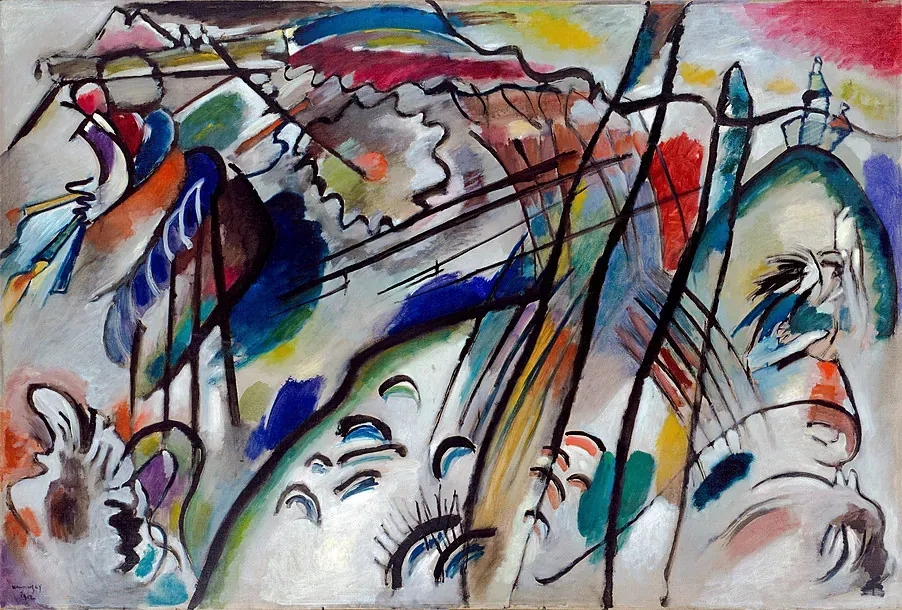
Wassily Kandinsky, Improvisation 28 (second version), 1912. Solomon R. Guggenheim Museum, New York. Image: Wikimedia Commons, public domain.
Kandinsky, Improvisation 28 (second version), 1912. Kandinsky’s improvisations, now at the Guggenheim in New York, were shown in the city in the 1940s. Look at how the black lines move independently of the colour patches. That idea, line and colour as separate voices, is one the New York painters took much further.
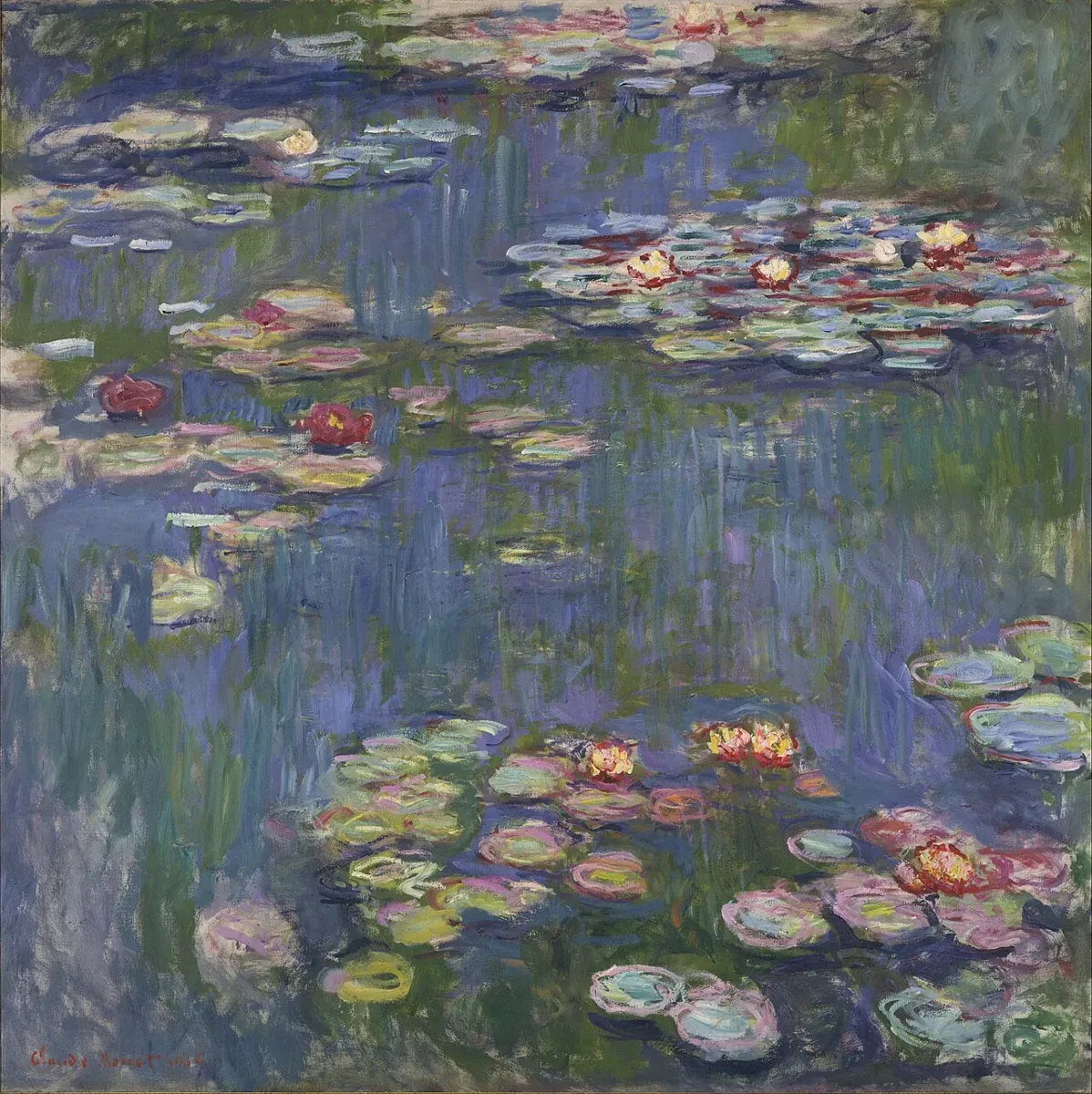
Claude Monet, Water Lilies, 1916. National Museum of Western Art, Tokyo. Image: Wikimedia Commons, public domain.
Monet, Water Lilies, 1916. In Monet’s late lily pond paintings the horizon disappears and the canvas becomes an all-over field of colour. When these late works were rediscovered in the 1950s, critics saw them as forerunners of the new American painting.
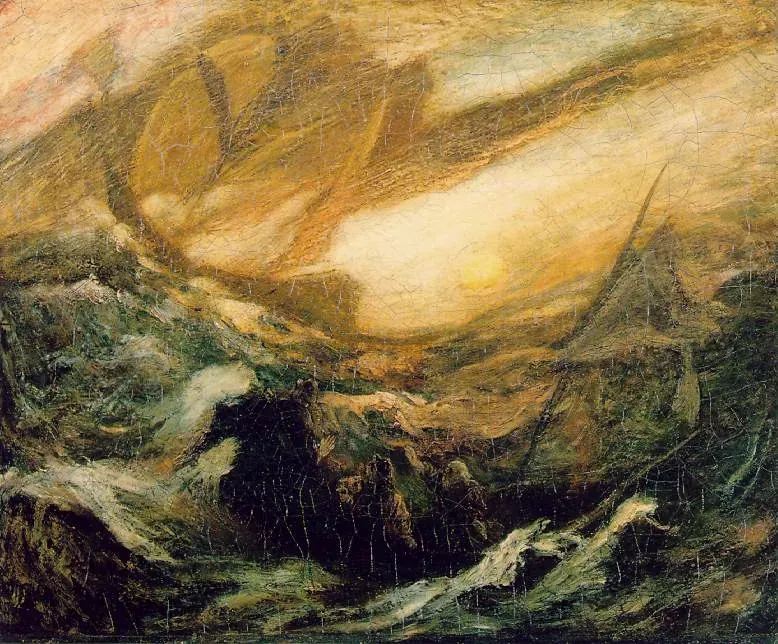
Albert Pinkham Ryder, The Flying Dutchman, about 1887. Smithsonian American Art Museum, Washington. Image: Wikimedia Commons, public domain.
Albert Pinkham Ryder, The Flying Dutchman, about 1887. Pollock said in 1944 that Ryder was the only American master who interested him. Look at the thick, worked surface and the way the sea and sky dissolve into one stormy mood.
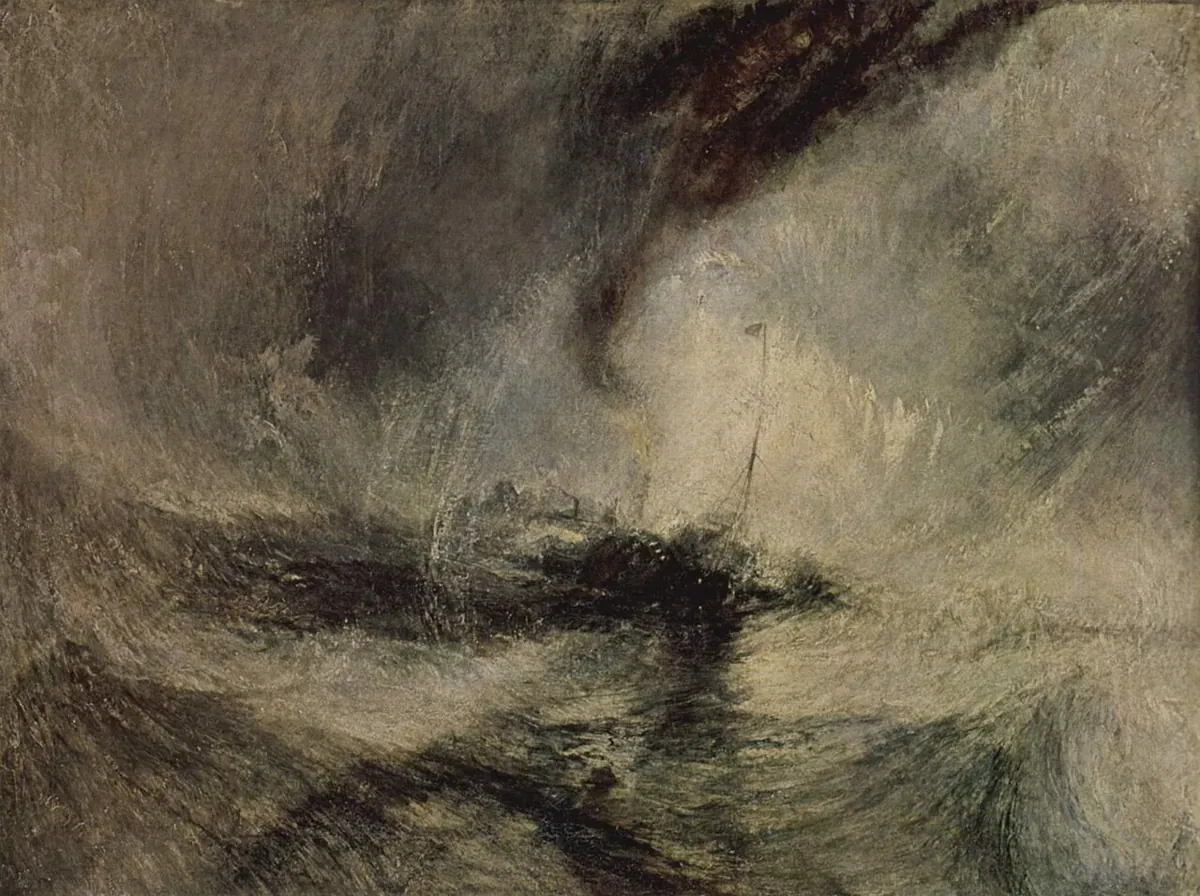
J. M. W. Turner, Snow Storm: Steam-Boat off a Harbour’s Mouth, 1842. Tate Britain, London. Image: Wikimedia Commons, public domain.
J. M. W. Turner, Snow Storm: Steam-Boat off a Harbour’s Mouth, 1842. At Tate Britain. Almost nothing is solid; the whole canvas turns around a dark centre. Critics in the 1950s pointed to late Turner as an ancestor of the new American painting.
Then read on to Pop Art, the movement that answered all this inner seriousness with soup cans, or go back to the first abstract painters of the 1910s.
Try this
Put a large sheet of paper on the floor. With one color, make marks by moving your whole arm, not just your wrist, for two minutes. Then stand up and look. Does it record your mood?
What next
Before this: Surrealism.
After this: Pop Art.
Also worth reading alongside it: Early abstraction.
See every movement in order on the art movements timeline, or learn to look step by step in the free Art History for Beginners course.
If you want to carry this into tarot and practice, these pages connect to it: The Star, pouring and flowing, the painter’s act as ritual; The Moon, the unconscious as a source; Sitting with a color field; and Myth and the sublime in modern art.
Sources
- Harold Rosenberg, The American Action Painters, ARTnews (1952).
- Clement Greenberg, Art and Culture: Critical Essays (1961).
- The Metropolitan Museum of Art, Autumn Rhythm (Number 30), 57.92. Open the record
- Rothko Chapel, Houston, Rothko Chapel. Visit the website
- David Anfam (ed.), Royal Academy of Arts, Abstract Expressionism (exhibition catalogue) (2016).
- Richard P. Taylor, Adam P. Micolich and David Jonas, Fractal analysis of Pollock’s drip paintings, Nature 399 (1999). Open the record
- Katherine Jones-Smith and Harsh Mathur, Revisiting Pollock’s drip paintings, Nature 444 (2006). Open the record
- E. H. Gombrich, The Story of Art (1950).
- Wikimedia Commons, Composition VII (a precursor of Abstract Expressionism) (hero image record). Open the record
- Ellen G. Landau, Reading Abstract Expressionism: Context and Critique (2005).
- Mary Gabriel, Ninth Street Women (2018).

Questions
What is the difference between action painting and color field?
Action painting, like Pollock's, records the energy of the painter's body. Color field painting, like Rothko's or Frankenthaler's, uses large areas of color to create a calm, enveloping space.
Did the CIA promote Abstract Expressionism?
A CIA-funded organization supported some exhibitions abroad during the Cold War. How much this shaped the movement's success is debated by historians.
Where can I see works of Abstract Expressionism in person?
Good places to start are New York (the Met, MoMA, the Guggenheim, the Whitney), Houston (the Rothko Chapel), Washington, and London (Tate). Museums change their displays, so check the collection page before you travel.
Who are the most famous Abstract Expressionist artists?
Jackson Pollock, Willem de Kooning, Mark Rothko, Lee Krasner, Franz Kline, Barnett Newman, Clyfford Still, Joan Mitchell and Helen Frankenthaler are the names you will meet most often.
Why is Abstract Expressionism important?
It moved the centre of the art world from Paris to New York after 1945 and made scale, gesture and the act of painting itself into subjects. Almost every later movement, from Pop Art to Minimalism, reacted to it.
Get the free Mini-Grimoire
A short printable starter guide to tarot and everyday witchcraft, plus my newsletter. Unsubscribe any time.
Opens Substack in a new tab to confirm. More about the newsletter · Privacy