


| Arcana | Major Arcana |
|---|---|
| Number | XVIII |
| Image | RWS 1909 (PD) |
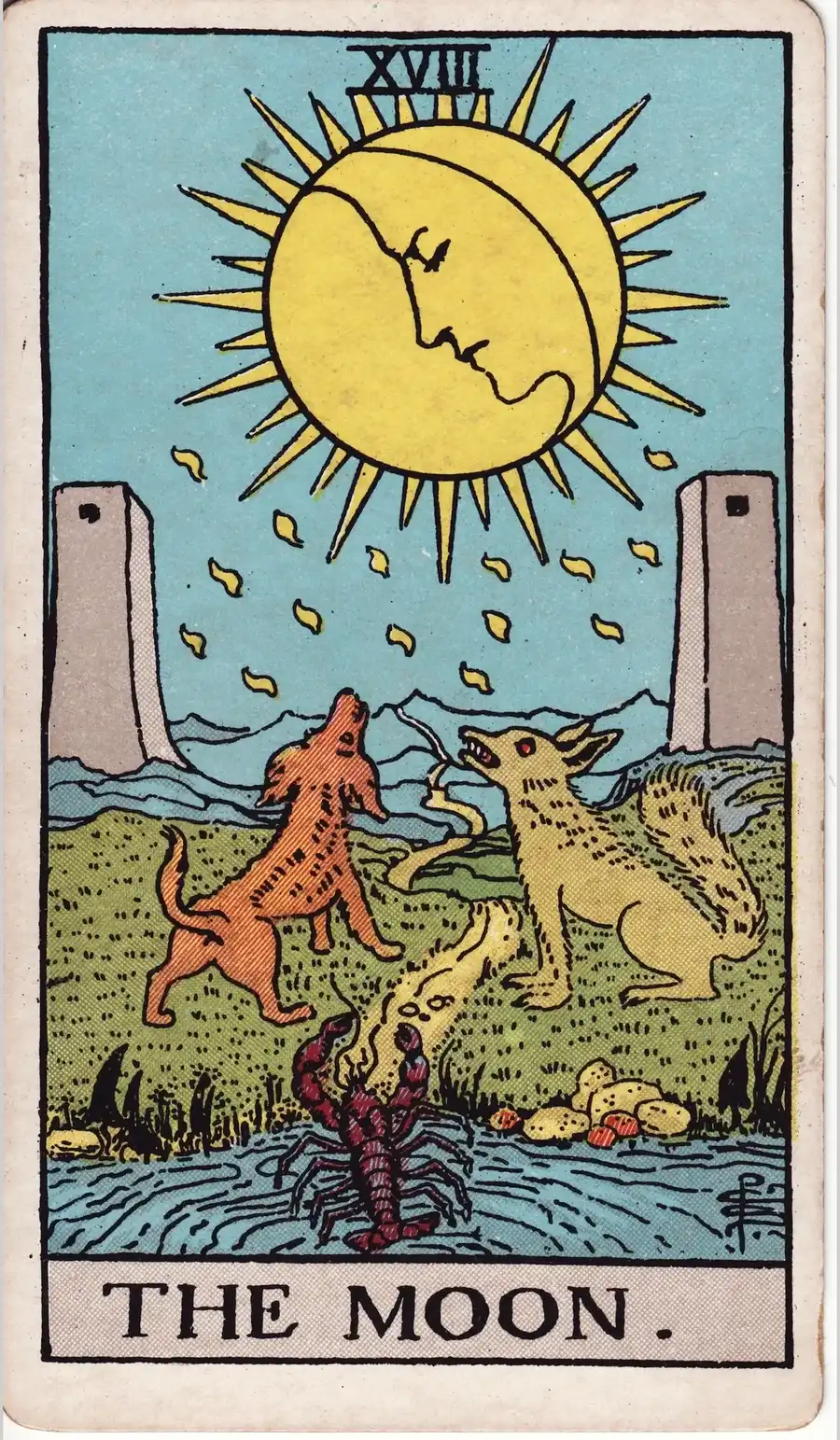
The Moon is card XVIII of the Major Arcana, the card of the night road. Under a pale moon a dog and a wolf howl, a crayfish crawls out of a pool, and a path winds between two towers into the unknown.
Nothing is quite what it seems. The card is about intuition, dreams, fear and uncertainty. Here is what the Moon means upright and reversed, the symbols in the 1909 card and how the card has been read over time.
Here is the Moon at a glance.
| At a glance | This card |
|---|---|
| Upright keywords | intuition, dreams, uncertainty, illusion |
| Reversed keywords | confusion lifting, deception exposed, fear easing |
| Number | XVIII (18) in the Major Arcana |
| Golden Dawn title | The Ruler of Flux and Reflux; the Child of the Sons of the Mighty Later tradition |
| Hebrew letter | Qoph (ק), “back of the head” Later tradition |
| Tree of Life path | 29, from Netzach to Malkuth Later tradition |
| Astrology | Pisces Later tradition |
| Element | Water Later tradition |
| Yes or no | No Modern |
The Golden Dawn gave the Moon card the sign Pisces, not the planet Moon, which belongs to the High Priestess. The letter is Qoph, “the back of the head”, which the Order linked with the half-conscious, instinctive body. The crayfish rising from the pool goes back to Marseille decks, where a crab or crayfish sits in the water below two dogs and two towers.
The card: what Pamela Colman Smith drew
Waite wrote that the card “represents life of the imagination apart from life of the spirit”, and that “the path between the towers is the issue into the unknown”.
The moon. The moon shows a face in profile and drops of dew fall from it. Moonlight is reflected light. It shows shapes but not details. Waite said the message of the card is: “Peace, be still”.
The dog and the wolf. A tame dog and a wild wolf howl at the moon. Waite called them “the fears of the natural mind”. They are the tame and the wild sides of us, both stirred up at night.
The crayfish. A crayfish crawls out of the pool onto the land. It is something rising from the deep: a dream, a buried feeling, an old fear. Waite added that “as a rule it sinks back whence it came”.
The path and the towers. A path runs from the water between two towers to distant hills. The way forward exists, but you must walk it in half-light.
Upright meaning
Upright, the Moon is the uncertain path at night. A full moon with a face shines over two towers. Below, a dog and a wolf howl at it, and a crayfish crawls out of a pool. A path winds between them towards distant hills. Drops of light fall from the moon, and its face looks down with eyes half closed.
The card describes uncertainty, intuition and the things that are not yet clear. It often appears when the facts are incomplete and fear or imagination is filling the gaps. It can point to dreams, anxiety, confusion or deception. It also points to the creative, intuitive mind that works best in half-light.
The Moon asks you not to make permanent decisions in the dark. Walk carefully, notice what your instincts say and wait for more light before you commit.
Reversed meaning
Reversed, the fog starts to lift. The card can describe confusion clearing, a fear seen for what it is, or a secret coming out. It can also describe the opposite, a refusal to look at what is unclear, so that anxiety goes underground and comes back as sleeplessness or irritability.
Sometimes the reversed Moon points to self-deception: telling yourself a comforting story that does not quite fit.
Ask what you are afraid of, and write it down in plain words. Fears named in daylight are usually smaller than they feel at night.
In love, work and spirituality
In love. Upright: Uncertainty, mixed feelings or something hidden; take your time. Reversed: Confusion clearing, or the truth about a relationship coming out.
At work. Upright: Unclear information, office politics or a project whose direction is uncertain. Check facts. Reversed: Clarity returning, or deception at work revealed.
With money. Upright: Uncertain finances; avoid risky deals and read the details. Reversed: Hidden costs come to light; a clearer picture.
In spiritual practice. Upright: Dreams, intuition and psychic sensitivity; working with the unconscious. Reversed: Fear of the inner world, or confusion between intuition and anxiety.
As feelings. Uncertain, complex feelings. The person may not be sure of their own heart.
As a person. Imaginative, sensitive and intuitive; sometimes secretive or anxious.
As advice. Do not decide in the dark. Wait for more light.
Reading the Moon: positions, pairs and yes or no
In the past position: A confusing time, or fears that colored how you saw things. In the present position: Things are unclear. Do not decide in the dark.
In the future position: A period of uncertainty, so keep checking facts. As advice: Trust your intuition, but verify before you act.
When the Moon shows up among mostly Minor cards, give it extra weight: the theme of intuition runs under the whole question.
Pairs matter too. Next to The Sun, it can mean confusion clearing into daylight. Next to The High Priestess, it can mean strong intuition. Trust your inner voice, and check the facts. Next to The Lovers, it can mean uncertainty in a relationship or a choice.
In modern yes or no readings, the Moon leans no. It is a card of uncertainty, so the honest answer is that it is unclear right now. Wait for more light.
The history and art behind the card
In the Tarot de Marseille pattern the card is called La Lune, the Moon. The early Italian Moon cards show a woman holding a crescent moon, or astronomers measuring the sky. The Marseille pattern brought in the elements Smith later drew: the moon with drops falling, two dogs howling, two towers and a crayfish in a pool.
The Golden Dawn linked the card to Pisces, the last sign of the zodiac and a water sign. In astrology, Pisces has long been tied to dreams and the sea, which suits the deep pool at the bottom of the card.
Waite pointed out one detail of his design: the moon is “increasing on what is called the side of mercy, to the right of the observer”. For most beginners, the card’s message is simpler: the night is not the time for final decisions.
When A. E. Waite published The Pictorial Key to the Tarot in 1910, he listed these divinatory meanings for the card: “Hidden enemies, danger, calumny, darkness, terror, deception, occult forces, error.”
Reversed, he gave: “Instability, inconstancy, silence, lesser degrees of deception and error.” Waite himself called the fortune-telling meanings of the trumps “artificial and arbitrary”, and on this site I read the picture first and treat lists like this as history.
On the modern Fool’s Journey, the traveler walks the Moon’s path after the Star’s hope, and finds that hope still has to cross uncertain ground. It is the dream-country of the third stage, where fears and intuitions look alike.
Common questions
Is the Moon a bad card? Not really. It means uncertainty and strong feelings. It asks you to slow down and check, not to panic.
Does the Moon mean someone is lying? It can point to deception, but it often points to our own fears and assumptions. Tarot cannot prove what someone else is doing.
What does the Moon mean in love? Uncertainty, hidden feelings or doubt. Reversed, things become clearer.
Try this
Try this small spread for the Moon. Use it when you feel confused and cannot see the way clearly.
| Card | Question | What it shows |
|---|---|---|
| 1 | What is real? | What I know for sure. |
| 2 | What is fear? | What my worry is adding to the picture. |
| 3 | What is my intuition saying? | The quiet signal under the noise. |
Affirmation: I walk carefully through uncertainty and listen without forcing certainty.
Reversed affirmation: I clear confusion with facts and stop chasing every shadow.
If you keep a tarot journal, take one of these questions to it: What am I afraid of that might not be real? What is my intuition saying under the fear? What dream or image keeps coming back to me?
What next
Cards that sit close to this one are The High Priestess (another card of intuition and the moon), The Star (the card before: starlight before the moonlit road) and The Sun (the next card: daylight after the night).
The Moon is part of the lesson The Devil to the World in my free Tarot for Beginners course. To keep walking the Major Arcana, read the card before it, The Star or the card after it, The Sun, or go back to all the card meanings.
For every card with keywords, affirmations and examples, see my book The Novice’s Guide to Tarot. If you would like a printable cheat sheet for all 78 cards, my 45-page Tarot Workbook is on Etsy.
Sources
- A. E. Waite, The Pictorial Key to the Tarot (London: Rider, 1910), Part II and Part III, section 3.
- Pamela Colman Smith and A. E. Waite, the Rider-Waite-Smith tarot (London: Rider, 1909).
- Nicolas Conver, Tarot de Marseille (Marseille, 1760).
- Eden Gray, A Complete Guide to the Tarot (New York: Crown, 1970), epilogue “The Fool’s Journey”.
- Lauri Mukkala, The Novice’s Guide to Tarot, entry for The Moon.
- Aleister Crowley, 777 (London: Walter Scott, 1909), columns of the Hebrew letters, paths and Tarot trumps.
- Israel Regardie, ed., The Golden Dawn (Chicago: Aries Press, 1937 to 1940), “Book T” and the titles of the trumps.
All 78 cards
Major Arcana
- The Fool
- The Magician
- The High Priestess
- The Empress
- The Emperor
- The Hierophant
- The Lovers
- The Chariot
- Strength
- The Hermit
- Wheel of Fortune
- Justice
- The Hanged Man
- Death
- Temperance
- The Devil
- The Tower
- The Star
- The Moon
- The Sun
- Judgement
- The World
Wands
- Ace of Wands
- Two of Wands
- Three of Wands
- Four of Wands
- Five of Wands
- Six of Wands
- Seven of Wands
- Eight of Wands
- Nine of Wands
- Ten of Wands
- Page of Wands
- Knight of Wands
- Queen of Wands
- King of Wands
Cups
- Ace of Cups
- Two of Cups
- Three of Cups
- Four of Cups
- Five of Cups
- Six of Cups
- Seven of Cups
- Eight of Cups
- Nine of Cups
- Ten of Cups
- Page of Cups
- Knight of Cups
- Queen of Cups
- King of Cups
Swords
- Ace of Swords
- Two of Swords
- Three of Swords
- Four of Swords
- Five of Swords
- Six of Swords
- Seven of Swords
- Eight of Swords
- Nine of Swords
- Ten of Swords
- Page of Swords
- Knight of Swords
- Queen of Swords
- King of Swords
Pentacles
Get the free Mini-Grimoire
A short printable starter guide to tarot and everyday witchcraft, plus my newsletter. Unsubscribe any time.
Opens Substack in a new tab to confirm. More about the newsletter · Privacy