


How to read the labels Historical what the old sources say. Later tradition what later writers added. Modern modern practice and my own notes.
Pop Art is the movement of the mid-1950s to the early 1970s, born in London and New York, that took its images from advertising, comics, packaging and celebrity. Its key artists include Richard Hamilton and Pauline Boty in Britain, and Andy Warhol, Roy Lichtenstein, Claes Oldenburg, Marisol and Corita Kent in the United States. Warhol’s 32 Campbell’s Soup Cans of 1962 are at the Museum of Modern Art in New York.
After the solemn, mythic canvases of Abstract Expressionism, a younger generation looked around at supermarkets, comic books and film stars, and painted them. Pop could be cheerful, cool, ironic or quietly sad. It is the last movement in this series, and in a way it brings us back to the beginning: images that everyone recognises, repeated until they become icons.
Key dates
| When | What happened |
|---|---|
| 1952 | The Independent Group begins meeting in London. |
| 1956 | The exhibition This Is Tomorrow opens at the Whitechapel Gallery. |
| 1957 | Richard Hamilton lists what Pop should be: “popular, transient, expendable, low-cost”. |
| 1962 | Andy Warhol shows his Campbell’s Soup Cans in Los Angeles. |
| 1963 | Roy Lichtenstein paints Whaam! |
What is Pop Art?
Pop Art is art that borrows the look and subjects of mass culture, such as ads, comics and brands, and puts them in the gallery.
Throughout this page I mark three layers. Historical What the works and records show. Later tradition The myths. Modern How we live with it now.
Historical London first. In London in the 1950s a circle called the Independent Group discussed advertising, science fiction and American magazines.
For the 1956 exhibition This Is Tomorrow, Richard Hamilton made a small collage, Just what is it that makes today’s homes so different, so appealing?, now in Tübingen: a modern living room crammed with a television, a tape recorder, a vacuum cleaner and figures cut from adverts.
One of them holds a giant lollipop labeled POP. Pauline Boty, one of the few women in British Pop, painted film stars and politics before her death at twenty-eight in 1966.
Historical Warhol. Andy Warhol (1928 to 1987) had been a successful commercial illustrator. In 1962 he showed thirty-two paintings of Campbell’s soup cans, one for each flavor, in Los Angeles.
He then used silkscreen to repeat images of Marilyn Monroe, car crashes and electric chairs. Repetition empties an image and also turns it into an icon, like a saint on a church wall.
Historical Lichtenstein and the others. Roy Lichtenstein painted single comic-strip frames huge, with hand-painted dots imitating cheap printing. Claes Oldenburg made soft sculptures of hamburgers and giant clothespins. The Venezuelan-American sculptor Marisol carved wooden figures of families and celebrities, often with her own face.
Historical Pop around the world. Pop was never only British and American. Tate Modern’s 2015 exhibition The World Goes Pop showed artists in Latin America, Japan and Eastern Europe using the same bright language, often for sharp political ends.
In Buenos Aires, Marta Minujín built La Menesunda (1965), a walk-through environment of neon, mirrors and strange rooms. Where Pop in New York could look like a celebration of shopping, elsewhere it was frequently a protest.
Historical Corita Kent. Sister Corita Kent (1918 to 1986), a Catholic nun who taught art at Immaculate Heart College in Los Angeles, made joyful screenprints mixing advertising slogans with scripture and poetry. She took the supermarket’s language and made it sing about love, justice and hope.
Key artists
| Artist | Lived | Why they matter |
|---|---|---|
| Richard Hamilton | 1922 to 2011 | The British artist often called the father of Pop. |
| Eduardo Paolozzi | 1924 to 2005 | The Scottish sculptor who collaged magazines into art. |
| Andy Warhol | 1928 to 1987 | The painter of soup cans and celebrities. |
| Roy Lichtenstein | 1923 to 1997 | The painter of enlarged comic panels. |
| Pauline Boty | 1938 to 1966 | The British Pop painter and actor. |
| Corita Kent | 1918 to 1986 | The Catholic sister who made joyful screenprints from advertising slogans. |
How do you recognise Pop Art?
Look for images from advertising, comics, packaging and film stars, enlarged, repeated or silkscreened. Colors are flat and bright. Benday dots, brand names and celebrity faces turn mass culture into art.
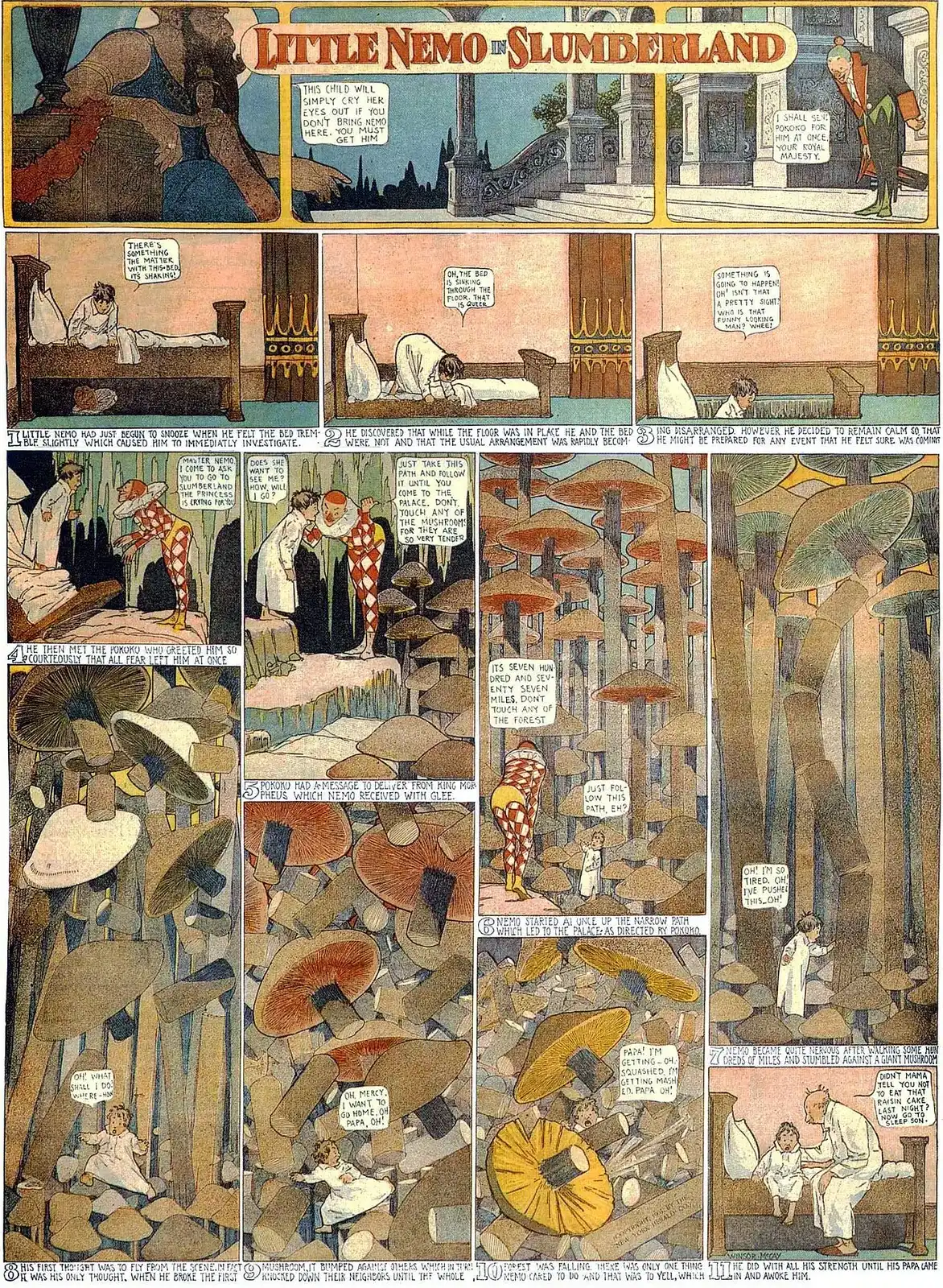
Common misconceptions. One is that Pop Art came out of nowhere. Commercial art had been bold and graphic for decades, from Chéret’s posters of the 1890s to the comic strips of Winsor McCay, and Stuart Davis painted tobacco packaging in 1921.
Another is that it simply celebrated consumerism. Many works are ambiguous, and Warhol’s car crashes and electric chairs of the 1960s are dark. A third is that it was all men. Pauline Boty, Marisol, Rosalyn Drexler, Evelyne Axell and Corita Kent were part of it from the start, and exhibitions since the 2010s have restored them to the story.
Esoteric themes
Historical Warhol was raised in a Byzantine Catholic family in Pittsburgh, grew up with icons, and attended church through his life. In his last years he made a large series based on Leonardo’s Last Supper. The gold backgrounds of his Marilyns recall Byzantine icons.
Later tradition In the same years, the German artist Joseph Beuys cast himself as a shaman, and told how Tatar nomads had saved him after a plane crash in the war by wrapping him in fat and felt.
Historians have found no evidence for the rescue story. Beuys built his own myth, which is itself a very old magical act.
Modern Pop art is the grandparent of every meme. The question it asks is still ours: when images repeat endlessly, which ones become sacred?
Works to see
| Work | Artist | Date | Where to see it |
|---|---|---|---|
| Little Nemo in Slumberland (a precursor) | Winsor McCay | 1905 | Published in the New York Herald |
| Divan Japonais poster (a precursor) | Henri de Toulouse-Lautrec | 1893 | The Metropolitan Museum of Art, New York |
| Job poster (a precursor) | Alphonse Mucha | 1896 | Many collections |
Every work in this list is free of nudity, so you can look them up with confidence. Works still in copyright are named but not shown here.
How to look at a Pop Art work
Ask where the image came from: an ad, a comic, a newspaper photo? Then look at how it was changed. Enlarged, repeated, cropped, printed with dots or in odd colours. The change is where the artist speaks.
Here are some of the sources and ancestors of Pop, all now in the public domain.
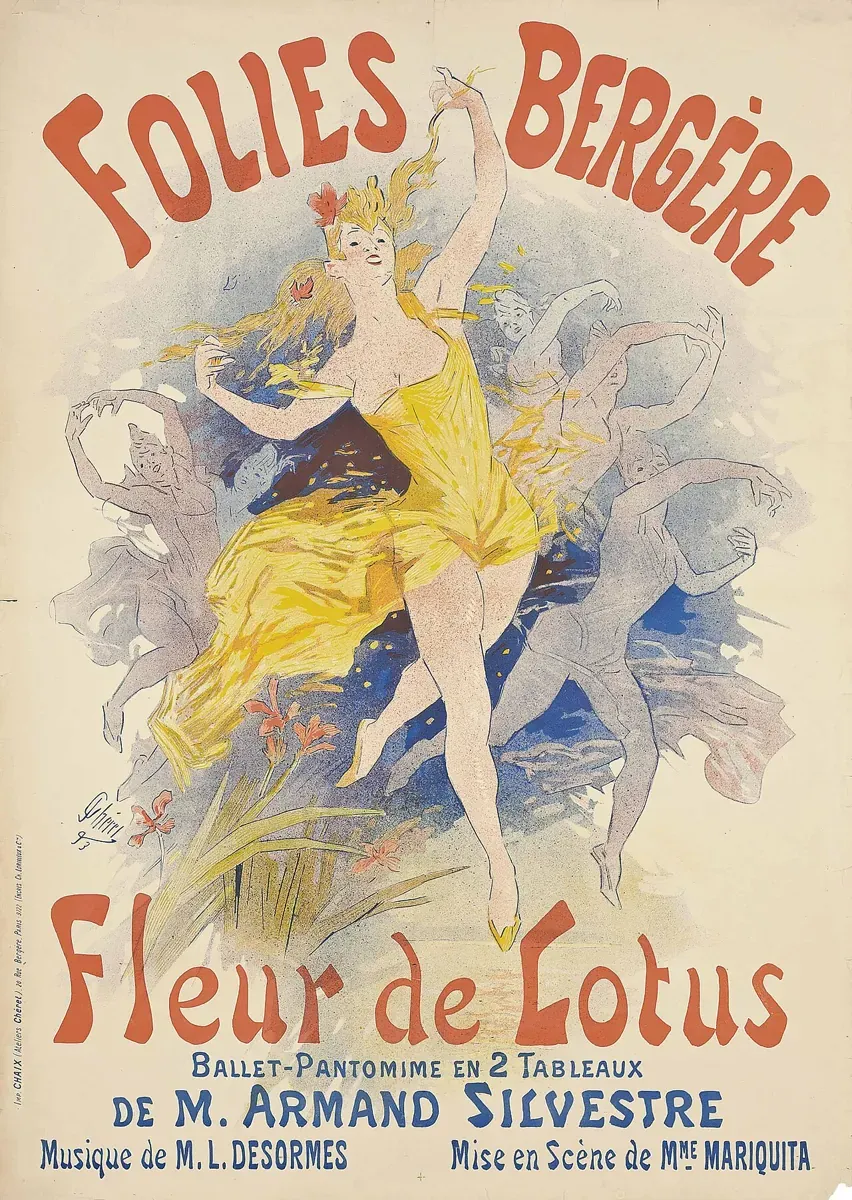
Jules Chéret, Folies-Bergère: Fleur de Lotus (poster), 1893. Prints in many collections. Image: Wikimedia Commons, public domain.
Jules Chéret, Folies-Bergère: Fleur de Lotus, 1893. Chéret’s colour lithographs filled the streets of Paris. Bold lettering, a single bright figure and flat colour: the language of advertising that Pop later took into the gallery.
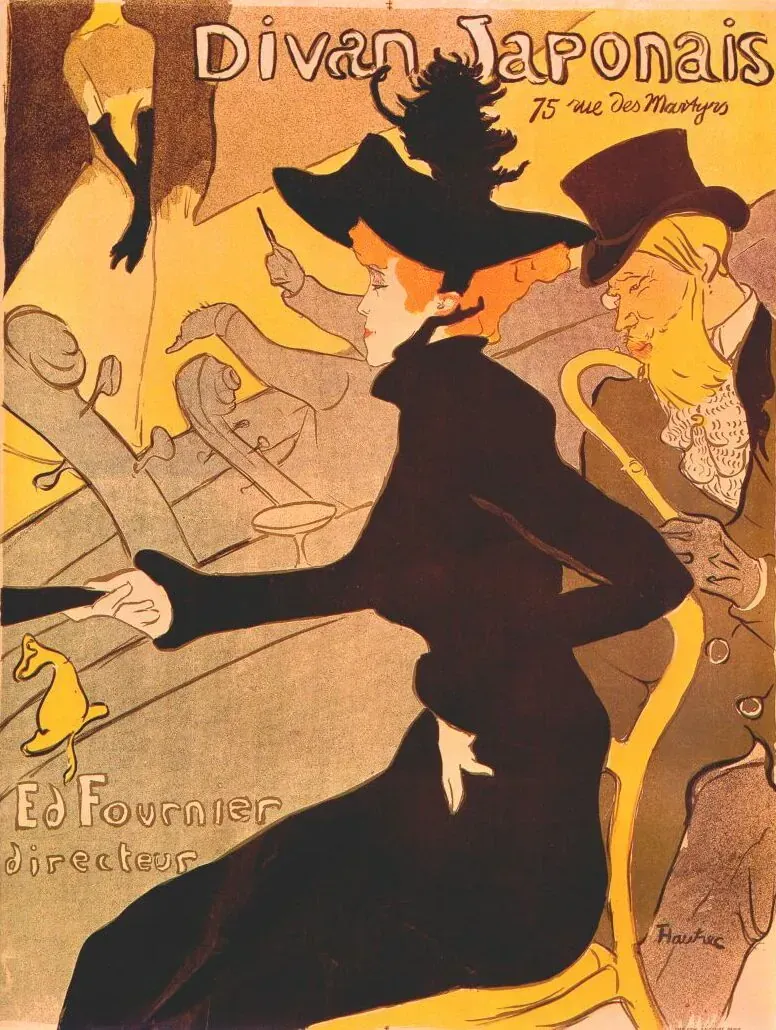
Henri de Toulouse-Lautrec, Divan Japonais (poster), 1893. Prints in many collections. Image: Wikimedia Commons, public domain.
Henri de Toulouse-Lautrec, Divan Japonais, 1893. A poster for a Paris café-concert, featuring the dancer Jane Avril. Look at the flat black shape of her dress, cut out against the yellow.
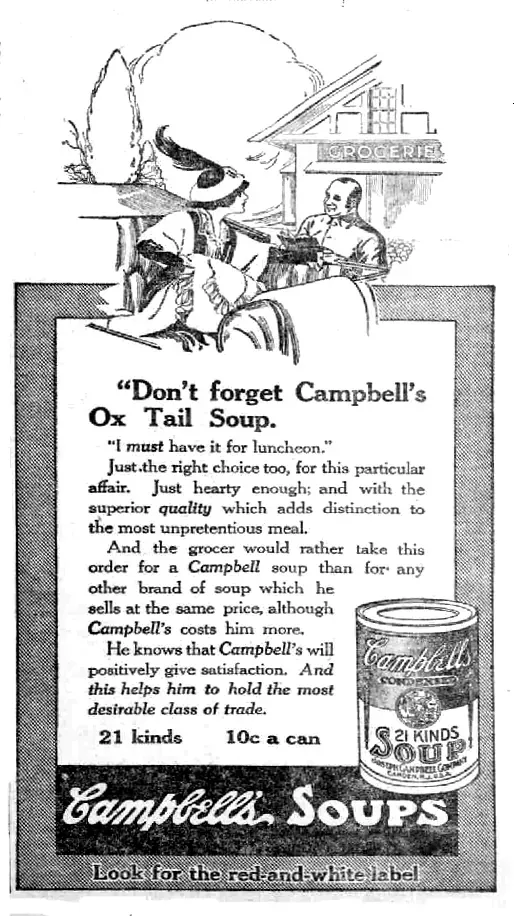
Unknown advertising artist, Campbell’s soup advertisement, 1914. Oregon newspaper advertisement. Image: Wikimedia Commons, public domain.
Campbell’s Soups advertisement, 1914. The red and white can was already familiar decades before Warhol painted it.
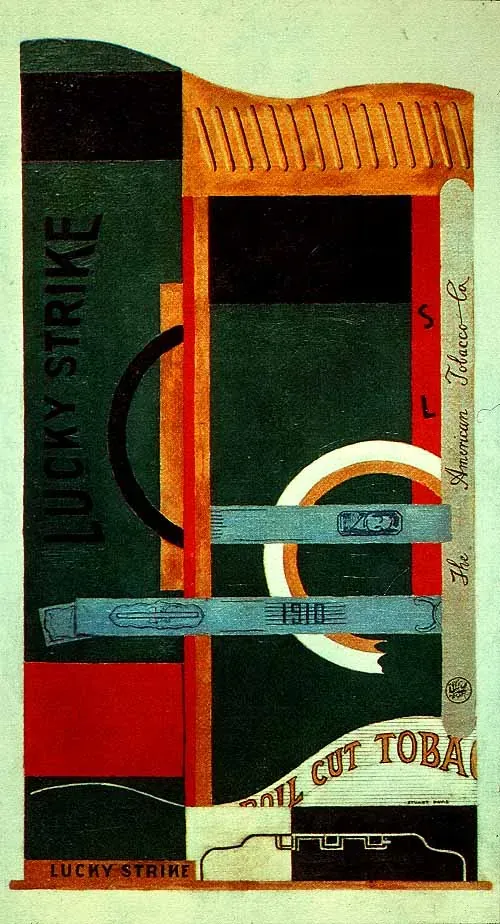
Stuart Davis, Lucky Strike, 1921. Museum of Modern Art, New York. Image: Wikimedia Commons, public domain.
Stuart Davis, Lucky Strike, 1921. At the Museum of Modern Art. A brand package painted as a modern still life, forty years before Pop.
Pop reacted against Abstract Expressionism, drew on the collage and readymades of Dada, and borrowed the graphic boldness of the Golden Age of Illustration and Art Nouveau posters.
Try this
Choose one everyday object you use daily, a mug, a toothbrush, a bus ticket. Draw or photograph it six times in a grid, each in a different color. Look at the grid. Has the ordinary thing become something more?
What next
Before this: Abstract Expressionism.
Also worth reading alongside it: Golden Age of Illustration.
See every movement in order on the art movements timeline, or learn to look step by step in the free Art History for Beginners course.
If you want to carry this into tarot and practice, these pages connect to it: The Sun, bright, popular, open to everyone; Wheel of Fortune, fame and fortune turning; Tarot as a mass-produced image, then and now; and Witches and magic in popular culture.
Sources
- Steven Henry Madoff (ed.), Pop Art: A Critical History (1997).
- Jessica Morgan and Flavia Frigeri (eds.), Tate Modern, The World Goes Pop (exhibition catalogue) (2015).
- The Andy Warhol Museum, Pittsburgh, The Andy Warhol Museum. Visit the website
- Corita Art Center, Los Angeles, Corita Kent. Visit the website
- E. H. Gombrich, The Story of Art (1950).
- Wikimedia Commons, Little Nemo in Slumberland, first page (a precursor of Pop Art) (hero image record). Open the record
- Lucy R. Lippard, Pop Art (1966).

Questions
Where did Pop art begin?
In London in the mid 1950s, with the Independent Group and Richard Hamilton's 1956 collage, before it exploded in New York in the early 1960s.
Was Andy Warhol religious?
Yes, quietly. He was raised Byzantine Catholic, often visited church, and late in life made more than a hundred works based on Leonardo's Last Supper.
Where can I see works of Pop art in person?
Good places to start are New York (MoMA, the Whitney), Pittsburgh (the Andy Warhol Museum), London (Tate), and Los Angeles. Museums change their displays, so check the collection page before you travel.
Who are the main Pop artists?
Richard Hamilton, Eduardo Paolozzi, Pauline Boty, Peter Blake, Andy Warhol, Roy Lichtenstein, Claes Oldenburg, James Rosenquist, Marisol, Rosalyn Drexler and Corita Kent.
Where did Pop Art start?
In London in the 1950s, with the Independent Group, including Richard Hamilton and Eduardo Paolozzi, and then in New York, where Warhol and Lichtenstein had their breakthroughs around 1961 to 1962.
Where can I see Pop Art?
The Museum of Modern Art and the Whitney in New York, the Andy Warhol Museum in Pittsburgh, Tate Modern in London, and the Museum Ludwig in Cologne, which holds one of the largest Pop collections in Europe.
Get the free Mini-Grimoire
A short printable starter guide to tarot and everyday witchcraft, plus my newsletter. Unsubscribe any time.
Opens Substack in a new tab to confirm. More about the newsletter · Privacy