


| Arcana | Minor Arcana: Cups |
|---|---|
| Image | RWS 1909 (PD) |
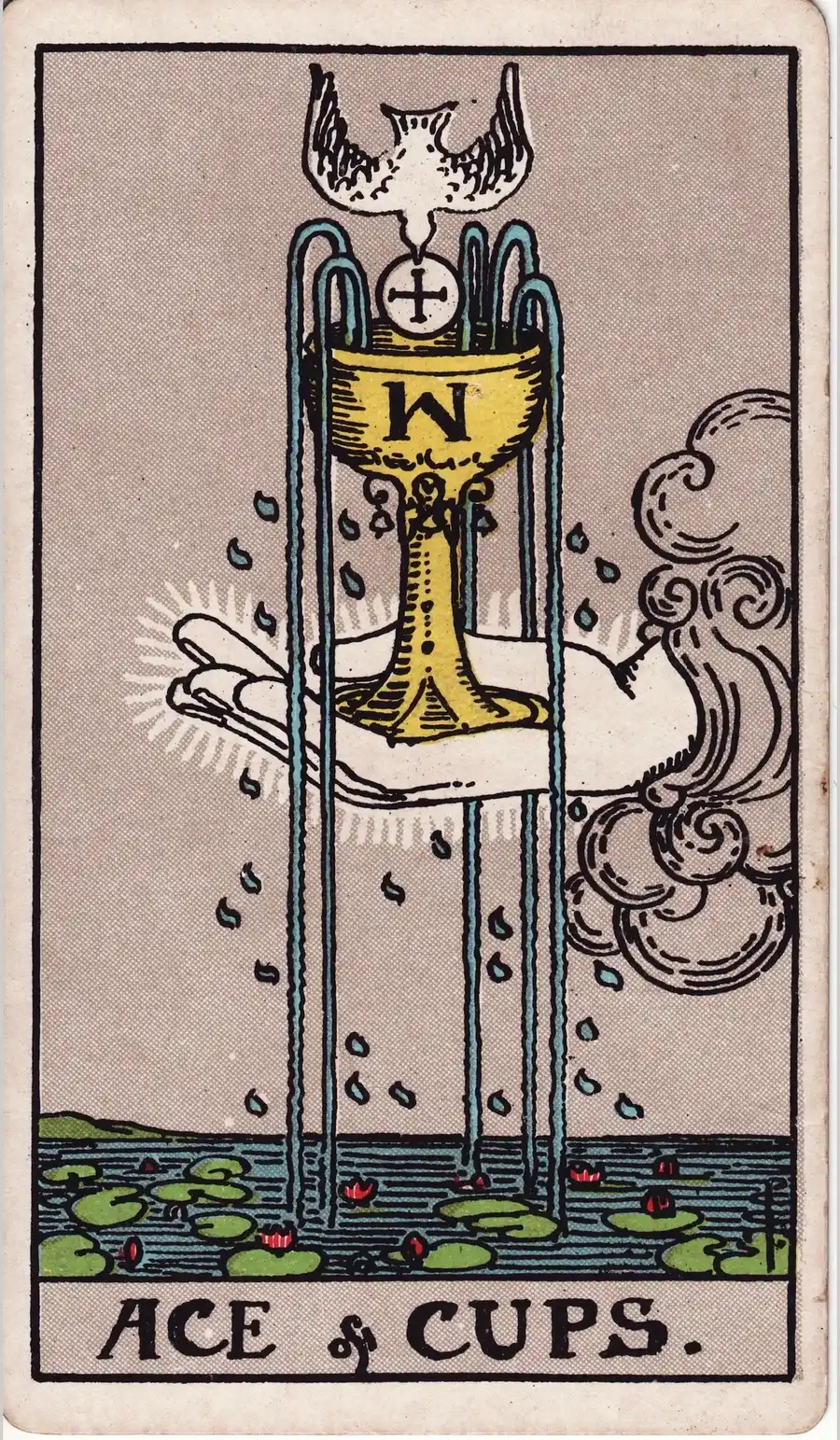
The Ace of Cups is the first card of the suit of water. A hand reaches out of a cloud holding a golden cup that overflows into a pond full of water lilies, and a white dove flies down toward it.
It is a beginning of feeling: love, compassion, creativity or the wish to care again. This page covers what the Ace of Cups means upright and reversed, the symbols Pamela Colman Smith drew and a spread for opening your heart.
Here is the Ace of Cups at a glance.
| At a glance | This card |
|---|---|
| Upright keywords | new emotions, relationships, love |
| Reversed keywords | emotional loss, blocked emotions, emptiness |
| Number | Ace (1), the seed of the suit of Cups |
| Golden Dawn title | The Root of the Powers of Water Later tradition |
| Astrology | In Book T, a quarter of the heavens: Libra, Scorpio and Sagittarius, centered on Scorpio Later tradition |
| Tree of Life | Kether (1), the Crown Later tradition |
| Astrology printed on my first deck | Moon, Cancer, Scorpio, Pisces Modern |
| Suit and element | Cups, Water Later tradition |
| Yes or no | Yes Modern |
Book T calls this card the Root of the Powers of Water and, like every Ace, places it on Kether, the crown of the Tree of Life. It rules the quarter of the heavens around Scorpio rather than one decan. The astrology printed on my first deck, the Moon with the three water signs, is a later and simpler pairing.
The card: what Pamela Colman Smith drew
Waite wrote that “the hand issues from the cloud, holding in its palm the cup, from which four streams are pouring; a dove, bearing in its bill a cross-marked Host, descends to place the Wafer in the Cup; the dew of water is falling on all sides.”
Smith actually drew five streams. Waite added that the card is “an intimation of that which may lie behind the Lesser Arcana”, which tells you how much he valued it.
The overflowing cup. The cup gives more than it can hold. Water runs over the edges into the pond below. Feeling in this card is generous and moving, not stored away.
The dove. A dove carries a small round wafer marked with a cross toward the cup. In Christian art the dove is the Holy Spirit and the wafer is the communion bread, so the card hints at grace, something given rather than earned. You do not need to be Christian to read it as a blessing arriving.
The water lilies. Lilies float on the pond below, rooted in water and open to the light. They show feeling that has somewhere to go and something to grow from.
Upright meaning
Upright, the Ace of Cups is the heart opening. A hand from a cloud holds a golden cup that overflows in five streams into a pond of water lilies, while a dove descends with a wafer in its beak. It is the first card of feeling, and it offers love, tenderness, compassion or a creative flow that seems to come from somewhere beyond you.
This Ace often appears at the start of a relationship, a friendship, a pregnancy, a reconciliation or a period of emotional healing. It can also mark a spiritual opening, a moment when you feel held by something larger. The cup is more than full. It gives without running dry.
Receiving is the skill here. Many people find it easier to give love than to accept it. Let the cup fill you before you pour it out for others.
Reversed meaning
Reversed, the cup tips the wrong way and the water drains out. The card can show emotional emptiness, love that is not returned, or feelings held back so long that they no longer flow. Sometimes it is a heart that is too full: crying for no clear reason, or overflowing in ways that feel out of control.
Ask whether your feelings are blocked or simply unheard. Write them down, say them to someone safe, or let them out through music or water. A reversed Ace of Cups usually asks for gentleness with yourself first.
In a spread, a reversed Ace of Cups next to the Five or Eight of Cups often marks a heart that has closed after loss. Next to the Star or Temperance it reads more gently, as feelings that are slowly returning. Either way, the cup is not broken. It only needs to be turned upright again.
In love, work and spirituality
In love. Upright: A new love, deep affection, or a tender new phase in a relationship. Reversed: Feelings that are not returned, or love held back out of fear.
At work. Upright: Work that touches the heart: caring, art, healing or a team that genuinely supports each other. Reversed: Emotional exhaustion at work, or a job that feels empty.
With money. Upright: Generosity, gifts and spending that nourishes. Money linked to care or creativity. Reversed: Spending to fill an emotional gap.
In spiritual practice. Upright: Water rituals, devotion, the feeling of grace. A heart-centered practice. Reversed: Spiritual dryness. Return to simple acts of devotion.
As feelings. Love, tenderness and an open heart toward you.
As a person. Someone loving, emotionally open and generous with care.
As advice. Open your heart, and let yourself receive.
Reading the Ace of Cups: positions and yes or no
In the past position: A new feeling or relationship opened something in you. In the present position: Your heart is opening. Let the feeling in.
In the future position: A new love, friendship or creative flow is coming. As advice: Say yes to what makes your heart full.
In modern yes or no readings, the Ace of Cups leans yes. An open heart points to yes.
What the Ace means, and the history behind the card
As the Ace of the water suit, this card is the raw capacity for feeling. Everything the rest of the suit explores, from partnership to loss to joy, grows out of this overflowing cup.
Here is how the Ace looks across the four suits:
- Ace of Wands: new inspiration, potential, creativity
- Ace of Cups (this card): new emotions, relationships, love
- Ace of Swords: mental clarity, truth, new ideas
- Ace of Pentacles: new opportunities, prosperity, stability
When A. E. Waite published The Pictorial Key to the Tarot in 1910, he listed these divinatory meanings for the Ace of Cups: “House of the true heart, joy, content, abode, nourishment, abundance, fertility; Holy Table, felicity hereof.” Reversed, he gave: “House of the false heart, mutation, instability, revolution.”
Common questions
Is the Ace of Cups a yes or no card? It leans yes. It is one of the most loving cards in the deck.
What does the Ace of Cups mean in love? New love, a fresh start or a deepening of feeling. Reversed, emotions that are blocked or unreturned.
What does the Ace of Cups mean as feelings? Openness, tenderness and the wish to connect. It is a warm card to receive in a feelings question.
Try this
Try this small spread for the Ace of Cups. Use it when you want to open your heart to something new.
| Card | Question | What it shows |
|---|---|---|
| 1 | What is filling my cup? | The new feeling or connection arriving. |
| 2 | What blocks the flow? | The fear or habit that keeps me closed. |
| 3 | How do I receive? | One way to let the feeling in. |
Affirmation: I notice what I feel and give it honest attention.
Reversed affirmation: I let feeling return at a pace I can sustain.
If you keep a tarot journal, take one of these questions to it: What would I love to feel more of this season? Where is my cup overflowing, and where is it dry? Who or what makes it easy for me to receive?
What next
Cards that sit close to this one are Two of Cups (the next step: feeling shared between two people), The Star (the Major Arcana card of pouring water and hope) and Ace of Wands (the fire Ace: a spark of action rather than feeling).
The Ace of Cups is part of the lesson Cups in my free Tarot for Beginners course. To see the whole suit on one page, go to the suit of Cups. To keep walking the suit, read the card after it, Two of Cups, or go back to all the card meanings.
For the suits and numbers in one place, see The Minor Arcana: suits and numbers made simple. For every card with keywords, affirmations and examples, see my book The Novice’s Guide to Tarot. If you would like a printable cheat sheet for all 78 cards, my 45-page Tarot Workbook is on Etsy.
Sources
- A. E. Waite, The Pictorial Key to the Tarot (London: Rider, 1910), Part III, sections 1 and 2.
- Pamela Colman Smith and A. E. Waite, the Rider-Waite-Smith tarot (London: Rider, 1909).
- Nicolas Conver, Tarot de Marseille (Marseille, 1760).
- Lauri Mukkala, The Novice’s Guide to Tarot, entry for the Ace of Cups.
- Aleister Crowley, 777 (London: Walter Scott, 1909), columns of the decans, the Minor Arcana and the court cards.
- Israel Regardie, ed., The Golden Dawn (Chicago: Aries Press, 1937 to 1940), “Book T”, titles and attributions of the small cards and the court.
All 78 cards
Major Arcana
- The Fool
- The Magician
- The High Priestess
- The Empress
- The Emperor
- The Hierophant
- The Lovers
- The Chariot
- Strength
- The Hermit
- Wheel of Fortune
- Justice
- The Hanged Man
- Death
- Temperance
- The Devil
- The Tower
- The Star
- The Moon
- The Sun
- Judgement
- The World
Wands
- Ace of Wands
- Two of Wands
- Three of Wands
- Four of Wands
- Five of Wands
- Six of Wands
- Seven of Wands
- Eight of Wands
- Nine of Wands
- Ten of Wands
- Page of Wands
- Knight of Wands
- Queen of Wands
- King of Wands
Cups
- Ace of Cups
- Two of Cups
- Three of Cups
- Four of Cups
- Five of Cups
- Six of Cups
- Seven of Cups
- Eight of Cups
- Nine of Cups
- Ten of Cups
- Page of Cups
- Knight of Cups
- Queen of Cups
- King of Cups
Swords
- Ace of Swords
- Two of Swords
- Three of Swords
- Four of Swords
- Five of Swords
- Six of Swords
- Seven of Swords
- Eight of Swords
- Nine of Swords
- Ten of Swords
- Page of Swords
- Knight of Swords
- Queen of Swords
- King of Swords
Pentacles
Get the free Mini-Grimoire
A short printable starter guide to tarot and everyday witchcraft, plus my newsletter. Unsubscribe any time.
Opens Substack in a new tab to confirm. More about the newsletter · Privacy