


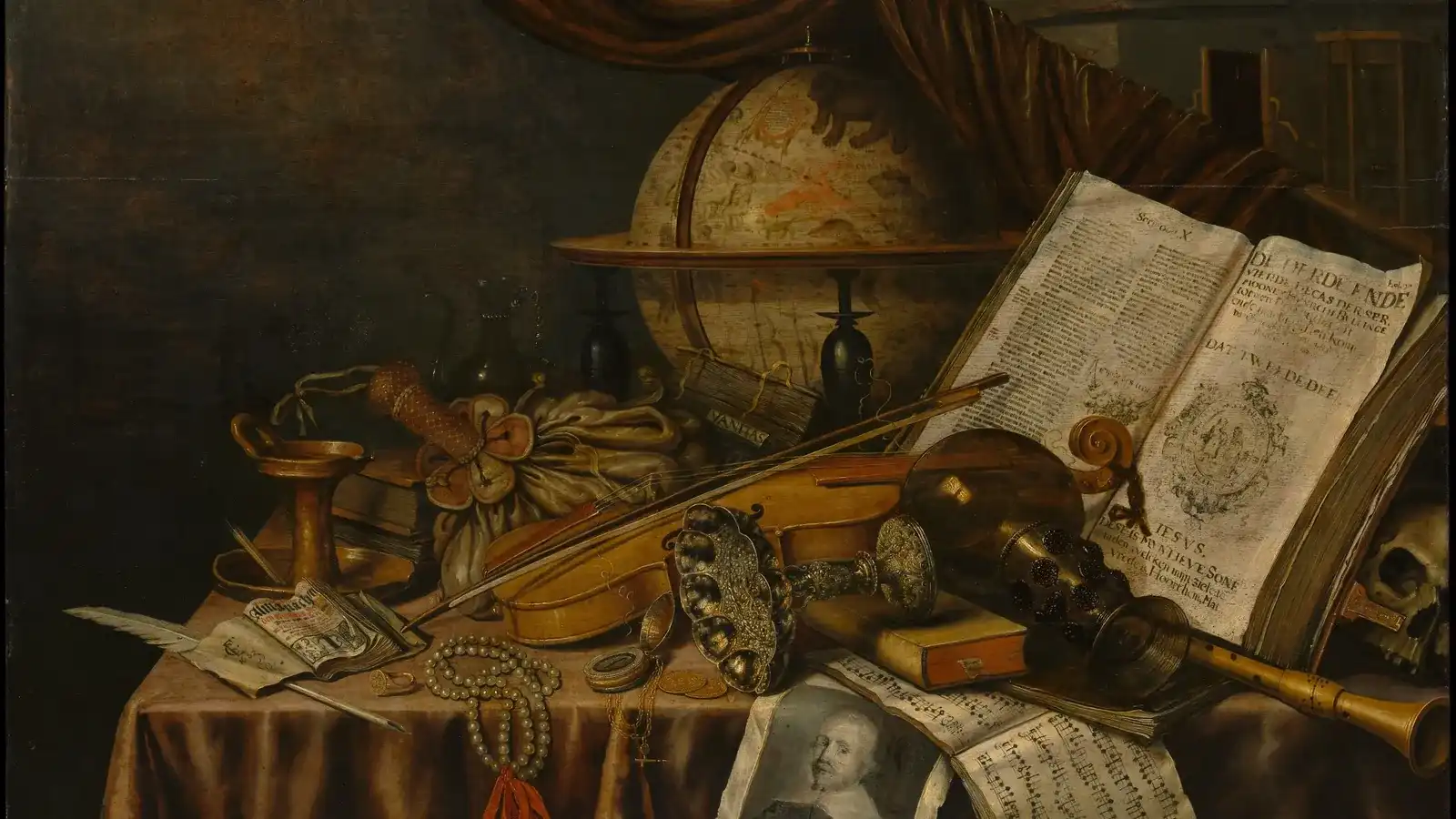
An altar is where a habit of practice takes shape. It gives your attention somewhere to land, and it reminds you, every time you walk past, that you meant to show up. The four elements give that space a simple structure, and they are one of the oldest maps in Western thought. In this lesson you will set up one small, safe altar, meet earth, air, fire and water in ordinary life, and learn where the elements actually come from, so you can use them as a living tool rather than a rule.
What an altar is for
Modern An altar is a dedicated surface for practice: a place to put tools, mark an intention and return to. It does not have to be expensive, permanent or visible to anyone else. Decide its main job first. It might be for devotion, a working surface, a seasonal marker or, as for most beginners, a small mix of all three.
Choose a spot you can reach easily and where nobody will bump you mid-candle. A shelf, a nightstand, a windowsill or the lid of a sturdy box all work. If you share your home, a closed cabinet or a tray you put away is enough, and a mint tin can hold a travel altar: a scrap of cloth, an LED light, a stone and a folded note.
You need very little: a clear flat surface, a notebook and pen and, if you use flame, a fireproof holder. A cloth, a small bowl of water and a pinch of salt or a stone are nice but optional. Leave the multiple candles, athame, wand, statues and expensive blank book for later, if ever. A kitchen cup can be a chalice, and a butter knife can stand in for a blade.
One token per element
Each element needs only one humble token. For earth, use salt in a lidded dish, a stone, a seed or a small plant you can keep alive. For air, a bell, a paper fan or a few minutes with the window open will do; please do not collect wild bird feathers, because in many countries most are protected by law. For fire, a candle in a proper holder, or an LED light. For water, a cup of clean water that you empty and refresh so it does not grow mold.
Later tradition A common layout in Wicca-influenced practice puts earth in the north, air in the east, fire in the south and water in the west. Other traditions differ, and many Southern Hemisphere witches swap fire and earth. Use a layout because it helps you remember, not because it is a law.
Where the elements come from
Historical The four elements come from Greek philosophy. Empedocles, in the fifth century BCE, called earth, air, fire and water the “roots” of everything, and Aristotle later added aether for the heavens. The idea ran through medieval and Renaissance natural philosophy, medicine and alchemy.
Later tradition In the late 1800s the Hermetic Order of the Golden Dawn tied the elements to directions, tools and tarot suits, and modern witchcraft inherited much of that system. That is why wands, cups, swords and pentacles turn up in both tarot and witchcraft. These links are teaching maps, not physics.
Altars across history
Historical The word altar comes from Latin altare, probably related to altus, “high”. In ancient Greece and Rome, altars usually stood outside temples, where offerings were made in the open air.
Households had their own small shrines: the Roman lararium, a niche or cupboard for the household gods, the Lares, can still be seen in the houses of Pompeii, preserved since the eruption of Vesuvius in 79 CE. Many lararia have paintings of the household gods and a snake, a protective spirit. They are a good model for a modern home altar: small, part of daily life, and tended regularly.
Historical In modern witchcraft, the altar became central through Wicca in the 1950s, which borrowed tools from ceremonial magic, such as the knife (athame), cup, wand and pentacle. Those tools in turn echo the four suits of the tarot and the four elements. Today many witches keep a far simpler altar, and that is completely valid.
The four elements: a longer history
Historical The Greek philosopher Empedocles (fifth century BCE) taught that everything is made of four “roots”: earth, water, air and fire. Aristotle later added qualities: earth is cold and dry, water cold and wet, air hot and wet, fire hot and dry. The doctor Galen (second century CE) linked the elements to the four humors of the body, a theory that shaped European medicine until the eighteenth century. A fifth element, aether or quintessence, was proposed by Aristotle for the heavens. Modern witches often call this fifth element spirit.
Modern Science today has replaced the four elements with the periodic table, but as symbols they remain useful. Earth can stand for stability and the body, water for feelings, air for thought and speech, fire for energy and will. Many traditions link them to directions too, though which direction goes with which element varies by tradition and by where you live.
Variations for small or shared spaces
A pocket altar: a small tin with a pebble, a shell, a feather and a match (unlit) can be opened anywhere. A windowsill altar: a plant for earth, a glass of water, a wind chime for air and a candle only if it is safe. An invisible altar: a specific place on your desk where you pause for a minute each morning, with nothing on it at all. A shared altar: if you live with others, agree on what can go on it and keep anything fragile out of reach of children and pets.
A worked example
Imagine someone who lives in a shared flat with a cat and a strict no-candles rule. She clears the top of a bookshelf and lays down a folded scarf. Earth is a smooth stone from a beach walk. Air is a small bell from a gift shop. Fire is a battery tea light. Water is an egg cup she refills every morning.
She wipes the shelf, rings the bell once to air the space, sets the four objects down and says, “I dedicate this space to my practice and learning. May the work I do here be careful, honest and mine to own.” She sits for one grounded minute and writes the date in her notebook. Her whole altar cost almost nothing, it is safe for the cat and it fits the rules of her home.
Caring for your altar through the year
An altar is a living space, not a museum. Once a week, dust it, change the water in any bowl, and remove anything that has wilted or no longer feels right. Once a season, clear it completely, wipe the surface, and put back only the things you still want. Many witches add one seasonal item, such as a spring flower, a summer shell, an autumn leaf or a winter pinecone, so the altar follows the year outside the window.
A variation for travel. A travel altar fits in a small tin: a pebble for earth, a feather for air, a birthday candle or a match for fire (unlit unless it is safe), and a tiny shell for water. Set it on a hotel bedside table or a desk for a few quiet minutes, then pack it away again.
A variation for children. If you share your home with children, invite them to choose the season’s item. It turns the altar into a family nature table and teaches them to notice the year.
A beginner’s worry, answered. “My altar is just a shelf with a few things on it. Is that enough?” Yes. What makes an altar is your attention, not its size.
Questions beginners ask
Do I need to buy special tools? No. Everyday objects work. Many witches use a kitchen knife, a favorite cup and stones from a walk.
Which direction should my altar face? Any direction that fits your room. Some traditions prefer north or east, but none is required.
Can I touch or move things on my altar? Yes. It is yours. Clean and rearrange it as often as you like.
What if someone else touches it? Nothing bad happens. You might simply wipe it and reset it if that makes you feel better.
Myths to drop: An altar is not required to practice witchcraft. The elements are not ancient Celtic teaching; they come mainly from Greek philosophy. And there is no single correct layout.
Try this
Clean one small surface, place one token for each element and say a short dedication. Write the date in your notebook. Then try the four-beat check-in once a day for three days: ten seconds feeling your feet (earth), one clear breath (air), naming one action you will take (fire) and naming one feeling without fixing it (water).
Journal prompts: Which element do I feel closest to, and which feels distant? What object would I choose for each element from my own home? How did it feel to tend my altar for a week?
Recap
An altar is a dedicated surface that helps a habit form, and it can be as small as a shelf or a tin. Start with what you own: one token each for earth, air, fire and water, and a notebook. The four elements come from Empedocles in the fifth century BCE, and the links to directions, tools and tarot suits come from the Golden Dawn in the late 1800s. Layouts are memory aids, and fire safety always comes first.
What next
Press “Mark as done” and continue with Correspondences and colors. For more, read about setting up an altar, the four elements and practising privately. To see the same elements in the cards, visit the four suits.
Further reading: Kathleen Freeman, Ancilla to the Pre-Socratic Philosophers (Harvard University Press, 1948), for Empedocles’ fragments. Mary Beard, Pompeii: The Life of a Roman Town (Profile, 2008), on household religion.
Sources
- Lauri Mukkala, The Novice’s Guide to Witchcraft, chapter 4, “Creating Your Altar”, and chapter 5, “Working with the Elements”.
- Empedocles, fragments on the four roots, in Kathleen Freeman (trans.), Ancilla to the Pre-Socratic Philosophers (Oxford: Blackwell, 1948).
Quick check
Go deeper: The Novice's Guide to Witchcraft
Get the free Mini-Grimoire
A short printable starter guide to tarot and everyday witchcraft, plus my newsletter. Unsubscribe any time.
Opens Substack in a new tab to confirm. More about the newsletter · Privacy
Comments
Questions and notes from readers. Anyone with a free account can comment, and I reply when I can. Please read the community guidelines.
Comments load from Google Firebase (EU) when you ask for them. Nothing is stored on your device. Privacy