


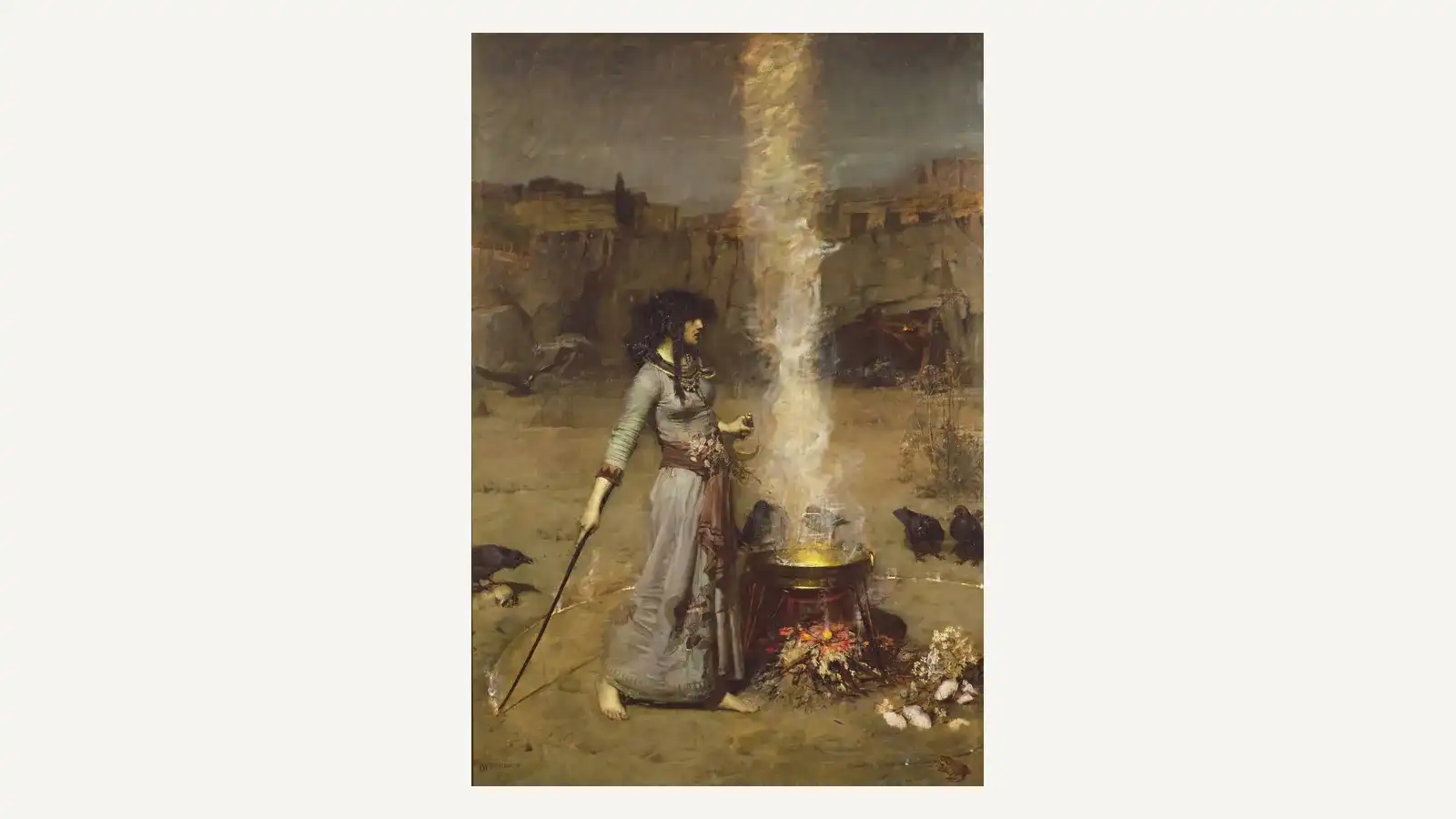
In this lesson: the real witch trials, the cunning folk, Murray’s myth and a step-by-step practice reading one real trial record.
In lesson 1 you met the history of witchcraft in outline. Now you go to the sources yourself. You learn what the trials really were, who the cunning folk were, why the idea of a surviving witch religion was dropped by historians, and then you read one real trial record step by step. It is the most grounding history lesson I know.
The trials in real numbers
Historical Witch trials took place across Europe and its colonies from the fifteenth to the eighteenth century, with the worst waves between about 1560 and 1660. Historians estimate about 40,000 to 60,000 executions, not the “nine million” you may see online. Most of the accused were women, though not everywhere, and most were ordinary neighbors accused after quarrels, illness or bad luck. They were not witches in the modern sense. Remembering them as real people, not as symbols, is part of practicing ethically.
Cunning folk
Historical Alongside the trials there were cunning folk: local healers, charmers and finders of lost goods, known in England, Scandinavia and elsewhere. Most saw themselves as good Christians. They used prayers, charms, herbs and simple divination, and people paid them for help. Some were also accused, many were not. Much of what modern witches call folk magic comes closer to the cunning folk than to the trial records.
A closer look at three places
Historical Numbers are easier to understand through places. In Scotland, the Witchcraft Act of 1563 made witchcraft a capital crime. The Survey of Scottish Witchcraft, the database you will use below, records nearly 4,000 people accused between 1563 and 1736. The famous North Berwick trials of 1590 involved King James VI himself, who believed witches had raised storms against his ship. He later wrote a book on the subject, Daemonologie (1597). When he became James I of England in 1603, his interest helped shape the English law of 1604.
Historical In England, the worst episode came during the Civil War, when Matthew Hopkins, who called himself the “Witchfinder General”, and his colleague John Stearne led accusations in East Anglia in 1645 to 1647. Around a hundred people were hanged as a result. Hopkins used sleep deprivation and “watching” to get confessions, methods that were already criticized at the time.
Historical In Finland, which was then part of the Swedish realm, trials followed a different pattern. Many cases concerned folk magic and healing rather than devil worship, and a large share of the accused were men, especially in the earlier period. Old Finnish folk religion had the tietäjä, a “knower”, a man or woman who healed with charms and words.
In the nineteenth century, collectors such as Elias Lönnrot wrote down thousands of these charm poems, and they are now published in the large collection Suomen Kansan Vanhat Runot (“Ancient Poems of the Finnish People”). You can read some of them online through the Finnish Literature Society.
Cunning folk in more detail
Historical The historian Owen Davies estimates that there were thousands of cunning folk in England in the nineteenth century, more than there were doctors in some rural areas. They found lost property, cured warts and illnesses, identified thieves, cast horoscopes and, ironically, protected clients against witchcraft. One of the best known was James Murrell, called “Cunning Murrell”, who practiced in Hadleigh, Essex, until his death in 1860. He left behind papers and astrological notes. Cunning folk often used printed books, such as almanacs and cheap editions of astrology and herbals, so their magic was literate as well as oral.
Cunning folk sometimes worked alongside the trials in an uncomfortable way: a client who believed they were bewitched might go to a cunning person to identify the witch, and that identification could start an accusation. That is a sobering reminder that magic and fear were tangled together.
Murray, Gardner and the modern revival
Later tradition In 1921 Margaret Murray argued in The Witch-Cult in Western Europe that the accused belonged to a surviving pagan religion. Historians tested her claims against the records and rejected them. Gerald Gardner drew on her idea when he published Witchcraft Today in 1954, and Wicca grew from there.
Modern Modern witchcraft is a twentieth-century religion and practice with older ingredients. That is a perfectly good thing to be. It just means we do not claim the trial victims as our spiritual ancestors.
Your archive practice, step by step
What you need: about forty-five minutes, your notebook or Book of Shadows, and a free online database such as the Survey of Scottish Witchcraft from the University of Edinburgh. Many national archives and museums also publish trial records.
- Open the database and search by a place name or a year that interests you.
- Choose one accused person and write down their name, place and year.
- Note what they were accused of, in the words of the record where possible.
- Note who accused them, if the record says, and what happened in the end.
- Look for anything that sounds like cunning folk work, such as healing, charming or finding lost things.
- Write a short paragraph describing this person’s life as far as the record shows it.
- Finish with one sentence on how their story differs from your own practice today.
Journal prompts: What surprised you most about the real person you found? How did it feel to read the accusation in the language of the time? Which parts of your own practice come closer to the cunning folk, and which are clearly modern?
Questions beginners ask
Many beginners ask whether the people executed were really witches. The overwhelming evidence from the records is that they were ordinary people caught in fear, disputes and harsh legal systems. Some practiced folk healing or charms, but that did not make them members of a secret religion, and confessions were often produced by torture or pressure.
Another common question is whether modern witches should think of the victims as ancestors. You can honor them as people who suffered injustice, and you can feel kinship with healers and charmers of the past. The problem comes when we claim them as members of our own religion, because that rewrites their lives. Most saw themselves as Christians.
People also ask why so many accused were women. Historians give several reasons: beliefs about women’s weakness and sexuality in demonological books, women’s roles in healing and childbirth that put them near illness and death, and the vulnerability of poor older women in villages. But the pattern varied: in some regions, such as Iceland, most of the accused were men.
Myths to drop: Witches were not burned at Salem; they were hanged. The trials were not mainly a medieval event; they peaked in the early modern period. Margaret Murray’s ancient witch-cult theory is not supported by the evidence. And the Church was not the only driver: secular courts carried out most executions.
Words that shaped the trials
Historical Two short pieces of text help explain how people in early modern Britain imagined witches. The first is a single verse of the Bible. In the King James Version of 1611, Exodus 22:18 reads: “Thou shalt not suffer a witch to live.” Trial writers and preachers quoted it often. Scholars point out that the Hebrew word behind “witch” most likely meant someone who worked harmful magic or sorcery, not a herbalist or a healer, and translators still debate the best English word. Even so, the verse was used to justify executions for centuries.
The second is a play. Shakespeare’s Macbeth, usually dated to around 1606, gave English audiences the most famous witches in literature. Their chant is still known by heart:
Double, double, toil and trouble; Fire, burn; and cauldron, bubble.
The play was written in the reign of James I, the king who had written Daemonologie, and many scholars link its witches to his interest in the subject. Shakespeare’s witches are figures of the stage, part prophet and part nightmare. They tell us what audiences feared and enjoyed, not what real accused people did. Most people tried for witchcraft were ordinary neighbours, often poor and often old, caught up in quarrels, illness and bad luck.
There were also sceptics. In 1584 the English gentleman Reginald Scot published The Discoverie of Witchcraft, arguing that most accusations came from fraud, illness and cruelty to poor old women. His book shows that doubt about the trials existed even at their height.
Reading a trial record with care
When you look at a trial record, remember who wrote it. Court clerks, ministers and judges wrote down what accused people said, often after pressure, fear or torture. A confession about meeting the devil tells you what the questioners believed, and sometimes what frightened people would say to make it stop. Read with compassion. Behind each entry is a real person with a name, a family and a village.
A worked example
A learner searches the Scottish survey for her grandmother’s home county and finds a woman accused in the 1660s. The record mentions healing a neighbor’s cow with words and water, and a quarrel over borrowed meal before the accusation. The learner writes: “She was a healer and a neighbor in a hard year, not a priestess.” Her last line reads: “My candle spells are a modern choice. Her charms were a living for her, and they cost her everything.”
Try this
Find one accused person in a public witch trial database. Write their name, the year, the accusation and the outcome, then one sentence on how their life differs from a modern witch’s practice.
A variation for a group: if you study with friends, each person can choose a different accused person and then share short portraits, which shows how varied the cases were.
A beginner’s worry, answered. “Reading about the trials makes me sad.” That is a healthy response. Take breaks, read in daylight if it helps, and end a study session by writing the accused person’s name in your notebook as a small act of remembrance.
Recap
About 40,000 to 60,000 people were executed in the trials, mostly ordinary neighbors. Cunning folk were local, usually Christian healers and charmers. Murray’s witch-cult theory was rejected, and modern witchcraft dates from the twentieth century. Reading one real record keeps your practice honest and respectful.
What next
Press “Mark as done” and continue with A moon journal and kitchen herb cards. My history of witchcraft page goes further, and witches in art shows how the trials shaped images.
Further reading: Julian Goodare, The European Witch-Hunt (Routledge, 2016). Owen Davies, Cunning-Folk (Hambledon and London, 2003). The Survey of Scottish Witchcraft, University of Edinburgh (online).
Sources
- Margaret Murray, The Witch-Cult in Western Europe (Oxford: Clarendon Press, 1921).
- Gerald Gardner, Witchcraft Today (London: Rider, 1954).
- Julian Goodare, Lauren Martin, Joyce Miller and Louise Yeoman, The Survey of Scottish Witchcraft (University of Edinburgh, 2003, online database).
Quick check
Go deeper: the witchcraft pages on this site, and The Novice's Guide to Witchcraft
Get the free Mini-Grimoire
A short printable starter guide to tarot and everyday witchcraft, plus my newsletter. Unsubscribe any time.
Opens Substack in a new tab to confirm. More about the newsletter · Privacy
Comments
Questions and notes from readers. Anyone with a free account can comment, and I reply when I can. Please read the community guidelines.
Comments load from Google Firebase (EU) when you ask for them. Nothing is stored on your device. Privacy