


In this lesson: guardian spirits of Assyria, Egyptian conventions, Hekate on a Greek vase, Byzantine icons and the light of Gothic glass.
Many of the symbols that fill tarot cards and occult art, from winged guardians to haloes and golden backgrounds, are far older than the cards themselves. To read them well, you need to meet them where they started: in palaces, temples, tombs and churches, where images were expected to do real work. This lesson walks through ancient and medieval art with one question in mind, “what was this for?”, and shows you how to read those symbols on their own terms before adding your own.
Art that works
Historical For most of history, art was not made to hang on a wall and be admired. It was made to do something: guard a door, stand in prayer, serve the dead, teach a story or make a holy person present. When you look at old art, ask “what was this for?” before you ask “is it beautiful?”
Guardians, the eternal and the gods
Historical In the ninth century BCE, the Assyrian king Ashurnasirpal II lined his palace at Nimrud, in today’s Iraq, with carved stone reliefs. At the gateways stood lamassu: huge guardian figures with the body of a bull or lion, wings and a human head wearing a divine horned crown. The Met has one from his reign, 883 to 859 BCE.
They were protective spirits, set at thresholds where danger could enter. Look closely at the side view and you may count five legs: the sculptor wanted the figure to look complete from the front and from the side. Earlier, in the Sumerian city-states, people placed small stone figures with clasped hands and huge eyes in temples, to stand in prayer for them forever.
Historical Egyptian art kept a remarkably stable style for nearly three thousand years, on purpose. In wall paintings, a figure shows each part from its clearest angle: head in profile, eye from the front, shoulders from the front, legs in profile. Artists laid out figures on grids, as the Egyptologist Gay Robins has shown. Much of what survives comes from tombs, where images worked for the dead and were not meant for living eyes.
Historical Greek painted pottery is our best evidence for Greek painting, since almost all wall paintings are lost. On a red-figure bell-krater made in Athens around 440 BCE, now at the Met, the painter we call the Persephone Painter shows Persephone rising from the underworld. Hermes stands by, Demeter waits, and Hekate holds two torches to light the way. It is one of the clearest ancient images of Hekate as a guide between worlds. And one more surprise: Greek and Roman statues were painted. The white marble we imagine is what was left after the colors wore away.
Icons and the war over images
Historical An icon, from the Greek eikon, “image”, is a sacred image used in prayer. In the eighth and ninth centuries, the Byzantine world fought over whether such images could be venerated. Iconoclasm, “image-breaking”, was imperial policy in two phases, roughly 726 or 730 to 787 and 815 to 843. Its opponents argued that honor shown to an image passes to the person it shows. Gold backgrounds in icons and mosaics were not a lack of skill. They place the holy figure outside ordinary space, in heavenly light.
Books that glow
Historical Medieval illuminated manuscripts are another treasure for anyone who loves symbols. The Book of Kells, made around 800 and now at Trinity College Dublin, turns letters into knots, animals and spirals. The visions of the abbess Hildegard of Bingen, written in her Scivias (finished in 1151), were illustrated in a manuscript at her convent at Rupertsberg. The original was lost during the Second World War, but a hand-painted copy made between 1927 and 1933 survives, so we can still see her cosmic egg and flaming visions.
Historical Bestiaries, illustrated books of animals, gave each creature a moral or religious meaning. The pelican was said to wound its own breast to feed its young with its blood, so it became a symbol of Christ. The phoenix rose from its ashes, a sign of resurrection. These books were not zoology in our sense; they read the natural world like a text full of lessons.
Gothic light
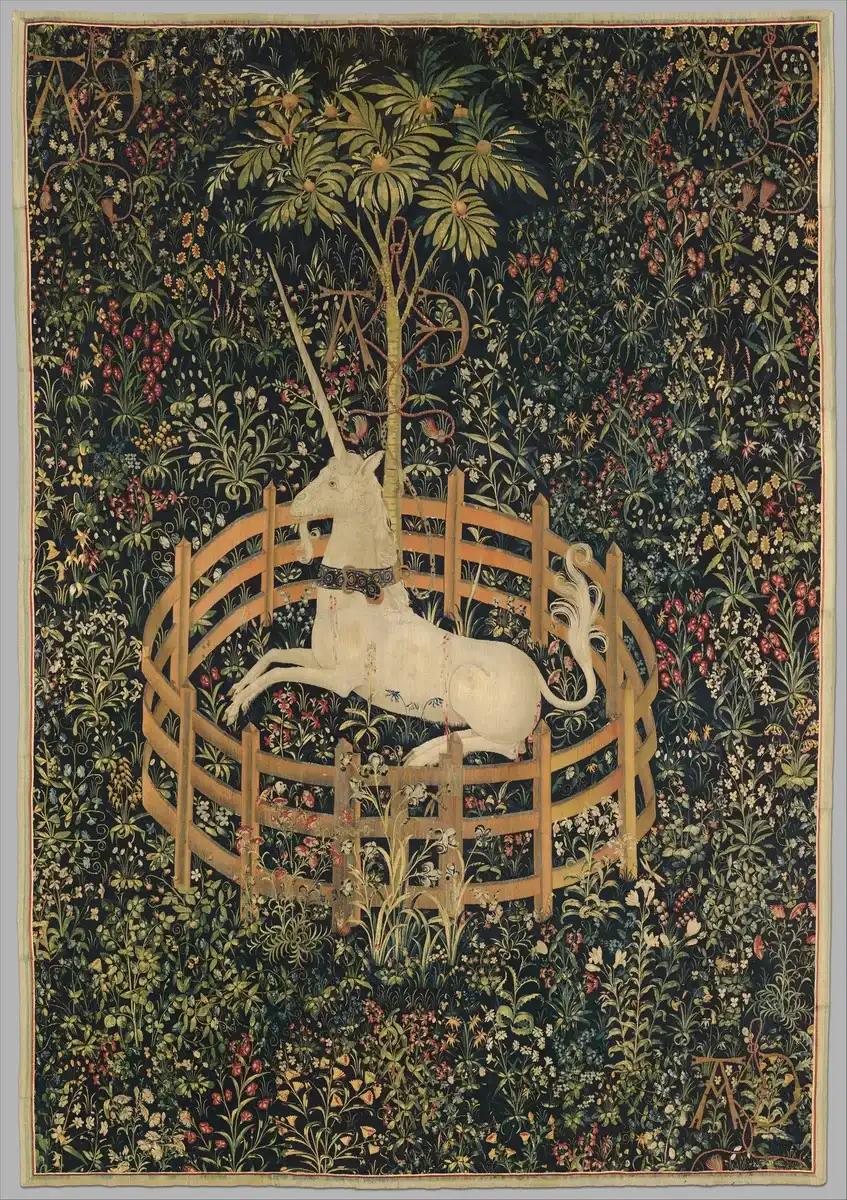
Historical The Gothic style began at the abbey church of Saint-Denis near Paris, whose new choir was consecrated in 1144. Pointed arches, rib vaults and flying buttresses let walls grow thin and high, opened by vast windows of colored glass. The cathedral became a frame for light. Late medieval homes had their own small wonders: the book of hours, a personal prayer book often painted by hand, and luxury tapestries such as the Unicorn Tapestries, woven around 1495 to 1505.
Modern You will read online that gargoyles were made to ward off evil. They were rainspouts. A protective meaning is possible, but medieval texts say little about it, so treat it as a modern guess.
Abbot Suger and the light
Historical Abbot Suger of Saint-Denis wrote about his new church, and his words explain why Gothic glass mattered. He described how the beauty of the gems and colors carried his mind from material things to immaterial ones, transporting him, as he put it, from this lower world to a higher one in an “anagogical” way, meaning leading upward. Light through colored glass was a picture of divine light.
A pentagram in a medieval poem
Historical Here is a surprise for witches. In the late fourteenth-century English poem Sir Gawain and the Green Knight, the hero’s shield bears a gold pentangle, a five-pointed star drawn in one unbroken line. The poet explains that it is a sign of “truth”, standing for Gawain’s five senses, five fingers, his faith in the five wounds of Christ, the five joys of Mary and five knightly virtues. It is an “endless knot”. Long before modern witchcraft, the pentagram could be a Christian symbol of perfection and faithfulness.
Reading an icon, step by step
Historical One of the oldest surviving icons is the image of Christ Pantokrator, “ruler of all”, at the Monastery of Saint Catherine at Mount Sinai in Egypt. It is usually dated to the sixth century and was painted in encaustic, pigment mixed with hot wax, which helped it survive. The monastery’s remote desert site kept it safe through the period of iconoclasm, when many icons elsewhere were destroyed.
Try reading any Pantokrator image with the steps from lesson 2. First, the inventory: a bearded man seen from the front, one hand raised in blessing, the other holding a book, a halo marked with a cross, a gold or plain background. Second, the conventions: the frontal pose invites the viewer into direct encounter, and letters such as IC XC, the Greek abbreviation for Jesus Christ, name the figure so that there can be no doubt. Third, the purpose: the image was meant to be prayed before, kissed and lit by candles, not admired from a distance.
Scholars have also noticed that the two halves of the Sinai face differ, one side calmer and the other sterner. Some read this as showing both mercy and judgment, or Christ’s two natures. That reading is debated, so treat it as an interpretation, a good example of Panofsky’s third level.
Studying sacred art with respect
A question beginners ask: “Is it disrespectful to study someone’s holy image as art?” Not if you remember that for many people it is still holy. Icons are prayed before in Orthodox churches today. When you visit, follow local customs, ask before photographing and keep your voice low. Looking carefully is a form of respect in its own right.
Questions beginners ask
Were medieval people afraid of images? Not usually; they used them constantly. The iconoclasts objected to venerating images, not to all art.
Is the halo a pagan symbol? Rays and discs of light were used for gods and emperors in the Roman world before Christian art adopted the halo, so the form is older, but its Christian meaning is its own.
Where can I see manuscripts? Many libraries, such as the British Library and Trinity College Dublin, have digitized them for free.
Myths to drop: Gargoyles were not mainly demons to scare evil; they were drains. The pentagram was not always a “pagan” or “evil” sign. And Egyptian art was not stiff because artists could not draw; its conventions were deliberate.
A worked example
Imagine you are a palace visitor at Nimrud in around 870 BCE. You walk toward the gate in bright sunlight. The lamassu rise above you, more than four meters tall, their carved eyes level with nothing you can reach. You see them from the front first, standing still and calm, and then from the side as you pass, striding forward. You have heard that they guard the king against evil spirits.
You pass between them in a few seconds, slightly afraid. Now compare that with how most of us see the same figure today: in a quiet museum gallery, under even electric light, for as long as we like, with a label explaining it. Same object, completely different experience. Remembering the first viewer is how you begin to read an image on its own terms.
Try this
Choose one object from this lesson, such as the lamassu or the Persephone krater. Write who would have seen it when it was new, in what light, from how far away and for how long. Then write how you see it now.
Recap
Ancient and medieval images were made to work: to guard, to pray, to serve the dead or to make the holy present. Assyrian lamassu protected thresholds, Egyptian tomb art followed fixed rules on purpose, and a Greek vase gives one of the clearest ancient images of Hekate with her torches. Byzantine icons survived a long fight over images, gold backgrounds signal heavenly light, and Gothic cathedrals turned walls into frames for colored light. Ask what an image was for, and who first saw it, before you interpret it.
What next
Press “Mark as done” and continue with Renaissance magic and melancholy. Each period here has its own page: Ancient Near Eastern art, Ancient Egyptian art, Ancient Greek art, Byzantine art, Gothic, illuminated manuscripts and International Gothic. If you are taking the Hekate course, the Persephone krater is worth ten slow minutes.
Further reading: Michelle P. Brown, Understanding Illuminated Manuscripts (Getty, 2018 edition). Sir Gawain and the Green Knight, the pentangle passage in the second part (fitt), in any translation.
Sources
- E. H. Gombrich, The Story of Art (London: Phaidon, 1950).
- Robin Cormack, Byzantine Art (Oxford: Oxford University Press, 2000).
- Gay Robins, Proportion and Style in Ancient Egyptian Art (Austin: University of Texas Press, 1994).
- The Metropolitan Museum of Art, Human-headed winged lion (lamassu), accession 32.143.2; Terracotta bell-krater attributed to the Persephone Painter, accession 28.57.23; The Unicorn Rests in a Garden, accession 37.80.6.
Quick check
Go deeper: the art movements timeline and art history pages on this site
Get the free Mini-Grimoire
A short printable starter guide to tarot and everyday witchcraft, plus my newsletter. Unsubscribe any time.
Opens Substack in a new tab to confirm. More about the newsletter · Privacy
Comments
Questions and notes from readers. Anyone with a free account can comment, and I reply when I can. Please read the community guidelines.
Comments load from Google Firebase (EU) when you ask for them. Nothing is stored on your device. Privacy