


How to read the labels Historical what the old sources say. Later tradition what later writers added. Modern modern practice and my own notes.
Ancient Greek art is the art of the Greek world from about 900 BCE to the Roman conquest in the 1st century BCE. Historians divide it into the Geometric, Archaic, Classical and Hellenistic periods. It gave Europe the idea of the idealised human figure, the painted vase as a storytelling surface and the temple as sculpture, and its statues were once brightly painted.
For centuries European art education began with Greece, which made it the most studied art in the world and also the most mythologised. I want to look at it with fresh eyes, starting with that fact about paint, which changes how you see almost everything.
Key dates
| When | What happened |
|---|---|
| About 900 to 700 BCE | Geometric pottery with bands of figures and meanders. |
| About 530 BCE | Red-figure vase painting begins in Athens. |
| 447 to 432 BCE | The Parthenon is built on the Athenian Acropolis. |
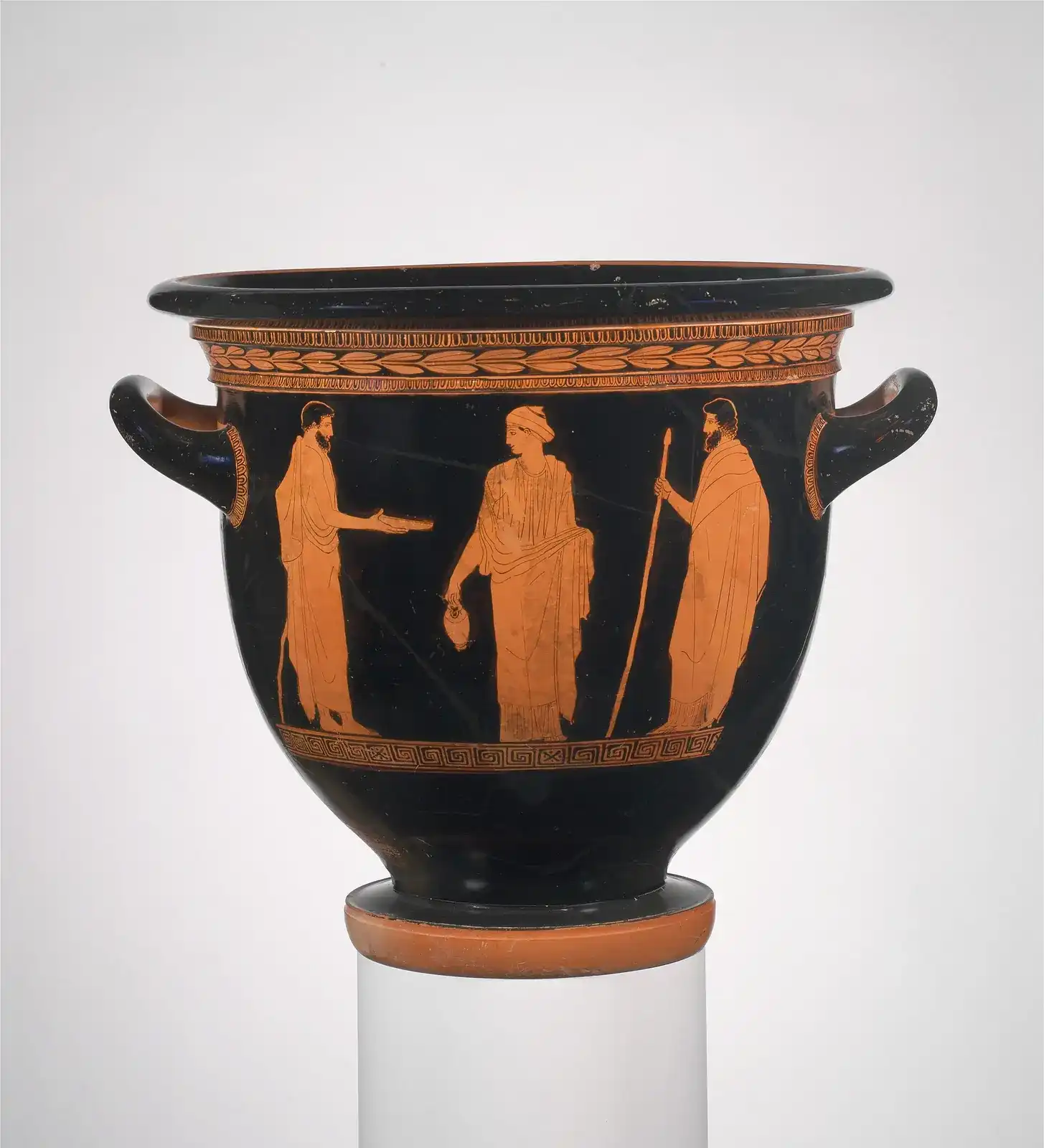
| About 440 BCE | The Persephone Painter decorates the krater shown above. |
| 323 BCE | Alexander the Great dies and the Hellenistic age begins. |
| 31 BCE | The battle of Actium; Greece is now part of the Roman world. |
What is Ancient Greek art?
Ancient Greek art covers the pottery, sculpture, architecture and painting of the Greek cities and kingdoms, from the Geometric vases of the 8th century BCE to the dramatic sculpture of the Hellenistic kingdoms.
Throughout this page I mark three layers. Historical What the objects and texts show. Later tradition What Rome, the Renaissance and the eighteenth century made of Greece. Modern How people use Greek gods and images today.
Historical The painted past. Ancient stone sculpture was regularly painted, and bronzes were polished to a warm gold-brown with inlaid eyes and copper lips. Buried statues lost their paint, so when they were dug up in the Renaissance they were already white, and collectors learned to love them that way.
In 2003 the archaeologists Vinzenz Brinkmann and Ulrike Koch-Brinkmann opened the exhibition Gods in Color in Munich with full-size painted reconstructions, and in 2022 and 2023 the Met showed a related exhibition, Chroma. The reconstructions are hypotheses: the colors were there, and how they looked is still under study.
Historical Before Classical Greece. Bronze Age Aegean art came first. Cycladic marble figures, folded-arm and strangely modern, were made in the islands from about 3000 BCE. The Minoans of Crete painted lively frescoes of dolphins and young people leaping over bulls at Knossos, and the Mycenaeans of mainland Greece buried their rulers with gold masks.
From Geometric to Hellenistic. 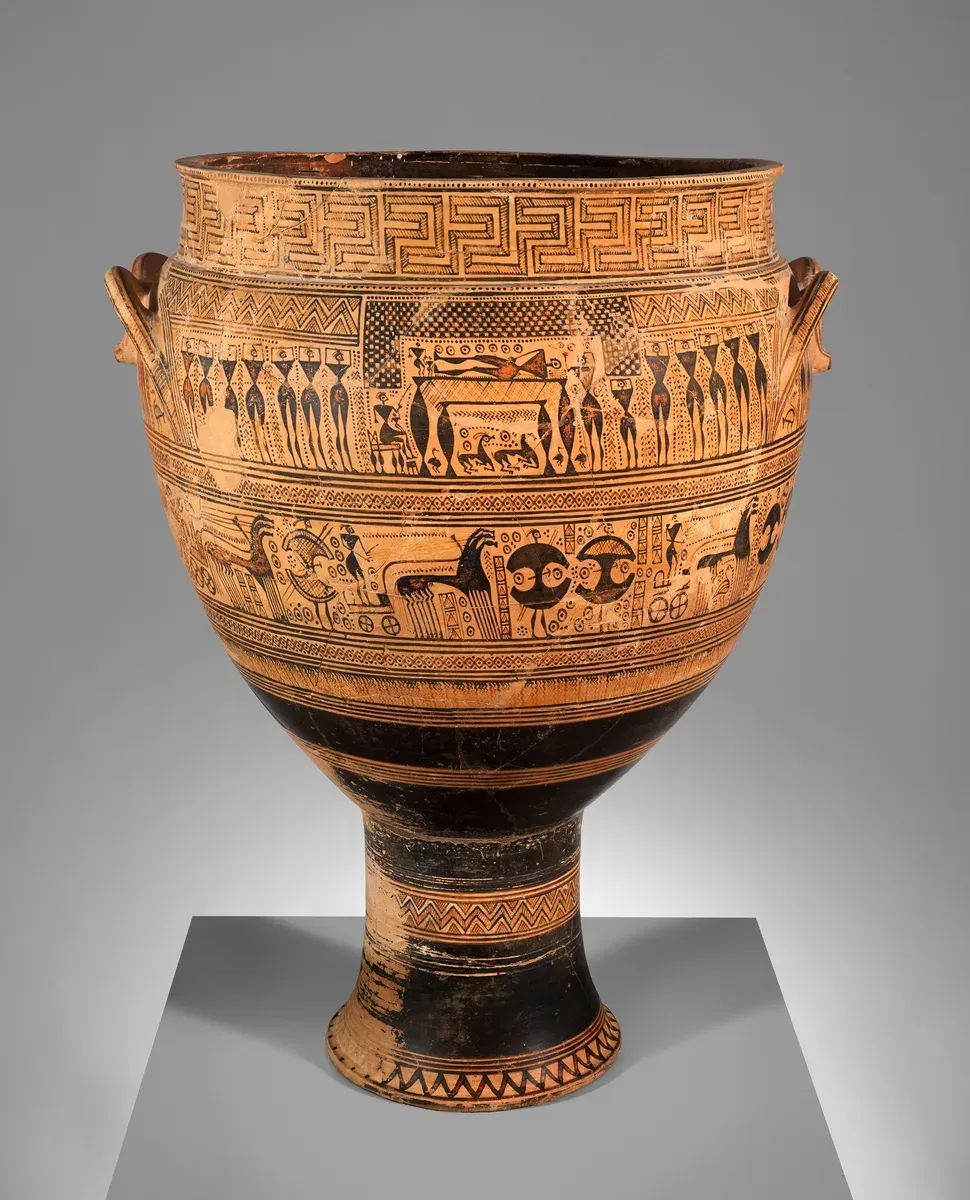
Hirschfeld Workshop, Terracotta krater, about 750 to 735 BCE. The Metropolitan Museum of Art (14.130.14). Image: Open Access, public domain (CC0).
Historical Greek art is usually divided into periods. In the Geometric period, about 900 to 700 BCE, huge vases were painted with bands of pattern and tiny silhouette figures. This krater at the Met, from about 750 to 735 BCE, stood over a grave in Athens and shows mourners and a procession of chariots.
In the Archaic period, about 700 to 480 BCE, sculptors carved standing young men called kouroi, stiff and smiling, influenced by Egypt. The Classical period, about 480 to 323 BCE, brought the relaxed pose called contrapposto, with weight on one leg, and a search for ideal proportion.
The sculptor Polykleitos wrote a lost treatise on the subject called the Canon. The Hellenistic period, after Alexander’s death in 323 BCE, turned to drama, old age, suffering and movement.
Much of what we call Greek sculpture survives only in Roman copies, because bronze was melted down for reuse. Always check the label for “Roman copy of a Greek original”.
Historical The Parthenon. The Parthenon in Athens, built from 447 to 432 BCE for Athena, was decorated with sculpture designed under Phidias. Many of its sculptures were removed by agents of Lord Elgin in the early 1800s and are now in the British Museum, and Greece has long asked for their return.
Later tradition You may read that the Parthenon was designed with the golden ratio. No Greek source says so, measurements do not clearly support it, and the term “golden section” dates only to the nineteenth century.
Historical Vase painting. Painted pottery is our best evidence for Greek painting, since almost all large wall and panel painting is lost.
In black-figure, figures are painted in black on the red clay; in red-figure, from about 530 BCE, the figures are left in red against a black background, which allowed finer detail. Many Athenian painters signed their work, and scholars have named hundreds more after a typical vase, such as “the Persephone Painter”.
Key artists
| Artist | Lived | Why they matter |
|---|---|---|
| Exekias | active about 545 to 530 BCE | The greatest black-figure painter, famous for Achilles and Ajax playing a board game. |
| Pheidias | about 480 to 430 BCE | The sculptor who oversaw the Parthenon and made its gold and ivory Athena. |
| Polykleitos | active about 450 to 420 BCE | The sculptor who wrote a rule of ideal proportions, the Canon. |
| Praxiteles | active about 370 to 330 BCE | The sculptor of softly curving gods, whose work survives mostly in Roman copies. |
How do you recognise Ancient Greek art?
Look for figures that move from stiff, smiling statues to relaxed bodies standing with the weight on one leg. On vases, black figures on red clay come first, then red figures on a black ground. Stories come from myth and the Trojan War. And remember that the white marble you see was painted in bright colors.
Common misconceptions. Many of the “Greek” statues in museums are Roman marble copies of lost Greek bronzes. The famous Discobolus, for example, is known through Roman copies of a bronze by Myron.
Another myth is that Greek art was made only by men. Most named artists are men, but Pliny the Elder records women painters, among them Timarete, daughter of Mikon, who painted an Artemis at Ephesus. None of their work survives, which is a loss rather than proof of absence. A third is that the Greeks admired plain white marble. Traces of paint on many works, studied in modern projects such as the Gods in Color exhibitions since 2003, show bright colour.
Esoteric themes
Historical The Persephone Painter’s bell-krater at the Met, about 440 BCE, shows Persephone rising from the underworld. Hermes stands nearby, Demeter waits, and Hekate holds two torches to light the way. It is one of the clearest early images of Hekate as a guide between worlds. My Hekate course starts from scenes like this one.
Later tradition Greek mystery religions, such as the rites at Eleusis for Demeter and Persephone, were secret, and their initiates kept the secret well. Later writers have filled that silence with many confident theories. Treat them as theories.
Modern Many people honor Greek gods today. I suggest letting objects like this vase, and the hymns and texts of the time, be your starting point.
Works to see
| Work | Artist | Date | Where to see it |
|---|---|---|---|
| Terracotta bell-krater with the return of Persephone | Attributed to the Persephone Painter | about 440 BCE | The Metropolitan Museum of Art, New York |
| Amphora with Achilles and Ajax playing a game | Exekias | about 540 to 530 BCE | Vatican Museums, Rome |
| Parthenon sculptures | Workshop of Pheidias | 447 to 432 BCE | The British Museum, London, and the Acropolis Museum, Athens |
| Peplos Kore | Greek, Attic | about 530 BCE | Acropolis Museum, Athens |
Every work in this list is free of nudity, so you can look them up with confidence. Works still in copyright are named but not shown here.
How to look at a Greek vase or statue
With a Greek vase, first decide whether the figures are black on red clay, which is black-figure and mostly earlier, or red figures left in the clay on a black ground, which is red-figure, invented in Athens around 530 BCE. Then follow the story around the pot, because many scenes continue on the back.
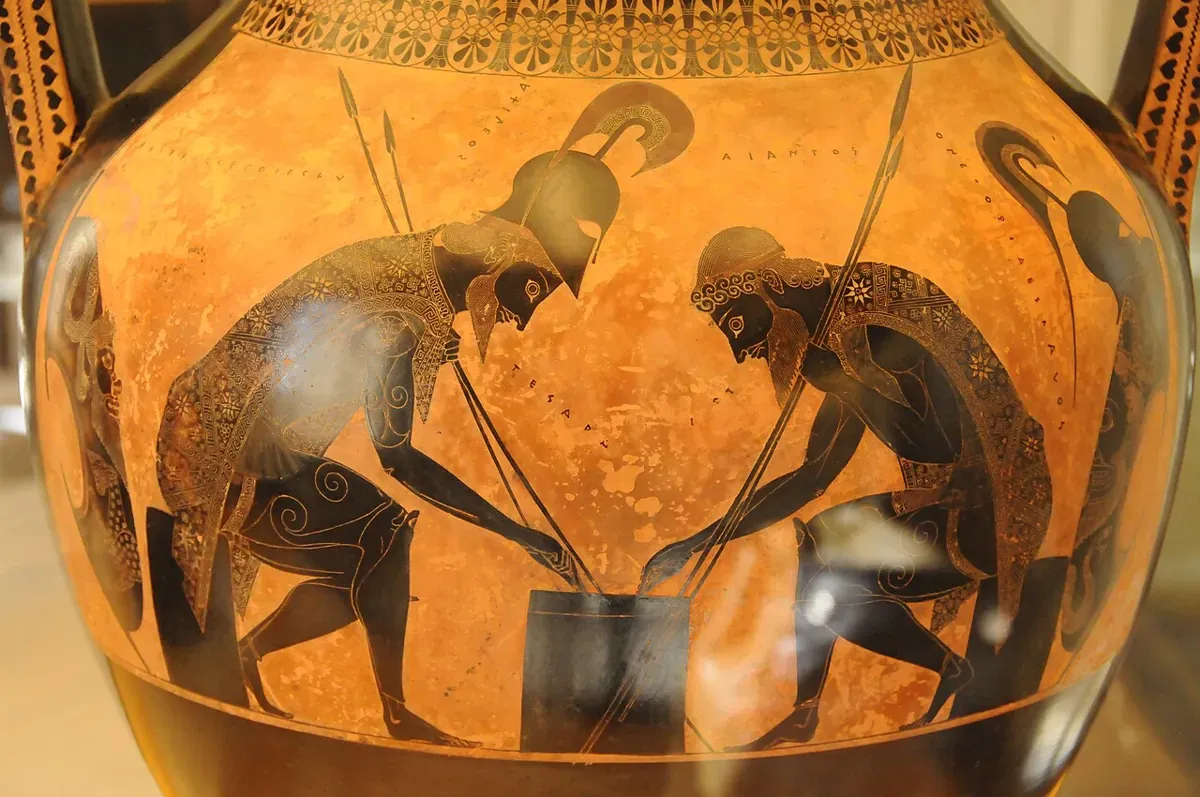
Exekias, Amphora with Achilles and Ajax playing a board game, about 540 to 530 BCE. Vatican Museums, Rome. Image: Wikimedia Commons, public domain.
Exekias, amphora with Achilles and Ajax, about 540 to 530 BCE. In the Vatican Museums. Two heroes of the Trojan War play a game during a break in the fighting. Look at the incised detail on their cloaks, scratched through black slip, and at the tension of the bent backs. Exekias signed it as both potter and painter.
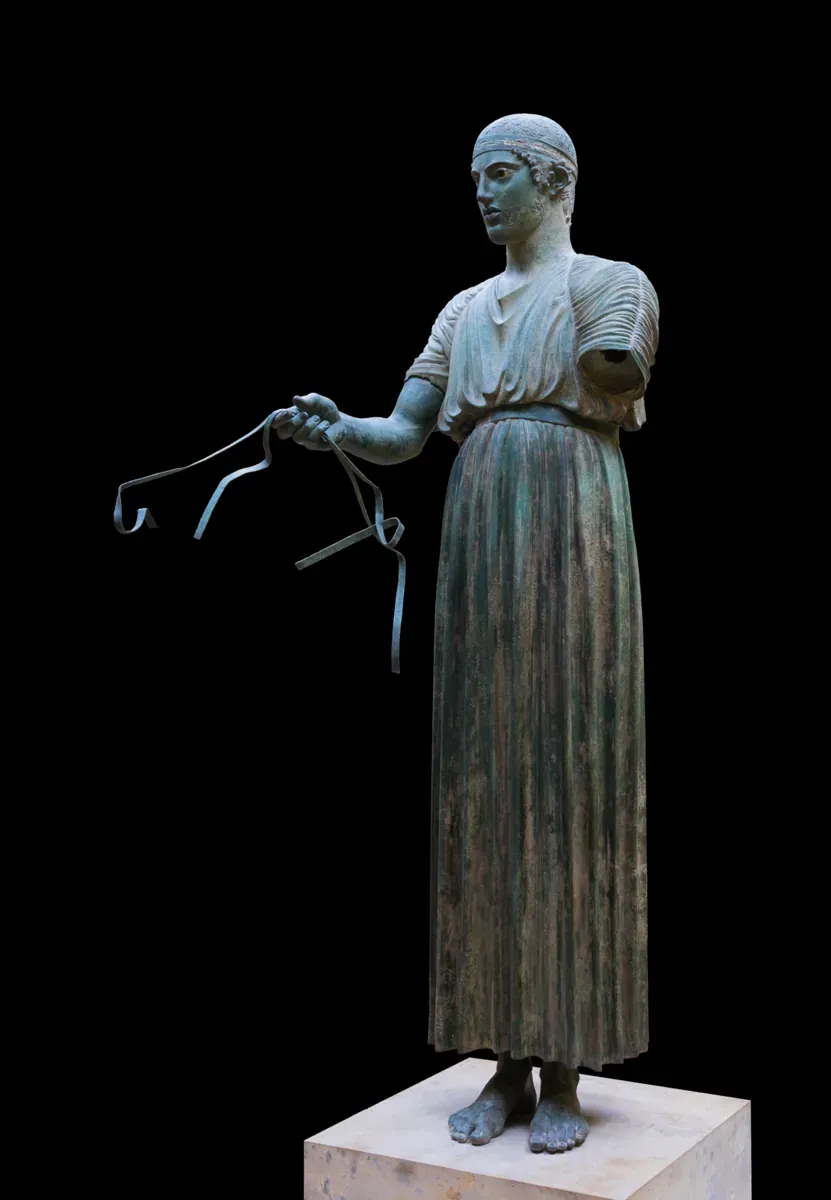
Unknown Greek sculptor, Charioteer of Delphi, about 470 BCE. Delphi Archaeological Museum. Image: Wikimedia Commons, public domain.
The Charioteer of Delphi, about 470 BCE. At the Delphi Archaeological Museum, one of the few large Greek bronzes to survive, because it was buried by an earthquake. This is the Severe Style, between Archaic and Classical. Look at the eyes, which are inlaid glass and stone, and at the robe falling in folds like the fluting of a column.
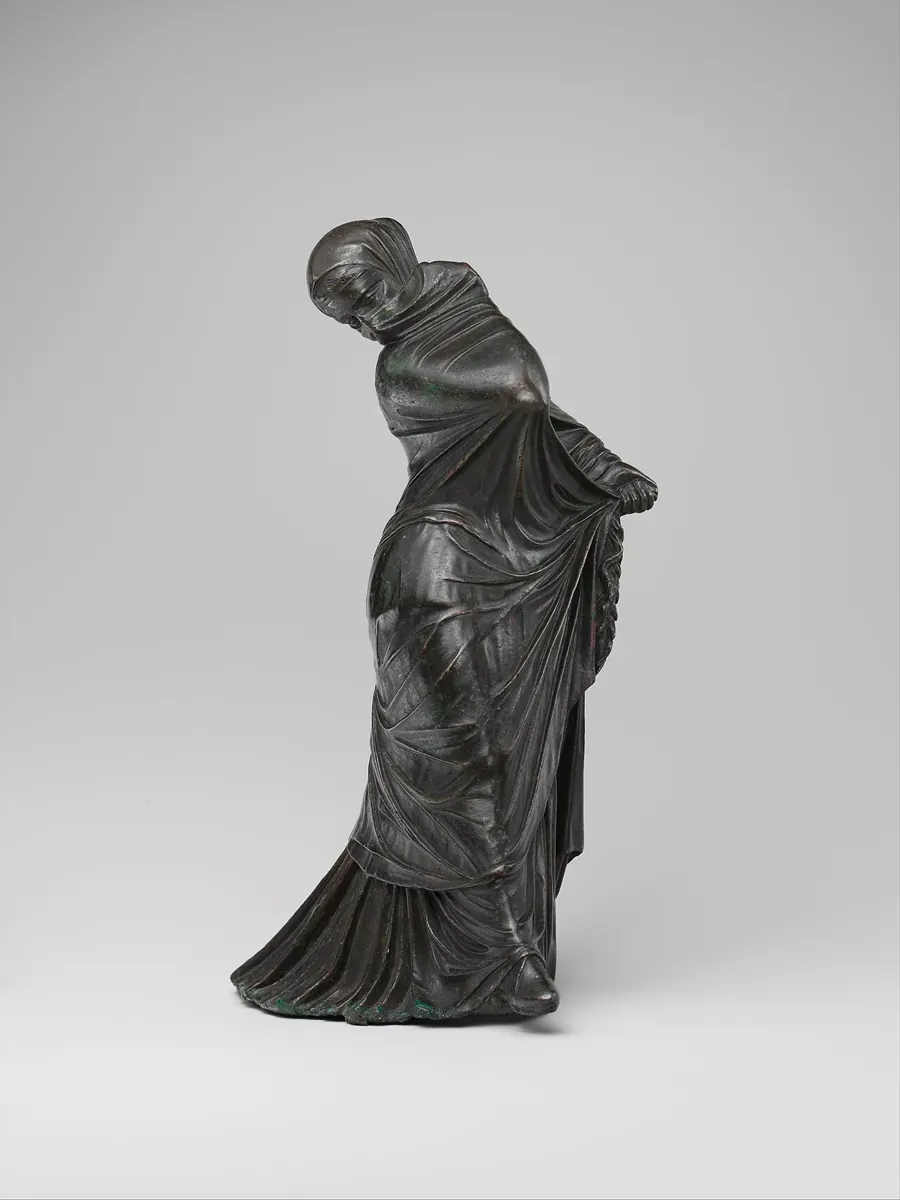
Unknown Greek artist, Bronze statuette of a veiled and masked dancer, 3rd to 2nd century BCE. The Metropolitan Museum of Art, New York. Image: Wikimedia Commons, public domain.
Bronze statuette of a veiled and masked dancer, 3rd to 2nd century BCE. At the Metropolitan Museum of Art. Hellenistic art loves movement and everyday people as well as gods. Walk around her, if you visit, and see how the mantle pulls in spirals across her body.
Greek art grew from contact with Egypt and the Near East, was collected and copied by Rome, and was rediscovered in the Renaissance and again by Neoclassicism.
Try this
Choose a Greek vase in an online collection that shows several views. Describe the scene on each side. Then think of it as an object: how big is it, and was it used at a drinking party or a funeral? A vase painting is made for a curved surface that turns in the hand, not for a flat page.
What next
Before this: Ancient Egyptian art.
After this: Ancient Roman art.
Also worth reading alongside it: Neoclassicism.
See every movement in order on the art movements timeline, or learn to look step by step in the free Art History for Beginners course.
If you want to carry this into tarot and practice, these pages connect to it: The High Priestess, Persephone, who belongs to two worlds and keeps their secrets; Strength, the taming of the lion, a theme Greek art gave to Herakles; Hekate, who lights Persephone home with her torches; and Reading gods by their attributes.
Sources
- Vinzenz Brinkmann and Raimund Wünsche (eds.), Gods in Color: Painted Sculpture of Classical Antiquity (2007).
- John Boardman, Greek Art (1964).
- The Metropolitan Museum of Art, Terracotta bell-krater, Persephone Painter, 28.57.23. Open the record
- The Metropolitan Museum of Art, Terracotta krater, Hirschfeld Workshop, 14.130.14. Open the record
- The Metropolitan Museum of Art, Chroma: Ancient Sculpture in Color (exhibition, 2022 to 2023).
- E. H. Gombrich, The Story of Art (1950).
- Wikimedia Commons, Terracotta bell-krater showing the return of Persephone (hero image record). Open the record
- John Boardman, Greek Art (5th edition) (2016).

Questions
Were Greek statues really white?
No. Stone sculpture was regularly painted, and bronzes were polished with inlaid eyes and copper lips. The paint wore away underground. Exactly how bright the colors were is still debated, but that they were there is not.
Where can I see Hekate in Greek art?
One clear example is a bell-krater by the Persephone Painter at the Met, about 440 BCE, where Hekate holds two torches to light Persephone's return from the underworld.
Where can I see works of Ancient Greek art in person?
Good places to start are the Met, the British Museum, the Louvre, and the Acropolis Museum and the National Archaeological Museum in Athens. Museums change their displays, so check the collection page before you travel.
What are the periods of ancient Greek art?
Usually the Geometric period (about 900 to 700 BCE), the Archaic (about 700 to 480 BCE), the Classical (480 to 323 BCE) and the Hellenistic (323 to about 31 BCE).
What is the difference between black-figure and red-figure?
In black-figure the figures are painted black on the red clay and details are scratched in. In red-figure, invented in Athens around 530 BCE, the background is black and the figures stay the colour of the clay, so details can be painted with a brush.
Get the free Mini-Grimoire
A short printable starter guide to tarot and everyday witchcraft, plus my newsletter. Unsubscribe any time.
Opens Substack in a new tab to confirm. More about the newsletter · Privacy