


How to read the labels Historical what the old sources say. Later tradition what later writers added. Modern modern practice and my own notes.
Ancient Egyptian art is the art made along the Nile from about 3100 BCE, when Upper and Lower Egypt were united, until Roman rule after 30 BCE. It is famous for figures shown in profile with a frontal eye and shoulders, for tomb paintings and for statues made to last forever. Its style stayed recognisable for about three thousand years, because it was built on shared rules rather than on individual taste.
Once you learn its few rules, you can read an Egyptian wall almost like a page. Egypt is also the place Western esotericism has dreamed about most, so on this page I keep the real Egypt and the imagined Egypt apart, because both are fascinating.
Key dates
| When | What happened |
|---|---|
| About 3100 BCE | The Narmer Palette shows a king of a united Egypt. |
| About 2560 BCE | The Great Pyramid of Khufu is completed at Giza. |
| About 1479 to 1458 BCE | Hatshepsut rules as king. |
| About 1353 to 1336 BCE | Akhenaten moves the capital to Amarna and changes the style of art. |
| About 1323 BCE | Tutankhamun is buried in the Valley of the Kings. |
| 30 BCE | Cleopatra VII dies and Egypt becomes a Roman province. |
What is Ancient Egyptian art?
Ancient Egyptian art is a rule-based visual language made mainly for temples, tombs and kings, meant to show people, gods and offerings in their ideal and lasting form.
Throughout this page I mark three layers. Historical What objects and texts show. Later tradition What Greeks, Romans and Renaissance Europeans believed about Egypt. Modern How people use Egyptian gods and symbols today.
Historical The rules of the picture. In Egyptian two-dimensional art, a person is shown in a composite view: head in profile, eye from the front, shoulders from the front, waist and legs in profile. No one stands like that.
The aim was to show each part in its most complete, recognizable form. Figures are arranged in bands called registers, and important people are larger. The Narmer Palette, about 3100 BCE, already uses all these rules at the very start of the Egyptian state.
Artists drew grids on walls before painting, and unfinished tombs still show them.
The Egyptologist Gay Robins explains in Proportion and Style in Ancient Egyptian Art (1994) that in the Old and Middle Kingdoms a standing figure was laid out on eighteen squares from the soles of the feet to the hairline. The grid is why Egyptian figures look so consistent across centuries.
Historical Pyramids and tombs. The pyramids of Giza were built around 2550 BCE. Excavations of the workers’ villages in the 1990s showed that the builders were organized, fed and housed laborers, not slaves as legend says.
Much of what survives comes from tombs, because tombs were built to last and the dry climate preserved them. A tomb statue could be a home for the ka, part of a person’s life force. The paintings provided food, servants and protection forever. When we see them in a museum, we see them in a way their makers never intended.
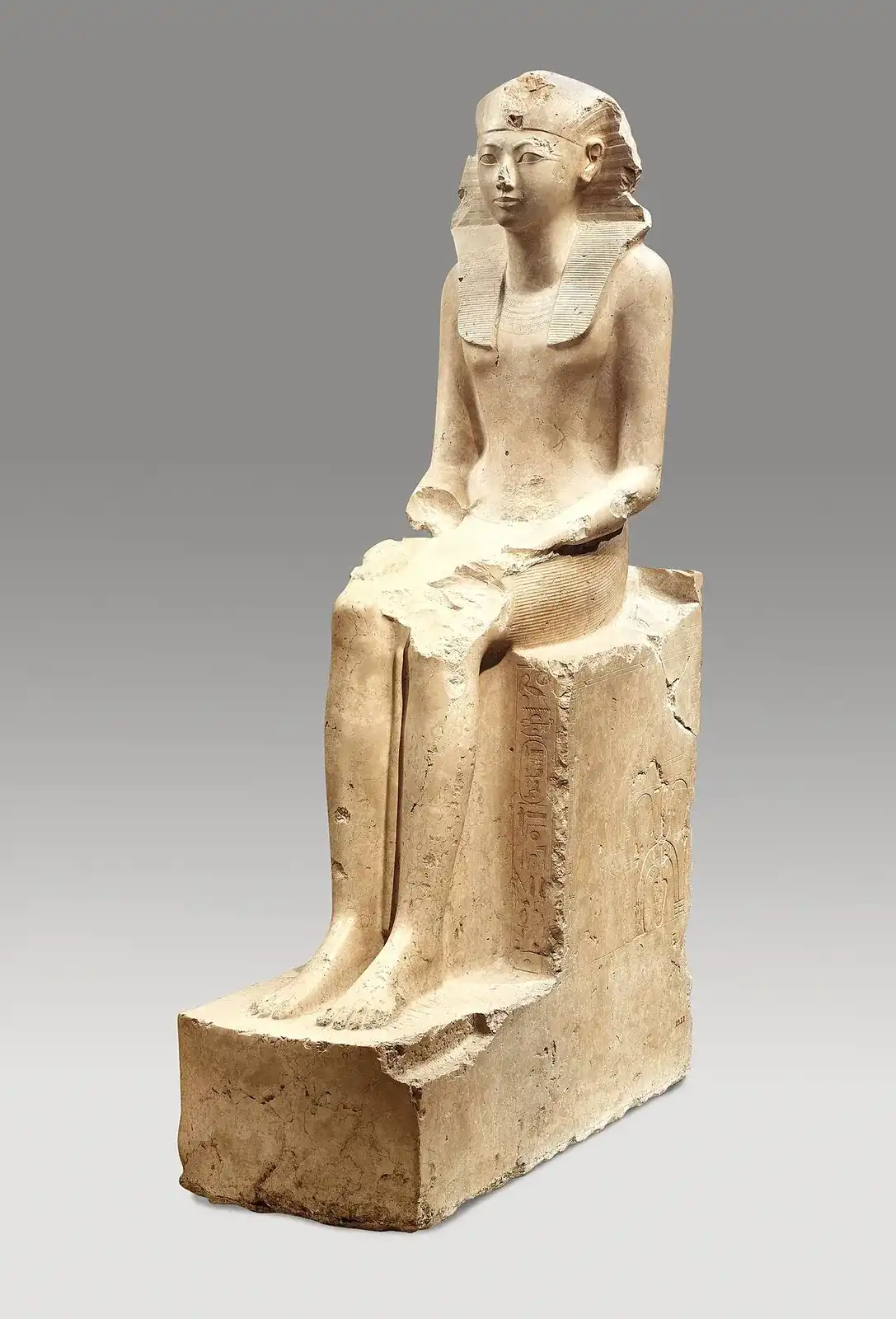
Historical Hatshepsut and the image of a king. Hatshepsut ruled as pharaoh from about 1479 to 1458 BCE, one of the few women to do so. She was usually shown with the regalia of a male king, including the false beard.
This seated statue at the Met, from her temple at Deir el-Bahri, gives her a slimmer, more feminine body than many later images. After her death many of her statues were smashed, and the Met’s pieces were reassembled from fragments in the twentieth century.
Historical Amarna: a brief revolution. Akhenaten, who ruled roughly 1353 to 1336 BCE, promoted worship of the Aten, a sun disk whose rays end in hands, and moved the capital to a new city now called Amarna.
Art of his reign shows long faces, full hips and tender scenes of the royal family with their children. The painted bust of Queen Nefertiti, found at Amarna in 1912, is in the Egyptian Museum in Berlin. After Akhenaten, the old style returned.
Historical The Book of the Dead. The Book of the Dead was a collection of spells written and illustrated on papyrus to guide the dead through the underworld.
Its best-known scene shows the heart weighed against the feather of Maat, goddess of truth and order. If the heart was heavy with wrongdoing, a creature waited to devour it. It is one of the oldest pictures of moral judgment.
Key artists
| Artist | Lived | Why they matter |
|---|---|---|
| Imhotep | about 2650 BCE | Architect of the Step Pyramid of Djoser, later worshipped as a god of healing. |
| Senenmut | about 1470 BCE | Steward and architect for Hatshepsut, linked with her temple at Deir el-Bahri. |
| Thutmose | about 1340 BCE | The sculptor at Amarna whose workshop held the painted bust of Nefertiti. |
| The painters of Deir el-Medina | about 1500 to 1100 BCE | The village of craftsmen who decorated the royal tombs and left their own names on the walls. |
How do you recognise Ancient Egyptian art?
Look for the composite figure: head and legs in profile, the eye and shoulders seen from the front. Figures stand on ground lines in registers, sized by importance.
A grid of squares kept proportions the same for nearly three thousand years. Hieroglyphs and images share the same surface, and colors carry meaning: green for new life, black for fertile earth, gold for the flesh of the gods.
Common misconceptions. The first is that Egyptian artists could not draw a body “correctly”. They could, and some animals and servants are drawn very naturally. The profile head, frontal eye and frontal shoulders were a deliberate way to show each part at its most complete.
The second is that the art never changed. Under Akhenaten, in the Amarna period around 1350 BCE, bodies became long and curving and the royal family was shown in tender scenes.
Esoteric themes
Later tradition Egypt has long been imagined as a land of secret wisdom. The Greek texts attributed to “Hermes Trismegistus”, which Renaissance thinkers believed were ancient Egyptian, were written in the Roman period, roughly the first to third centuries CE.
In 1614 the scholar Isaac Casaubon showed they were not as old as people thought. In 1781 Antoine Court de Gébelin claimed that tarot was an Egyptian “Book of Thoth”, a claim with no evidence that I explain on my art history of tarot page.
Modern Many people today work with Egyptian gods such as Isis, Thoth or Bastet. Egyptian religious texts are real and moving; I suggest reading them in good translation so that your practice rests on the sources and not on Victorian fantasy.
Works to see
| Work | Artist | Date | Where to see it |
|---|---|---|---|
| Seated Statue of Hatshepsut | Egyptian, New Kingdom | about 1479 to 1458 BCE | The Metropolitan Museum of Art, New York |
| Temple of Dendur | Egyptian, Roman period | about 10 BCE | The Metropolitan Museum of Art, New York |
| Book of the Dead of Hunefer | Egyptian, New Kingdom | about 1275 BCE | The British Museum, London |
| The Seated Scribe | Egyptian, Old Kingdom | about 2600 to 2350 BCE | Musée du Louvre, Paris |
Every work in this list is free of nudity, so you can look them up with confidence. Works still in copyright are named but not shown here.
How to look at an Egyptian wall painting or papyrus
An Egyptian picture is read more than viewed. I start with three questions: who is the biggest figure, which way are they facing, and where are the hieroglyphs. Size shows importance, the direction of the figures usually matches the direction of the writing, and the text often names everyone.
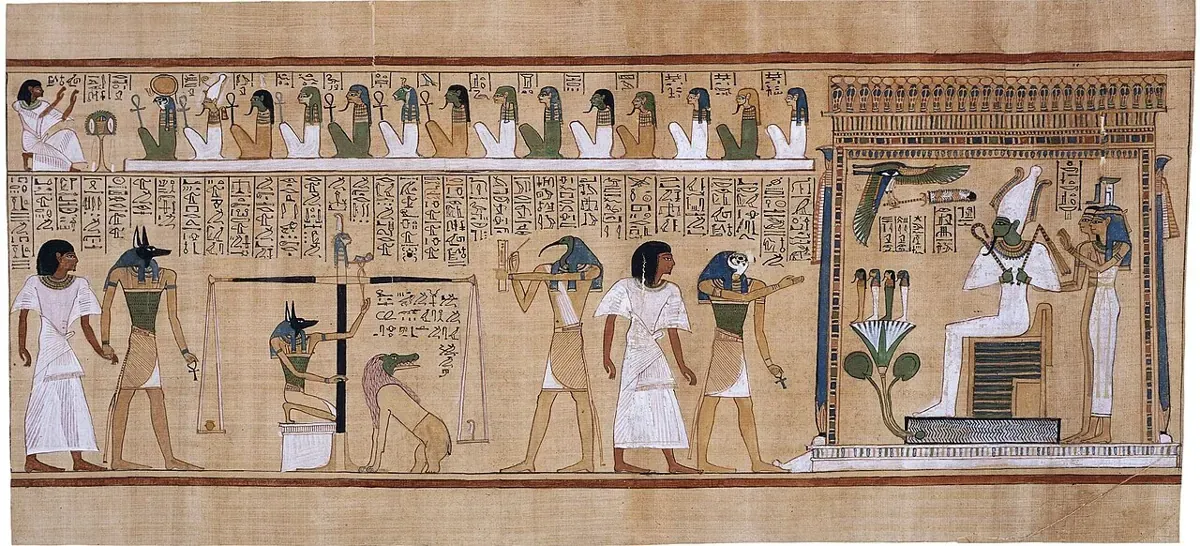
Unknown Egyptian artist, Book of the Dead of Hunefer, weighing of the heart, about 1275 BCE. British Museum, London. Image: Wikimedia Commons, public domain.
The Book of the Dead of Hunefer, about 1275 BCE. Read it from left to right like a comic strip. Anubis, with a jackal head, leads the royal scribe Hunefer to the scale. His heart is weighed against the feather of Maat, truth and order. Thoth writes down the result, and the beast Ammit waits to eat the heart if it fails. Then Horus leads Hunefer to Osiris.
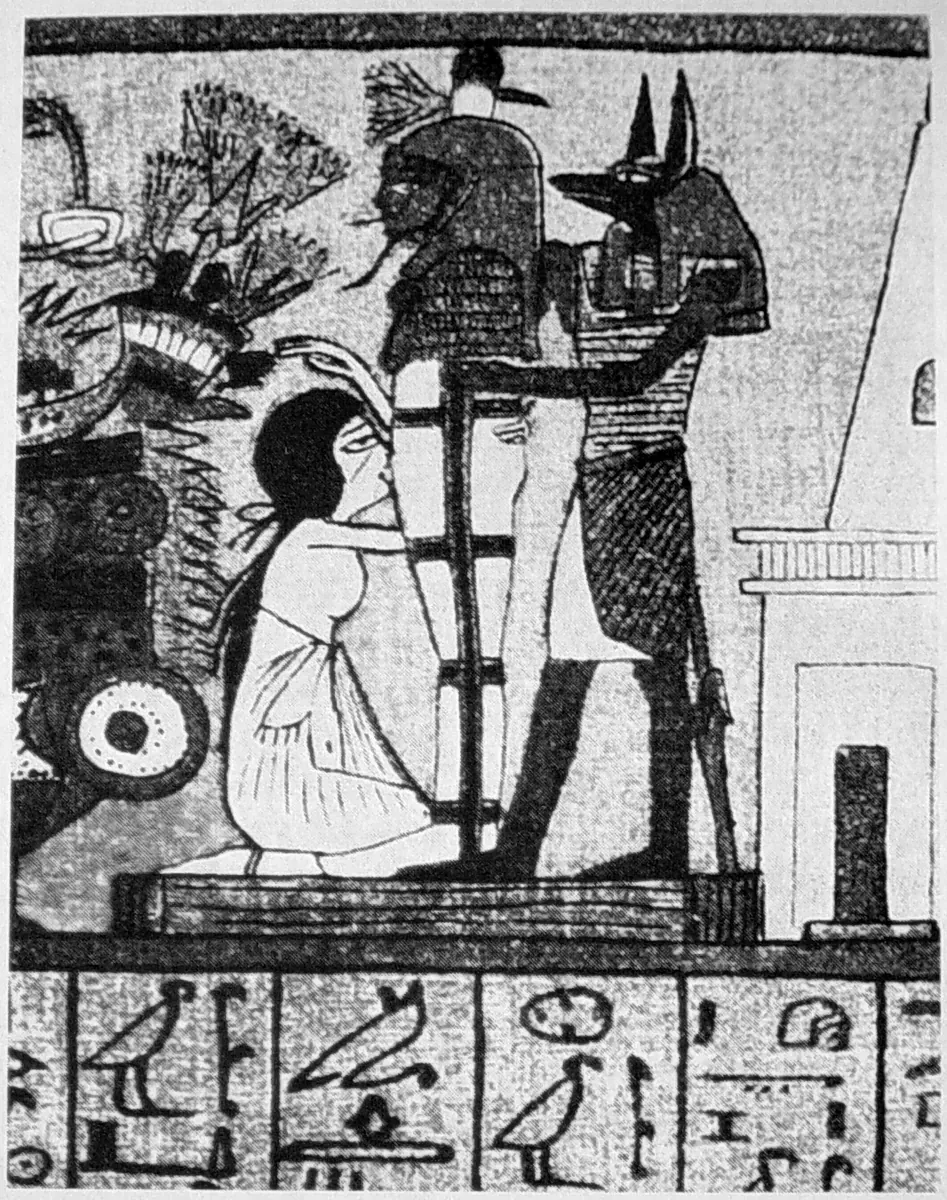
Unknown Egyptian scribe and artist, Book of the Dead of Ani, sheet 6 (detail), about 1250 BCE. British Museum, London. Image: Wikimedia Commons, public domain.
The Book of the Dead of Ani, about 1250 BCE. The same spell, made for the scribe Ani, at the British Museum. Compare it with Hunefer: same pattern, different hand. That is what working within a tradition looks like.
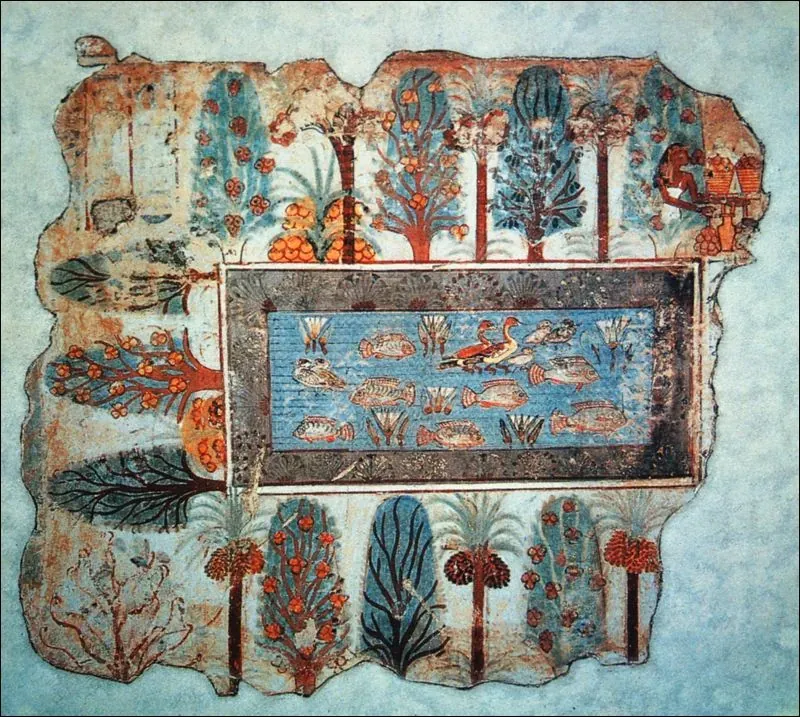
Unknown Egyptian painter, Pool in a garden, fragment from the tomb-chapel of Nebamun, about 1350 BCE. British Museum, London. Image: Wikimedia Commons, public domain.
Pool in a garden, tomb-chapel of Nebamun, about 1350 BCE. The pond is seen from above, while the trees around it are seen from the side. Each thing is drawn in the view that explains it best. The painting was meant to give Nebamun a garden in the afterlife.
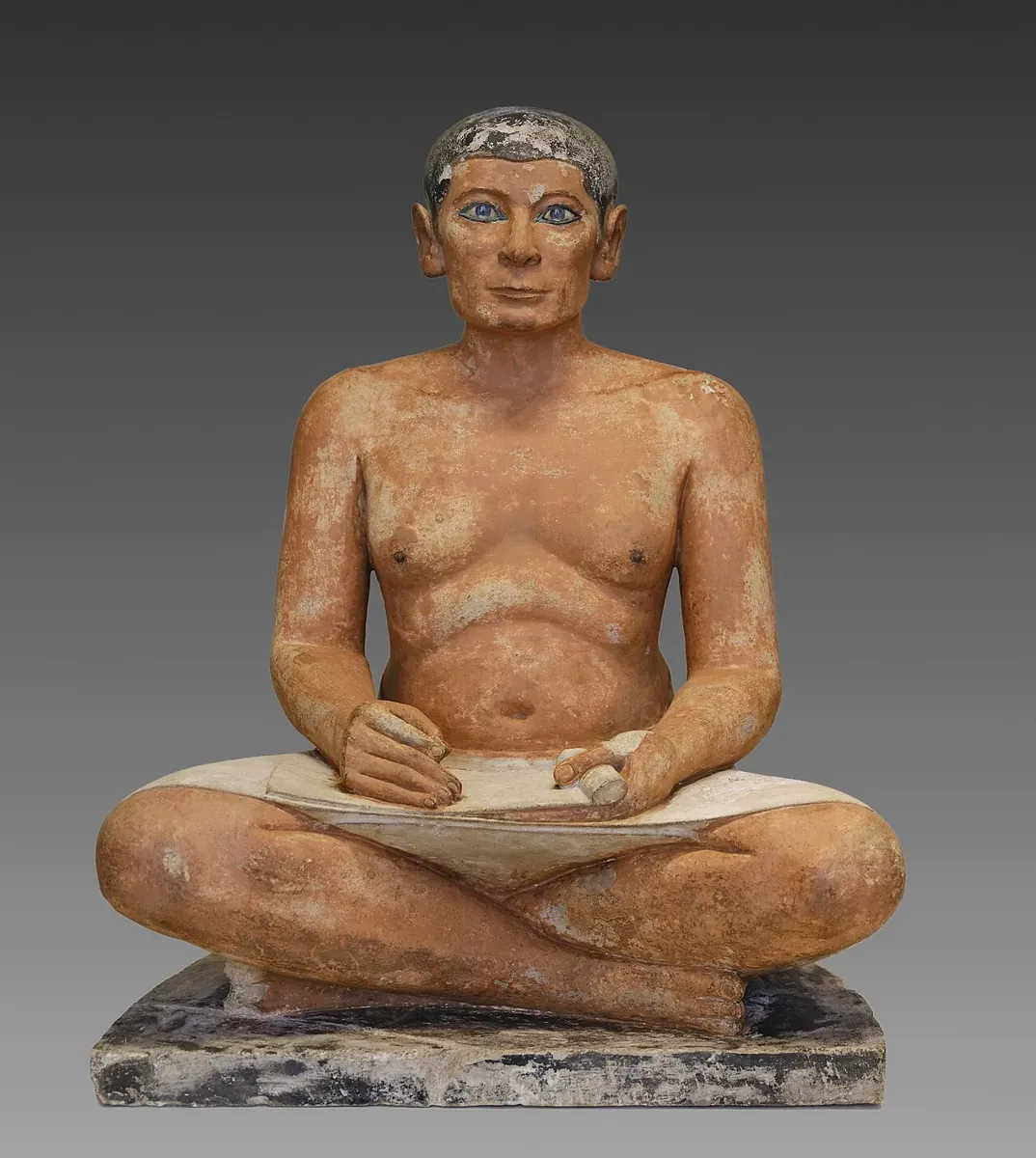
Unknown Egyptian sculptor, The Seated Scribe, about 2600 to 2350 BCE. Musée du Louvre, Paris. Image: Wikimedia Commons, public domain.
The Seated Scribe, about 2600 to 2350 BCE. Found at Saqqara in 1850 and now in the Louvre. The inlaid rock crystal eyes seem to follow you.
Egyptian rules for proportion and the striding pose shaped early Greek sculpture, and Egypt later became part of the Roman world, as the mummy portraits on the Roman art page show. The idea of a secret Egyptian wisdom, which is a modern legend, is traced in the history of tarot.
Try this
Find an Egyptian relief in an online collection; the Met’s Mastaba of Perneb is a good choice. Pick one standing figure. Is the head in profile or frontal? The eye? The shoulders? The feet? Stand up and try the pose. Then write one sentence on why an artist might choose clarity over realism.
What next
Before this: Ancient Near Eastern art.
After this: Ancient Greek art.
See every movement in order on the art movements timeline, or learn to look step by step in the free Art History for Beginners course.
If you want to carry this into tarot and practice, these pages connect to it: The High Priestess, temple, veil and moon, the images later occultists borrowed from Isis; Wheel of Fortune, the jackal-headed figure on the Rider-Waite-Smith card, a nod to Anubis; Why Renaissance readers thought Hermes Trismegistus was an ancient Egyptian sage; and The eighteenth-century myth that tarot came from Egypt.
Sources
- Gay Robins, Proportion and Style in Ancient Egyptian Art (1994).
- Gay Robins, The Art of Ancient Egypt (1997).
- The Metropolitan Museum of Art, Seated Statue of Hatshepsut, 29.3.2. Open the record
- The Metropolitan Museum of Art, Heilbrunn Timeline of Art History. Visit the website
- Alexander Dziadosz, Reuters, Egypt opens colossal new antiquities museum after two-decade wait (2025). Open the record
- E. H. Gombrich, The Story of Art (1950).
- Wikimedia Commons, Seated Statue of Hatshepsut (hero image record). Open the record
- Gay Robins, The Art of Ancient Egypt (2008).

Questions
Why do Egyptian figures stand in such a strange pose?
Egyptian artists used a composite view: head in profile, eye and shoulders from the front, legs in profile. Each part is shown in its clearest form. It was a choice for clarity and permanence, not a failure to draw.
Is Hermetic wisdom really ancient Egyptian?
No. The Greek texts attributed to Hermes Trismegistus were written in the Roman period, roughly the first to third centuries CE. Isaac Casaubon showed in 1614 that they were not as ancient as Renaissance thinkers believed.
Where can I see works of Ancient Egyptian art in person?
Good places to start are the Met, the British Museum, the Louvre, the Egyptian Museum in Berlin, and the Grand Egyptian Museum near Giza (opened 1 November 2025). Museums change their displays, so check the collection page before you travel.
Who were the artists of ancient Egypt?
Most worked in workshops and are anonymous, but some names survive. The sculptor Thutmose ran the workshop at Amarna where the bust of Nefertiti was found in 1912, and the village of Deir el-Medina housed the painters of the royal tombs.
Were women shown in Egyptian art?
Yes, often. Queens, wives, daughters, musicians and goddesses appear everywhere. Hatshepsut, who ruled as pharaoh about 1479 to 1458 BCE, had herself shown with the king's beard and kilt.
Get the free Mini-Grimoire
A short printable starter guide to tarot and everyday witchcraft, plus my newsletter. Unsubscribe any time.
Opens Substack in a new tab to confirm. More about the newsletter · Privacy