


| Arcana | Major Arcana |
|---|---|
| Number | XI |
| Image | RWS 1909 (PD) |
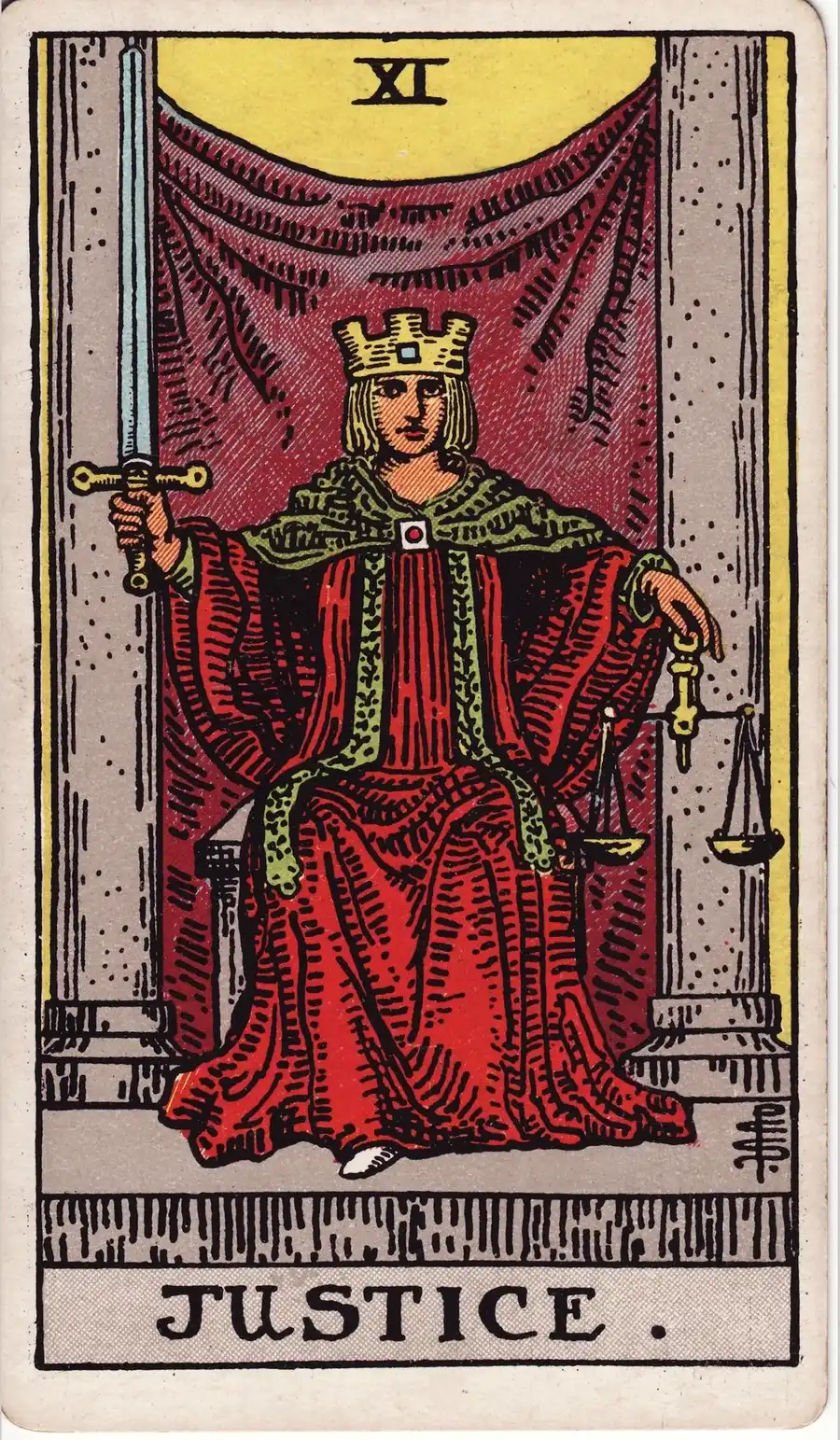
Justice is card XI of the Major Arcana in the Rider-Waite-Smith deck. A crowned figure sits between two pillars with scales in one hand and a sword in the other. She looks straight at you.
The card asks for honest accounting: what is true, what is fair and what you owe. Here is what Justice means upright and reversed, the symbols in the 1909 card and why your deck may number it VIII.
Here is Justice at a glance.
| At a glance | This card |
|---|---|
| Upright keywords | fairness, truth, accountability, cause and effect |
| Reversed keywords | unfairness, dishonesty, avoiding responsibility |
| Number | XI (11) in the Major Arcana |
| Golden Dawn title | The Daughter of the Lords of Truth; the Ruler of the Balance Later tradition |
| Hebrew letter | Lamed (ל), “ox-goad” Later tradition |
| Tree of Life path | 22, from Geburah to Tiphareth Later tradition |
| Astrology | Libra Later tradition |
| Element | Air Later tradition |
| Yes or no | Maybe Modern |
The Golden Dawn gave Justice the sign Libra, the scales, and the letter Lamed, the “ox-goad” used to keep an animal on the straight furrow. In the Golden Dawn and Waite order Justice is XI; in Marseille decks it is VIII, and Strength is XI. Justice is one of the four cardinal virtues of classical philosophy, and the early Italian decks drew it the way medieval art drew the virtue, as a crowned woman with a sword and scales.
The card: what Pamela Colman Smith drew
Waite said very little about this card, because it “follows the traditional symbolism and carries above all its obvious meanings”. Smith drew a frontal, steady figure in red, with a purple veil behind her.
The scales. The scales weigh both sides. Justice asks for balance and proportion, not revenge. What you put into a situation comes back to you.
The sword. The double-edged sword points straight up. It cuts through spin and excuses, and it cuts both ways: the truth applies to you as well as to others.
The pillars and the veil. Like the High Priestess, Justice sits between two pillars. Waite noted that “the pillars of Justice open into one world and the pillars of the High Priestess into another”: one is the law of the world, the other the hidden law of the spirit.
No blindfold. Modern statues of justice often wear a blindfold. This figure does not. She sees clearly, which is a good picture of a reading that looks at facts directly.
Upright meaning
Upright, Justice weighs. A crowned figure in red sits between two pillars, holding an upright double-edged sword in one hand and scales in the other. A purple veil hangs behind, and a white shoe peeks from under the robe. Unlike the blindfolded Justice of courthouses, this one looks straight at you.
The card describes fairness, truth and consequences. It often appears around contracts, legal matters, decisions with lasting effects and situations in which honesty is the only way forward. It says that actions have results and that the results will be proportionate. If you have acted well, that is good news.
Justice also asks you to judge clearly yourself. Weigh both sides, take responsibility for your own part, then decide and cut cleanly with the sword.
Reversed meaning
Reversed, the scales tip. The card can describe unfairness, a decision that does not go your way, dishonesty or a process that seems rigged. It can also describe avoiding accountability: blaming others, refusing to look at your own part, or hoping a consequence will not arrive.
Sometimes the reversed card points inward. You may be judging yourself far more harshly than you would judge anyone else, or putting off a decision until it is made for you.
Ask what the honest account looks like, including your share. Then ask what fair action is still possible. For real legal matters, Justice is a card to take to a qualified professional, not a verdict.
In love, work and spirituality
In love. Upright: Honesty, fairness and balance between partners; commitments made formally. Reversed: Imbalance, unfair blame, or a relationship decision being avoided.
At work. Upright: Contracts, fair treatment and decisions based on merit. Good for applications and negotiations. Reversed: Unfair treatment, a dispute, or cutting corners that will come back.
With money. Upright: Balanced accounts, fair settlements and paying what is owed. Reversed: Financial disputes, or debts and taxes that need facing.
In spiritual practice. Upright: Integrity: living by your values; understanding cause and effect. Reversed: Self-righteousness, or harsh judgment of yourself or others.
As feelings. Respect and a wish to be fair. The person is weighing things carefully.
As a person. Fair, principled and analytical; a good mediator or decision-maker.
As advice. Weigh honestly, own your part, then decide.
Reading Justice: positions and yes or no
In the past position: A decision or a consequence that still affects you. In the present position: Look at the facts honestly and take responsibility.
In the future position: A fair outcome, a decision or a contract. As advice: Act in a way you could defend in daylight.
When Justice shows up among mostly Minor cards, give it extra weight: the theme of fairness runs under the whole question.
In modern yes or no readings, Justice is a maybe. It depends on whether the outcome you hope for is fair. If you have acted honestly, it leans yes.
The history and art behind the card
In the Tarot de Marseille pattern the card is called La Justice, Justice. The Marseille pattern numbers Strength XI and Justice VIII. Waite swapped them for the 1909 deck to fit the Golden Dawn’s astrological order, so if your deck differs, read by the card’s title.
Justice is one of the four cardinal virtues of ancient and medieval thought, with Fortitude, Temperance and Prudence. Early tarot decks included three of them as trumps. Her image with sword and scales goes back to Roman and medieval art and still stands outside courthouses today.
Many people have wondered where the fourth virtue, Prudence, went. Some writers suggest the Hermit or the Star took its place, but there is no evidence for any of these theories. It is a good example of an open question in tarot history.
When A. E. Waite published The Pictorial Key to the Tarot in 1910, he listed these divinatory meanings for the card: “Equity, rightness, probity, executive; triumph of the deserving side in law.”
Reversed, he gave: “Law in all its departments, legal complications, bigotry, bias, excessive severity.” Waite himself called the fortune-telling meanings of the trumps “artificial and arbitrary”, and on this site I read the picture first and treat lists like this as history.
On the modern Fool’s Journey, Justice follows the Wheel and answers it. Fortune turns without asking, but here the traveler is asked to weigh their own choices honestly and accept that actions have consequences.
Common questions
Is Justice card 8 or 11? In the Rider-Waite-Smith deck it is XI. In the Tarot de Marseille and the Thoth deck it is VIII. Read by the title.
Does Justice mean a court case? It can mean legal or formal matters, but most often it means fairness, honesty and consequences in everyday life.
Is Justice a yes or no? It depends on fairness. If you have acted honestly, it leans yes. If not, it asks you to set things right first.
Try this
Try this small spread for Justice. Use it when you need a fair view of a conflict or a decision.
| Card | Question | What it shows |
|---|---|---|
| 1 | What are the facts? | What actually happened, without spin. |
| 2 | What is my part? | What I am responsible for. |
| 3 | What would be fair? | A balanced next step. |
Affirmation: I act with fairness and accept the consequences of my choices.
Reversed affirmation: I face dishonesty and restore accountability where I can.
If you keep a tarot journal, take one of these questions to it: What is the honest truth here, without excuses? What do I owe, and what am I owed? Would I be comfortable if everyone knew how I handled this?
What next
Cards that sit close to this one are Strength (the card it swapped numbers with), Judgement (a deeper reckoning and a call to renewal) and The Emperor (rules and structure in the world).
Justice is part of the lesson Strength to Temperance in my free Tarot for Beginners course. To keep walking the Major Arcana, read the card before it, Wheel of Fortune or the card after it, The Hanged Man, or go back to all the card meanings.
For every card with keywords, affirmations and examples, see my book The Novice’s Guide to Tarot. If you would like a printable cheat sheet for all 78 cards, my 45-page Tarot Workbook is on Etsy.
Sources
- A. E. Waite, The Pictorial Key to the Tarot (London: Rider, 1910), Part II and Part III, section 3.
- Pamela Colman Smith and A. E. Waite, the Rider-Waite-Smith tarot (London: Rider, 1909).
- Nicolas Conver, Tarot de Marseille (Marseille, 1760).
- Eden Gray, A Complete Guide to the Tarot (New York: Crown, 1970), epilogue “The Fool’s Journey”.
- Lauri Mukkala, The Novice’s Guide to Tarot, entry for Justice.
- Aleister Crowley, 777 (London: Walter Scott, 1909), columns of the Hebrew letters, paths and Tarot trumps.
- Israel Regardie, ed., The Golden Dawn (Chicago: Aries Press, 1937 to 1940), “Book T” and the titles of the trumps.
All 78 cards
Major Arcana
- The Fool
- The Magician
- The High Priestess
- The Empress
- The Emperor
- The Hierophant
- The Lovers
- The Chariot
- Strength
- The Hermit
- Wheel of Fortune
- Justice
- The Hanged Man
- Death
- Temperance
- The Devil
- The Tower
- The Star
- The Moon
- The Sun
- Judgement
- The World
Wands
- Ace of Wands
- Two of Wands
- Three of Wands
- Four of Wands
- Five of Wands
- Six of Wands
- Seven of Wands
- Eight of Wands
- Nine of Wands
- Ten of Wands
- Page of Wands
- Knight of Wands
- Queen of Wands
- King of Wands
Cups
- Ace of Cups
- Two of Cups
- Three of Cups
- Four of Cups
- Five of Cups
- Six of Cups
- Seven of Cups
- Eight of Cups
- Nine of Cups
- Ten of Cups
- Page of Cups
- Knight of Cups
- Queen of Cups
- King of Cups
Swords
- Ace of Swords
- Two of Swords
- Three of Swords
- Four of Swords
- Five of Swords
- Six of Swords
- Seven of Swords
- Eight of Swords
- Nine of Swords
- Ten of Swords
- Page of Swords
- Knight of Swords
- Queen of Swords
- King of Swords
Pentacles
Get the free Mini-Grimoire
A short printable starter guide to tarot and everyday witchcraft, plus my newsletter. Unsubscribe any time.
Opens Substack in a new tab to confirm. More about the newsletter · Privacy