


How to read the labels Historical what the old sources say. Later tradition what later writers added. Modern modern practice and my own notes.
Rococo is the light, playful style of art and decoration that grew up in Paris after 1715 and spread across Europe until about the 1770s. It is the art of pastel colours, curling shell ornament, garden parties and flirting lovers, made for private townhouses rather than for kings’ halls. Its painters, above all Antoine Watteau, François Boucher and Jean-Honoré Fragonard, turned small pleasures into a whole way of seeing.
After the death of Louis XIV, French aristocratic taste turned away from the heavy grandeur of Versailles. It is easy to dismiss what followed as frivolous. I think it is also the world in which tarot first became an occult object, which makes it worth a closer look.
Key dates
| When | What happened |
|---|---|
| 1715 | Louis XIV dies and the court relaxes into Paris salons. |
| 1717 | Watteau presents his Pilgrimage to Cythera and invents the fête galante. |
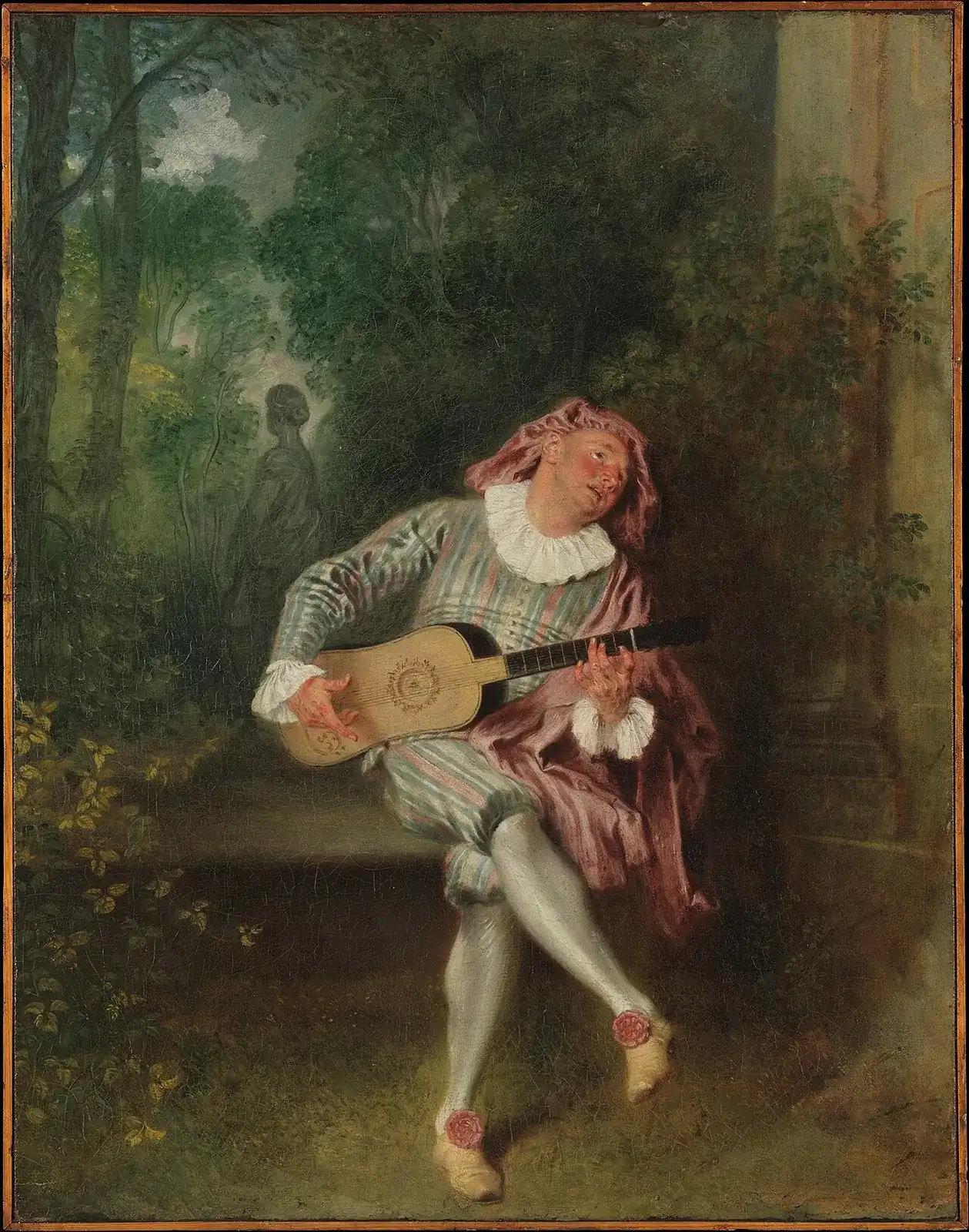
| About 1718 to 1720 | Watteau paints Mezzetin. |
| 1767 | Fragonard paints The Swing. |
| 1780s | Neoclassicism replaces Rococo in fashion. |
What is Rococo?
Rococo is the late, lighter cousin of Baroque: smaller rooms, softer colours, private subjects. Here is how it grew, and why I find it more interesting than its reputation.
Throughout this page I mark three layers. Historical What the works and the salons show. Later tradition What later critics and occultists made of the period. Modern How people use Rococo style today.
Historical Shells and curves. The name comes from rocaille, decoration of shells and rocks used in garden grottoes. Rococo rooms in Paris, Munich and Würzburg melt walls into ceilings with gilded scrolls, mirrors and painted skies. Porcelain from Meissen and Sèvres filled the cabinets.
In Würzburg, the Venetian painter Giambattista Tiepolo covered the vast staircase ceiling of the prince-bishop’s Residence in 1752 and 1753 with Apollo and allegories of the four known continents, a sky so bright and airy that the stone vault seems to vanish.
Historical Watteau and the fête galante. Antoine Watteau (1684 to 1721) invented a new kind of picture, the fête galante, with elegant couples in parkland. The Academy accepted his Pilgrimage to Cythera in 1717; whether the lovers are leaving for the island of Venus or departing from it is still debated.
Watteau also loved the Italian comedy. Mezzetin, about 1718 to 1720, shows the stock character of the lovesick servant singing in a garden, while behind him a statue of a woman turns her back. It is funny and sad at once, which is very Watteau.
Historical Boucher, Fragonard and Carriera. François Boucher painted mythological scenes and pastoral fantasies for Madame de Pompadour, mistress of Louis XV.
Jean-Honoré Fragonard’s The Swing (1767), in the Wallace Collection in London, shows a young woman flying high on a swing and kicking her slipper toward a hidden admirer. In Venice, Rosalba Carriera made pastel portraits so admired that she was elected to academies in Rome, Bologna and Paris.
Historical Chinoiserie. Rococo designers loved chinoiserie, decoration in an imagined Chinese style. It was a European fantasy of Asia built on imported porcelain, lacquer and wallpaper, and it tells us more about European desire than about China.
Historical Reason pushes back. The Enlightenment valued reason and virtue. By the 1760s the critic Denis Diderot was calling for art that would teach morality instead of flirting. That demand opened the way for Neoclassicism.
Key artists
| Artist | Lived | Why they matter |
|---|---|---|
| Antoine Watteau | 1684 to 1721 | The painter of wistful garden parties and theater players. |
| François Boucher | 1703 to 1770 | The favorite painter of Madame de Pompadour. |
| Rosalba Carriera | 1673 to 1757 | The Venetian pastel portraitist admired across Europe. |
| Jean-Honoré Fragonard | 1732 to 1806 | The painter of flirtation and quick, feathery brushwork. |
| Giovanni Battista Tiepolo | 1696 to 1770 | The painter of airy ceilings full of light. |
How do you recognise Rococo?
Look for pastel colors, curving shell forms, gilded interiors and asymmetry. Scenes are private: garden parties, love games, actors, playful gods. Pastel portraits glow softly. Porcelain, chinoiserie and decorative arts matter as much as painting.
Three common misconceptions. The first is that Rococo is simply frivolous. Watteau’s pictures are often melancholy, and Boucher’s portrait of Madame de Pompadour is full of books and letters; pleasure was treated as something worth thinking about.
The second is that Rococo and Baroque are the same thing. They share curves and drama, but Baroque wants to overwhelm you with power and faith, while Rococo wants to charm you in a drawing room. The third is that Rococo was only French. Some of its finest rooms are in Bavaria, such as the pilgrimage church of the Wies by Dominikus Zimmermann, built from 1745 to 1754, and Venice gave the style Tiepolo and Rosalba Carriera.
Esoteric themes
Historical The same salons that hung Boucher and Fragonard were full of Freemasons, mesmerists and seekers. In 1781 the scholar Antoine Court de Gébelin published, in volume 8 of Le Monde primitif, the claim that tarot cards preserved an ancient Egyptian book of wisdom.
There was no evidence for it; tarot began as a card game in fifteenth-century Italy. Soon after, a Paris card reader who called himself Etteilla published a method for reading tarot and designed decks for divination.
Later tradition The Egyptian theory shaped occult tarot for a century, through Éliphas Lévi to the Golden Dawn. I trace it in the history of tarot and tarot in art history.
Modern Rococo pastels and shell motifs are everywhere in modern witchy decor. Few people know how close that taste is to tarot’s occult birth.
Works to see
| Work | Artist | Date | Where to see it |
|---|---|---|---|
| Mezzetin | Antoine Watteau | about 1718 to 1720 | The Metropolitan Museum of Art, New York |
| The Pilgrimage to Cythera | Antoine Watteau | 1717 | Musée du Louvre, Paris |
| The Swing | Jean-Honoré Fragonard | 1767 | The Wallace Collection, London |
| Portrait of a Man in Gray | Rosalba Carriera | about 1720s | The Metropolitan Museum of Art, New York |
Every work in this list is free of nudity, so you can look them up with confidence. Works still in copyright are named but not shown here.
How to look at a Rococo painting
Start with the mood, not the story. Ask yourself whether the picture feels like a sigh, a laugh or a whisper. Then follow the lines: Rococo painters avoid straight edges and build pictures from S and C curves. Finally, look at the surface. Many Rococo painters let you see the brush, and pastel artists leave a soft, powdery bloom. Here are five works I like to practise on.
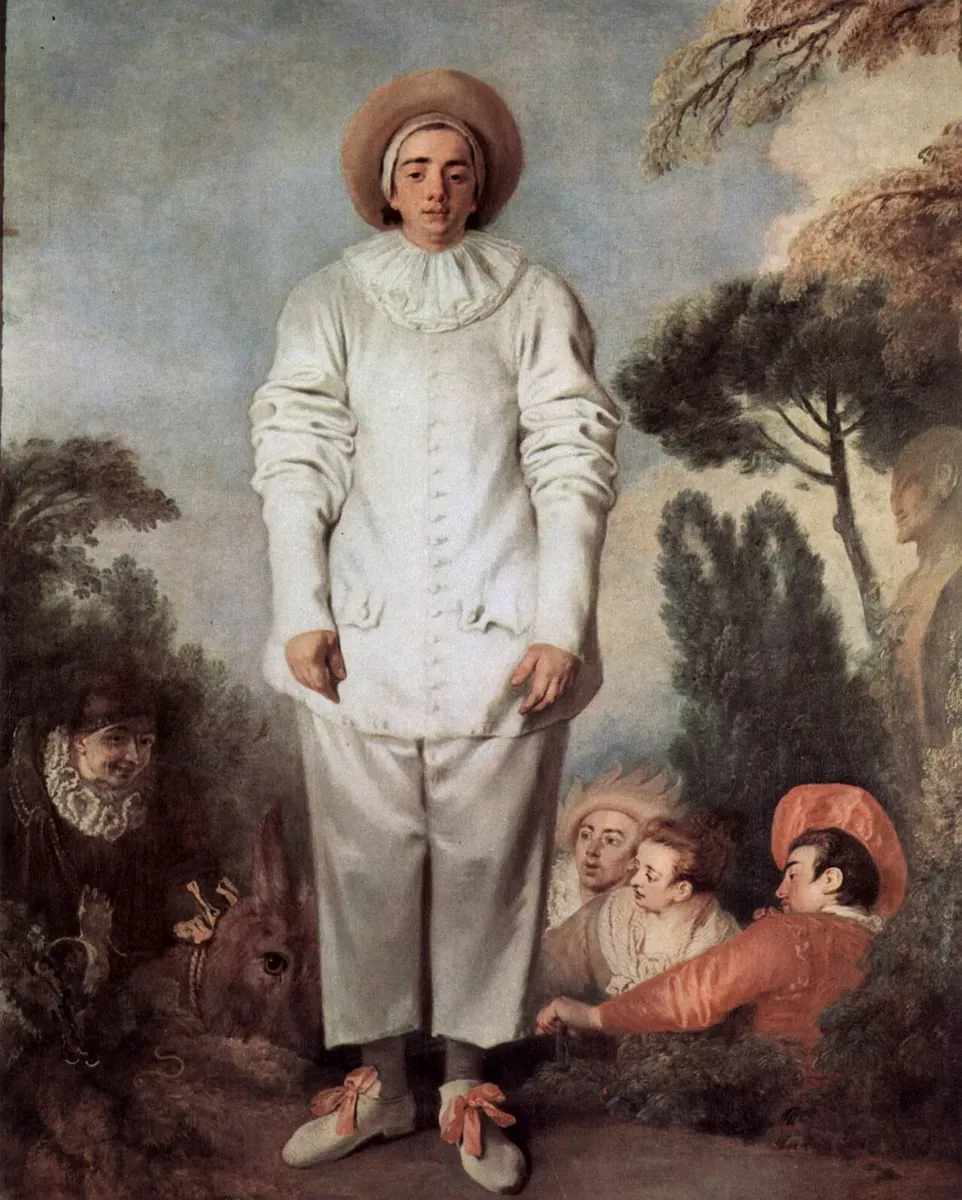
Antoine Watteau, Pierrot, formerly known as Gilles, about 1718 to 1719. Musée du Louvre, Paris. Image: Wikimedia Commons, public domain.
Watteau, Pierrot, about 1718 to 1719. A life-size actor from the Italian comedy stands in shining white satin, arms limp, looking straight at us. Behind him, his fellow actors chatter and a donkey peers out. Notice how the white costume is painted with dozens of greys, creams and pinks, and how lonely he looks in the middle of all that fun. Nobody knows for certain why it was made; one theory is that it was a sign for a theatre or café.
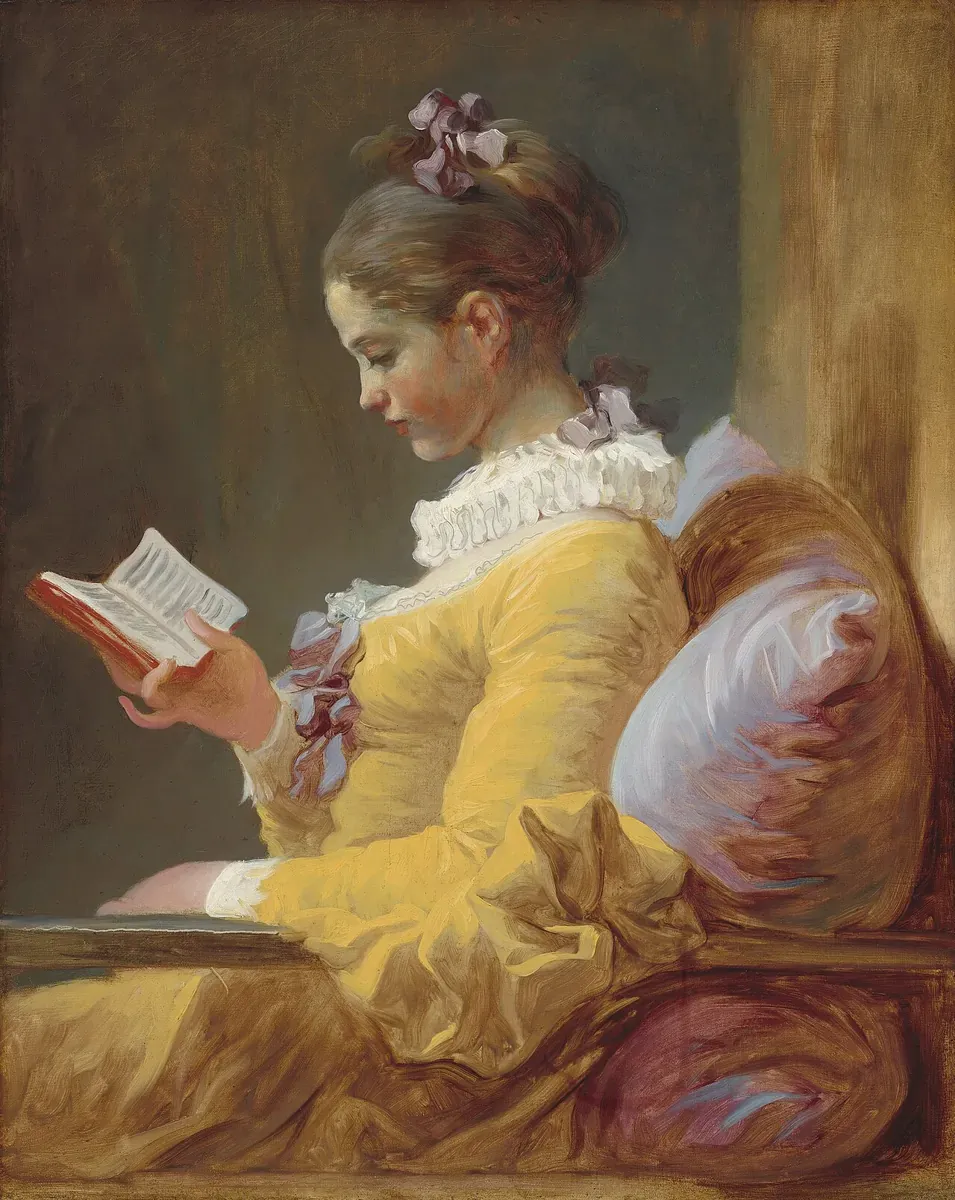
Jean-Honoré Fragonard, Young Girl Reading, about 1769. National Gallery of Art, Washington. Image: Wikimedia Commons, public domain.
Fragonard, Young Girl Reading, about 1769. A girl in lemon yellow reads, lost in her book. This is one of Fragonard’s quick “fantasy figures”. The National Gallery of Art in Washington has shown that he scratched the ruff and folds into the wet paint with the end of his brush, and that an earlier head, turned towards the viewer, lies under the one we see. Look at how the whole picture is built on one soft diagonal from the cushion to her hand.
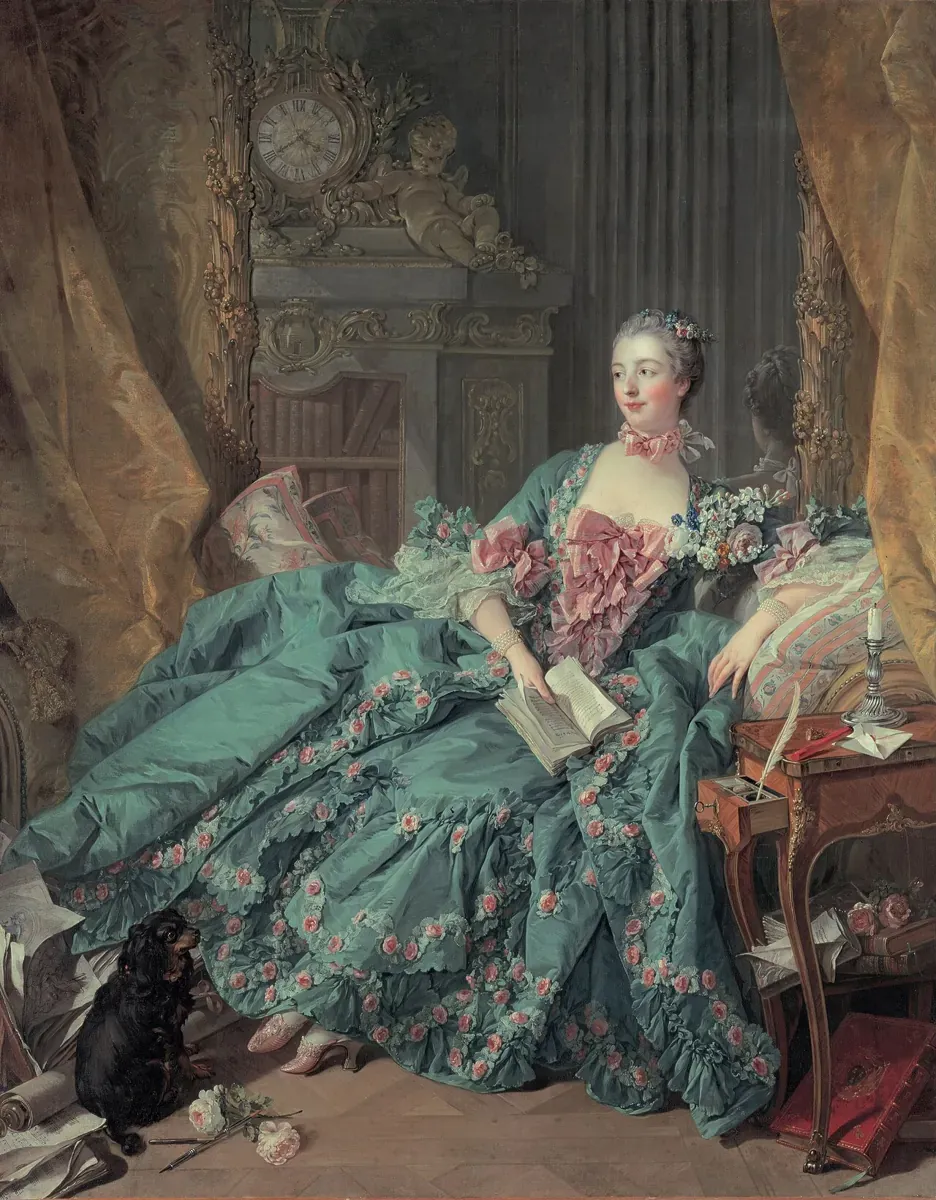
François Boucher, Madame de Pompadour, 1756. Alte Pinakothek, Munich. Image: Wikimedia Commons, public domain.
Boucher, Madame de Pompadour, 1756. Louis XV’s official mistress and Boucher’s most important patron reclines in a silk gown covered in roses. Count the clues: an open book, a letter, a quill, engravings and a bookcase reflected in the mirror. This is a portrait of a woman who wanted to be seen as a patron of learning and the arts, not only as a beauty.
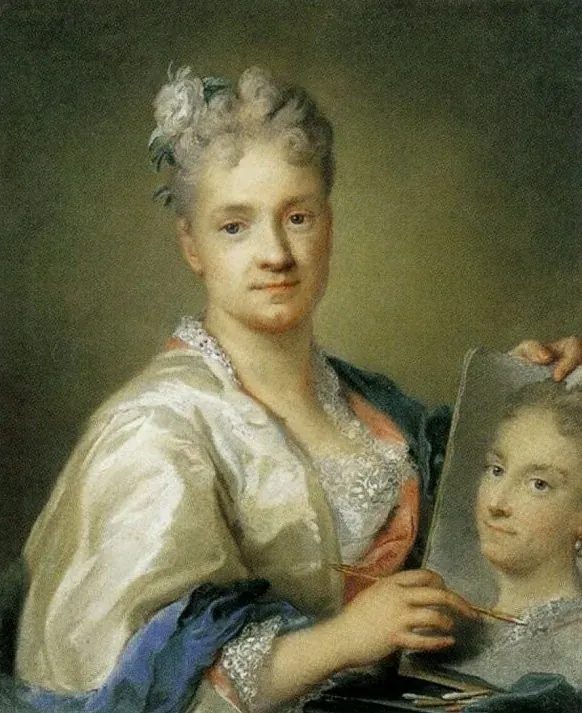
Rosalba Carriera, Self-Portrait Holding a Portrait of her Sister, 1715. Uffizi Gallery, Florence. Image: Wikimedia Commons, public domain.
Rosalba Carriera, Self-Portrait Holding a Portrait of her Sister, 1715. Carriera made pastel, chalk made of pure pigment, fashionable across Europe. This self-portrait was made for the Medici collection of artists’ self-portraits, now in the Uffizi in Florence. Look closely at the skin: the colour is rubbed and blended so softly that it seems to breathe.
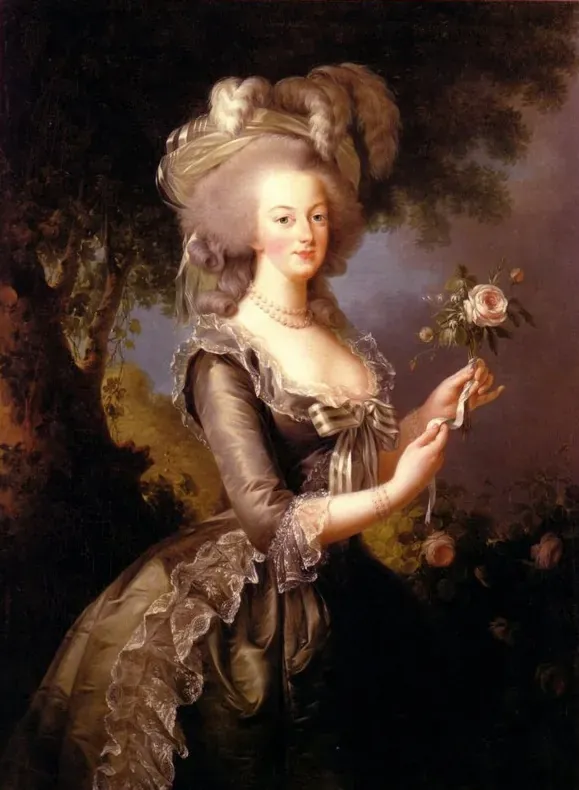
Élisabeth Vigée Le Brun, Marie Antoinette with a Rose, 1783. Palace of Versailles. Image: Wikimedia Commons, public domain.
Élisabeth Vigée Le Brun, Marie Antoinette with a Rose, 1783. At the Salon of 1783 Vigée Le Brun showed the queen in a simple white muslin dress, and the public found it shockingly informal. She quickly painted this version in silk to replace it. It is late Rococo: the pastel colours and the rose are still there, but the pose is calmer, and the age of Neoclassicism is close.
When you have looked at these, compare them with the drama of the Baroque ceilings and altarpieces that came before, and with the stern history paintings of Neoclassicism that replaced Rococo. The contrast teaches you more than any definition.
Try this
Find Fragonard’s The Swing on the Wallace Collection website. Follow the curve of the swing rope, the branches and the flying slipper with your finger. How many S and C curves can you find? Then compare them with the straight lines of a Neoclassical painting.
What next
Before this: Dutch Golden Age.
After this: Neoclassicism.
Also worth reading alongside it: Baroque.
See every movement in order on the art movements timeline, or learn to look step by step in the free Art History for Beginners course.
If you want to carry this into tarot and practice, these pages connect to it: Six of Cups, nostalgia, play and sweet memory; The Fool, the carefree performer, a little foolish and a little wise; From Rococo play to the age of reason; and The eighteenth-century salons where tarot was first called Egyptian.
Sources
- Thomas E. Crow, Painters and Public Life in Eighteenth-Century Paris (1985).
- Antoine Court de Gébelin, Le Monde primitif, volume 8 (1781).
- Ronald Decker, Thierry Depaulis and Michael Dummett, A Wicked Pack of Cards: The Origins of the Occult Tarot (1996).
- The Metropolitan Museum of Art, Mezzetin, 34.138. Open the record
- E. H. Gombrich, The Story of Art (1950).
- Wikimedia Commons, Mezzetin (hero image record). Open the record
- Melissa Hyde, Making Up the Rococo: François Boucher and His Critics (2006).

Questions
Where does the word Rococo come from?
From rocaille, a French word for decoration made of shells and rocks, used in garden grottoes. Critics later joined it with barocco to mock the style.
What is a fête galante?
A type of painting invented by Watteau: elegant people in silk enjoying music, talk and love in a park. The French Academy created the category for him in 1717.
Where can I see works of Rococo art in person?
Good places to start are Paris (the Louvre), London (the Wallace Collection), Würzburg, Munich, and the Met. Museums change their displays, so check the collection page before you travel.
How is Rococo different from Baroque?
Baroque, from about 1600, is grand and serious, made for churches and palaces with strong light and dark. Rococo, from about 1715, is lighter and more intimate, with pastel colours, curves and themes of love and leisure.
Who were the main women artists of the Rococo?
Rosalba Carriera, the Venetian pastel portraitist, and Élisabeth Vigée Le Brun, Marie Antoinette's portrait painter, are the best known. Adélaïde Labille-Guiard also became a member of the French Royal Academy in 1783.
Why did Rococo go out of fashion?
Enlightenment critics such as Denis Diderot wanted art to teach virtue. From the 1760s and 1770s, taste moved towards the clean lines and moral stories of Neoclassicism, and the French Revolution linked Rococo with the old aristocracy.
Get the free Mini-Grimoire
A short printable starter guide to tarot and everyday witchcraft, plus my newsletter. Unsubscribe any time.
Opens Substack in a new tab to confirm. More about the newsletter · Privacy