


How to read the labels Historical what the old sources say. Later tradition what later writers added. Modern modern practice and my own notes.
Neoclassicism is the European style of about 1760 to 1830 that turned back to ancient Greece and Rome for clear lines, calm compositions and moral subjects. It grew in Rome and Paris after the excavations at Herculaneum (from 1738) and Pompeii (from 1748), and its leading artists include Jacques-Louis David, Angelica Kauffman, Antonio Canova and Jean-Auguste-Dominique Ingres.
It was the first great style of an age of revolutions, American, French, Haitian and industrial. After the curls and pastels of the Rococo, it offered clear outlines and serious subjects. It also coincided with the moment when modern chemistry pushed alchemy out of the laboratory.
Key dates
| When | What happened |
|---|---|
| 1748 | Excavations begin at Pompeii. |
| 1764 | Winckelmann publishes his History of the Art of Antiquity. |
| 1784 to 1785 | David paints the Oath of the Horatii. |
| 1788 | David paints Lavoisier and his wife. |
| 1804 to 1815 | Napoleon’s empire carries the style across Europe. |
What is Neoclassicism?
Neoclassicism is art that imitates the order, clarity and virtue its makers saw in classical antiquity, in reaction against the playful Rococo.
Throughout this page I mark three layers. Historical What the works and the academies show. Later tradition How later ages used the classical ideal. Modern How we see it now.
Historical Digging up the past. Excavations at Herculaneum from 1738 and Pompeii from 1748 brought Roman houses and wall paintings back into view. Travellers on the Grand Tour carried home souvenirs.
Johann Joachim Winckelmann praised the “noble simplicity and quiet grandeur” of Greek sculpture in 1755, and his History of the Art of Antiquity (1764) made Greek art the measure of beauty. He knew it mostly through Roman copies and imagined it pure white.
Historical The academy and its rules. The French Royal Academy of Painting and Sculpture, founded in 1648, trained artists and ran the official exhibition, the Salon. Students drew from casts of ancient statues and then from the nude model, a class closed to women. In 1770 the Academy limited women members to four.
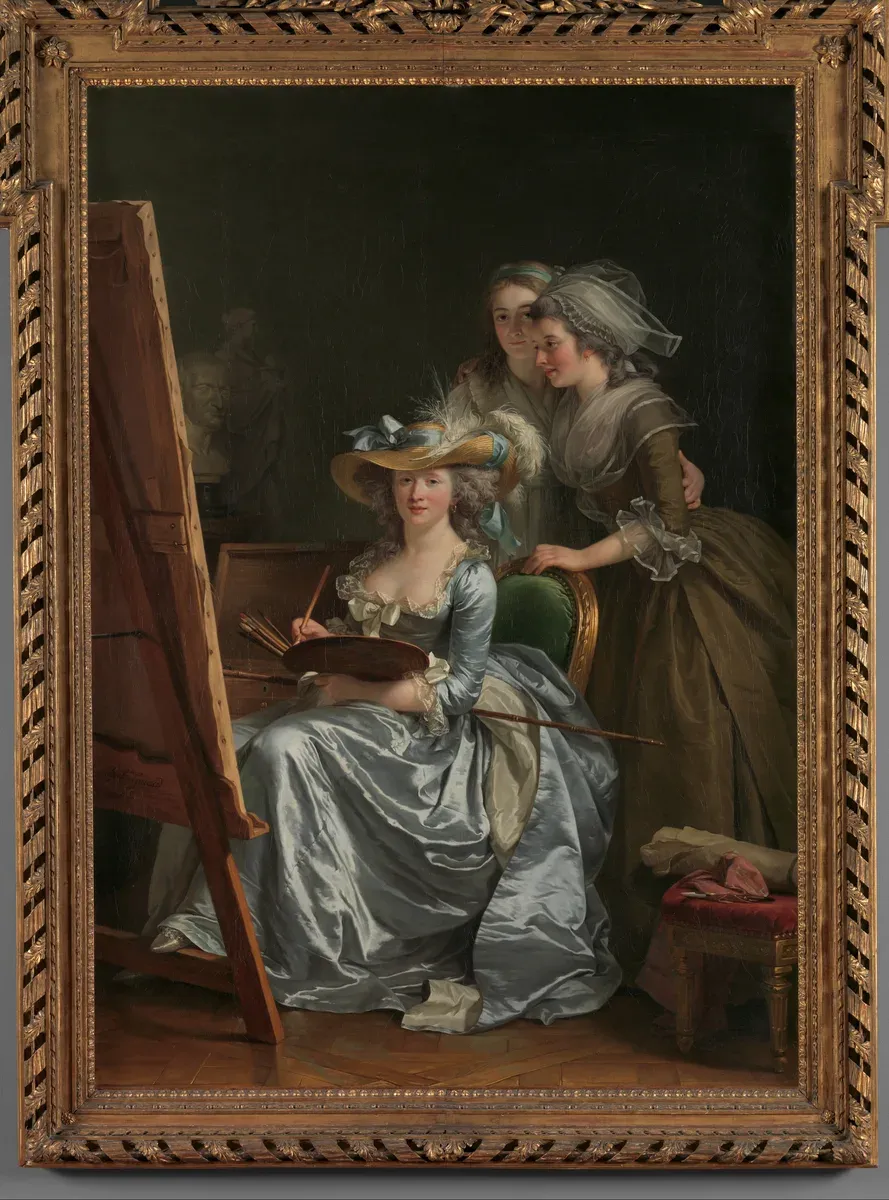
Adélaïde Labille-Guiard, Self-Portrait with Two Pupils, Marie Gabrielle Capet (1761 to 1818) and Marie Marguerite Carraux de Rosemond (1765 to 1788), 1785. The Metropolitan Museum of Art (53.225.5). Image: Open Access, public domain (CC0).
Adélaïde Labille-Guiard, one of the four, painted this large self-portrait in 1785. She sits at the easel in shimmering silk while her pupils Marie Gabrielle Capet and Marie Marguerite Carreaux de Rosemond stand behind her. It is both a display of skill and an argument: women should be allowed to train women.
Historical David. Jacques-Louis David (1748 to 1825) became the leading painter of the movement. His scenes of virtuous Romans and Greeks, with sculptural figures and stage-like settings, carried messages about duty and sacrifice.
The Met’s Death of Socrates (1787) shows the philosopher reaching for the hemlock while teaching his grieving friends. David became a revolutionary, voted for the execution of Louis XVI, painted the murdered Marat and later served Napoleon. Antonio Canova (1757 to 1822) carved marble with cool, smooth perfection.
In 1800 Marie-Guillemine Benoist showed a portrait of a Black woman, a servant in her brother-in-law’s household, at the Salon. Long given a demeaning title, it was renamed Portrait of Madeleine in 2019, after the sitter’s name was found in records.
Key artists
| Artist | Lived | Why they matter |
|---|---|---|
| Johann Joachim Winckelmann | 1717 to 1768 | The scholar who praised the “noble simplicity and calm grandeur” of Greek art. |
| Jacques-Louis David | 1748 to 1825 | The painter of the Revolution and of Napoleon. |
| Angelica Kauffman | 1741 to 1807 | A founding member of the Royal Academy in London. |
| Antonio Canova | 1757 to 1822 | The sculptor of smooth white marble. |
| Élisabeth Vigée Le Brun | 1755 to 1842 | Portraitist of Marie Antoinette. |
How do you recognise Neoclassicism?
Look for clear outlines, calm poses, shallow stage-like space and classical columns. Colors are restrained and surfaces smooth. Subjects are civic virtue, sacrifice, reason and heroes from Greece and Rome. Science and the Enlightenment are present in the furniture of the picture.
Common misconceptions. One is that ancient statues were white, so Neoclassical white marble was faithful. In fact Greek and Roman sculpture was often painted. The pure white ideal was largely a modern taste, encouraged by Johann Joachim Winckelmann, who praised the “noble simplicity and quiet grandeur” of Greek art in 1755.
Another is that the style only served the French Revolution. David painted for the king before 1789, for the Revolution and then for Napoleon, and Neoclassicism shaped buildings from St Petersburg to Washington. A third is that women stayed on the margins. Angelica Kauffman and Mary Moser were founding members of the Royal Academy in London in 1768, and Adélaïde Labille-Guiard and Élisabeth Vigée Le Brun were admitted to the French Royal Academy in 1783.
Esoteric themes
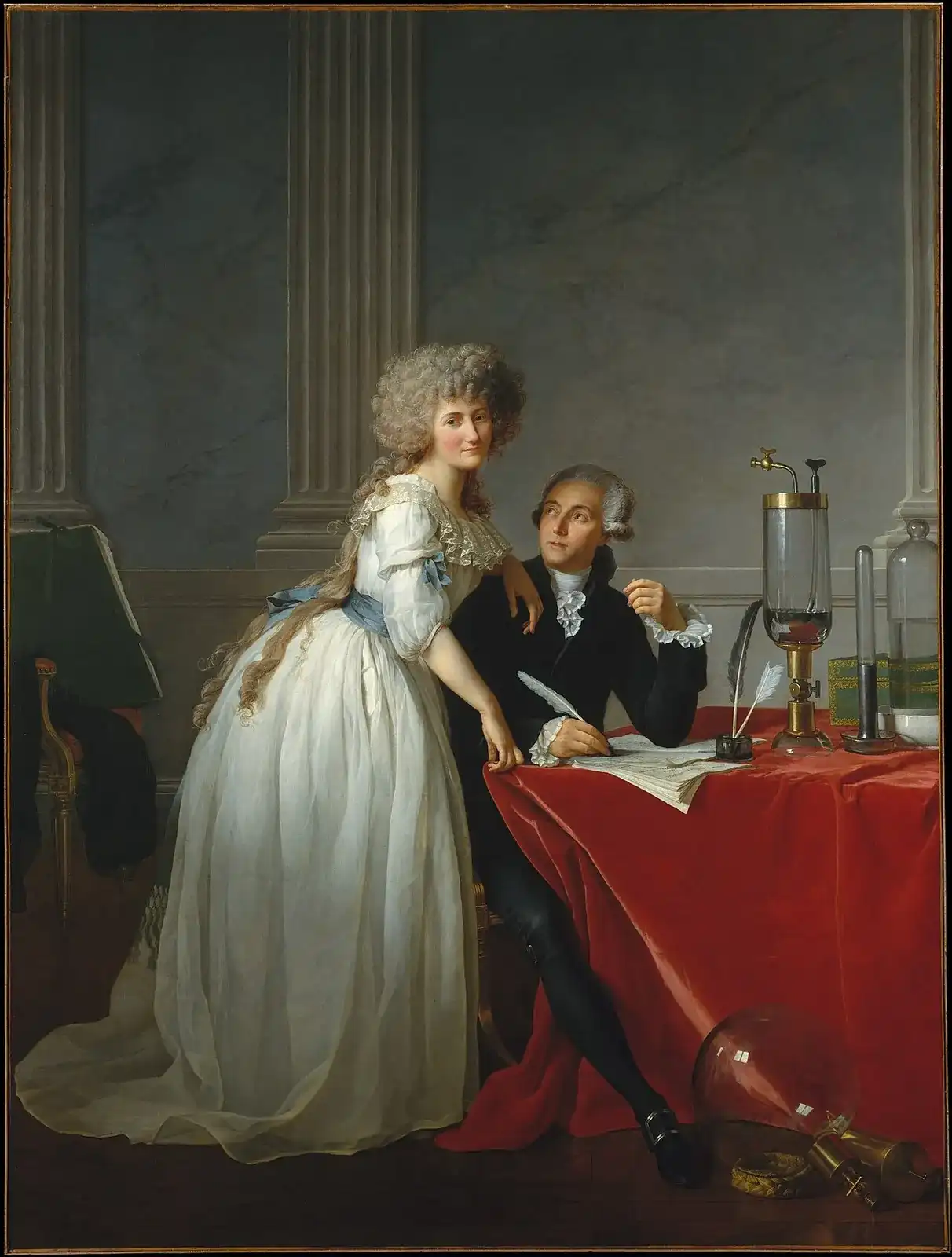
Historical In 1788 David painted the chemist Antoine Lavoisier and his wife Marie-Anne Paulze Lavoisier. Glass flasks and other instruments stand on the table. Marie-Anne had studied drawing with David, and she drew the plates of laboratory equipment for her husband’s Traité élémentaire de chimie (1789).
That book set out a new list of chemical elements and the principle that matter is conserved in reactions. It closed the long era in which alchemy and chemistry were one science. Lavoisier, also a tax farmer, was guillotined in 1794.
Later tradition Alchemy did not disappear. It moved from the furnace to the soul, and nineteenth-century occultists reread it as spiritual transformation.
Modern Many witches today use alchemical symbols for inner work. That is a later reading, and a fruitful one.
Works to see
| Work | Artist | Date | Where to see it |
|---|---|---|---|
| Antoine-Laurent Lavoisier and His Wife | Jacques-Louis David | 1788 | The Metropolitan Museum of Art, New York |
| The Death of Socrates | Jacques-Louis David | 1787 | The Metropolitan Museum of Art, New York |
| Self-Portrait with Two Pupils | Adélaïde Labille-Guiard | 1785 | The Metropolitan Museum of Art, New York |
| Oath of the Horatii | Jacques-Louis David | 1784 | Musée du Louvre, Paris |
Every work in this list is free of nudity, so you can look them up with confidence. Works still in copyright are named but not shown here.
How to look at a Neoclassical painting
Look for the stage. Figures often stand in a shallow space, like a frieze, in front of columns or plain walls. Then read the gestures, which are clear and meant to teach a lesson: duty, sacrifice, love of country.
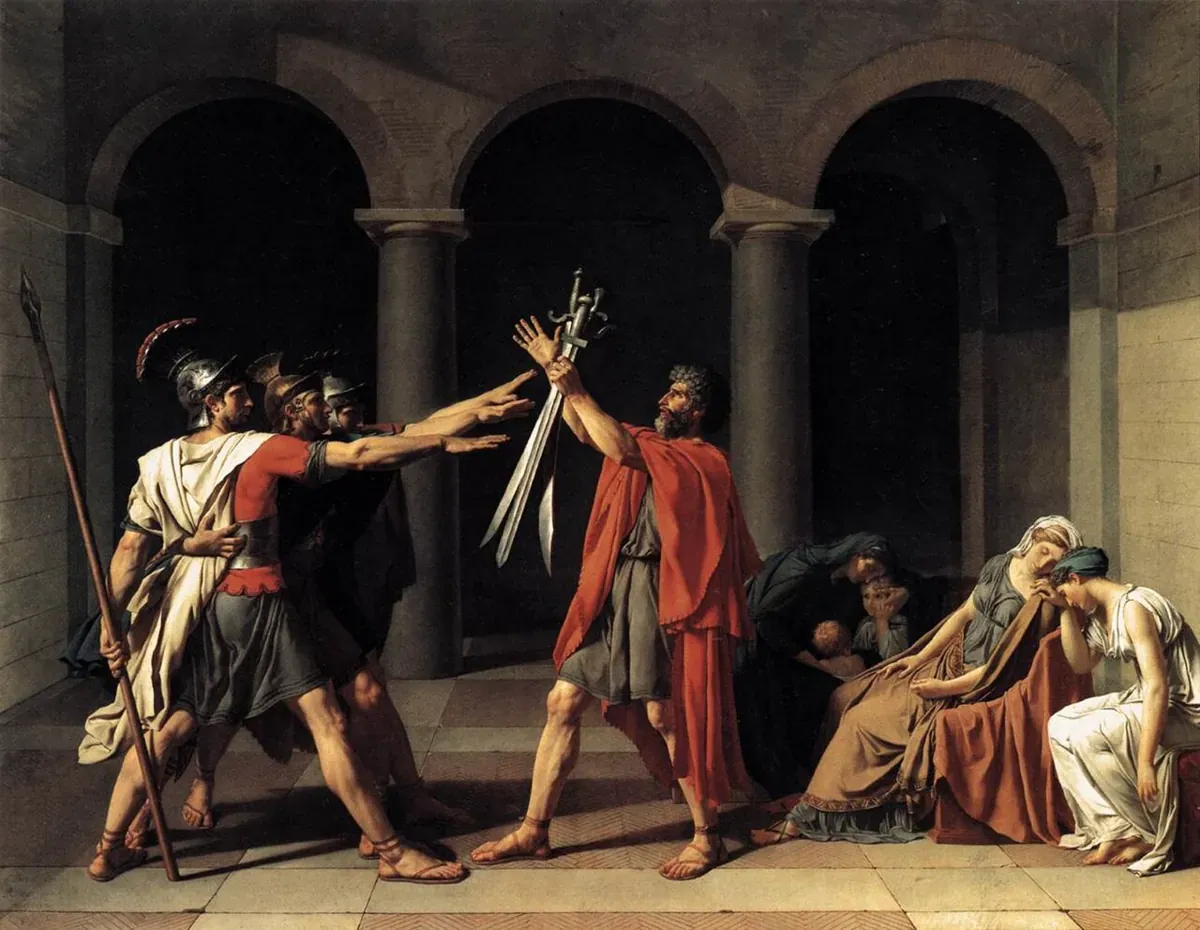
Jacques-Louis David, Oath of the Horatii, 1784. Musée du Louvre, Paris. Image: Wikimedia Commons, public domain.
Jacques-Louis David, The Oath of the Horatii, 1784. At the Louvre. Painted in Rome and shown at the Paris Salon of 1785. Count in threes: three arches, three brothers, three groups. The men are all straight lines; the grieving women at the right are all curves.
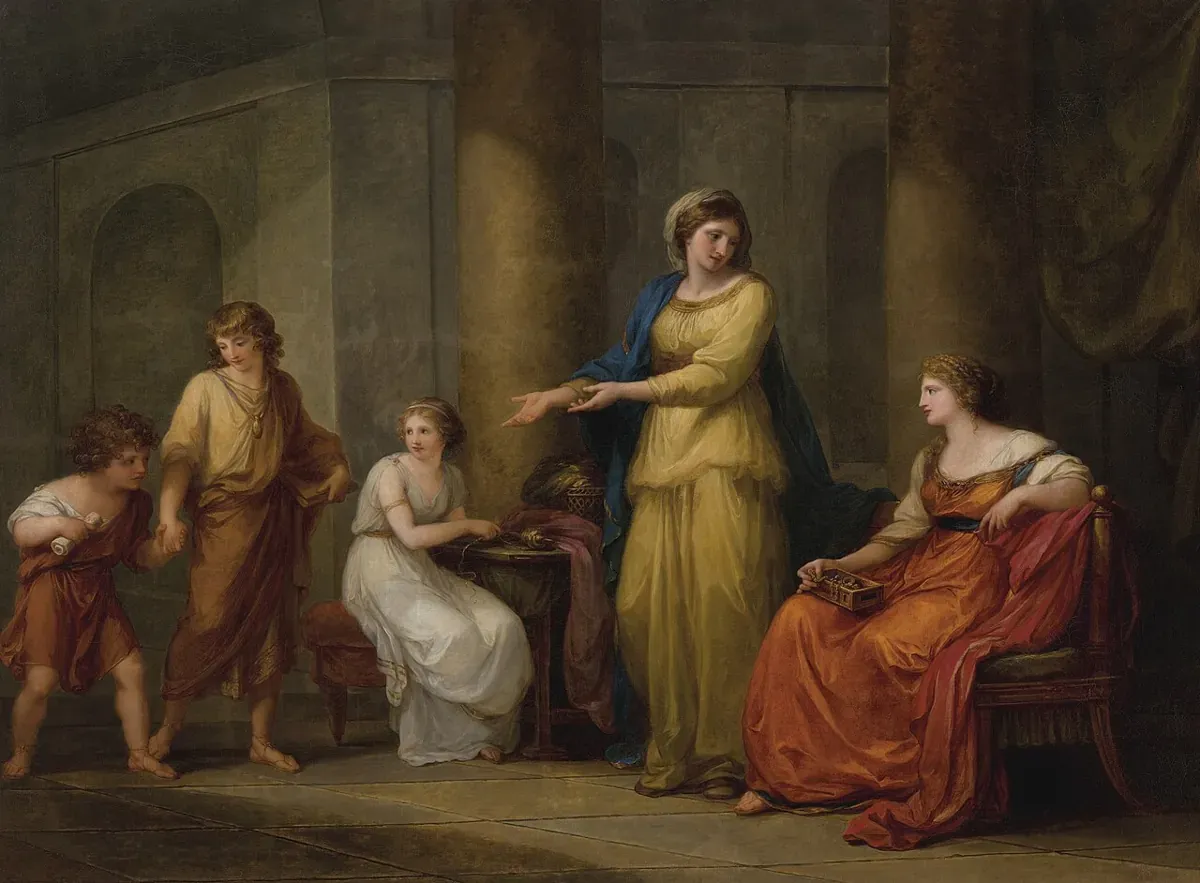
Angelica Kauffman, Cornelia, Mother of the Gracchi, 1788. Royal Castle, Warsaw. Image: Wikimedia Commons, public domain.
Angelica Kauffman, Cornelia, Mother of the Gracchi, Pointing to her Children as her Treasures. A visitor shows off her jewels; Cornelia answers that her children are her jewels. Kauffman often chose heroines and moral choices from ancient history.
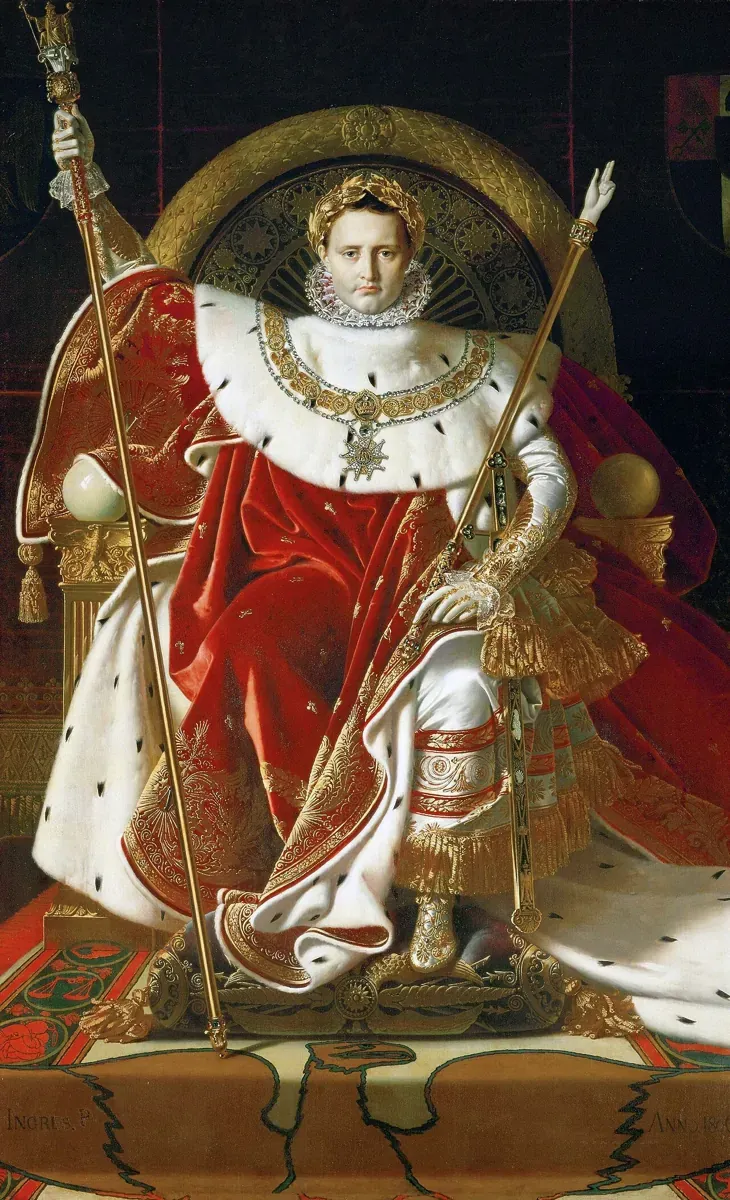
Jean-Auguste-Dominique Ingres, Napoleon I on his Imperial Throne, 1806. Musée de l’Armée, Paris. Image: Wikimedia Commons, public domain.
Jean-Auguste-Dominique Ingres, Napoleon I on his Imperial Throne, 1806. At the Musée de l’Armée in Paris. Napoleon appears like Jupiter or a Byzantine icon. Look at the polished, almost invisible brushwork that Ingres prized.
Neoclassicism reacted against the Rococo, looked back to ancient Greek and ancient Roman art and the High Renaissance of Raphael, and was in turn challenged by Romanticism.
Try this
Put David’s Death of Socrates (Met 31.45) beside Turner’s Whalers (Met 96.29). For each, describe the edges of forms, the color, the composition and the role of the human figure. Then write one sentence on what each painting asks of you.
What next
Before this: Rococo.
After this: Romanticism.
See every movement in order on the art movements timeline, or learn to look step by step in the free Art History for Beginners course.
If you want to carry this into tarot and practice, these pages connect to it: Justice, reason, law and the clear scales of the Enlightenment; The Emperor, order and the classical state; How chemistry grew out of alchemy, the world of Lavoisier; and Reason against feeling.
Sources
- Johann Joachim Winckelmann, Thoughts on the Imitation of Greek Works in Painting and Sculpture (1755).
- The Metropolitan Museum of Art, Antoine Laurent Lavoisier and Marie Anne Lavoisier, 1977.10. Open the record
- The Metropolitan Museum of Art, Self-Portrait with Two Pupils, 53.225.5. Open the record
- Antoine Lavoisier, Traité élémentaire de chimie (1789).
- E. H. Gombrich, The Story of Art (1950).
- Wikimedia Commons, Antoine-Laurent Lavoisier and His Wife (hero image record). Open the record
- Hugh Honour, Neo-classicism (1968).

Questions
What is the hierarchy of genres?
The ranking of subjects taught by the French Academy, set out by André Félibien in 1667: history painting at the top, then portraits, scenes of daily life, landscapes and, at the bottom, still lifes.
Were ancient statues really white?
No. Most ancient sculpture was painted. Winckelmann and his followers knew it mostly through weathered Roman copies and imagined pure white marble, an idea that shaped taste for two centuries.
Where can I see works of Neoclassicism in person?
Good places to start are Paris (the Louvre), Rome, Possagno (Canova's museum), and the Met. Museums change their displays, so check the collection page before you travel.
Who are the main Neoclassical artists?
Jacques-Louis David, Angelica Kauffman, Antonio Canova, Jean-Auguste-Dominique Ingres, Anton Raphael Mengs, Bertel Thorvaldsen, Jean-Antoine Houdon and Adélaïde Labille-Guiard.
What is the difference between Neoclassicism and Romanticism?
Neoclassicism values reason, line, balance and public virtue. Romanticism values feeling, colour, nature and the individual imagination. They overlapped in time, around 1800 to 1830.
Where can I see Neoclassical art?
The Louvre in Paris for David and Ingres, the Galleria Borghese in Rome for Canova's sculpture, the Thorvaldsen Museum in Copenhagen, and the Royal Academy and National Gallery in London for Angelica Kauffman.
Get the free Mini-Grimoire
A short printable starter guide to tarot and everyday witchcraft, plus my newsletter. Unsubscribe any time.
Opens Substack in a new tab to confirm. More about the newsletter · Privacy