


How to read the labels Historical what the old sources say. Later tradition what later writers added. Modern modern practice and my own notes.
Dutch Golden Age painting is the art of the Dutch Republic in the 17th century, roughly 1600 to 1700, a time when the young Protestant nation became Europe’s richest trading power. Painters in Amsterdam, Haarlem, Delft, Leiden and Utrecht sold portraits, landscapes, still lifes and everyday scenes to merchants and townspeople on an open market. Its leading names include Rembrandt van Rijn, Johannes Vermeer, Frans Hals, Judith Leyster and Rachel Ruysch.
Many of these pictures are quiet: a kitchen, a canal, a vase of flowers, a face. I find that quiet as powerful as any Baroque altarpiece.
Key dates
| When | What happened |
|---|---|
| 1588 | The Dutch Republic is founded. |
| 1609 | The Twelve Years’ Truce with Spain begins and trade booms. |
| 1642 | Rembrandt paints The Night Watch. |
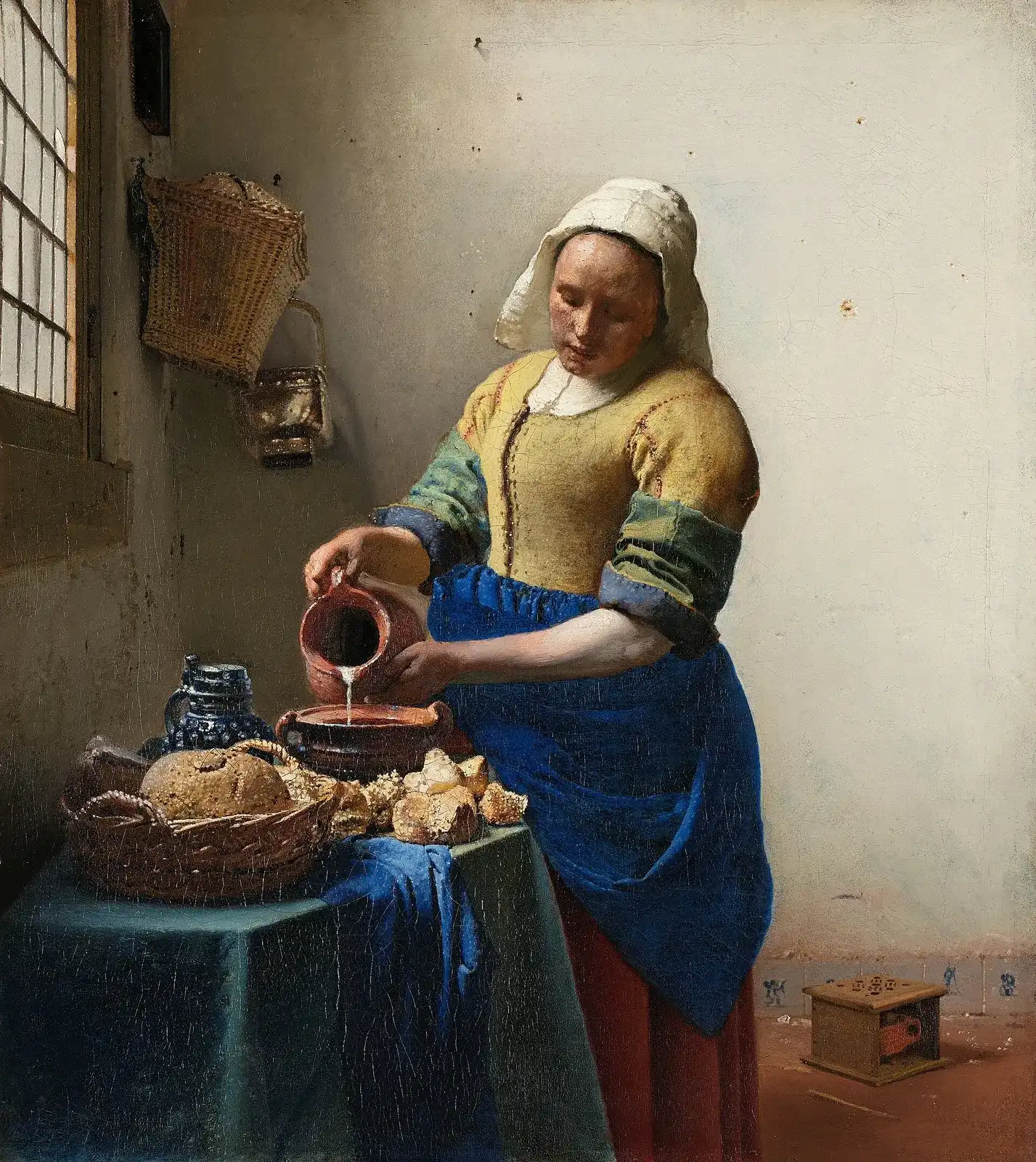
| About 1660 | Vermeer paints The Milkmaid. |
| 1672 | The “disaster year”: war collapses the art market. |
What is Dutch Golden Age painting?
Dutch Golden Age painting is the realistic, detailed and often small-scale painting of the 17th-century Netherlands, made largely for private homes rather than churches or courts.
Throughout this page I mark three layers. Historical What the works and the documents show. Later tradition Myths that grew around the artists. Modern How we use the images today.
Historical An open market. Dutch Calvinist churches did not commission religious images. Instead a broad public of merchants, artisans and professionals bought paintings for their homes. An open market developed, and painters specialized in landscapes, seascapes, still lifes, portraits, church interiors and scenes of daily life, called genre painting.
The money came in large part from the Dutch East India Company and West India Company, which were involved in colonial violence and the Atlantic slave trade. The Rijksmuseum’s 2021 exhibition Slavery looked at this history directly, and I think every lover of these paintings should know it.
Rembrandt. 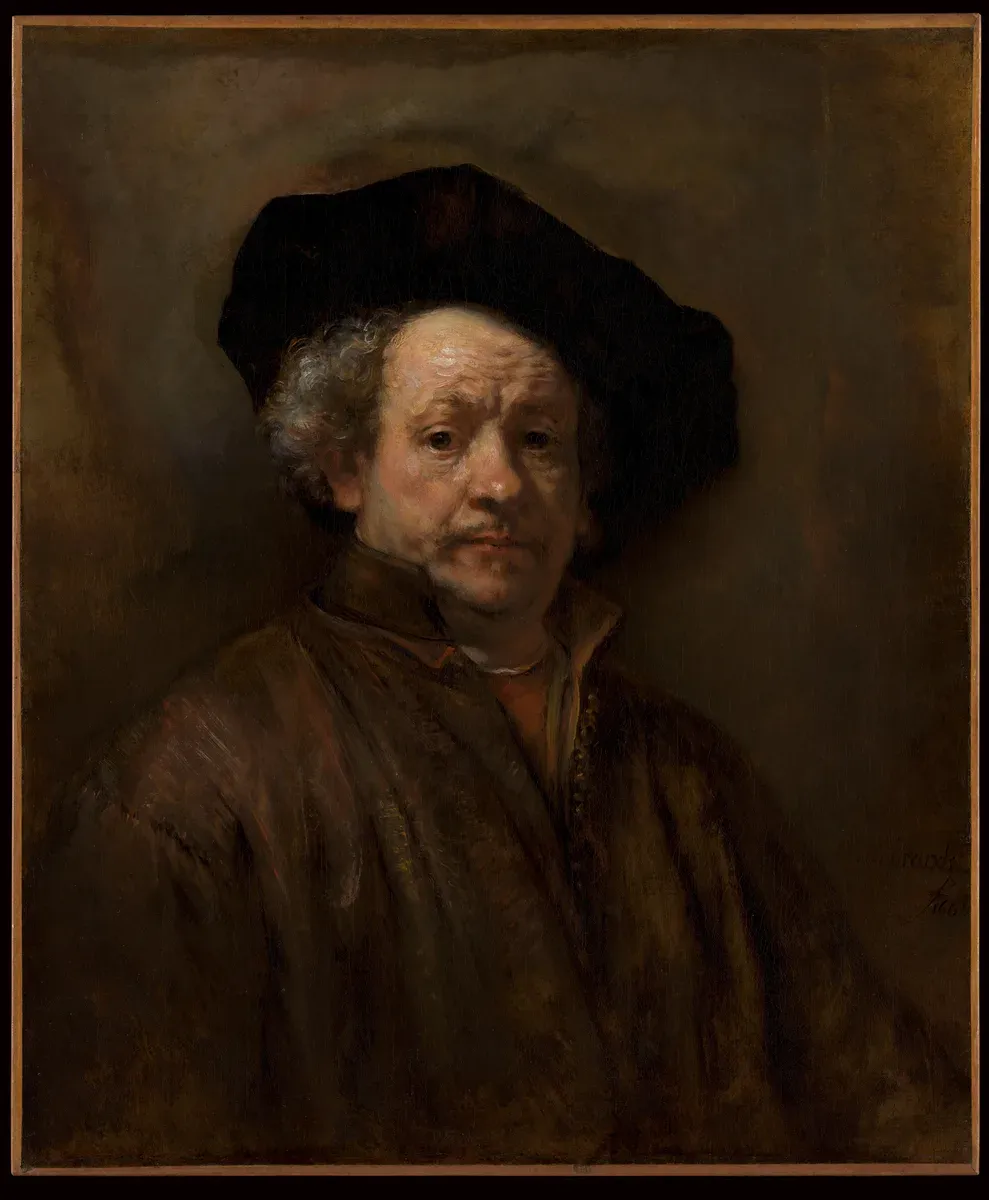
Rembrandt, Self-Portrait, 1660. The Metropolitan Museum of Art (14.40.618). Image: Open Access, public domain (CC0).
Historical Rembrandt van Rijn (1606 to 1669) worked in Amsterdam. The Night Watch (1642), in the Rijksmuseum, turned a militia group portrait into a scene of movement, light and shadow, and since 2019 it has been studied and conserved in public view in Operation Night Watch.
Rembrandt painted and drew himself all his life. In this self-portrait of 1660 his face is shown with unsparing directness. He went bankrupt in 1656, but the idea that he died forgotten is false; he kept receiving commissions.
Historical Vermeer and the window light. Johannes Vermeer of Delft (1632 to 1675) left only about thirty-five paintings, mostly women in quiet rooms lit from a window on the left.
In the Met’s Young Woman with a Water Pitcher, about 1662, light passes through the leaded glass onto a white headcloth, a blue cloth and a silver basin. Some researchers think he used a camera obscura, an optical box that projects an image; others disagree, and it remains a hypothesis.
Leyster and Ruysch. 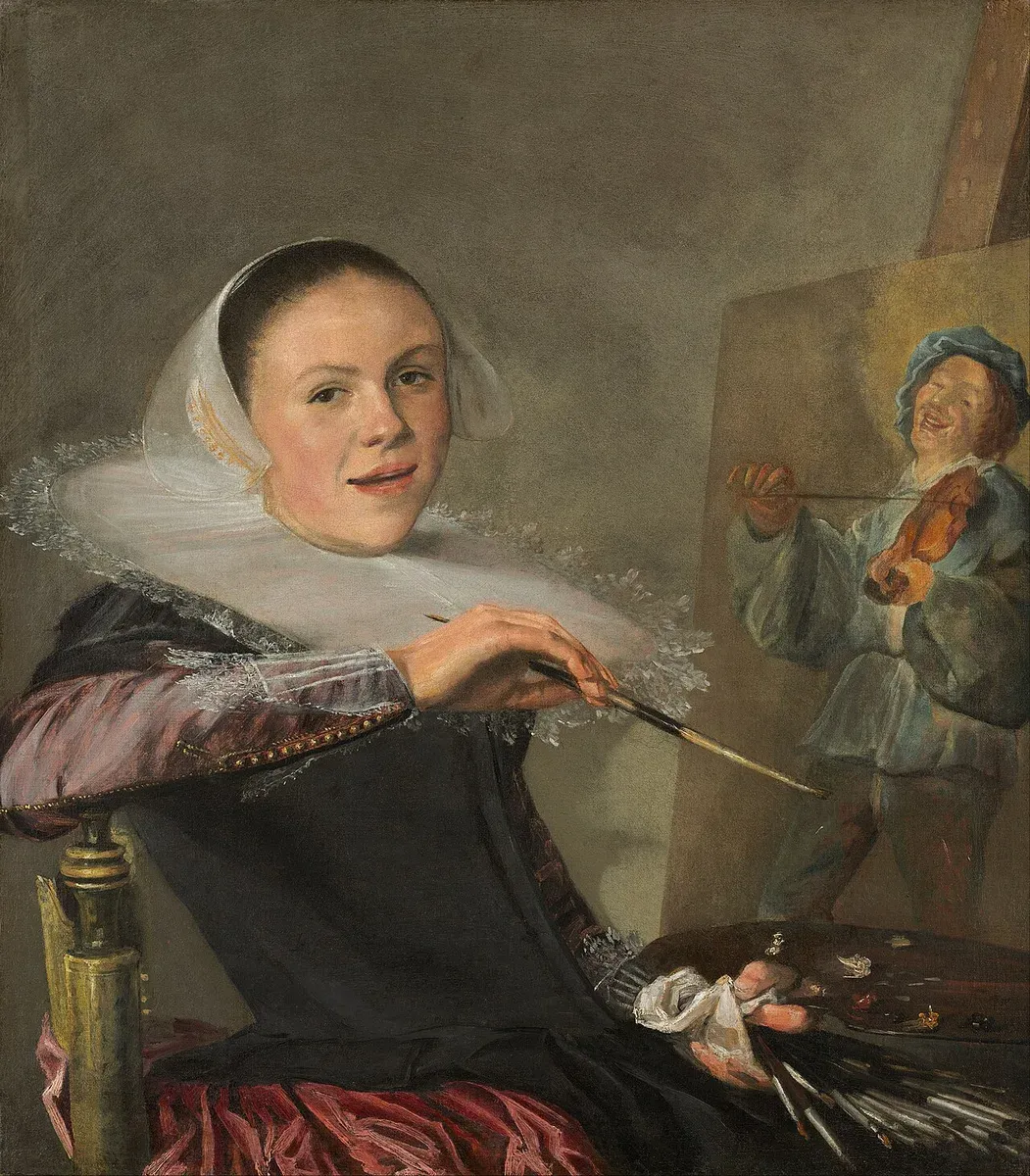
Judith Leyster, Self-Portrait, about 1630. National Gallery of Art, Washington, image via Google Arts and Culture. Image: Wikimedia Commons, public domain.
Historical Judith Leyster (1609 to 1660) became a master in the Haarlem painters’ guild and painted lively musicians and genre scenes. In her self-portrait of about 1630, now in Washington, she turns from the easel as if we just walked in.
Rachel Ruysch (1664 to 1750) became one of the most successful flower painters of her age. In 1710 a Leiden collector paid 1,300 guilders for a pair of her flower pieces.
Key artists
| Artist | Lived | Why they matter |
|---|---|---|
| Rembrandt van Rijn | 1606 to 1669 | The painter of light, age and inner life. |
| Johannes Vermeer | 1632 to 1675 | The painter of quiet rooms lit by a window. |
| Frans Hals | about 1582 to 1666 | The portraitist of quick, laughing brushwork. |
| Judith Leyster | 1609 to 1660 | A member of the Haarlem painters’ guild with her own workshop. |
| Rachel Ruysch | 1664 to 1750 | The flower painter whose bouquets fetched top prices. |
How do you recognise Dutch Golden Age painting?
Look for ordinary life: kitchens, taverns, streets, flowers and cheese. Paintings are small and made for homes, sold on an open market. Light falls through windows. Still lifes hide reminders of death and vanity, a skull, a guttering candle, a fly on the fruit.
Common misconceptions. One is that all these paintings are simple records of daily life. Many genre scenes and still lifes carry moral messages: an oyster, a lute or a burning candle could hint at temptation, love or the shortness of life.
Another is that the Golden Age was only Rembrandt and Vermeer. There were hundreds of painters, and Vermeer was not famous until the French critic Théophile Thoré-Bürger rediscovered him in the 1860s. A third is that women were rare. Judith Leyster joined the Haarlem painters’ guild in 1633, and Rachel Ruysch’s flower pieces sold for higher prices in her lifetime than most paintings by Rembrandt.
Esoteric themes
Historical Many Dutch still lifes are vanitas pictures, from the Latin for emptiness. Skulls, burnt-down candles, hourglasses, wilting flowers and soap bubbles remind the viewer that life is short.
We know this meaning because emblem books of the time spell it out, such as Cesare Ripa’s Iconologia (1593, illustrated 1603) and Roemer Visscher’s emblems (1614). Dutch and Flemish painters also made a whole genre of alchemists at work in cluttered rooms, often mocking them as fools who wasted their families’ money.
Later tradition The story of tulip mania in 1636 to 1637, when bulbs supposedly sold for the price of houses, is told everywhere. The historian Anne Goldgar has argued that its extent and damage were greatly exaggerated.
Modern Today many people build memento mori altars or meditations from vanitas imagery. That is a modern use of a historical symbol, and a beautiful one.
Works to see
| Work | Artist | Date | Where to see it |
|---|---|---|---|
| The Milkmaid | Johannes Vermeer | about 1660 | Rijksmuseum, Amsterdam |
| Young Woman with a Water Pitcher | Johannes Vermeer | about 1662 | The Metropolitan Museum of Art, New York |
| Self-Portrait | Rembrandt van Rijn | 1660 | The Metropolitan Museum of Art, New York |
| Flowers in a Glass Vase | Rachel Ruysch | 1704 | Detroit Institute of Arts |
Every work in this list is free of nudity, so you can look them up with confidence. Works still in copyright are named but not shown here.
How to look at a Dutch Golden Age painting
Get close and look at the surfaces: bread, brass, lace, glass, petals. Dutch painters competed to make materials feel touchable. Then step back and ask what is hidden in plain sight: a skull, a letter, a clock, a fly on a flower.
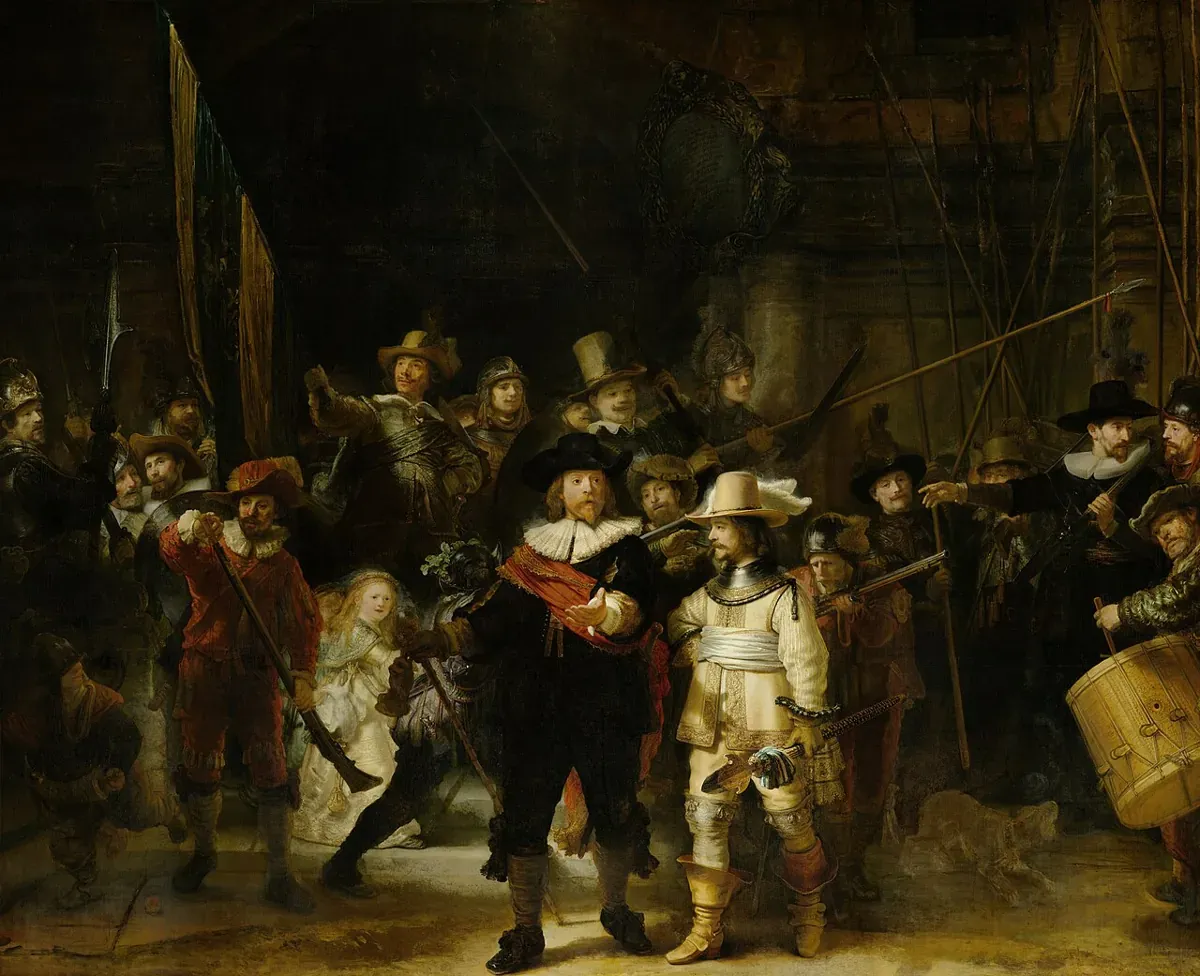
Rembrandt van Rijn, The Night Watch, 1642. Rijksmuseum, Amsterdam. Image: Wikimedia Commons, public domain.
Rembrandt van Rijn, The Night Watch, 1642. At the Rijksmuseum in Amsterdam. It is really a group portrait of a civic militia company, and it is not set at night; old varnish darkened it. Instead of lining the men up, Rembrandt shows them starting to march. Find the glowing girl with a chicken hanging from her belt, an emblem of the company.
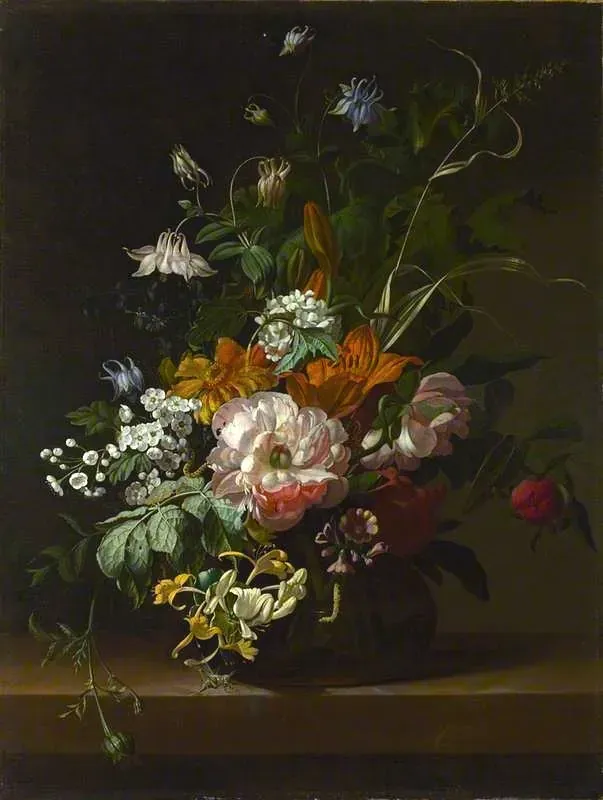
Rachel Ruysch, Flowers in a Vase, about 1685. National Gallery, London. Image: Wikimedia Commons, public domain.
Rachel Ruysch, Flowers in a Vase, about 1685. At the National Gallery in London. Ruysch’s bouquets mix flowers that bloom in different seasons, so they could never have stood together. Look for the insects, and for the S-shaped curve the whole arrangement follows. Ruysch painted for about seventy years and became court painter in Düsseldorf.
Dutch painting is the Protestant cousin of the Baroque, grew from the detail of the Northern Renaissance, and influenced the Realism of the 19th century and the Impressionists who admired Hals’s quick brushwork.
Try this
Place Vermeer’s Young Woman with a Water Pitcher beside Caravaggio’s The Musicians (Met 52.81) on your screen. Write five words for the mood of each. Then list the choices behind the mood: light, color, gesture, space. Both are called Baroque. What separates them?
What next
Before this: Baroque.
After this: Rococo.
Also worth reading alongside it: Northern Renaissance.
See every movement in order on the art movements timeline, or learn to look step by step in the free Art History for Beginners course.
If you want to carry this into tarot and practice, these pages connect to it: Nine of Pentacles, quiet abundance, a home and garden earned by work; Death, the vanitas still life and its gentle reminders that everything ends; The still life as a meditation on time; and Hearth and household as places of practice.
Sources
- Philip Steadman, Vermeer’s Camera: Uncovering the Truth behind the Masterpieces (2001).
- Anne Goldgar, Tulipmania: Money, Honor, and Knowledge in the Dutch Golden Age (2007).
- Cesare Ripa, Iconologia (1593).
- The Metropolitan Museum of Art, Young Woman with a Water Pitcher, 89.15.21. Open the record
- The Metropolitan Museum of Art, Self-Portrait, 14.40.618. Open the record
- E. H. Gombrich, The Story of Art (1950).
- Wikimedia Commons, The Milkmaid (hero image record). Open the record
- Seymour Slive, Dutch Painting 1600 to 1800 (1995).

Questions
What is a vanitas painting?
A still life with reminders that life is short: skulls, guttering candles, hourglasses, wilting flowers, soap bubbles. The name comes from the Latin for emptiness, as in vanity of vanities.
Did Vermeer use a camera obscura?
Some researchers, including Philip Steadman, argue that he used one to help compose his pictures. Others disagree. It remains a hypothesis.
Where can I see works of Dutch Golden Age painting in person?
Good places to start are Amsterdam (the Rijksmuseum), The Hague (the Mauritshuis), Haarlem, the Met, and London. Museums change their displays, so check the collection page before you travel.
What is a genre painting?
A genre painting shows everyday life: people cooking, drinking, playing music or reading letters. Dutch painters such as Vermeer, Jan Steen, Pieter de Hooch and Gerard ter Borch made the type famous.
Why was there so much art in the Dutch Republic?
Trade wealth spread widely, the Protestant churches did not commission religious images, and a large middle class bought paintings for their homes from an open market.
Get the free Mini-Grimoire
A short printable starter guide to tarot and everyday witchcraft, plus my newsletter. Unsubscribe any time.
Opens Substack in a new tab to confirm. More about the newsletter · Privacy