


Between 1600 and the mid-1800s, European art swung from blazing religious drama to quiet Dutch kitchens, from pastel garden parties to moonlit ruins and nightmares. For anyone interested in witches and the occult, this stretch matters because it is when witches, demons and the night came back into painting, sometimes as satire and sometimes as a new kind of beauty. In this lesson you will follow that journey and learn to read each style by asking what its makers wanted it to do to the viewer.
Baroque: art that wants to move you
Historical After the Protestant Reformation, some reformers smashed or whitewashed church images. The Catholic Church answered at the Council of Trent, which in December 1563 defended sacred images as ways to teach and to stir devotion. Baroque art, in the 1600s, took that task and made it theatrical: strong light out of darkness, bodies in motion, faces caught at the moment of crisis.
Caravaggio lit his figures as if by a single lamp. Artemisia Gentileschi, one of the most powerful painters of the age, became in 1616 one of the first women admitted to the academy of artists in Florence, and she painted strong women from the Bible again and again, such as Esther fainting before the king, now at the Met. In Spain, Diego Velázquez painted his assistant Juan de Pareja in 1650 with the dignity of a gentleman; that same year he signed a document freeing him.
The Dutch: daily life for sale
Historical In the Dutch Republic, mostly Calvinist churches did not buy religious pictures. Instead, merchants, artisans and professionals bought paintings for their homes, and painters specialized in landscapes, still lifes, portraits and scenes of daily life. Rembrandt painted himself throughout his life, Vermeer painted quiet rooms filled with window light, and Judith Leyster painted herself at the easel, smiling.
Vanitas: the skull on the table
Historical A special kind of Dutch still life, the vanitas, takes its name from Ecclesiastes 1:2, “vanity of vanities; all is vanity” in the King James Version. These paintings set a skull, an hourglass, a guttering candle, wilting flowers, books or musical instruments on a table, as reminders that life is short and earthly things pass. Many modern altars use the same objects, which shows how long these symbols have lasted.
Witches in Baroque painting
Historical Witches appeared in seventeenth-century painting too. The Neapolitan painter Salvator Rosa made Witches at their Incantations around 1646, now in the National Gallery in London, a dark, crowded scene of spells, skeletons and a hanged man. In Flanders, David Teniers the Younger painted many small witch scenes for collectors. Like the prints of the previous century, they mixed fear, fascination and entertainment.
Rococo and the turn to reason
Historical In early eighteenth-century France, taste moved from the grandeur of Versailles to intimate townhouses. Rococo loved pastel colors, curving lines, shells and lovers in parks; Antoine Watteau’s Mezzetin, at the Met, sings his serenade in a garden. Then the Enlightenment called for art that taught virtue. Neoclassicism looked back to Greece and Rome for clear lines and moral lessons, as in Jacques-Louis David’s work. Adélaïde Labille-Guiard, one of only four women then allowed in the French academy, painted herself with two of her pupils in 1785.
Romanticism: feeling, the sublime and the night
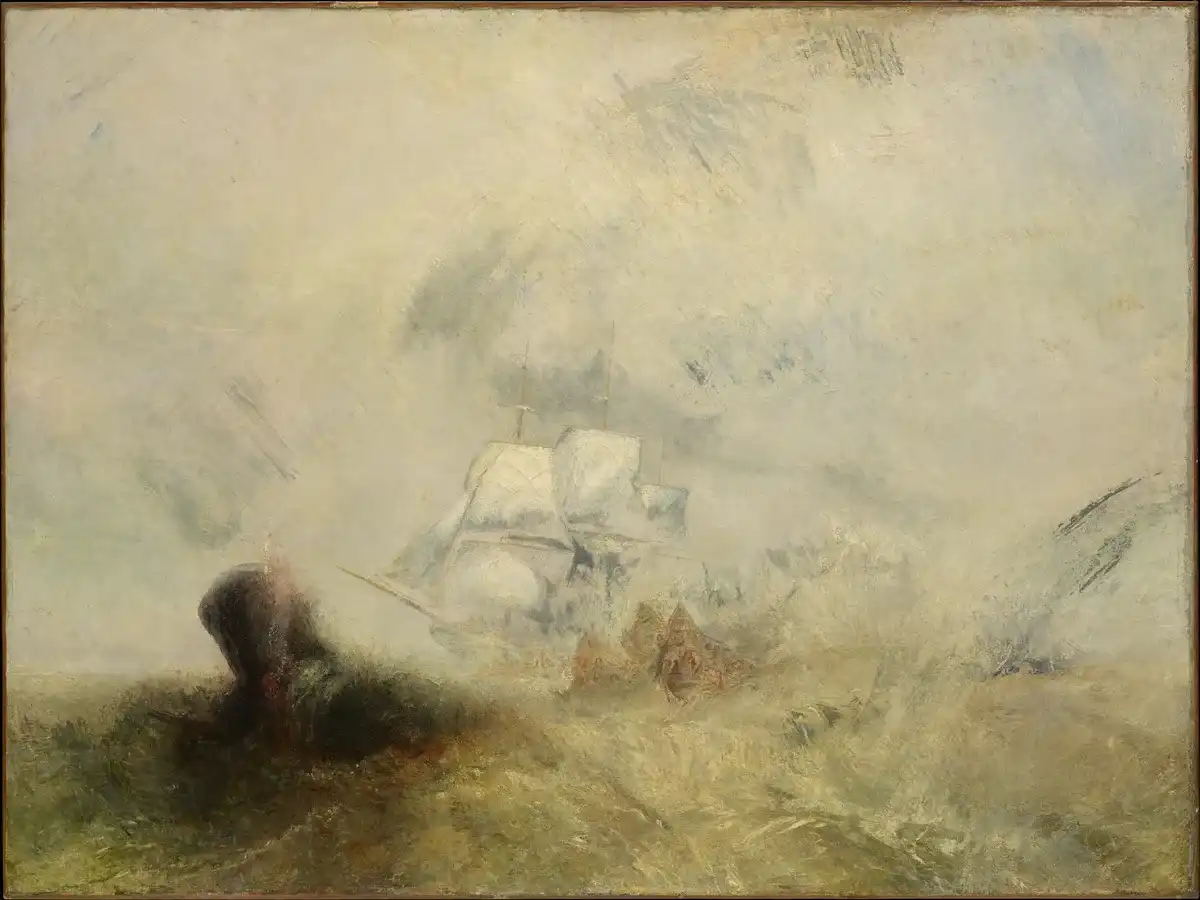
Historical Romanticism was less a style than an attitude. It valued feeling over rules, wild nature over gardens and the strange past over the present. In 1757 the philosopher Edmund Burke described the sublime: the vast, dark and terrifying, which gives a kind of delightful horror. Storms, ruins, mountains and moonlit coasts filled canvases. Caspar David Friedrich painted two men contemplating the moon; J. M. W. Turner turned whaling ships into storms of light.
Historical The supernatural came back too. Henry Fuseli’s The Nightmare (1781) shows a demon crouched on a sleeping woman. Francisco de Goya published Los Caprichos in 1799, eighty etchings (prints whose lines are bitten into metal with acid) satirizing superstition and abuse of power. Plate 43 shows the artist asleep at his desk while owls and bats rise behind him, with the words “The sleep of reason produces monsters”. Many Caprichos show witches.
Modern For witches today, an important point: Goya’s witches are not friendly portraits of real practitioners. They are satire, aimed at ignorance and at the powerful. They can still be wonderful to look at, but read them as Goya meant them.
Burke’s sublime, in his own words
Historical Edmund Burke’s definition in A Philosophical Enquiry into the Origin of Our Ideas of the Sublime and Beautiful (1757) is worth reading: “Whatever is fitted in any sort to excite the ideas of pain, and danger, that is to say, whatever is in any sort terrible, or is conversant about terrible objects, or operates in a manner analogous to terror, is a source of the sublime.” Think of a storm at sea, a mountain in fog or a ruined abbey at night. Romantic painters chose these subjects on purpose.
Two Romantic visionaries
Historical Caspar David Friedrich painted lone figures before vast nature, such as The Monk by the Sea (1808 to 1810) and Wanderer above the Sea of Fog (about 1818), where we see a man from behind gazing over clouds. In England, the poet and printmaker William Blake (1757 to 1827) made visionary works from his own mythology, and around 1819 to 1820 painted The Ghost of a Flea, now at Tate, from a vision he said he had. Both artists made the inner life a subject of art.
Light out of darkness: two useful words
Historical Two Italian words help you describe Baroque light. Chiaroscuro, “light-dark”, means the modelling of forms through strong contrasts of light and shade. Tenebrism, from tenebroso, “dark”, is the extreme version associated with Caravaggio and his followers, where most of the picture falls into deep shadow and a few figures leap out as if caught by a single lamp. When you describe a Baroque painting, ask where the light comes from, what it falls on and what it leaves in darkness. The answer usually tells you what the painter wanted you to notice first.
Reading a vanitas, object by object
Historical The full verse behind the vanitas reads in the King James Version: “Vanity of vanities, saith the Preacher, vanity of vanities; all is vanity” (Ecclesiastes 1:2). Painters turned that idea into objects, and once you know a few, you can read almost any vanitas.
The skull is the plainest reminder of death. The hourglass and the pocket watch measure passing time. A candle just snuffed out, with a thin line of smoke, shows how quickly life can end. Soap bubbles recall the old Latin saying homo bulla, “man is a bubble”, which Erasmus discussed in his collection of proverbs. A peeled lemon looks beautiful but tastes bitter, a reminder that pleasures can deceive. Books, coins and musical instruments stand for learning, wealth and pleasure, all of which death leaves behind.
Notice the irony that the paintings themselves were luxury goods, painted with dazzling skill. A rich merchant could hang a sermon on the vanity of possessions on his wall as a proud possession. Holding both meanings at once is part of reading these pictures well.
A practice variation: a vanitas on your table
You can learn a great deal by arranging a simple still life yourself. Choose five objects from your home that speak of time passing: a burnt-down candle, a cup with cold tea, a fading flower, an old letter, a watch. Arrange them on a table near a window and light them from one side only, with the room otherwise dim.
Take a photograph or make a quick sketch. Then write which object you placed in the light first and why. You will understand at once how much of a Baroque painting’s meaning lies in arrangement and light, not in the objects alone.
A question beginners ask: “Is a vanitas meant to be depressing?” Its makers meant it as a call to live well, with an eye on what lasts. Many viewers today find them calming rather than sad.
Questions beginners ask
Was Baroque art only religious? No. It included portraits, myths, landscapes and still lifes, though the Church was a major patron.
Why did witches come back in Romantic art? Romantics loved the strange, the past and strong feeling, and the Enlightenment had made witches safe enough to be fascinating rather than feared.
Are vanitas paintings gloomy? They can be, but many are also displays of skill and luxury, which is part of the irony.
Myths to drop: Romanticism is not about romance in the modern sense. Fuseli’s Nightmare is not a record of a real visitation. And the Enlightenment did not end belief in magic overnight.
A worked example
Imagine putting Vermeer’s Young Woman with a Water Pitcher next to Turner’s Whalers. For Vermeer you might write: still, cool, careful, private, patient. Then ask which visual choices create that mood: soft daylight from a window on the left, a closed room, blues and whites, a figure caught in a small, unhurried gesture. For Turner you might write: wild, roaring, blinding, dangerous, thrilling.
The choices: no clear edges, a sky and sea melting into one another, a blaze of white and yellow light, tiny boats lost in the storm. The Dutch picture invites you to look closely at a calm, visible world; the Romantic one wants you to feel the sublime. Seeing that difference is the heart of this lesson.
Try this
Put a calm Dutch painting beside a Romantic one, such as Vermeer’s Young Woman with a Water Pitcher and Turner’s Whalers, both in the Met’s online collection. Write five mood words for each, then write which visual choices create each mood.
Recap
Baroque art, encouraged by the Council of Trent, used dramatic light and motion to move viewers. Dutch Golden Age painters sold landscapes, still lifes and daily life to a broad public of merchants and artisans. Rococo brought pastel intimacy, and Neoclassicism a return to clear lines and moral lessons. Romanticism valued feeling and Burke’s sublime, and brought back the supernatural: Fuseli’s Nightmare and Goya’s Caprichos, whose witches are satire rather than portraits of practitioners.
What next
Press “Mark as done” and continue with Pre-Raphaelites, Symbolists and the occult revival. Each style has its own page: Baroque, Dutch Golden Age, Rococo, Neoclassicism and Romanticism. Then read the close reading of The Nightmare and witches in art.
Further reading: Edmund Burke, A Philosophical Enquiry into the Origin of Our Ideas of the Sublime and Beautiful (1757), part 1, section 7. The National Gallery and Tate websites have good short essays on Rosa and Blake.
Sources
- E. H. Gombrich, The Story of Art (London: Phaidon, 1950).
- Edmund Burke, A Philosophical Enquiry into the Origin of Our Ideas of the Sublime and Beautiful (London, 1757).
- Francisco de Goya, Los Caprichos (Madrid, 1799), plate 43.
- The Metropolitan Museum of Art, Juan de Pareja, Velázquez, accession 1971.86; Adélaïde Labille-Guiard, Self-Portrait with Two Pupils, accession 53.225.5; Caspar David Friedrich, Two Men Contemplating the Moon, accession 2000.51.
Quick check
Go deeper: the art movements timeline and art history pages on this site
Get the free Mini-Grimoire
A short printable starter guide to tarot and everyday witchcraft, plus my newsletter. Unsubscribe any time.
Opens Substack in a new tab to confirm. More about the newsletter · Privacy
Comments
Questions and notes from readers. Anyone with a free account can comment, and I reply when I can. Please read the community guidelines.
Comments load from Google Firebase (EU) when you ask for them. Nothing is stored on your device. Privacy