


The Renaissance is where many esoteric threads in Western art begin: translated Hermetic texts, planetary magic, the melancholy genius and the very first tarot cards. It is also where a lot of modern myths begin, such as the idea that every Renaissance painting hides a secret code. In this lesson you will learn what actually changed in art between about 1400 and 1600, and where magic, astrology and tarot really appear, so you can enjoy the period’s mysteries with your feet on solid ground.
A rebirth, and a story about a rebirth
Later tradition “Renaissance” means rebirth. The painter and writer Giorgio Vasari, in his Lives of the Artists (1550, enlarged 1568), told the story of a rebirth of art in Italy after centuries of decline. Historians in the nineteenth century turned the word into the name of a whole period, roughly 1400 to 1600. The idea is useful, but remember that it was partly propaganda: the art of the Middle Ages had not been in decline at all.
Florence and the open window
Historical Early fifteenth-century Florence was a rich city of bankers and merchants, above all the Medici family. Here artists worked out linear perspective, and the humanist Leon Battista Alberti explained it in On Painting (1435 in Latin, 1436 in Italian). He compared a picture to an open window through which we see the story.
Painters such as Masaccio gave figures weight and natural light, and portraits like Fra Filippo Lippi’s woman at a window, now at the Met, celebrated families and marriages. Around 1500, Leonardo da Vinci, Michelangelo and Raphael raised these ideas to what we call the High Renaissance. Leonardo’s soft, smoky shading, called sfumato, makes the corners of the Mona Lisa’s mouth and eyes impossible to fix.
Magic in Florence
Historical Renaissance Florence also revived ancient philosophy and magic. Cosimo de’ Medici asked the scholar Marsilio Ficino to translate a set of Greek texts attributed to “Hermes Trismegistus”. Ficino finished the Latin translation in 1463, and it was printed in 1471. In his Three Books on Life (1489), Ficino wrote about the influence of the planets on health and temperament, including how a scholar born under Saturn could balance melancholy with music, light and the right images.
Later tradition The historian Frances Yates argued in 1964 that this Hermetic tradition was central to Renaissance culture. Many scholars now think she overstated it, but she opened a whole field of study. Be careful with claims that every Renaissance painting hides a magical program, and ask for evidence from the time.
Ficino’s living with the stars
Historical Ficino did not only translate. In 1489 he published Three Books on Life (De vita libri tres), a health guide for scholars, who he thought were prone to melancholy. The third book, “On obtaining life from the heavens”, recommends ways to draw on good planetary influences: certain colors, scents, foods, music and images. To balance Saturn’s heaviness, he suggested the cheerful influences of Jupiter, Venus and the Sun, such as walks in sunlight, the color gold and pleasant music. It reads partly like medicine, partly like magic, and it shaped Renaissance ideas about art, mood and the stars.
The Hall of the Months in Ferrara
Historical In the Palazzo Schifanoia in Ferrara, painters including Francesco del Cossa decorated the Hall of the Months around 1469 to 1470. Each month has three bands: the gods at the top, the zodiac sign with three strange figures in the middle, and court life at the bottom.
In a famous lecture in 1912, the art historian Aby Warburg identified the middle figures as the decans, rulers of ten-degree slices of the zodiac, whose images had traveled from ancient Egypt and Greece through Indian and Arabic astrology to Renaissance Italy. It is one of the clearest cases of astrology painted on a wall.
Dürer’s melancholy angel
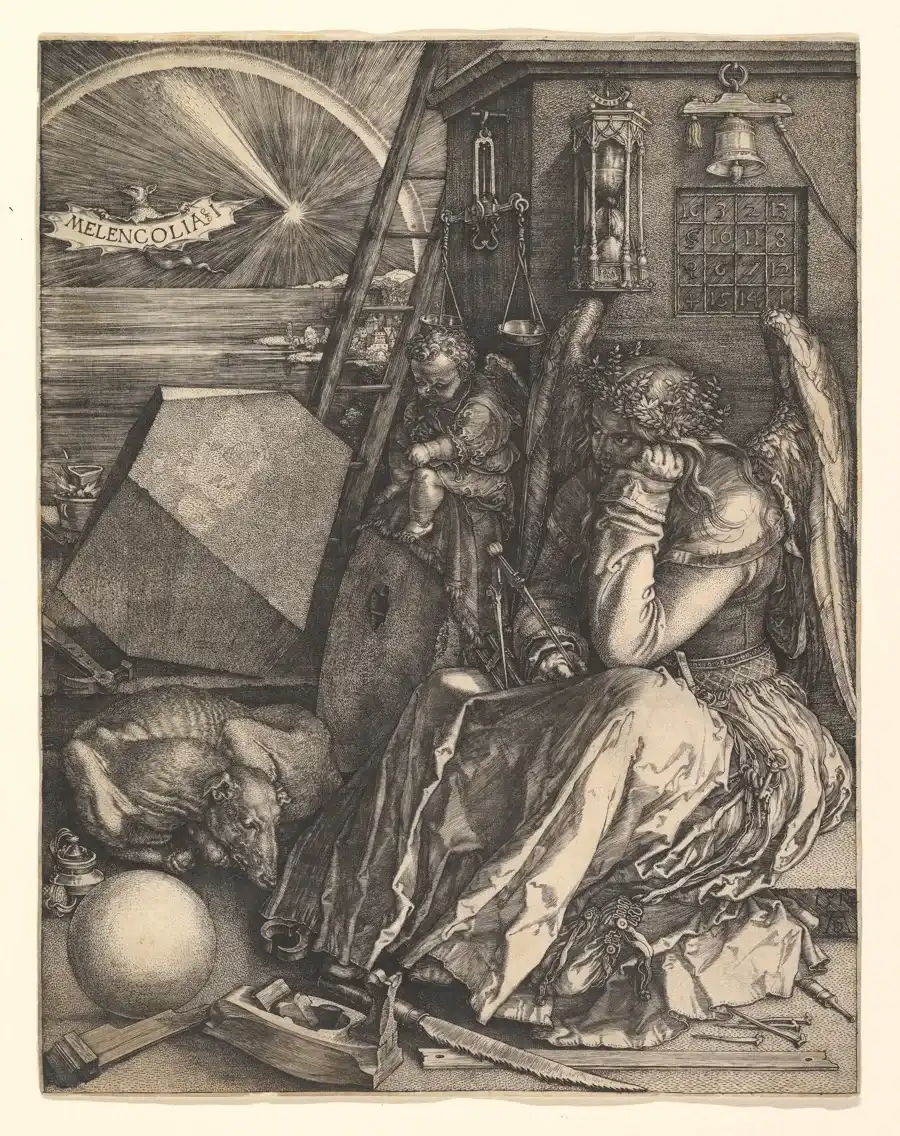
Historical North of the Alps, artists loved the detailed surfaces of the visible world. Albrecht Dürer of Nuremberg spread his fame through prints. His engraving (a print cut into a copper plate) Melencolia I (1514) shows a winged figure sitting among tools of measurement and building, with an hourglass, a bell, scales and a magic square of sixteen numbers whose rows add up to 34; the bottom row includes the date, 1514.
Later tradition The classic reading, by Raymond Klibansky, Erwin Panofsky and Fritz Saxl in Saturn and Melancholy (1964), links the image to the idea, found in Ficino and in Agrippa’s On Occult Philosophy, that melancholy, ruled by Saturn, was the temperament of creative genius. In astrological magic, a square of four was linked with Jupiter, which was thought to ease Saturn. It remains an interpretation, but a well-argued one.
The first tarot cards
Historical In northern Italy in the first half of the fifteenth century, a new kind of card deck appeared, with an extra series of picture cards called trionfi, triumphs. They were used to play a card game, not to tell fortunes. The most famous early cards, made for the Visconti and Sforza families of Milan, are usually dated to about 1450 to 1480 and are painted by hand with gold and silver leaf. Reading tarot for divination came centuries later, in eighteenth-century France.
Not quite tarot: the “Mantegna Tarocchi”
Historical A set of fifty engravings made in Ferrara around 1465 is often called the “Mantegna Tarocchi”. Both parts of the name are wrong: they are not by Andrea Mantegna, and they are not tarot cards. They show the ranks of society, the Muses and liberal arts, virtues and planets in five groups of ten, probably as a teaching set. Yet some of their images, like the figures of the planets, echo in later tarot designs, which is why the confusion persists.
The Visconti-Sforza cards today
Historical The best known early tarot cards, painted for the Visconti and Sforza dukes of Milan in the mid-fifteenth century, are scattered. Many are in the Morgan Library and Museum in New York, others in the Accademia Carrara in Bergamo and a private collection there. A few cards are missing, including the Devil and the Tower, so we do not know how the earliest painters showed them.
Testing a source against a painting: Vasari and the Mona Lisa
Historical Vasari is one of our richest sources for Renaissance art, and also a lesson in reading sources carefully. Here is part of his description of Leonardo’s portrait of Lisa del Giocondo, in Gaston de Vere’s English translation: “the eyes had that lustre and watery sheen which are always seen in life”.
He goes on to praise the eyebrows, “through his having shown the manner in which the hairs spring from the flesh, here more close and here more scanty”. He also tells a lovely story: while painting, Leonardo “always employed, while he was painting her portrait, persons to play or sing, and jesters, who might make her remain merry”.
Now look at the painting in the Louvre’s online images. The face has almost no visible eyebrows. Scholars offer two explanations. Vasari probably never saw the picture, which had gone to France with Leonardo, so he may have written from report and imagination. Or faint brows may have faded or been lost in old cleanings. Either way, you have just done what art historians do every day: you compared a written source with the object and found that they do not quite agree.
The story of the musicians and jesters is charming, and it may be true, but no other source from the time confirms it. Enjoy it, and mark it in your notes as “Vasari says”.
A practice variation: choose any artist whose life Vasari wrote and a work he describes. Read his description first, then look at the work, and list one detail he gets right and one he seems to invent or misremember.
Questions beginners ask
Did Renaissance painters belong to secret societies? There is no good evidence for most of the claims made online. Lesson 2’s rule applies: look for sources from the time.
Was tarot magical from the start? No. It began as a game. Divination with tarot is documented much later, from the eighteenth century.
Is Botticelli’s Primavera an occult painting? Scholars have linked it to Ficino’s Neoplatonism, but its meaning is debated, and many readings are possible.
Myths to drop: The Renaissance did not leave the Middle Ages entirely behind. Hermetic texts are not as old as Egypt; they date from the early centuries CE. And not every square or star in a painting is a hidden code.
A worked example
Imagine finding a claim online: “Dürer hid a secret alchemical formula in Melencolia I.” How would you test it? First, describe what is there: the figure, the tools, the square, the bat-like creature carrying the title. Then ask what people at the time could have known.
Ficino’s ideas about Saturn and melancholy were in print by 1489, and Agrippa’s book circulated in manuscript before Dürer made the print, so a link to melancholy and planetary magic has real support from the period. A specific hidden “formula”, though, has no source from the time. You can keep enjoying the alchemical reading as yours, while knowing that the Saturn reading is the one with evidence.
Try this
Compare one Italian and one Netherlandish portrait from the fifteenth century, for example Lippi’s Portrait of a Woman with a Man at a Casement and a Netherlandish portrait from any open-access collection. Make two columns: face, clothes, background, light. Which feels more like a real person to you, and why?
A variation: find the Hall of the Months online and choose your birth month. Describe the three bands, then read what scholars say about the decan figures.
Recap
“Renaissance” is partly Vasari’s story, but real changes happened: linear perspective, Alberti’s open window and the weight and light of Masaccio and the High Renaissance. Ficino translated the Hermetic texts and wrote about planets and melancholy, and Yates later argued, perhaps too strongly, that this magic was central to the age. Dürer’s Melencolia I is best read through Saturn and the melancholy genius. The first tarot cards were luxury game cards made in fifteenth-century Italy, and fortune-telling with them came much later.
What next
Press “Mark as done” and continue with From Baroque light to Romantic night. Read the close reading of Melencolia I and tarot as art history, and visit the Early Renaissance, High Renaissance and Northern Renaissance pages. For the wider story of Hermetic magic, try Occult History for Beginners.
Further reading: Marsilio Ficino, Three Books on Life, edited and translated by Carol V. Kaske and John R. Clark (1989). Aby Warburg’s 1912 lecture is in The Renewal of Pagan Antiquity (Getty, 1999).
Sources
- Raymond Klibansky, Erwin Panofsky and Fritz Saxl, Saturn and Melancholy (London: Nelson, 1964).
- Frances A. Yates, Giordano Bruno and the Hermetic Tradition (London: Routledge and Kegan Paul, 1964).
- Leon Battista Alberti, On Painting (1435; Italian version 1436).
- Giorgio Vasari, Lives of the Most Eminent Painters, Sculptors and Architects (1550; 2nd ed. 1568), translated by Gaston du C. de Vere (1912).
- The Metropolitan Museum of Art, Melencolia I, Albrecht Dürer, 1514, accession 43.106.1.
Quick check
Go deeper: the art movements timeline and art history pages on this site
Get the free Mini-Grimoire
A short printable starter guide to tarot and everyday witchcraft, plus my newsletter. Unsubscribe any time.
Opens Substack in a new tab to confirm. More about the newsletter · Privacy
Comments
Questions and notes from readers. Anyone with a free account can comment, and I reply when I can. Please read the community guidelines.
Comments load from Google Firebase (EU) when you ask for them. Nothing is stored on your device. Privacy