


How to read the labels Historical what the old sources say. Later tradition what later writers added. Modern modern practice and my own notes.
Early Renaissance art is the art of 15th-century Italy, roughly 1400 to 1490, which began in Florence and spread to Urbino, Mantua, Venice and Rome. Artists such as Filippo Brunelleschi, Donatello, Masaccio, Fra Angelico, Piero della Francesca and Sandro Botticelli revived ancient Roman forms, worked out linear perspective and gave figures real weight. It laid the foundation for the High Renaissance of Leonardo, Michelangelo and Raphael.
The word has its own history. Vasari spoke of a rinascita in the sixteenth century, and the historians Jules Michelet in 1855 and Jacob Burckhardt in 1860 made “the Renaissance” a name for a whole age. Medieval people had never forgotten antiquity, so I use the word with care.
The story is one of the great adventures of art, and it is also where much of later Western magic was born.
Key dates
| When | What happened |
|---|---|
| 1401 | Ghiberti wins the competition for the Florence Baptistery doors. |
| About 1415 to 1420 | Brunelleschi demonstrates linear perspective. |
| 1436 | Brunelleschi’s dome of Florence Cathedral is completed. |
| 1463 | Marsilio Ficino finishes translating the Hermetic texts for Cosimo de’ Medici. |
| About 1480s | Botticelli paints his great mythologies for the Medici circle. |
What is Early Renaissance art?
Early Renaissance art is the 15th-century Italian art that combined Christian subjects with the study of classical antiquity, mathematics and the observed world.
Throughout this page I mark three layers. Historical What works and documents of the time show. Later tradition What later centuries, and later magicians, read into the period. Modern How people use Renaissance images today.
Historical A city of patrons. Florence in the early fifteenth century was a rich city of bankers and wool and silk merchants, governed by a republic dominated by powerful families, above all the Medici.
Its guilds and citizens competed to commission public art. In 1401 a competition for new bronze doors for the Baptistery set Lorenzo Ghiberti against Filippo Brunelleschi, and Ghiberti won. Brunelleschi went on to build the great dome of Florence Cathedral.
Historical The window and the vanishing point. Brunelleschi demonstrated linear perspective in Florence around 1413 to 1420, and Leon Battista Alberti wrote down the method in On Painting (1435, with an Italian version in 1436). Parallel lines meet at a single vanishing point, and the picture becomes, in Alberti’s words, an open window.
Masaccio’s fresco of the Holy Trinity in Santa Maria Novella, painted in the 1420s, shows a painted chapel so convincing that it seems to cut into the wall. In the Brancacci Chapel he gave Adam and Eve, driven out of Eden, real weight and real grief.
Historical Sculpture comes alive. Donatello’s sculptures stand in contrapposto like ancient statues, but they feel like people from the street. His wooden Mary Magdalene, worn and fierce, is as far from ideal beauty as art can go.
Portraits and private lives. 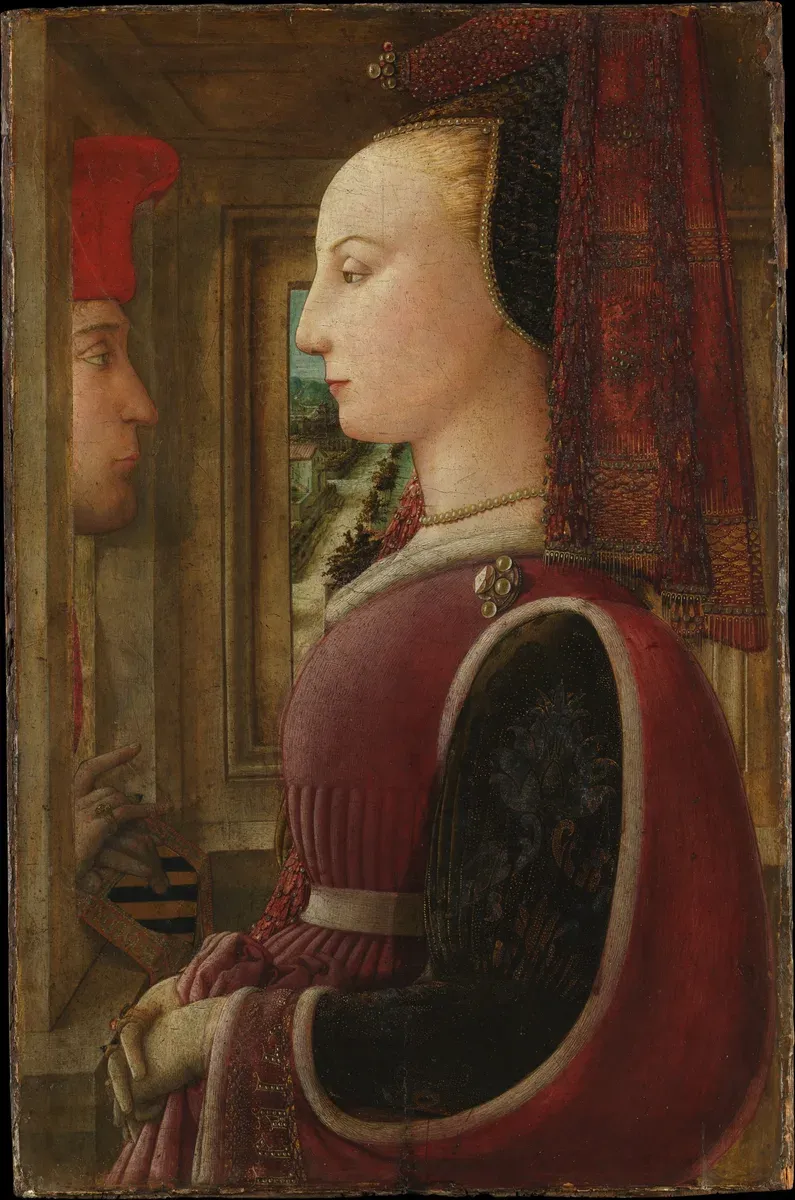
Fra Filippo Lippi, Portrait of a Woman with a Man at a Casement, about 1440. The Metropolitan Museum of Art (89.15.19). Image: Open Access, public domain (CC0).
Historical Fra Filippo Lippi, a Carmelite friar with a famously unruly life, painted this double portrait around 1440. A young woman in profile, dressed in jewels and brocade, stands in a room while a man peers in at the window.
It probably celebrates a marriage alliance, and it is one of the earliest surviving Italian portraits set in a real interior.
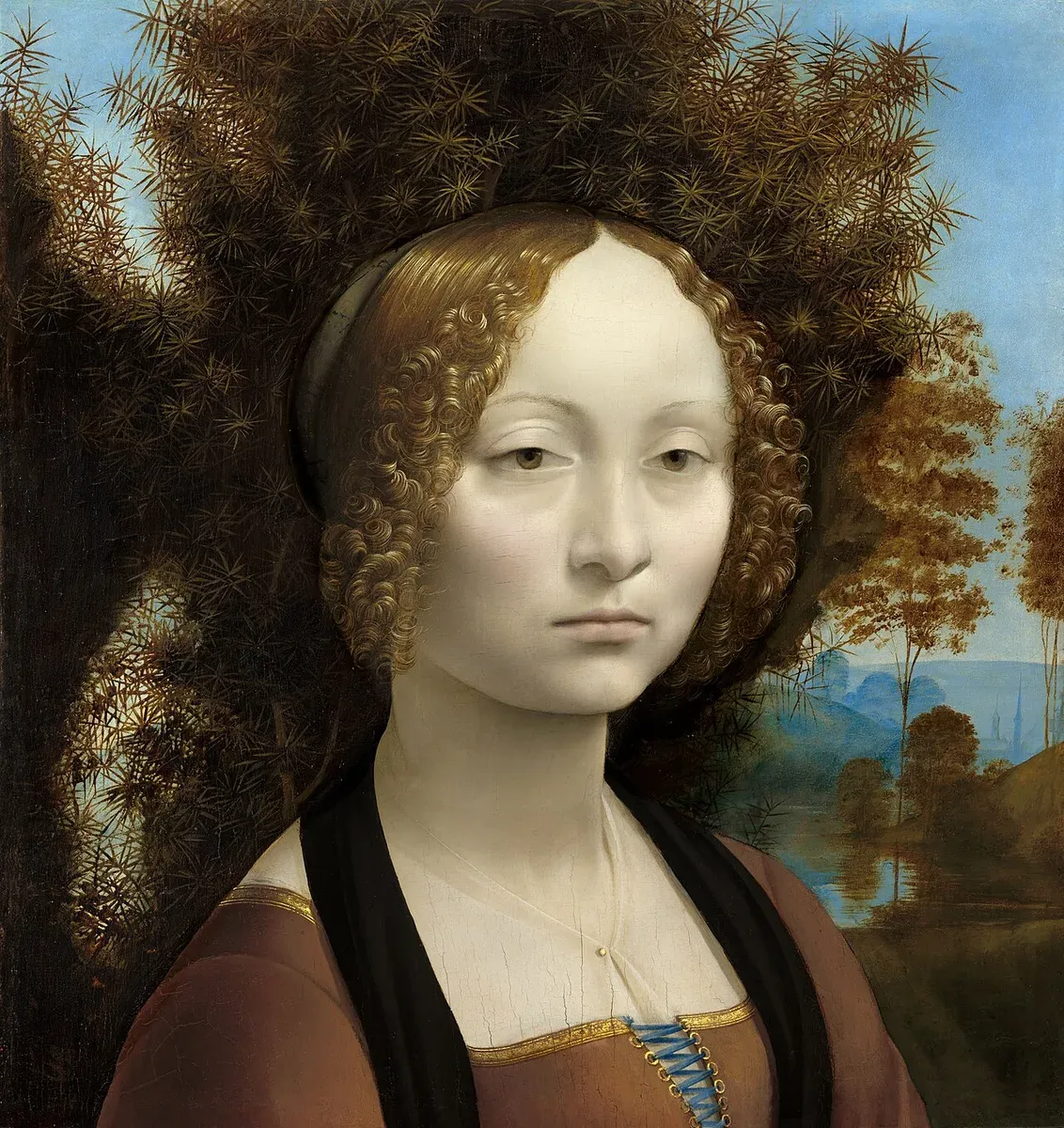
Leonardo da Vinci, Ginevra de’ Benci, about 1474 to 1478. National Gallery of Art, Washington, image via Google Arts and Culture. Image: Wikimedia Commons, public domain.
The young Leonardo da Vinci painted Ginevra de’ Benci around 1474 to 1478, now in the National Gallery of Art in Washington, the only painting by Leonardo in the Americas. The spiky juniper behind her, ginepro in Italian, is a pun on her name.
Historical Botticelli and the gods. Sandro Botticelli painted ancient gods for Medici circles in the 1480s. His Primavera and The Birth of Venus, both in the Uffizi, show Venus, the Graces and the winds in a dreamy, flowing line. I describe them in words only, since they include nudity, and the Uffizi website has good images.
Key artists
| Artist | Lived | Why they matter |
|---|---|---|
| Filippo Brunelleschi | 1377 to 1446 | Architect of the Florence dome and the man credited with the rules of perspective. |
| Donatello | about 1386 to 1466 | The sculptor who gave stone and bronze figures a living presence. |
| Masaccio | 1401 to 1428 | The young painter whose Trinity fresco is the first great perspective painting. |
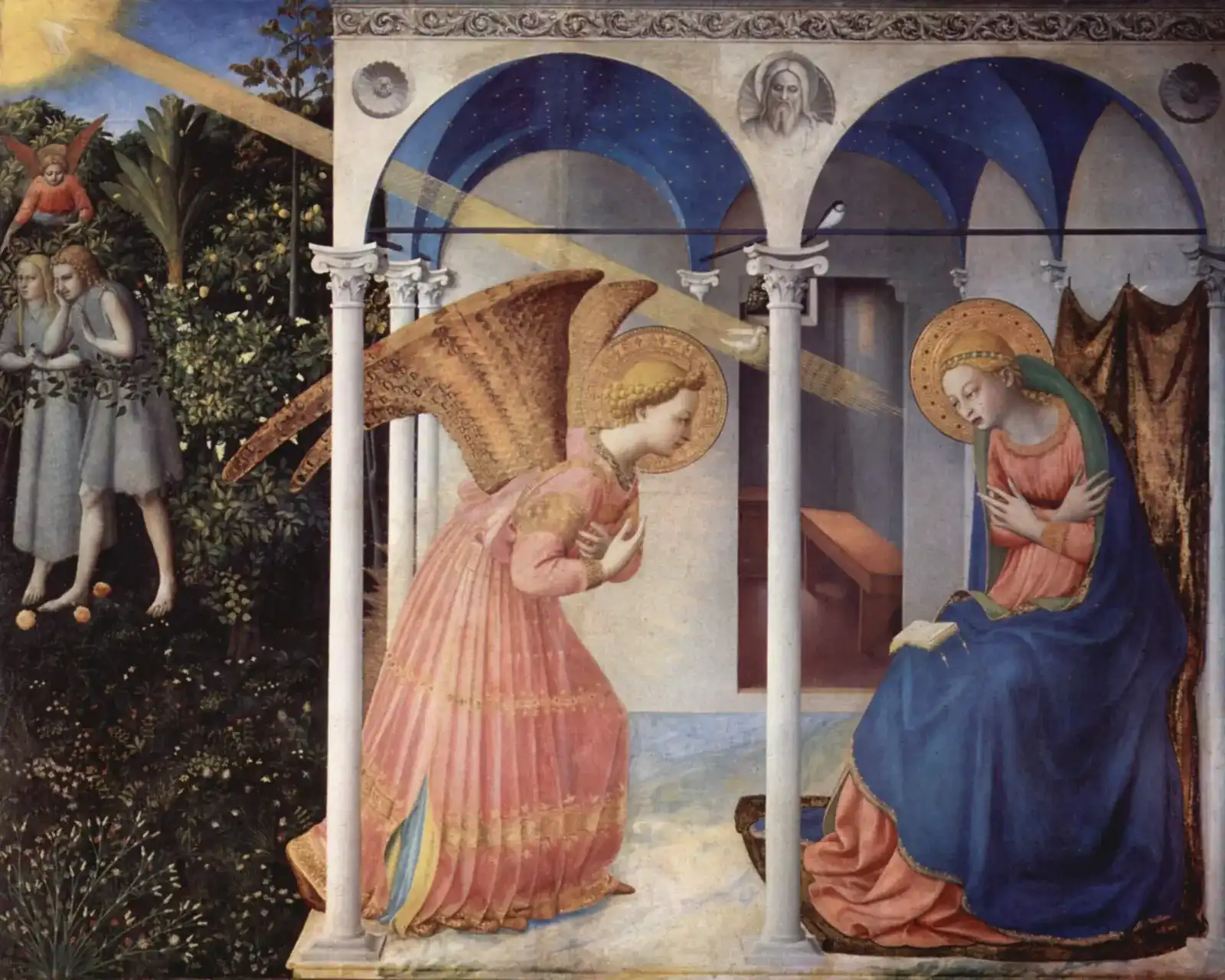
| Fra Angelico | about 1395 to 1455 | The Dominican friar who painted calm, luminous Annunciations. |
| Sandro Botticelli | about 1445 to 1510 | The painter of graceful saints and Neoplatonic mythologies. |
How do you recognise Early Renaissance art?
Look for a picture that works like a window: a single vanishing point, a box of real space and figures that stand firmly on the ground. Classical columns and arches return. Light falls from one direction and casts shadows. Patrons appear inside religious scenes, and portraits of real people become common.
Common misconceptions. “The Renaissance began suddenly in 1400” is too neat. Giotto had already given figures weight in the early 1300s, and Gothic and International Gothic styles lived on alongside the new art for decades.
Another is that the period had no women artists. Caterina Vigri, a nun in Bologna who was later canonised as Saint Catherine of Bologna, painted and wrote in the mid-1400s. Women were shut out of most workshops, but convents gave some of them a space to work. A third is that Renaissance art was secular. Most commissions were still religious, even when they look very human.
Esoteric themes
Historical In 1463 Cosimo de’ Medici asked the scholar Marsilio Ficino to set aside his Plato and translate the Greek Corpus Hermeticum, believed to be ancient Egyptian wisdom from Hermes Trismegistus. The translation was printed in 1471.
In Three Books on Life (1489), Ficino described how music, images and planetary correspondences could bring helpful influences into a person’s life. This is real history and a major root of later Western esotericism.
Later tradition The historian Frances Yates argued in 1964 that Hermetic magic was central to Renaissance culture. Her thesis has been widely criticized as overstated, but it opened a whole field of study. Some writers read Botticelli’s paintings as Neoplatonic talismans; that is possible, but not proven.
Modern Many modern magicians trace their correspondences back to Ficino. I explore this in lesson 4 of the course.
Works to see
| Work | Artist | Date | Where to see it |
|---|---|---|---|
| The Annunciation | Fra Angelico | about 1426 | Museo del Prado, Madrid |
| Portrait of a Woman with a Man at a Casement | Fra Filippo Lippi | about 1440 | The Metropolitan Museum of Art, New York |
| The Holy Trinity | Masaccio | about 1427 | Santa Maria Novella, Florence |
| The Adoration of the Magi | Sandro Botticelli | about 1475 | Uffizi Galleries, Florence |
Every work in this list is free of nudity, so you can look them up with confidence. Works still in copyright are named but not shown here.
How to look at an Early Renaissance painting
Find the vanishing point first. In many 15th-century paintings, the lines of floors, walls and roofs meet at one point, often near the most important figure. Then look at the light: where does it come from, and does it cast shadows on the ground?
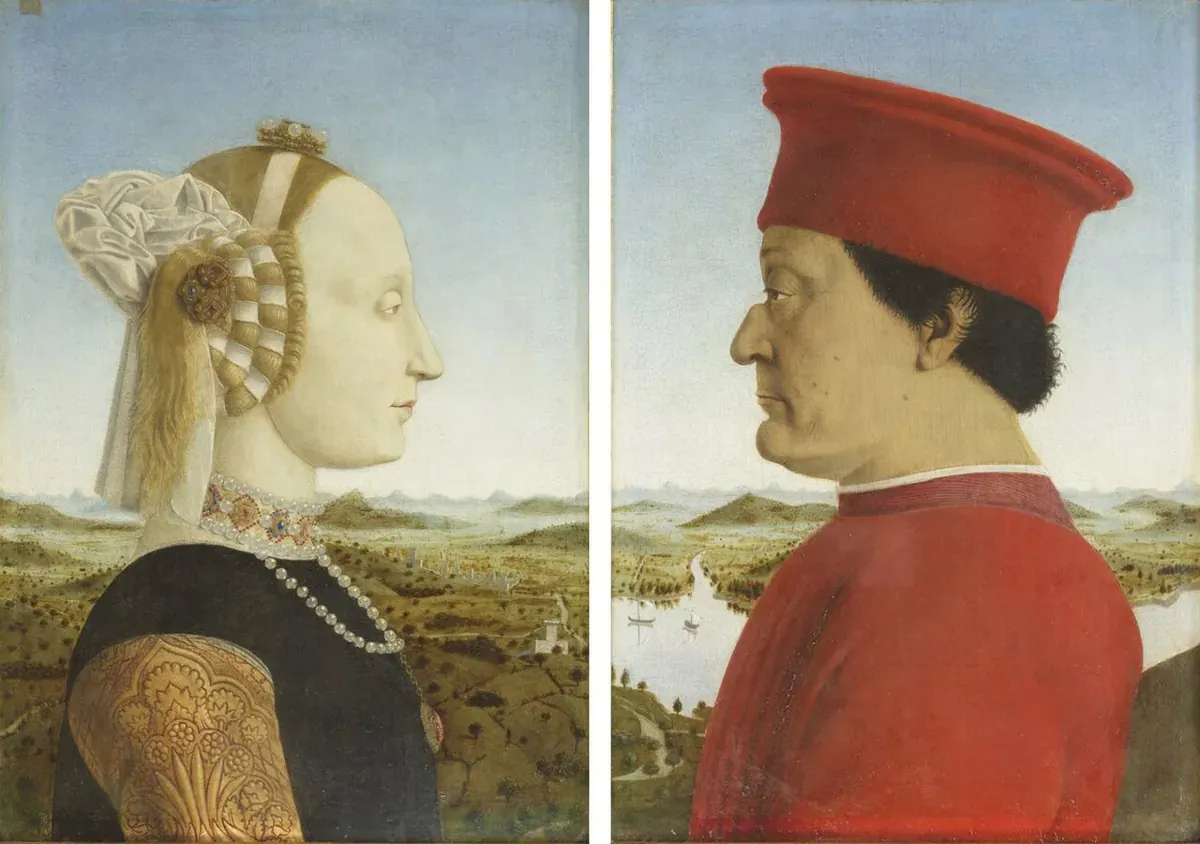
Piero della Francesca, Portraits of the Duke and Duchess of Urbino, about 1473 to 1475. Uffizi Gallery, Florence. Image: Wikimedia Commons, public domain.
Piero della Francesca, Duke and Duchess of Urbino, about 1473 to 1475. At the Uffizi in Florence. The couple face each other in profile, a style taken from ancient coins. Federico had lost his right eye in a tournament, so he is always shown from the left. Battista had died in 1472, and her very pale face may follow a death mask. Look at the misty landscape behind them, painted in the oil technique that was arriving from the north.
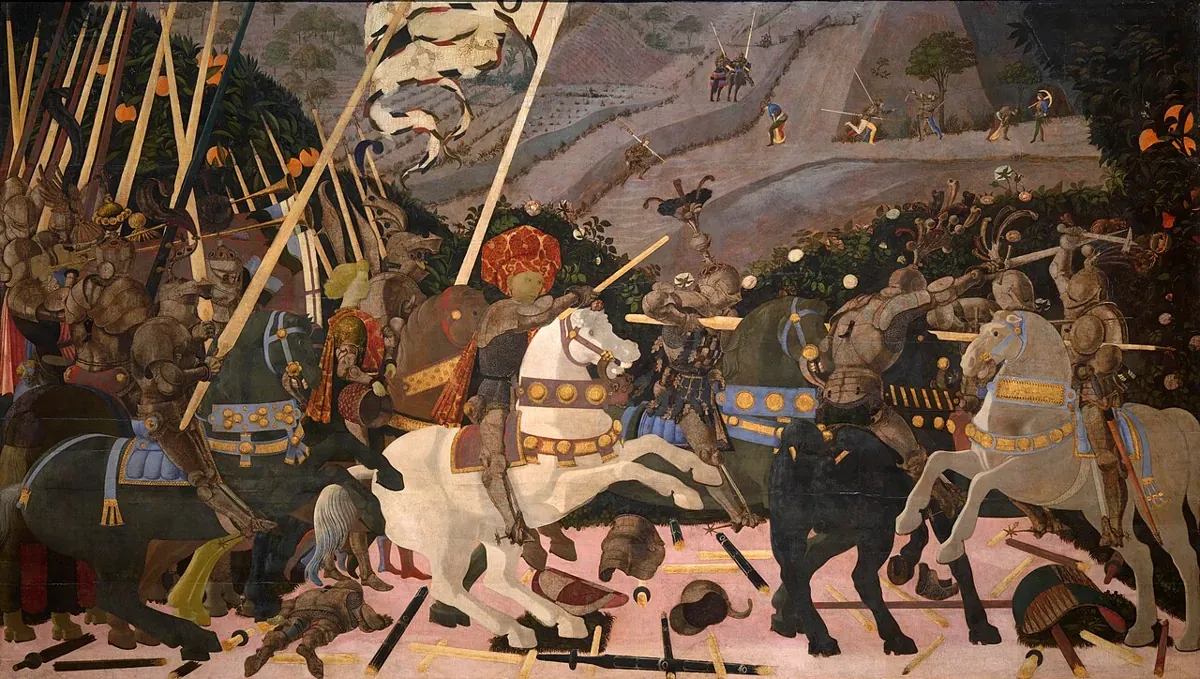
Paolo Uccello, The Battle of San Romano, about 1438 to 1440. National Gallery, London. Image: Wikimedia Commons, public domain.
Paolo Uccello, The Battle of San Romano, about 1438 to 1440. At the National Gallery in London, one of three panels; the others are in the Uffizi and the Louvre. Look at the broken lances on the ground. Uccello lined them up to point toward a vanishing point, showing off his perspective even in the chaos of battle.
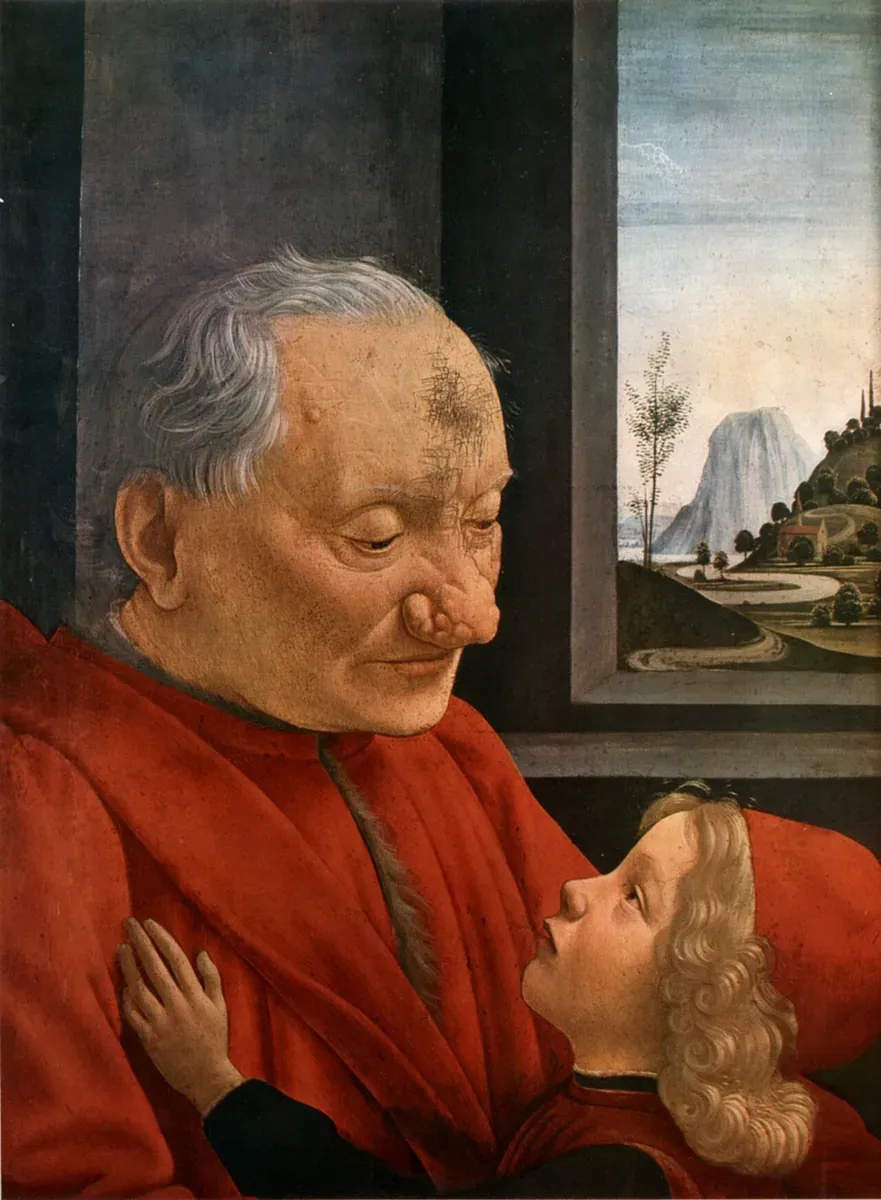
Domenico Ghirlandaio, An Old Man and his Grandson, about 1490. Musée du Louvre, Paris. Image: Wikimedia Commons, public domain.
Domenico Ghirlandaio, An Old Man and his Grandson, about 1490. At the Louvre. The old man’s nose shows a skin condition, painted without flattery, but the tenderness between the two faces is the real subject. Few 15th-century portraits are this warm.
The Early Renaissance grew from Gothic and International Gothic art and in dialogue with the Northern Renaissance. It led to the High Renaissance, and its rediscovery of ancient Rome returned in Neoclassicism.
Try this
Find an image of Masaccio’s Holy Trinity online. With a ruler on a printout, or in your mind, extend the lines of the painted ceiling until they meet. Where is the vanishing point, and at what height would your eye be standing in the church?
What next
Before this: International Gothic.
After this: High Renaissance.
Also worth reading alongside it: Northern Renaissance.
See every movement in order on the art movements timeline, or learn to look step by step in the free Art History for Beginners course.
If you want to carry this into tarot and practice, these pages connect to it: The Magician, the learned magus of Ficino’s Florence; The Lovers, the angel and the human pair, an Annunciation-like meeting of heaven and earth; Ficino, Hermes and the art of the Medici circle; and Learned magic in Renaissance Florence.
Sources
- Leon Battista Alberti, On Painting (De pictura) (1435).
- Jacob Burckhardt, The Civilization of the Renaissance in Italy (1860).
- Frances A. Yates, Giordano Bruno and the Hermetic Tradition (1964).
- The Metropolitan Museum of Art, Portrait of a Woman with a Man at a Casement, 89.15.19. Open the record
- National Gallery of Art, Washington, Ginevra de’ Benci. Open the record
- E. H. Gombrich, The Story of Art (1950).
- Wikimedia Commons, The Annunciation (hero image record). Open the record
- Michael Baxandall, Painting and Experience in Fifteenth-Century Italy (1972).

Questions
Who invented linear perspective?
The architect Filippo Brunelleschi demonstrated it in Florence around 1413 to 1420, and Leon Battista Alberti wrote down the method in On Painting (1435, Italian version 1436).
Was the Renaissance really a rebirth?
The idea of rebirth comes from the period itself, from writers like Vasari, and was later made famous by Michelet and Burckhardt. Medieval culture had never forgotten antiquity, so historians now treat the word with care.
Where can I see works of Early Renaissance art in person?
Good places to start are Florence (the Uffizi, the Brancacci Chapel, San Marco), the Met, and the National Gallery in London and Washington. Museums change their displays, so check the collection page before you travel.
What are the main features of Early Renaissance art?
Linear perspective, figures with weight and volume, interest in ancient Roman architecture and sculpture, careful study of light, and portraits of real, named people.
Who was the most important Early Renaissance painter?
Many historians name Masaccio, whose frescoes in the Brancacci Chapel and Holy Trinity in Santa Maria Novella, Florence, were the first to use perspective and light consistently, though he died at only 26 or 27.
Get the free Mini-Grimoire
A short printable starter guide to tarot and everyday witchcraft, plus my newsletter. Unsubscribe any time.
Opens Substack in a new tab to confirm. More about the newsletter · Privacy