


| Arcana | Major Arcana |
|---|---|
| Number | XIII |
| Image | RWS 1909 (PD) |
Death is card XIII of the Major Arcana, and the card beginners fear most. Let me say it plainly first: the Death card does not predict anyone’s physical death. It is about endings, change and making room for what comes next.
Something finishes so something else can begin. This page explains what Death means upright and reversed, the symbols in Pamela Colman Smith’s card and how the card was understood over time.
Here is Death at a glance.
| At a glance | This card |
|---|---|
| Upright keywords | endings, transformation, transition, clearing |
| Reversed keywords | fear of change, holding on, a stalled ending |
| Number | XIII (13) in the Major Arcana |
| Golden Dawn title | The Child of the Great Transformers; the Lord of the Gate of Death Later tradition |
| Hebrew letter | Nun (נ), “fish” Later tradition |
| Tree of Life path | 24, from Tiphareth to Netzach Later tradition |
| Astrology | Scorpio Later tradition |
| Element | Water Later tradition |
| Yes or no | No Modern |
The Golden Dawn gave Death the sign Scorpio, traditionally linked with endings, sex and regeneration, and the letter Nun, the “fish”, a creature that lives in the hidden depths. Early decks often left this card unnamed, and many Marseille decks still print no title on card XIII. The skeleton with a scythe comes from medieval images of the Dance of Death; Waite gave him armor, a horse and a banner with a white rose.
The card: what Pamela Colman Smith drew
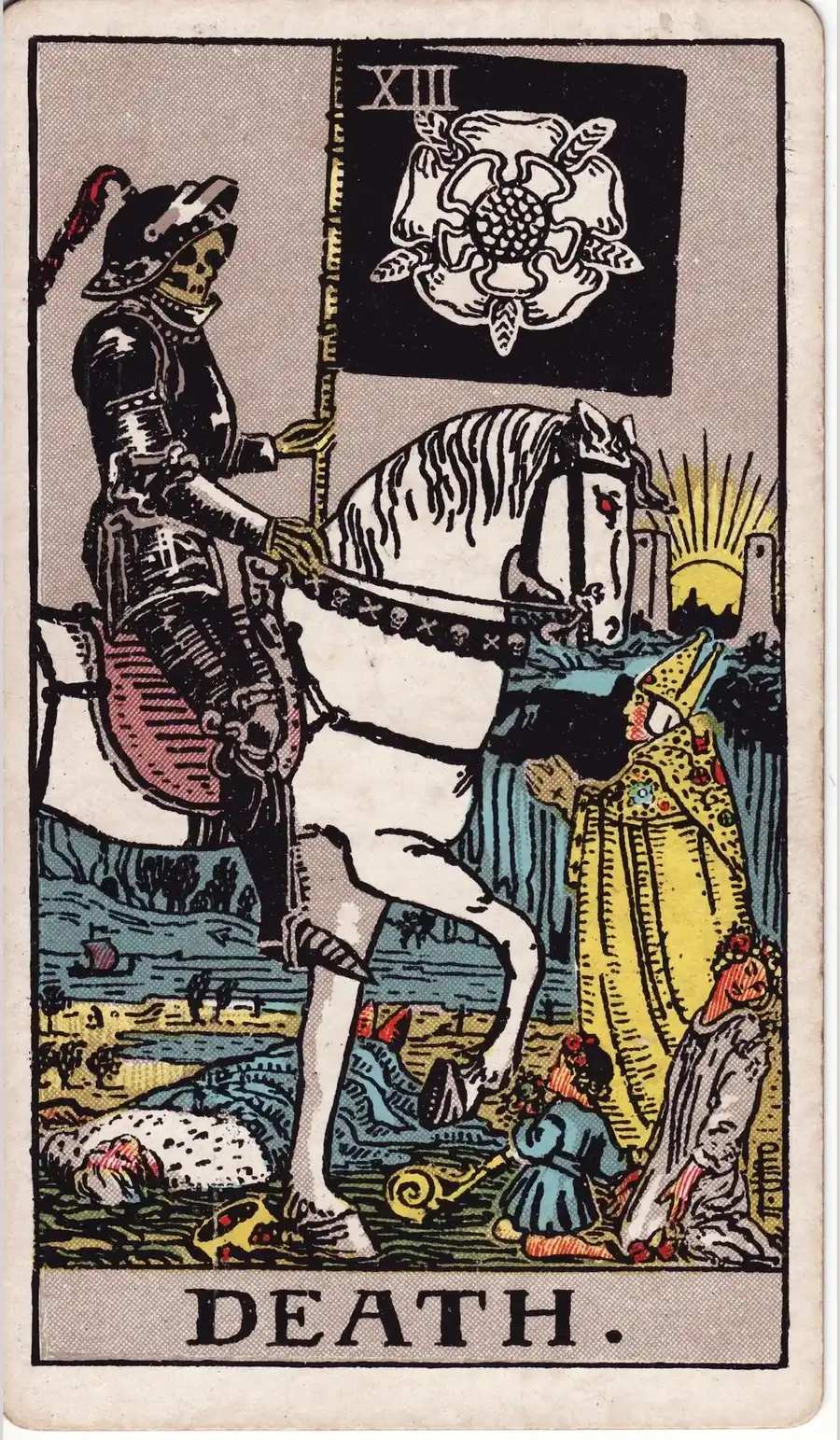
Smith drew a slow procession rather than a battle. Waite wrote that “the mysterious horseman moves slowly, bearing a black banner emblazoned with the Mystic Rose, which signifies life”, and that “between two pillars on the verge of the horizon there shines the sun of immortality”.
The rider and the white horse. A skeleton in black armor rides a white horse. He carries no weapon. Change does not need to fight. It simply arrives, as every season does.
The banner with the white rose. His black flag carries a white rose with five petals. Waite said the rose “signifies life”. Even this card holds life inside it.
The four figures. A king has fallen, a bishop waits with hands together, a young woman turns away and a child looks up calmly. Change comes to everyone, whatever their rank. Each figure shows a different way of meeting it.
The rising sun. On the horizon, between two towers, a sun is rising. After the ending, a new day. Many beginners never notice the sun until someone points it out.
Upright meaning
Upright, Death ends something so that something else can begin. An armored skeleton rides a white horse, carrying a black banner with a white rose. Before it a king lies fallen, a bishop prays, a young woman turns away and a child looks up without fear. In the distance the sun rises between two towers, and a boat moves along a river.
The card almost never means a physical death. It describes transformation: a job, a relationship, a home or an identity that has run its course. The ending may be sad, and grief is allowed. But the rising sun is in the picture too, and the card always holds both.
Death often appears when you already know that something is over. It asks you to let it finish properly, without dragging it out, so that the next season can arrive.
Reversed meaning
Reversed, the ending is resisted. You may be holding on to a situation that is already over, such as a relationship, a role or an old version of yourself, because the unknown is more frightening than the familiar. The card can describe stagnation: the change is needed but delayed, and everything else waits.
It can also describe a slow, partial ending, where some part of you has let go and another has not.
Ask what you would grieve if you let it go, and allow that grief its time. Endings that are mourned are easier to complete than endings that are refused.
In love, work and spirituality
In love. Upright: A relationship transforms or ends; a deep change in how two people relate. Reversed: Clinging to a relationship that is over, or fear of change keeping things stuck.
At work. Upright: A job or role ends; a career transformation; restructuring. Reversed: Resisting a necessary change at work, or staying in a dead end.
With money. Upright: The end of one financial chapter; clearing old debts or habits. Reversed: Holding on to losing investments, or refusing to change spending patterns.
In spiritual practice. Upright: Ego death, initiation and letting go of an old self. Reversed: Fear of transformation; staying spiritually small.
As feelings. Intense, transformative feelings, or a sense that the relationship has changed for good.
As a person. Someone going through, or helping others through, deep change.
As advice. Let it end properly so that the new can begin.
Reading Death: positions, pairs and yes or no
In the past position: An ending that cleared the way for who you are now. In the present position: A chapter is closing. Let it.
In the future position: A transition ahead, and something new after it. As advice: Name what is over, grieve it and make room.
When Death shows up among mostly Minor cards, give it extra weight: the theme of endings runs under the whole question.
Pairs matter too. Next to The Tower, it can mean big, sudden change. Look after yourself and your safety. Next to The Star, it can mean an ending followed by healing and hope. Next to The Lovers, it can mean a relationship changing form, or a choice that ends one path.
In modern yes or no readings, Death leans no. It means something is ending, so for questions about keeping things as they are, the answer is no.
The history and art behind the card
In many Tarot de Marseille decks card XIII is printed with a number but no name at all; readers call it Death, and some later French decks print La Mort. Death was a familiar figure in late medieval art.
After the plague years of the fourteenth century, paintings of the Dance of Death showed skeletons leading popes, kings and peasants alike. Early tarot Death cards share that message: everyone is equal before death. Many Marseille decks show a skeleton with a scythe cutting through a field of heads and hands, and leave the card without a name.
Waite wanted a gentler picture. He wrote that change and transformation are “more fitly represented in the rectified Tarot by one of the apocalyptic visions than by the crude notion of the reaping skeleton”. So Smith drew the rider on the white horse, borrowed from the Book of Revelation, and added the rising sun.
Modern readers almost always read the card as transformation. If a Death card in a reading frightens you, please remember that tarot cannot predict anyone’s death, and that no ethical reader would ever tell you otherwise.
When A. E. Waite published The Pictorial Key to the Tarot in 1910, he listed these divinatory meanings for the card: “End, mortality, destruction, corruption; also, for a man, the loss of a benefactor; for a woman, many contrarieties; for a maid, failure of marriage projects.”
Reversed, he gave: “Inertia, sleep, lethargy, petrifaction, somnambulism; hope destroyed.” Waite himself called the fortune-telling meanings of the trumps “artificial and arbitrary”, and on this site I read the picture first and treat lists like this as history.
Death comes late in the second stage of the modern Fool’s Journey. The traveler who surrendered in the Hanged Man now sees the cost and the gift of it: an old self ends so that the journey can continue.
Common questions
Does the Death card mean someone will die? No. The Death card is about endings and change. Tarot cannot predict anyone’s death, and a reading should never claim to.
Is the Death card bad? Not usually. Endings can hurt, but this card often brings relief and a fresh start.
What does Death mean in a love reading? The end of a phase or a deep change. Sometimes a relationship ends, and sometimes it renews itself.
Try this
Try this small spread for Death. Use it when something is ending and you want to move through it gently.
| Card | Question | What it shows |
|---|---|---|
| 1 | What is ending? | The chapter that is closing. |
| 2 | What do I need to let go of? | What I keep carrying out of habit or fear. |
| 3 | What is waiting to begin? | The sunrise behind the towers. |
Affirmation: I allow ended chapters to end so transformation can continue.
Reversed affirmation: I release what I have been keeping alive past its time.
If you keep a tarot journal, take one of these questions to it: What in my life has already ended, even if I have not admitted it? What would grow in the space it leaves? How do I want to honor what is ending?
What next
Cards that sit close to this one are The Tower (sudden change, where Death is slow change), Judgement (rising again after an ending) and The Hanged Man (the pause that comes before the ending).
Death is part of the lesson Strength to Temperance in my free Tarot for Beginners course. To keep walking the Major Arcana, read the card before it, The Hanged Man or the card after it, Temperance, or go back to all the card meanings.
For every card with keywords, affirmations and examples, see my book The Novice’s Guide to Tarot. If you would like a printable cheat sheet for all 78 cards, my 45-page Tarot Workbook is on Etsy.
Sources
- A. E. Waite, The Pictorial Key to the Tarot (London: Rider, 1910), Part II and Part III, section 3.
- Pamela Colman Smith and A. E. Waite, the Rider-Waite-Smith tarot (London: Rider, 1909).
- Nicolas Conver, Tarot de Marseille (Marseille, 1760).
- Eden Gray, A Complete Guide to the Tarot (New York: Crown, 1970), epilogue “The Fool’s Journey”.
- Lauri Mukkala, The Novice’s Guide to Tarot, entry for Death.
- Aleister Crowley, 777 (London: Walter Scott, 1909), columns of the Hebrew letters, paths and Tarot trumps.
- Israel Regardie, ed., The Golden Dawn (Chicago: Aries Press, 1937 to 1940), “Book T” and the titles of the trumps.
All 78 cards
Major Arcana
- The Fool
- The Magician
- The High Priestess
- The Empress
- The Emperor
- The Hierophant
- The Lovers
- The Chariot
- Strength
- The Hermit
- Wheel of Fortune
- Justice
- The Hanged Man
- Death
- Temperance
- The Devil
- The Tower
- The Star
- The Moon
- The Sun
- Judgement
- The World
Wands
- Ace of Wands
- Two of Wands
- Three of Wands
- Four of Wands
- Five of Wands
- Six of Wands
- Seven of Wands
- Eight of Wands
- Nine of Wands
- Ten of Wands
- Page of Wands
- Knight of Wands
- Queen of Wands
- King of Wands
Cups
- Ace of Cups
- Two of Cups
- Three of Cups
- Four of Cups
- Five of Cups
- Six of Cups
- Seven of Cups
- Eight of Cups
- Nine of Cups
- Ten of Cups
- Page of Cups
- Knight of Cups
- Queen of Cups
- King of Cups
Swords
- Ace of Swords
- Two of Swords
- Three of Swords
- Four of Swords
- Five of Swords
- Six of Swords
- Seven of Swords
- Eight of Swords
- Nine of Swords
- Ten of Swords
- Page of Swords
- Knight of Swords
- Queen of Swords
- King of Swords
Pentacles
Get the free Mini-Grimoire
A short printable starter guide to tarot and everyday witchcraft, plus my newsletter. Unsubscribe any time.
Opens Substack in a new tab to confirm. More about the newsletter · Privacy