


| Arcana | Major Arcana |
|---|---|
| Number | XV |
| Image | RWS 1909 (PD) |
The Devil is card XV of the Major Arcana. It sounds frightening, but in a reading it is rarely about evil. It is about what holds you: habits, cravings, money worries, controlling relationships, patterns you can see and still feed.
The good news is in the picture: the chains are loose. Here is what the Devil means upright and reversed, the symbols in the 1909 card and where the horned figure came from.
Here is the Devil at a glance.
| At a glance | This card |
|---|---|
| Upright keywords | bondage, attachment, temptation, unhealthy patterns |
| Reversed keywords | release, breaking free, facing the chain |
| Number | XV (15) in the Major Arcana |
| Golden Dawn title | The Lord of the Gates of Matter; the Child of the Forces of Time Later tradition |
| Hebrew letter | Ayin (ע), “eye” Later tradition |
| Tree of Life path | 26, from Tiphareth to Hod Later tradition |
| Astrology | Capricorn Later tradition |
| Element | Earth Later tradition |
| Yes or no | No Modern |
The Golden Dawn gave the Devil the sign Capricorn, the goat, and the letter Ayin, the “eye”, which the Order read as the eye that sees only the material surface of things. Smith’s horned figure owes a great deal to Éliphas Lévi’s drawing of Baphomet (1856), with its bat wings, raised right hand and inverted torch. Early Italian Devil cards were rare and crude; many of them are lost.
The card: what Pamela Colman Smith drew
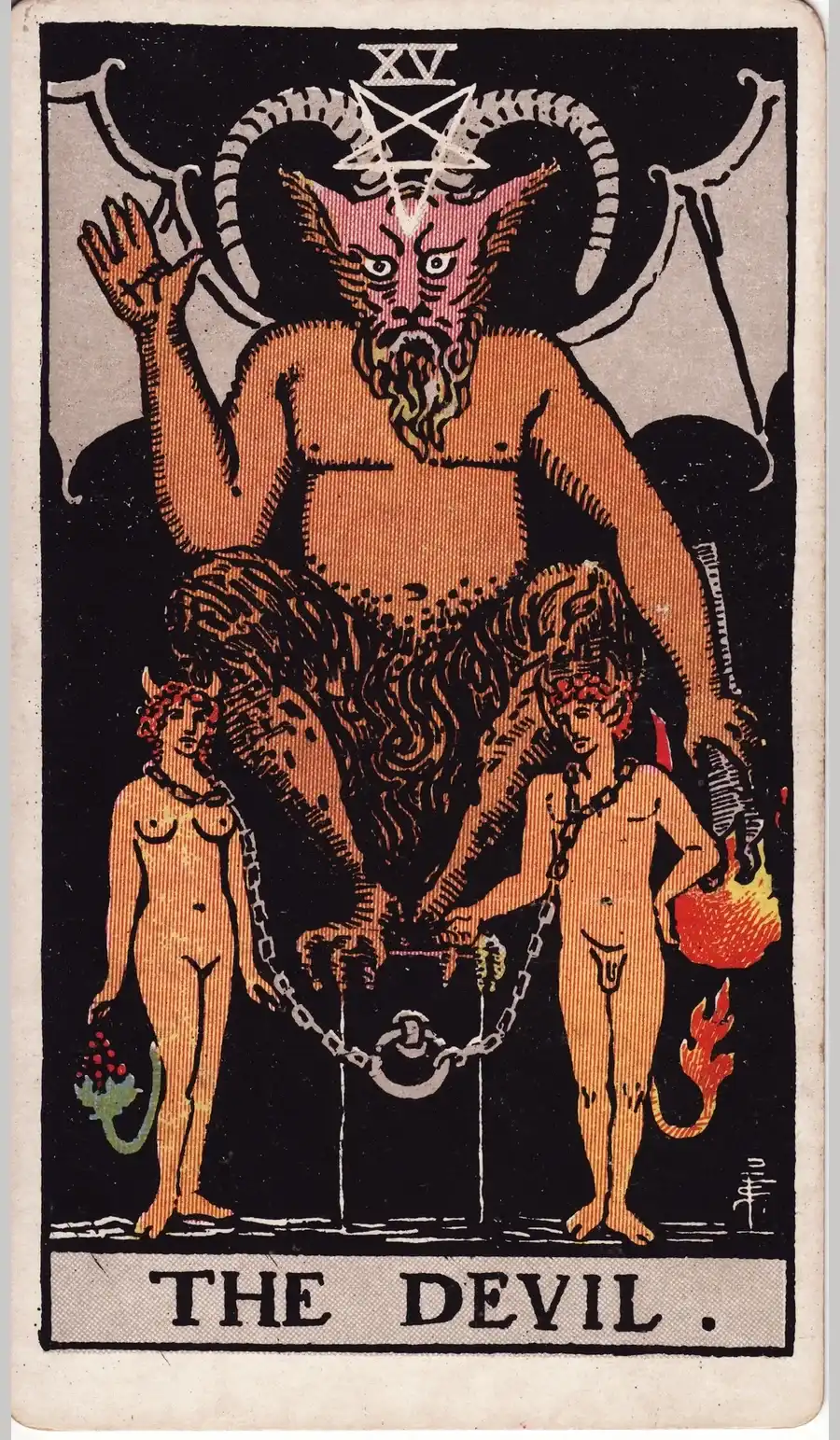
The 1909 card shows a horned, bat-winged figure on a dark block, with a man and a woman chained below it, unclothed and with small horns and tails. Waite described “the Horned Goat of Mendes, with wings like those of a bat, standing on an altar”, and two figures chained by the neck, “as if Adam and Eve after the Fall”.
The loose chains. The chains around the two figures’ necks are loose enough to lift off. Nothing but habit and fear keeps them there. That is the most important detail in the card. Freedom begins with noticing the chain.
The horned figure. A horned figure with bat wings sits on a dark block. Its right hand is raised in a gesture that Waite called “the reverse of that benediction which is given by the Hierophant”. It is a mirror of the Hierophant: control instead of guidance.
The torch. In the figure’s left hand is a torch pointing down to the earth. Energy and desire are turned toward the material world only.
The two figures. The two chained figures look like the Lovers, now with small tails and horns. Waite wrote that “there is human intelligence in the faces”, and that the figure above them “is not to be their master for ever”.
Upright meaning
Upright, the Devil names what holds you. A horned, bat-winged figure crouches on a black pedestal, one hand raised and the other holding a downward-pointing torch. Chained to the pedestal are a naked man and woman, now with small horns and tails. Look closely at the chains: they hang loosely around the necks. Either figure could lift them off.
The card describes attachment: a habit, a relationship, a job, a debt or a belief that has become a trap. It often appears when someone feels stuck but is also, in some way, choosing to stay, out of comfort, fear, desire or simply because the cost of leaving seems too high. It is also the card of appetite, materialism and the pull of the senses, which are not evil in themselves but become heavy when they run the show.
The Devil is not a curse. It is an honest mirror. It asks what you are giving your power to.
Reversed meaning
Reversed, the chains start to slip. The card often marks the beginning of freedom: noticing a pattern, admitting an addiction, ending an unhealthy relationship or simply saying “enough”. The first step out can feel shaky, and the old pull may return. That is normal.
The reversed Devil can also describe a pattern going underground, hidden rather than resolved, or a fear of looking at one’s own shadow at all.
Ask what you have started to see clearly. Then ask who can support you in staying free. For addiction or abuse, the card points to real help: a doctor, a counselor or a support line, not another reading.
In love, work and spirituality
In love. Upright: Intense attraction and strong sexual chemistry, or a relationship that feels hard to leave. Reversed: Breaking free from a controlling or unhealthy bond; reclaiming yourself.
At work. Upright: Feeling trapped by money or status; a job you stay in for the wrong reasons. Reversed: Leaving a toxic workplace, or loosening the grip of work on your life.
With money. Upright: Debt, materialism or spending that controls you. Reversed: Paying off debt, or changing your relationship with money.
In spiritual practice. Upright: Shadow work: honestly naming your attachments and appetites. Reversed: Release and liberation after a period of bondage.
As feelings. Strong desire, possibly obsession. The pull is intense, though not always healthy.
As a person. Charismatic, ambitious and sensual; someone who may control or be controlled.
As advice. Look at the chain honestly; it is looser than it feels.
Reading the Devil: positions, pairs and yes or no
In the past position: A habit or attachment that held you, perhaps still does. In the present position: Something has a hold on you. Look at the chain.
In the future position: A temptation to watch for, or a chance to break free. As advice: Name the hook, and ask for help to lift it off.
When the Devil shows up among mostly Minor cards, give it extra weight: the theme of bondage runs under the whole question.
Pairs matter too. Next to The Lovers, it can mean a relationship with an unhealthy pull. Next to Strength, it can mean the gentle courage it takes to break a habit. Next to The Tower, it can mean a pattern that breaks suddenly.
In modern yes or no readings, the Devil leans no. It warns that something is holding you, so it usually says no, or not until you deal with the chain.
The history and art behind the card
In the Tarot de Marseille pattern the card is called Le Diable, the Devil. The Devil is missing from the oldest surviving painted decks, perhaps lost, perhaps never made, and we cannot be sure which. On Marseille cards the Devil is a strange figure with wings, horns and breasts, standing on a pedestal with two small chained imps.
The goat-headed figure on modern cards comes from Éliphas Lévi, who in 1856 drew a winged, goat-headed being he called Baphomet. Waite said he based his design on several older motifs, and Smith’s picture clearly echoes Lévi’s drawing.
Waite also mocked Lévi for claiming that the figure stood for occult science and magic. For Waite it was about “the chain and fatality of the material life”.
Modern readers treat the Devil as a psychological card. It is about what we are attached to, not about an outside force that controls us. That reading is gentler and, for most people, more useful.
When A. E. Waite published The Pictorial Key to the Tarot in 1910, he listed these divinatory meanings for the card: “Ravage, violence, vehemence, extraordinary efforts, force, fatality; that which is predestined but is not for this reason evil.”
Reversed, he gave: “Evil fatality, weakness, pettiness, blindness.” Waite himself called the fortune-telling meanings of the trumps “artificial and arbitrary”, and on this site I read the picture first and treat lists like this as history.
The Devil opens the third stage of the modern Fool’s Journey, seeing through and returning. Having found balance in Temperance, the traveler now has to look at the chains they have accepted, and notice how loosely they actually sit.
Common questions
Is the Devil card evil? No. In tarot the Devil is about attachment, habits and temptation, not about evil forces. Its chains are loose.
Does the Devil mean someone is cheating? Not by itself. It can point to obsession, jealousy or temptation, but tarot cannot prove what another person is doing.
Try this
Try this small spread for the Devil. Use it when you feel stuck in a habit or a pattern.
| Card | Question | What it shows |
|---|---|---|
| 1 | What holds me? | The chain, named honestly. |
| 2 | What does it give me? | Why I keep it on, the reward hidden inside the habit. |
| 3 | How can I lift it off? | One step toward freedom, and who can help. |
Affirmation: I name what binds me and take the next freeing step I can sustain.
Reversed affirmation: I keep releasing what binds me with honest support and steady boundaries.
If you keep a tarot journal, take one of these questions to it: What do I keep doing even though I know it does not serve me? What does this chain give me, and what does it cost? Who could help me lift it off?
What next
Cards that sit close to this one are The Lovers (the card the Devil mirrors: love versus attachment), The Tower (the next card: the shock that breaks the chains) and Strength (the gentle strength that frees you).
The Devil is part of the lesson The Devil to the World in my free Tarot for Beginners course. To keep walking the Major Arcana, read the card before it, Temperance or the card after it, The Tower, or go back to all the card meanings.
For every card with keywords, affirmations and examples, see my book The Novice’s Guide to Tarot. If you would like a printable cheat sheet for all 78 cards, my 45-page Tarot Workbook is on Etsy.
Sources
- A. E. Waite, The Pictorial Key to the Tarot (London: Rider, 1910), Part II and Part III, section 3.
- Pamela Colman Smith and A. E. Waite, the Rider-Waite-Smith tarot (London: Rider, 1909).
- Nicolas Conver, Tarot de Marseille (Marseille, 1760).
- Eden Gray, A Complete Guide to the Tarot (New York: Crown, 1970), epilogue “The Fool’s Journey”.
- Lauri Mukkala, The Novice’s Guide to Tarot, entry for The Devil.
- Aleister Crowley, 777 (London: Walter Scott, 1909), columns of the Hebrew letters, paths and Tarot trumps.
- Israel Regardie, ed., The Golden Dawn (Chicago: Aries Press, 1937 to 1940), “Book T” and the titles of the trumps.
All 78 cards
Major Arcana
- The Fool
- The Magician
- The High Priestess
- The Empress
- The Emperor
- The Hierophant
- The Lovers
- The Chariot
- Strength
- The Hermit
- Wheel of Fortune
- Justice
- The Hanged Man
- Death
- Temperance
- The Devil
- The Tower
- The Star
- The Moon
- The Sun
- Judgement
- The World
Wands
- Ace of Wands
- Two of Wands
- Three of Wands
- Four of Wands
- Five of Wands
- Six of Wands
- Seven of Wands
- Eight of Wands
- Nine of Wands
- Ten of Wands
- Page of Wands
- Knight of Wands
- Queen of Wands
- King of Wands
Cups
- Ace of Cups
- Two of Cups
- Three of Cups
- Four of Cups
- Five of Cups
- Six of Cups
- Seven of Cups
- Eight of Cups
- Nine of Cups
- Ten of Cups
- Page of Cups
- Knight of Cups
- Queen of Cups
- King of Cups
Swords
- Ace of Swords
- Two of Swords
- Three of Swords
- Four of Swords
- Five of Swords
- Six of Swords
- Seven of Swords
- Eight of Swords
- Nine of Swords
- Ten of Swords
- Page of Swords
- Knight of Swords
- Queen of Swords
- King of Swords
Pentacles
Get the free Mini-Grimoire
A short printable starter guide to tarot and everyday witchcraft, plus my newsletter. Unsubscribe any time.
Opens Substack in a new tab to confirm. More about the newsletter · Privacy