


How to read the labels Historical what the old sources say. Later tradition what later writers added. Modern modern practice and my own notes.
Early medieval art is the art of Europe from roughly 500 to 1000 CE, between the end of the Western Roman Empire and the rise of Romanesque. It includes the Insular gospel books of Ireland and Britain, such as the Book of Durrow and the Lindisfarne Gospels, the Carolingian manuscripts made for Charlemagne’s court, Anglo-Saxon metalwork and Viking ornament. Most of it survives as small, precious objects and books.
Older books called the centuries after the fall of the western Roman Empire the “Dark Ages”. That phrase was invented by Renaissance writers who wanted their own time to look like a rebirth.
The art says otherwise. Monks, goldsmiths and carvers mixed Roman, Christian, Celtic and Germanic traditions into some of the most intricate objects ever made.
Key dates
| When | What happened |
|---|---|
| About 245 | The house church at Dura-Europos is painted. |
| About 625 | The Sutton Hoo ship burial in England. |
| About 715 to 720 | The Lindisfarne Gospels are made. |
| 800 | Charlemagne is crowned emperor and leads a revival of learning and art. |
| About 800 | The Book of Kells is made. |
| About 834 | The Oseberg ship burial in Norway. |
What is early medieval art?
Early medieval art is the Christian and pre-Christian art of post-Roman Europe, made mostly in monasteries and royal workshops, and famous for interlace, animal ornament and painted gospel books.
Throughout this page I mark three layers. Historical What objects and texts show. Later tradition What later centuries, especially the nineteenth, made of them. Modern How people use these symbols today.
Historical Dura-Europos: images where we least expect them. In the 1930s excavators at Dura-Europos, a Roman frontier town in Syria, found a synagogue whose walls were covered with paintings of Hebrew Bible stories, from Moses to Esther.
An inscription dates a renovation to 244 or 245 CE. It overturns the belief that Judaism always forbade figurative images. Nearby, a house converted into a Christian meeting place had a painted baptism room from around 232 or 233, among the oldest known Christian paintings.
Historical Insular manuscripts. In Ireland and Britain, monks made Gospel books that combine Christian text with an ornamental tradition of interlace, spirals and animals. Art historians call the style Insular, from the Latin for “island”.
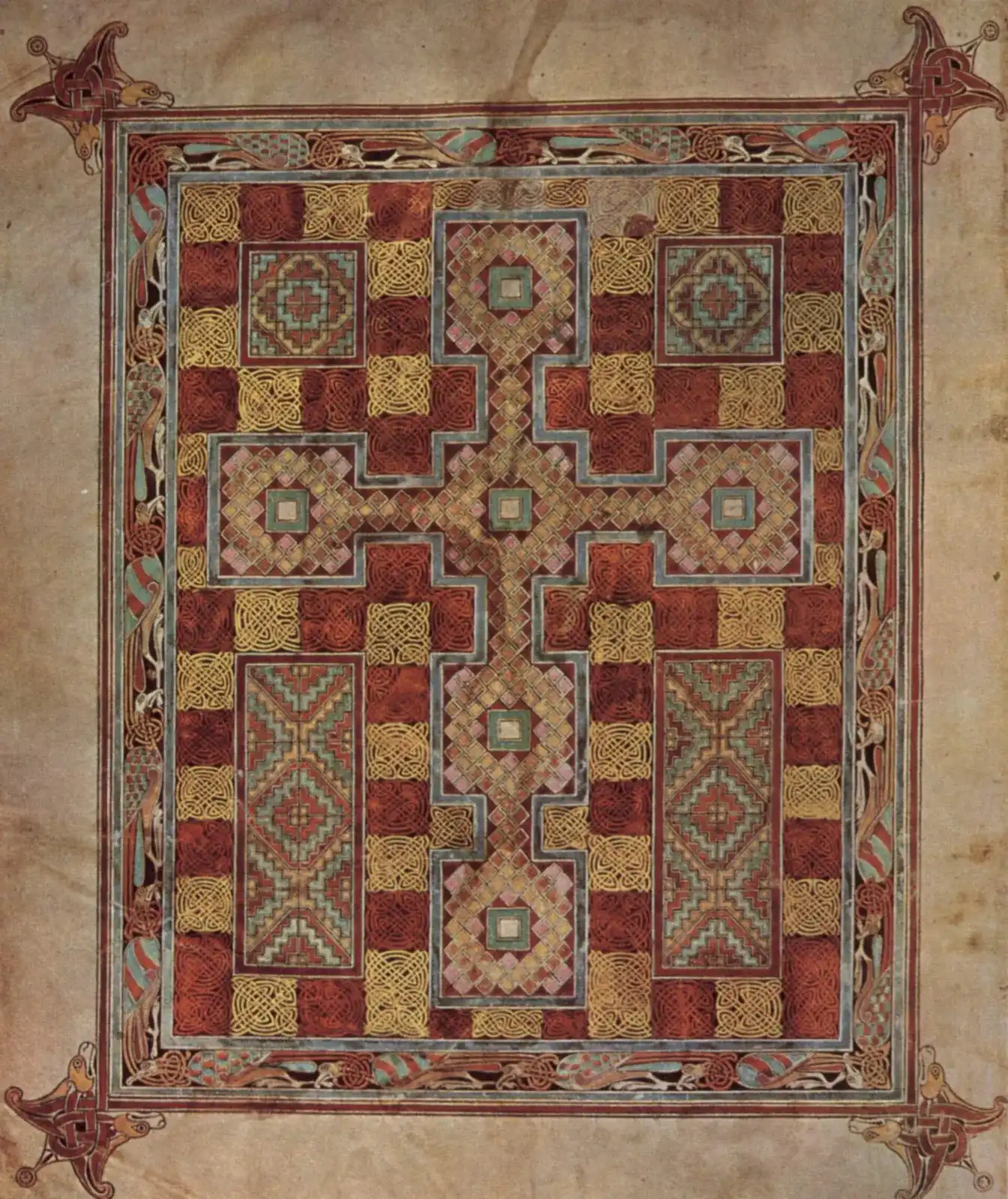
The Lindisfarne Gospels, made around 700 at the monastery of Lindisfarne in northeast England and now in the British Library, include “carpet pages” filled with interlocking patterns that form a cross.
The Book of Kells, made around 800, probably partly on Iona in Scotland, is now at Trinity College Dublin. Its Chi-Rho page fills a whole folio with the first two Greek letters of Christ’s name, wrapped in spirals, knots and tiny animals, including cats and mice.
Charlemagne’s revival. 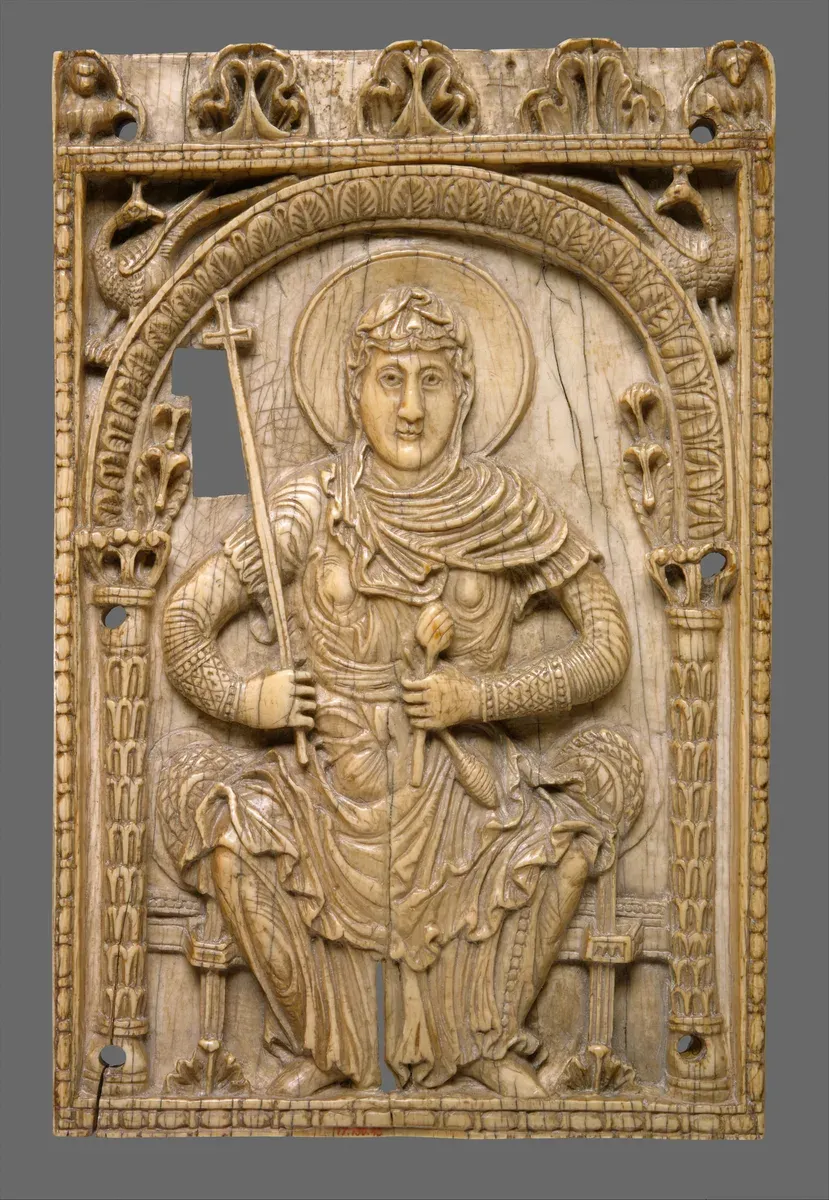
Plaque with the Virgin Mary as a Personification of the Church, about 800 to 825. The Metropolitan Museum of Art (17.190.49). Image: Open Access, public domain (CC0).
Historical Charlemagne, crowned emperor in Rome in 800, promoted a revival of learning and classical forms that historians call the Carolingian Renaissance. His court made manuscripts, ivories and metalwork that blended Roman models with northern traditions.
This ivory plaque at the Met, from about 800 to 825, shows the Virgin Mary as a personification of the Church, crowned and holding a staff, carved with a delicacy that looks back to Late Antique ivories.
Historical Viking and Norse art. Scandinavian art of the Viking Age, roughly 790 to 1100, survives mainly in metalwork, wood and stone, and it is dominated by animals: stretched, twisted creatures that bite and grip each other. Scholars name the styles after key finds, from Oseberg and Borre to Jelling, Mammen, Ringerike and Urnes.
The Oseberg ship burial in Norway, dated by tree rings to 834, held two women buried with a carved ship, a cart and sledges. The great Jelling runestone in Denmark, raised by King Harald Bluetooth around 965, carries an image of Christ to mark Denmark’s conversion.
Key artists
| Artist | Lived | Why they matter |
|---|---|---|
| Eadfrith | died 721 | Bishop of Lindisfarne, traditionally named as the scribe and artist of the Lindisfarne Gospels. |
| Alcuin of York | about 735 to 804 | The scholar at Charlemagne’s court who reformed handwriting and books. |
| The Ebbo Gospels painter | about 816 to 835 | An unnamed artist at Reims whose nervous, flickering line is unlike anything before. |
| Wolvinius | 9th century | The goldsmith who signed the golden altar of Sant’Ambrogio in Milan. |
How do you recognise early medieval art?
Look for interlace, knots and animals that bite and twist into each other, carried over from metalwork into books. Pages become solid carpets of pattern. Human figures are flat and stylised. In the Carolingian revival, Roman models return: drapery, columns and portraits of the evangelists at their desks.
Common misconceptions. “The Dark Ages had no art” is the big one; the surviving books and metalwork are some of the most intricate objects ever made in Europe.
Another is that monks did everything. Royal and lay goldsmiths were highly valued, and women worked as scribes and painters too. A nun called Ende signed her name as a painter in the Girona Beatus, an illustrated commentary on the Apocalypse finished in 975, and traces of lapis lazuli in the teeth of a medieval woman buried at Dalheim in Germany suggest she painted manuscripts. A third is that Viking art is all helmets with horns. Horned helmets come from 19th-century opera costumes, not from the Viking Age.
Esoteric themes
Historical Runes were primarily a writing system. Some inscriptions have magical or ritual content, but most are memorials, names and messages. Early medieval people also used charms and amulets, and some Old English healing charms survive in manuscripts.
Later tradition Modern rune divination sets are largely twentieth-century creations. One influential early system was invented by the Austrian occultist Guido von List in the early 1900s, whose ideas were later taken up by far-right movements. Many “Celtic” knot meanings sold online are also modern. My runes section explains what we know and what we do not.
Modern Many people use runes and knotwork in practice today. That is fine, and it is more honest and more interesting when we know which parts are old.
Works to see
| Work | Artist | Date | Where to see it |
|---|---|---|---|
| Lindisfarne Gospels | Traditionally Eadfrith of Lindisfarne | about 715 to 720 | British Library, London |
| Book of Kells | Insular scribes | about 800 | Trinity College Library, Dublin |
| Sutton Hoo helmet and buckle | Anglo-Saxon | about 625 | The British Museum, London |
| Oseberg ship | Norse | about 834 | Museum of the Viking Age, Oslo |
Every work in this list is free of nudity, so you can look them up with confidence. Works still in copyright are named but not shown here.
How to look at an early medieval manuscript page
Pick one strand of interlace and try to follow it with your eye, or a fingertip in the air. It will go over, under, and usually back to where it began. Then look for animals hidden in the knots, and for the colours, which came from plants, minerals and sometimes stones traded from far away.
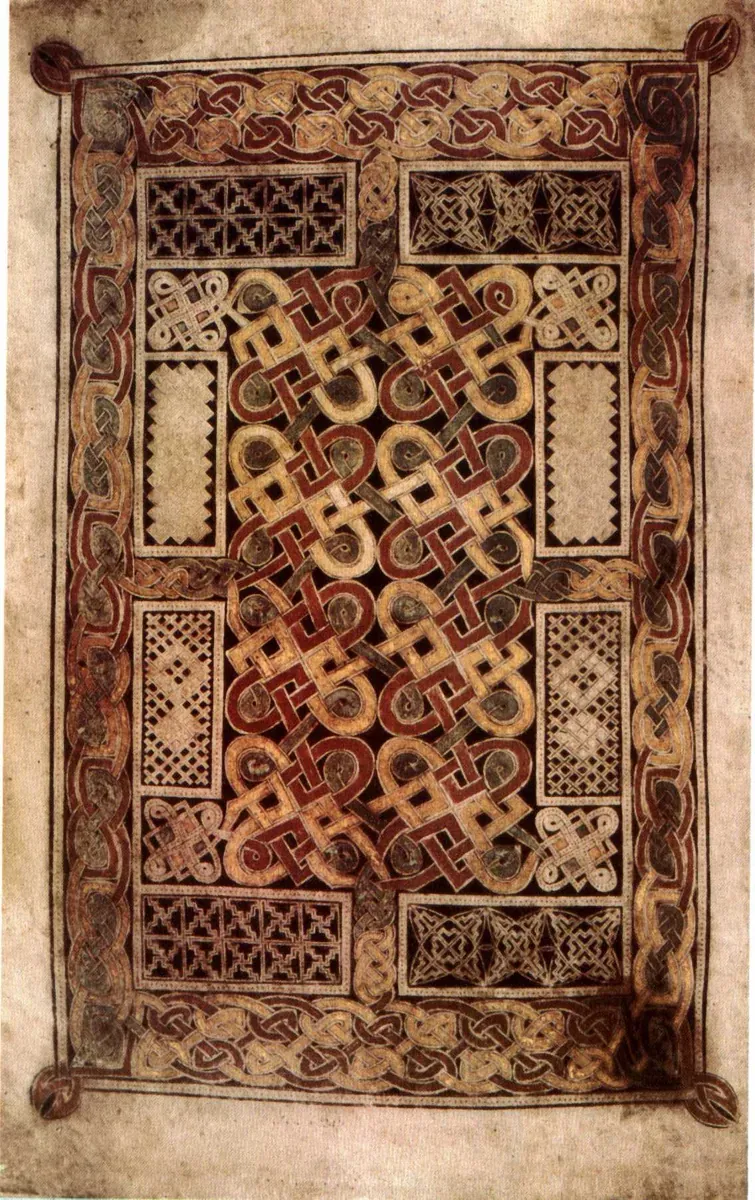
Unknown Insular artists, Book of Durrow, carpet page, about 650 to 700. Trinity College Library, Dublin. Image: Wikimedia Commons, public domain.
Book of Durrow, carpet page, about 650 to 700. At Trinity College Library, Dublin, beside the Book of Kells. A “carpet page” is a full page of ornament with no words, placed before a gospel like a doorway. Look at the narrow palette of yellow, red, green and black, and the way the ribbons never break.
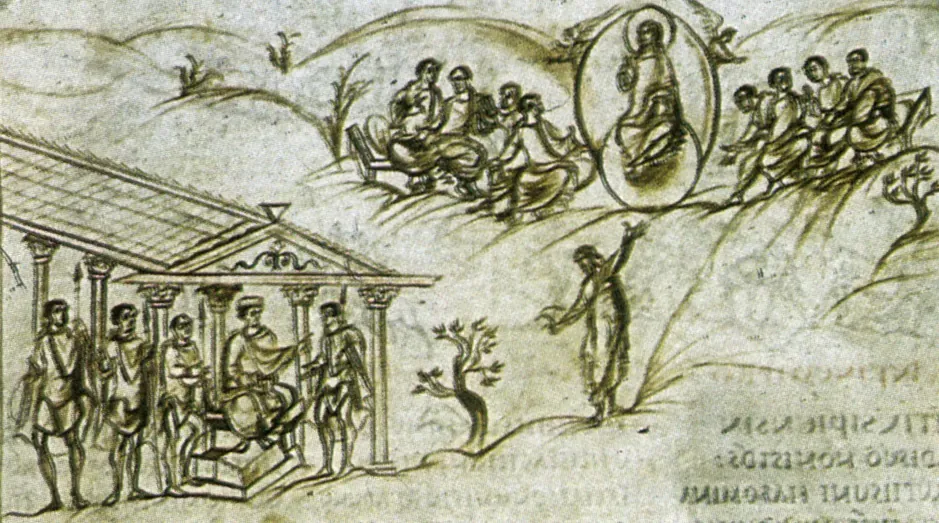
Unknown Carolingian artists, Utrecht Psalter, page with a psalm illustration, about 820 to 835. Utrecht University Library. Image: Wikimedia Commons, public domain.
Utrecht Psalter, about 820 to 835. Now at Utrecht University Library, made in the region of Reims in Carolingian France. Every psalm is illustrated with quick brown ink drawings of tiny, nervous figures acting out its words. The style was so admired that the book was copied in Canterbury around 1000.
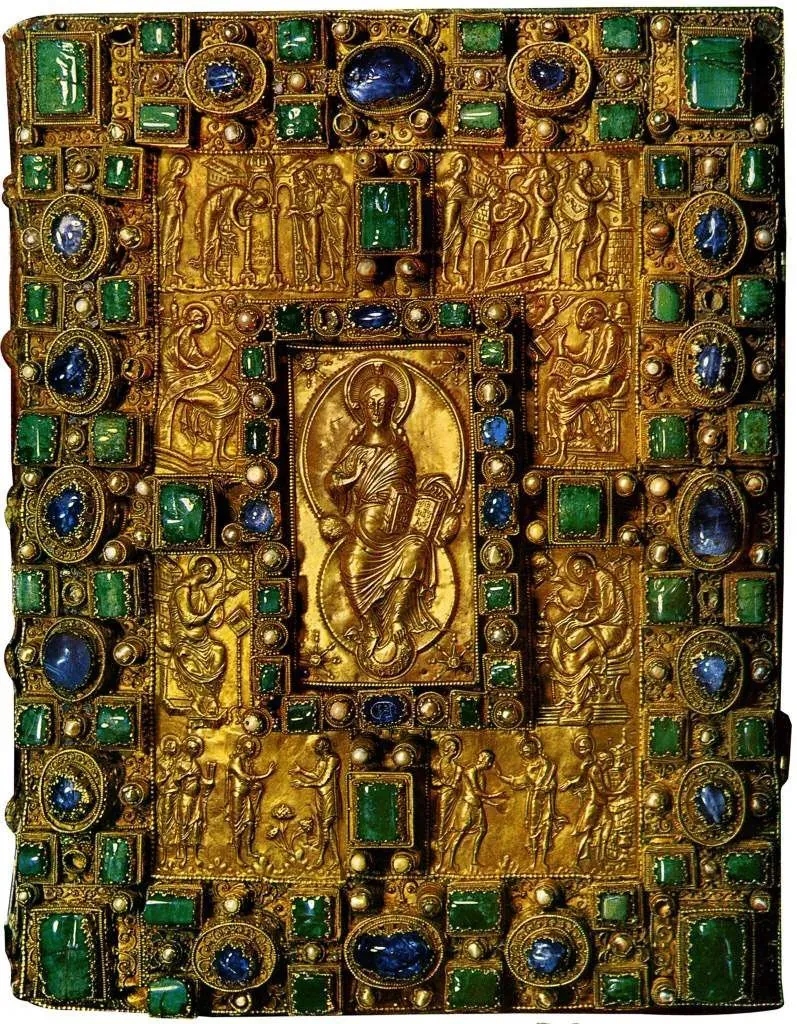
Unknown Carolingian artists, Codex Aureus of St. Emmeram, 870. Bavarian State Library, Munich. Image: Wikimedia Commons, public domain.
Codex Aureus of St. Emmeram, 870. At the Bavarian State Library in Munich. A gospel book written in gold letters for Charles the Bald, Charlemagne’s grandson. Its cover of gold, gems and pearls shows that a book could be treated like a relic.
Early medieval art grew from late Roman and Byzantine models, which it mixed with Celtic and Germanic ornament. It led into Romanesque art, and its books began the long story of illuminated manuscripts.
Try this
Open the Chi-Rho page in Trinity College Dublin’s digital edition of the Book of Kells, or a photo of an Urnes-style carving. Choose one animal and follow its body from head to tail with your finger. Count how many times it crosses something. How long did it take you to find its tail?
What next
Before this: Byzantine art.
After this: Illuminated manuscripts.
Also worth reading alongside it: Romanesque.
See every movement in order on the art movements timeline, or learn to look step by step in the free Art History for Beginners course.
If you want to carry this into tarot and practice, these pages connect to it: Wheel of Fortune, the endless knot and the turning of fate; The Hermit, the monk with his book and lamp, keeping learning alive; Reading interlace and animal style; and The runes carved in the same centuries.
Sources
- Michelle P. Brown, The Lindisfarne Gospels (2003).
- James Graham-Campbell, Viking Art (2013).
- The Metropolitan Museum of Art, Plaque with the Virgin Mary as a Personification of the Church, 17.190.49. Open the record
- Trinity College Dublin, Book of Kells, digital edition. Open the record
- E. H. Gombrich, The Story of Art (1950).
- Wikimedia Commons, Page from the Lindisfarne Gospels (hero image record). Open the record
- Lawrence Nees, Early Medieval Art (2002).

Questions
Were the Dark Ages really dark?
The phrase was invented by Renaissance writers who wanted their own age to look like a rebirth. The art of the early Middle Ages, from the Book of Kells to Viking carving, tells a very different story.
Were runes used for magic?
Runes were mainly a writing system. Some inscriptions have magical or ritual content, but most are memorials, names and messages. Modern rune divination sets are largely twentieth-century creations.
Where can I see works of Early medieval art in person?
Good places to start are the British Library, the British Museum, Trinity College Dublin, the Met Cloisters, and museums in Oslo and Copenhagen. Museums change their displays, so check the collection page before you travel.
What is Insular art?
Insular art is the art of Ireland and Britain from about 600 to 900, named after the islands. It is known for interlace, spirals and animal patterns, as in the Books of Durrow and Kells and the Lindisfarne Gospels.
What is Carolingian art?
Carolingian art was made under Charlemagne and his heirs, about 780 to 900. They revived late Roman and Byzantine models, especially in manuscripts, ivories and metalwork.
Get the free Mini-Grimoire
A short printable starter guide to tarot and everyday witchcraft, plus my newsletter. Unsubscribe any time.
Opens Substack in a new tab to confirm. More about the newsletter · Privacy