


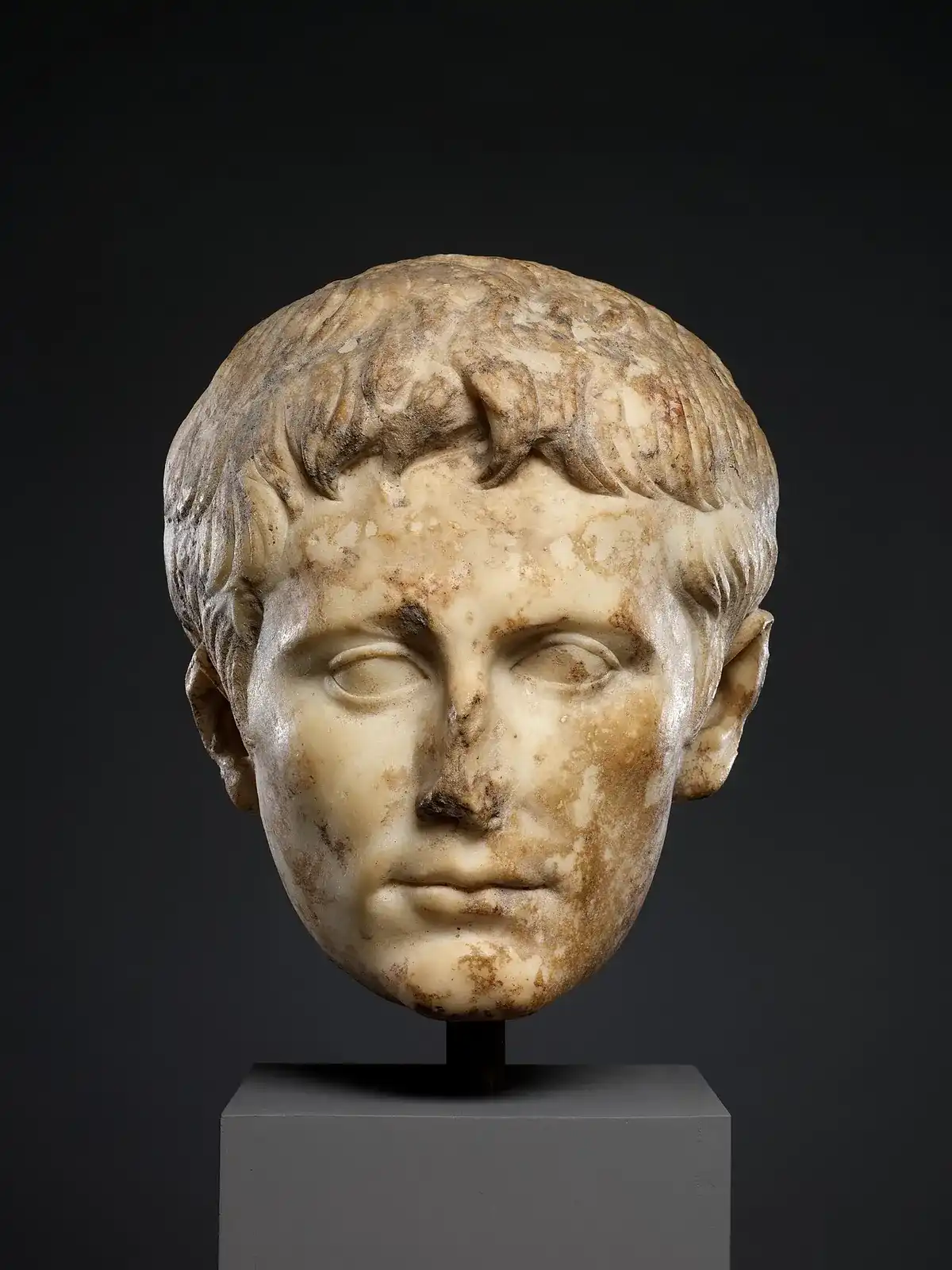
How to read the labels Historical what the old sources say. Later tradition what later writers added. Modern modern practice and my own notes.
Ancient Roman art is the art of Rome and its empire from about the 2nd century BCE to the 4th century CE, across Europe, North Africa and the Middle East. It is known for realistic portrait busts, painted villa walls at Pompeii, vast concrete buildings such as the Pantheon and the mummy portraits of Roman Egypt. Rome borrowed heavily from Greek art and spread it across its empire.
Roman art is sometimes treated as Greek art’s practical younger sibling. That is unfair. The Romans gave us the honest portrait, the painted room you can step into, concrete domes and a public art of messages, on coins, arches and columns, that every later empire copied.
Key dates
| When | What happened |
|---|---|
| About 500 BCE | Etruscan tomb painting flourishes at Tarquinia. |
| 27 BCE | Augustus becomes the first emperor and uses portraits to spread his image. |
| 79 CE | Vesuvius buries Pompeii and Herculaneum, preserving their wall paintings. |
| 113 CE | Trajan’s Column is dedicated in Rome. |
| About 125 CE | Hadrian rebuilds the Pantheon with its open eye in the dome. |
| 313 CE | Constantine allows Christian worship, and Christian imagery grows. |
What is Ancient Roman art?
Ancient Roman art is the portrait sculpture, wall painting, mosaic and architecture of the Roman Republic and Empire, made for homes, tombs, public buildings and imperial propaganda.
Throughout this page I mark three layers. Historical What objects and texts show. Later tradition What later Europe made of Rome. Modern How Roman gods and images are used today.
Historical The Etruscans first. Before Rome dominated Italy, the Etruscans flourished in central Italy from about the eighth to the third century BCE. Their language can be read aloud but is only partly understood. Their art is known mainly from tombs: painted chambers with banquets, dancers and musicians, and terracotta sarcophagi with reclining couples on the lid.
The Sarcophagus of the Spouses from Cerveteri, about 520 BCE, in the National Etruscan Museum in Rome, shows a husband and wife smiling together at a banquet. The Met’s bronze Monteleone chariot, from the sixth century BCE, is one of the finest pieces of ancient bronze work anywhere.
Historical The honest face and the ageless emperor. Roman Republican portraits show wrinkles, sagging cheeks and receding hair. Scholars call this verism. For a Roman senator, those marks were signs of experience and service to the state.
Augustus, the first emperor, who ruled from 27 BCE to 14 CE, chose a different message. His portraits show him forever young and calm, with a fringe of locks modeled on Classical Greek sculpture, even when he was in his seventies.
Later emperors used style the same way. Caracalla frowns with a soldier’s toughness; Constantine, the first Christian emperor, gazes upward with huge eyes, a sign of spiritual authority that looks forward to Byzantine art.
Rooms you can walk into. 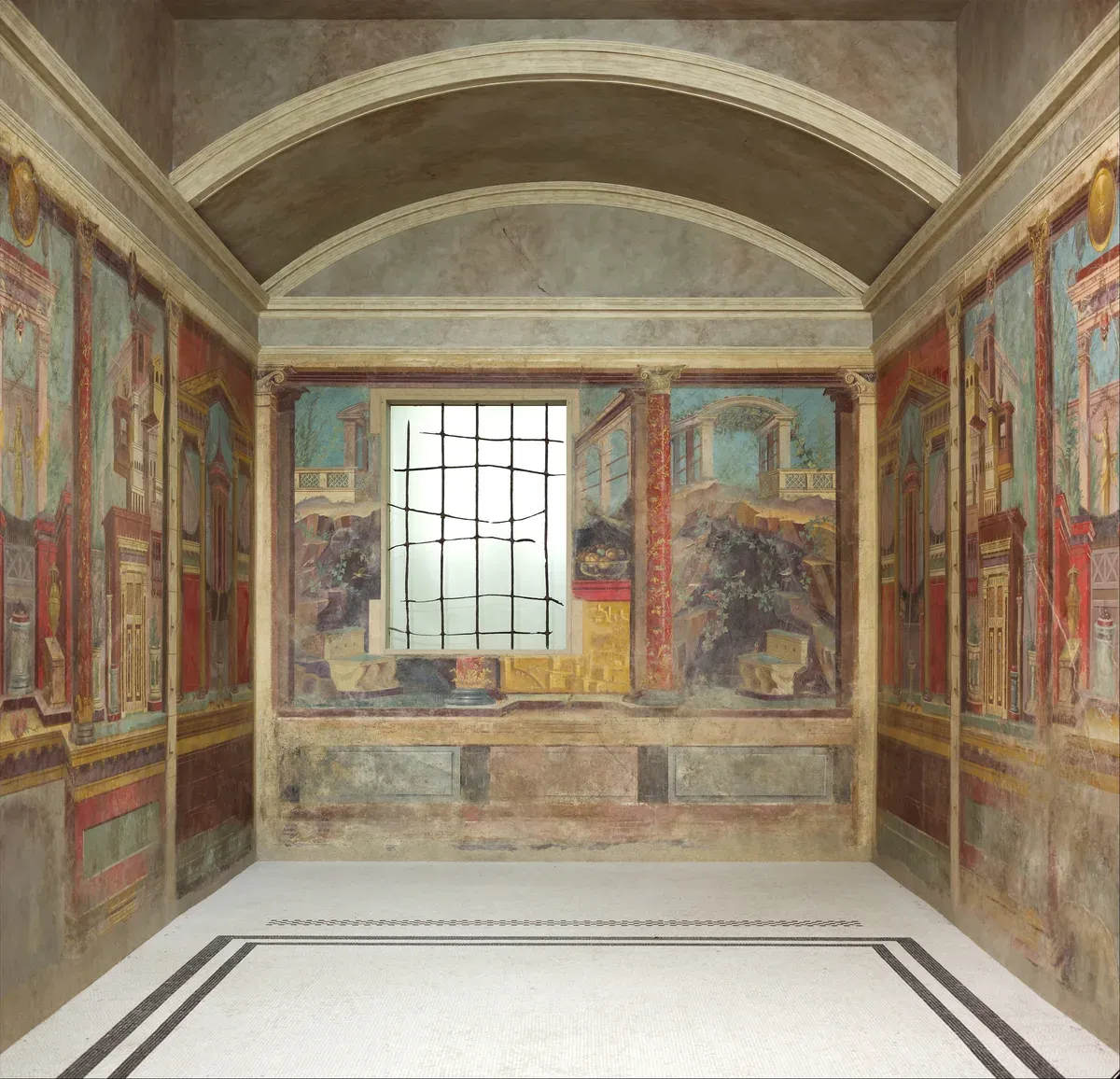
Cubiculum (bedroom) from the Villa of P. Fannius Synistor at Boscoreale, about 50 to 40 BCE. The Metropolitan Museum of Art (03.14.13a to g). Image: Open Access, public domain (CC0).
Historical When Vesuvius erupted in 79 CE, it buried Pompeii, Herculaneum and the villas around them, preserving painted walls in remarkable detail. The Met has a whole bedroom, a cubiculum, from a villa at Boscoreale painted about 50 to 40 BCE.
Its walls open into painted colonnades, city views and a garden grotto. Scholars group Roman wall painting into four “Pompeian styles”, a nineteenth-century scheme that is a helpful guide rather than a rule the Romans used.
Historical Building and public messages. Roman builders used concrete to make vaults and domes on a new scale. The Pantheon in Rome, rebuilt under Hadrian in the 120s CE, still has the largest unreinforced concrete dome in the world, open to the sky through a central oculus.
Public reliefs such as the Ara Pacis, the Altar of Augustan Peace, and Trajan’s Column, which spirals with scenes of war in Dacia, turned politics into pictures for everyone to read.
Key artists
| Artist | Lived | Why they matter |
|---|---|---|
| Vitruvius | about 80 to after 15 BCE | The architect whose Ten Books on Architecture shaped building for two thousand years. |
| Apollodorus of Damascus | 2nd century CE | Architect to Trajan, linked with Trajan’s Forum and Column. |
| The painters of Boscoreale | 1st century BCE | The unnamed workshop that painted the bedroom now rebuilt in the Met. |
| Mummy portrait painters of the Faiyum | 1st to 3rd century CE | Painters in Roman Egypt who made startlingly lifelike faces in wax paint. |
How do you recognise Ancient Roman art?
Look for honest, wrinkled faces of the Republic beside the smooth, ageless emperors. Walls open into painted gardens and imaginary buildings. Concrete, arches and domes make huge interiors. Public art tells stories in long spiraling bands, and almost everything has a political message.
Common misconceptions. “Roman art is only a copy of Greek art” is the classic one. Romans did copy Greek statues, and we owe them much of what we know about Greek sculpture, but the realistic portrait bust, the painted illusion of a villa wall and the concrete dome are Roman achievements.
Another is that Roman women were invisible in art. Empresses such as Livia were portrayed across the empire, and Pliny the Elder names a woman painter, Iaia of Cyzicus, who worked in Rome in the 1st century BCE and painted mostly portraits of women. A third is that Roman marble was white. Like Greek sculpture, it was usually painted.
Esoteric themes
Historical Roman homes had shrines called lararia for the household spirits, the lares, often painted on the wall with a serpent below. People also wore amulets, consulted astrologers and wrote curse tablets on lead. Wall paintings in Pompeii’s Villa of the Mysteries show a ritual sequence, probably connected with Dionysus, whose exact meaning is debated.
Later tradition Many grimoires, festivals and symbols of later Western magic passed through Rome, including much of the Greek magical papyri written in Roman Egypt. My Hekate course explores some of these texts.
Modern Some people today keep a household shrine inspired by the lararium. It is a lovely idea, and honest about being a modern revival.
Works to see
| Work | Artist | Date | Where to see it |
|---|---|---|---|
| Marble portrait of the emperor Augustus | Roman | about 14 to 37 CE | The Metropolitan Museum of Art, New York |
| Cubiculum from the Villa of P. Fannius Synistor at Boscoreale | Roman | about 50 to 40 BCE | The Metropolitan Museum of Art, New York |
| Augustus of Prima Porta | Roman | early 1st century CE | Vatican Museums, Rome |
| Mummy portrait of a woman | Romano-Egyptian | about 100 CE | The Metropolitan Museum of Art, New York |
Every work in this list is free of nudity, so you can look them up with confidence. Works still in copyright are named but not shown here.
How to look at a Roman portrait or building
With a portrait, ask whether the face is idealised or marked by age. Republican portraits proudly show wrinkles, a sign of experience. Imperial portraits, like those of Augustus, are often ageless and calm. With a building, look up, because Roman engineers loved to make interior space itself the subject.
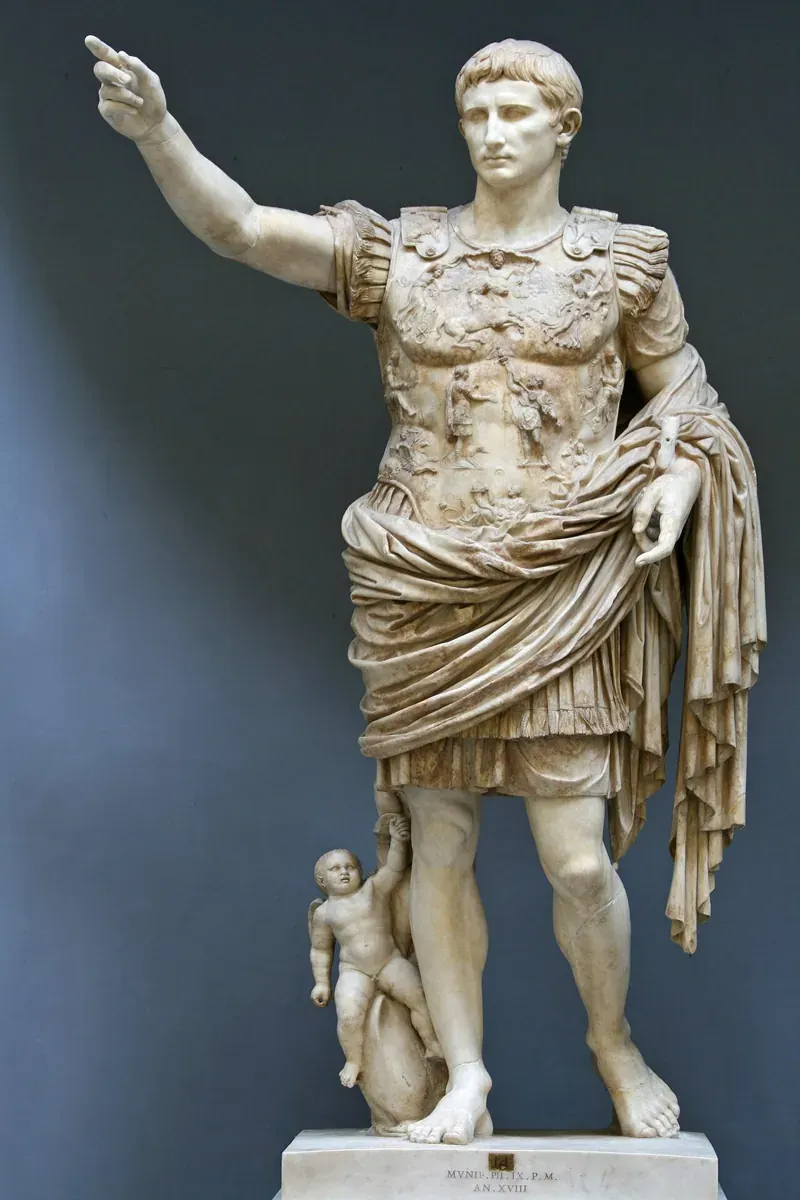
Unknown Roman sculptor, Augustus of Prima Porta, early 1st century CE. Vatican Museums, Rome. Image: Wikimedia Commons, public domain.
Augustus of Prima Porta, early 1st century CE. Found in 1863 at the villa of Augustus’s wife Livia at Prima Porta, near Rome, now in the Vatican Museums. The pose borrows from Greek statues of athletes. The breastplate shows the return of Roman military standards from Parthia in 20 BCE, and the Cupid on a dolphin links Augustus to the goddess Venus, whom his family claimed as an ancestor.
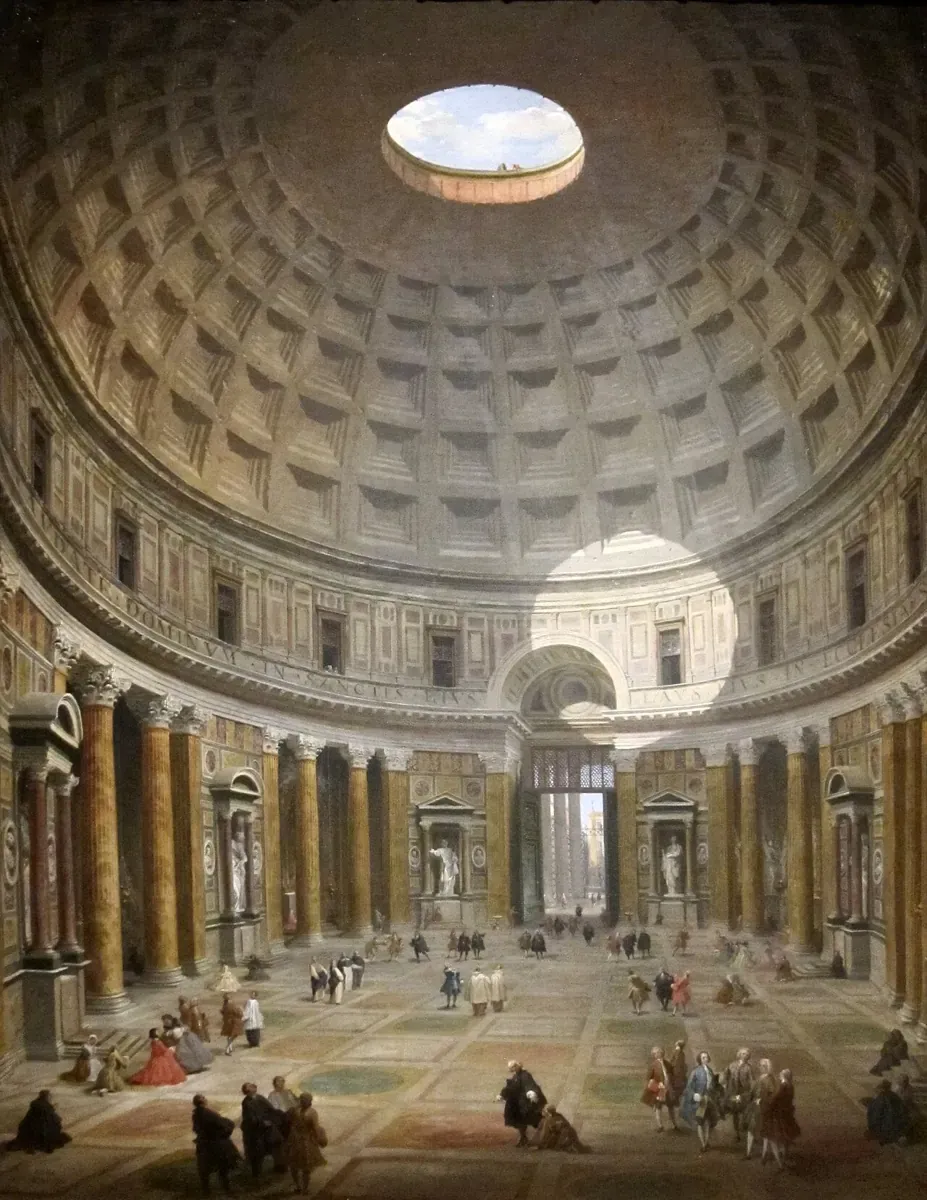
Giovanni Paolo Panini, Interior of the Pantheon, Rome, 1747. Cleveland Museum of Art. Image: Wikimedia Commons, public domain.
Giovanni Paolo Panini, Interior of the Pantheon, 1747. At the Cleveland Museum of Art. Panini painted this view many times for visitors to Rome. The building he shows was built under Hadrian, about 113 to 125 CE, and its concrete dome is still the largest unreinforced one in the world. Notice the patch of sunlight from the oculus, the open eye at the top, which moves around the room through the day.
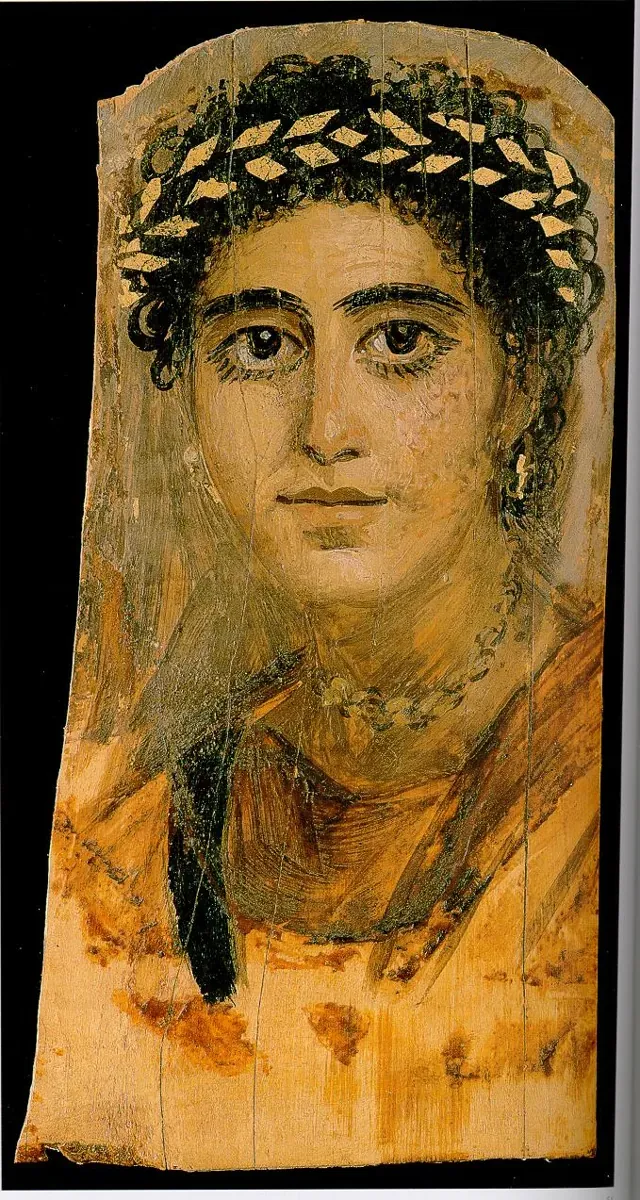
Unknown Romano-Egyptian artist, Portrait of a young woman in red, about 90 to 120 CE. The Metropolitan Museum of Art, New York. Image: Wikimedia Commons, public domain.
Portrait of a young woman in red, about 90 to 120 CE. At the Metropolitan Museum of Art. Painted on wood in Roman Egypt and placed over the face of a mummy. Look at the eyes and the highlights on the jewellery. Portraits like this mix Egyptian burial custom with Greek and Roman painting.
Roman art carried Greek forms across Europe and absorbed the traditions of Egypt. Its gold-ground and frontal late images led into Byzantine art, its round arches gave Romanesque its name, and its ruins inspired Neoclassicism.
Try this
Find a black-and-white photo of any Roman marble portrait. Trace its outline and color it, thinking of skin, eyes, hair and clothing. Then look up a scholarly painted reconstruction. How does color change the face, and the message?
What next
Before this: Ancient Greek art.
After this: Byzantine art.
See every movement in order on the art movements timeline, or learn to look step by step in the free Art History for Beginners course.
If you want to carry this into tarot and practice, these pages connect to it: The Emperor, authority, law and the carefully managed image of a ruler; The Chariot, the triumphal procession, a Roman image the card still echoes; The Roman Egypt where the Hermetic texts were written; and Hekate at Roman crossroads.
Sources
- Nancy H. Ramage and Andrew Ramage, Roman Art: Romulus to Constantine (1991).
- E. H. Gombrich, The Story of Art (1950).
- The Metropolitan Museum of Art, Marble portrait of the emperor Augustus, 07.286.115. Open the record
- The Metropolitan Museum of Art, Cubiculum from the Villa of P. Fannius Synistor at Boscoreale, 03.14.13a to g. Open the record
- Wikimedia Commons, Marble portrait of the emperor Augustus (hero image record). Open the record
- Nancy H. Ramage and Andrew Ramage, Roman Art: Romulus to Constantine (6th edition) (2015).

Questions
Why are Roman portraits so realistic?
In the Republic, wrinkles, sagging cheeks and baldness were signs of experience and service, a style called verism. Emperors later chose different looks, such as Augustus's ageless calm, to send their own messages.
What are the four Pompeian styles?
A modern scholar's scheme for Roman wall painting: imitation marble panels, painted architectural views, delicate panels with small pictures, and fantastic architecture. It is a helpful guide, not a rule Romans used.
Where can I see works of Ancient Roman art in person?
Good places to start are the Met, the Capitoline and Vatican Museums in Rome, the Naples Archaeological Museum, and Pompeii itself. Museums change their displays, so check the collection page before you travel.
What are Fayum mummy portraits?
They are portraits painted on wooden panels in Roman Egypt, mostly in the 1st to 3rd centuries CE, and placed over the faces of mummies. Many come from the Fayum region, which gives them their name.
How old is the Pantheon in Rome?
The present building was built under the emperor Hadrian, about 113 to 125 CE, replacing an earlier temple of Marcus Agrippa. It has been a church since 609.
Get the free Mini-Grimoire
A short printable starter guide to tarot and everyday witchcraft, plus my newsletter. Unsubscribe any time.
Opens Substack in a new tab to confirm. More about the newsletter · Privacy