


How to read the labels Historical what the old sources say. Later tradition what later writers added. Modern modern practice and my own notes.
Byzantine art is the art of the Eastern Roman Empire, centred on Constantinople, modern Istanbul, from the city’s founding in 330 until its fall to the Ottomans in 1453. Its best-known works are the gold-ground mosaics of Ravenna and Hagia Sophia and painted icons of Christ and the Virgin. The tradition continues today in Orthodox churches from Greece to Russia and Finland.
Its people called themselves Romans; “Byzantine” is a modern word. For more than a thousand years they made some of the most luminous art in the world, an art of gold, light and presence.
Key dates
| When | What happened |
|---|---|
| 330 | Constantine founds Constantinople. |
| About 547 | The mosaics of Justinian and Theodora are set in San Vitale, Ravenna. |
| 537 | Hagia Sophia is dedicated. |
| 726 to 843 | Iconoclasm: religious images are banned and destroyed, then restored. |
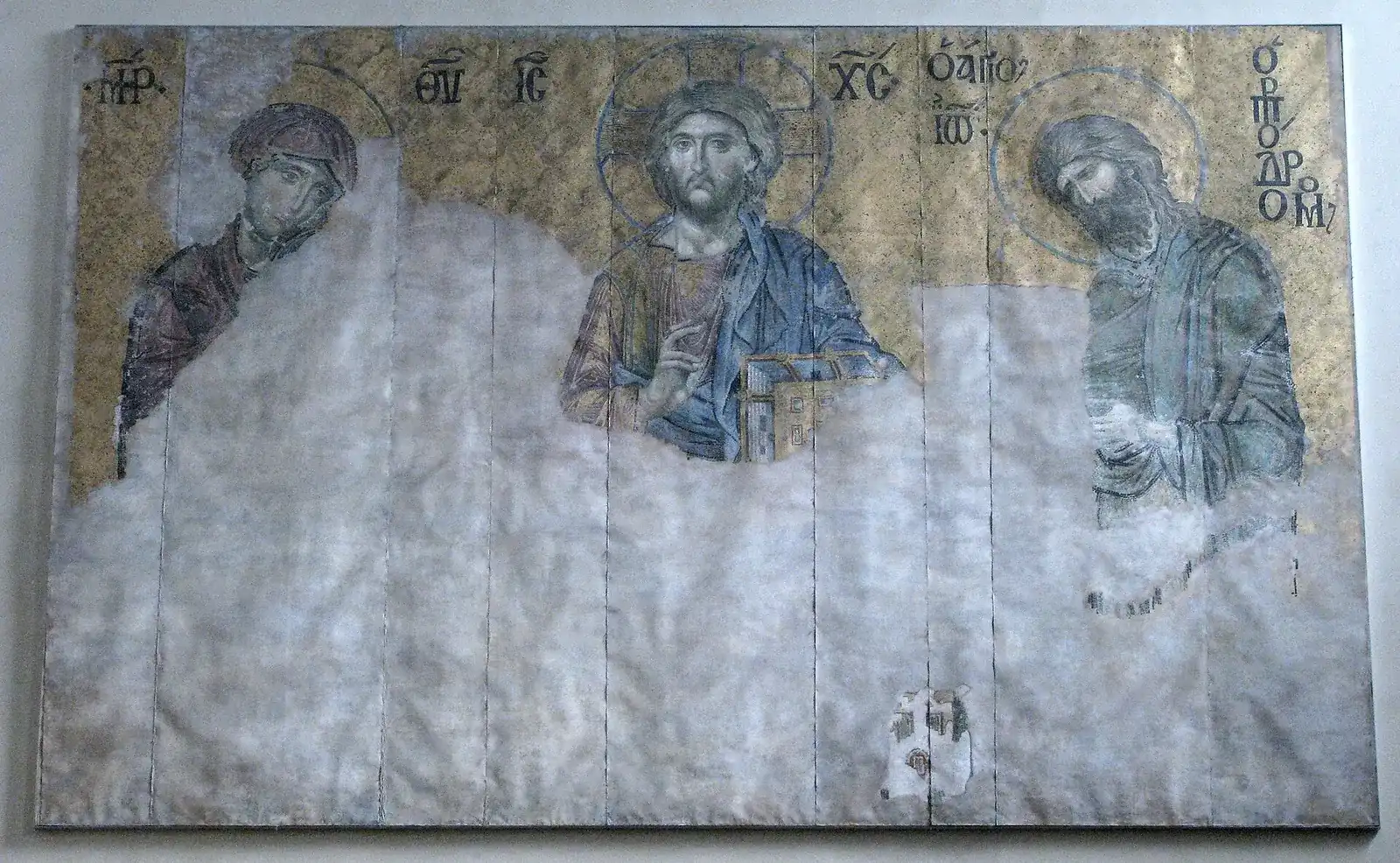
| About 1261 | The Deesis mosaic is made in Hagia Sophia. |
| 1453 | Constantinople falls to the Ottoman Turks. |
What is Byzantine art?
Byzantine art is the Christian art of the Byzantine Empire: mosaics, icons, frescoes, manuscripts and precious objects, made to show the holy as present and eternal.
Throughout this page I mark three layers. Historical What the works and texts of the time show. Later tradition What later centuries, and the Orthodox tradition, made of them. Modern How people use icons and their symbols today.
Historical A new way of seeing. Around the year 300, Roman art began to change. Figures became frontal and symmetrical, eyes grew large, bodies grew flatter and space mattered less. Older historians saw decline.
In 1901 the Austrian art historian Alois Riegl argued instead that it was a new artistic will, aiming at something other than the illusion of real space. Most scholars today agree. These images face you, because they were meant to be met, not just observed.
Historical Ravenna and Hagia Sophia. In the church of San Vitale in Ravenna, consecrated in 547, the emperor Justinian and the empress Theodora stand in mosaic with their courts, carrying gifts for the altar.
Their feet barely touch the ground, and gold surrounds them. Justinian’s great church of Hagia Sophia in Constantinople, built in just five years from 532 to 537, was crowned by a dome that seemed to float on a ring of windows.
Mosaic is made from small cubes of glass and stone called tesserae. In Byzantine mosaics many gold tesserae were set at slight angles, so the wall flickers as you move and as candlelight shifts. Photographs flatten this effect. If you can ever stand in one of these churches at dusk, do.
This is a painted copy on canvas, made in the late 1930s, of the Deesis mosaic in Hagia Sophia, from the late thirteenth century. Christ is flanked by Mary and John the Baptist, who turn toward him to plead for humanity. The faces are soft and sorrowful, a sign of how much warmth late Byzantine art could hold.
Historical Icons and the war over images. An icon is a holy image, usually painted on a wooden panel, of Christ, Mary or a saint. In the eighth century a bitter conflict broke out over whether such images were allowed. During Iconoclasm, roughly 726 or 730 to 787 and again from 815 to 843, many images were destroyed.
Their defenders, most famously the theologian John of Damascus, argued that because God had become human in Christ, Christ could be shown, and that honor given to an image passes to the person it represents.
Veneration was allowed; worship belonged to God alone. In 843 icons were restored for good, a day still celebrated in the Orthodox Church as the Triumph of Orthodoxy.
Because of Iconoclasm, few religious images survive from before the ninth century. The icons of Saint Catherine’s Monastery at Sinai, out of reach of imperial policy, are among the most precious survivors.
Key artists
| Artist | Lived | Why they matter |
|---|---|---|
| Anthemius of Tralles and Isidore of Miletus | 6th century | The mathematicians who designed the dome of Hagia Sophia. |
| Theophanes the Greek | about 1340 to 1410 | A Byzantine painter who carried the style to Novgorod and Moscow. |
| Andrei Rublev | about 1360 to 1430 | The Russian painter of the Trinity icon, trained in the Byzantine tradition. |
| Manuel Panselinos | active about 1300 | The painter traditionally linked with the frescoes of the Protaton church on Mount Athos. |
How do you recognise Byzantine art?
Look for gold backgrounds that turn the space into heaven, not a room. Figures are tall and frontal, with large eyes that meet yours. Folds are drawn as lines of light. Faces follow set types so a saint can be recognised anywhere. Mosaic, enamel, ivory and painted wooden icons are the main media.
Common misconceptions. “Byzantine art is flat because artists forgot how to paint bodies” is the old prejudice. Byzantine artists knew classical art well. They chose frontal, still figures and gold backgrounds to show a world outside time.
Another is that it never changed in a thousand years. Art after Iconoclasm, which ended in 843, looks different from the art of Justinian, and the Palaiologan art of the 14th century, as in the Chora Church in Istanbul, is full of movement and emotion. A third is that women had no role. Empresses such as Theodora and Irene were patrons, and the 9th-century nun Kassia wrote hymns that are still sung in Orthodox churches.
Esoteric themes
Historical Byzantine people also used protective objects: amulets, inscribed rings and images of saints worn against illness and harm. Church authorities sometimes criticized these practices, which tells us how common they were.
Later tradition The gold ground, the frontal gaze and the idea of the image as a window to the holy deeply influenced later religious art, and also modern artists.
The Russian painter Wassily Kandinsky later remembered the icons he saw in peasant houses on a journey to the Vologda region in 1889, and the gold of Byzantine mosaics, which Gustav Klimt saw in Ravenna in 1903, shines through Klimt’s golden paintings. See Art Nouveau.
Modern Many people today, of many faiths and none, keep an icon or icon-style image on an altar. If you do, I recommend learning what it shows and how it is used in Orthodox life, so you can treat it with respect.
Works to see
| Work | Artist | Date | Where to see it |
|---|---|---|---|
| Painted copy of the Deesis mosaic | Byzantine Institute, after the original | 1930s copy of about 1261 | The Metropolitan Museum of Art, New York |
| Justinian and his court | Byzantine | about 547 | San Vitale, Ravenna |
| Christ Pantocrator icon | Byzantine | 6th century | Saint Catherine’s Monastery, Sinai |
| The Trinity | Andrei Rublev | about 1411 to 1425 | State Tretyakov Gallery, Moscow |
Every work in this list is free of nudity, so you can look them up with confidence. Works still in copyright are named but not shown here.
How to look at a Byzantine icon or mosaic
An icon is not a portrait to be judged by likeness. It is a window: the figure looks out at you, and you are meant to look back. Look at the eyes first, then at the hands, which bless, point or hold a book. Gold means heavenly light, not a gold wall.
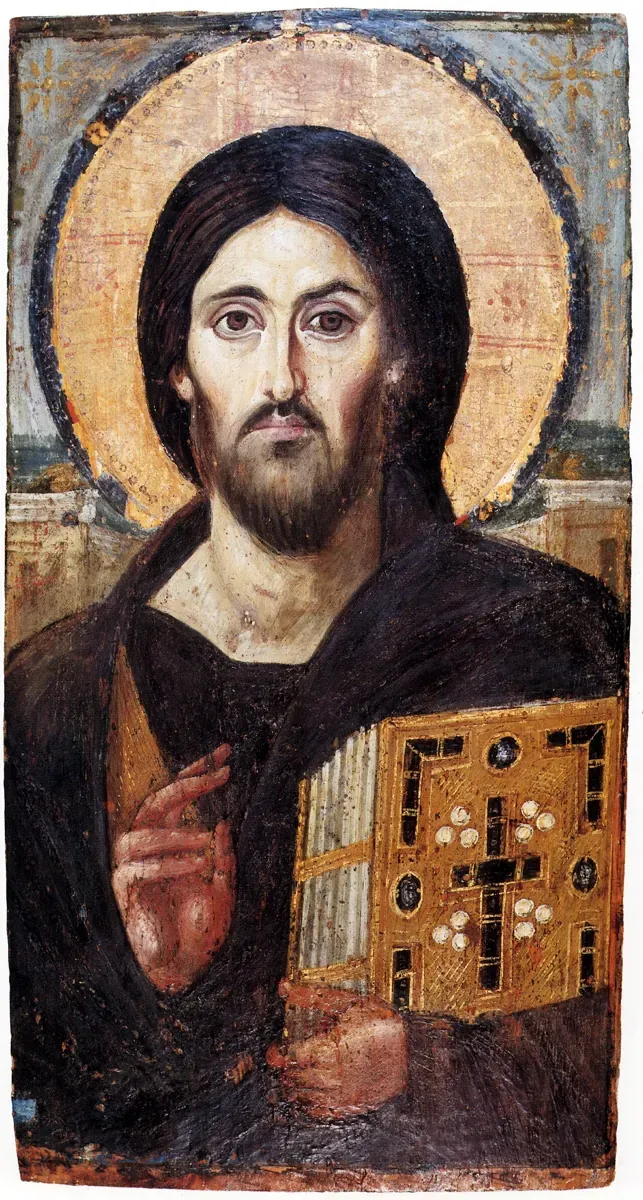
Unknown Byzantine painter, Christ Pantocrator icon, 6th century. Saint Catherine’s Monastery, Sinai. Image: Wikimedia Commons, public domain.
Christ Pantocrator, 6th century. At Saint Catherine’s Monastery, Sinai, painted in encaustic, coloured wax, before Iconoclasm. Cover one half of the face with your hand, then the other. The two sides look different, one gentler and one sterner, which many scholars read as Christ’s two natures.
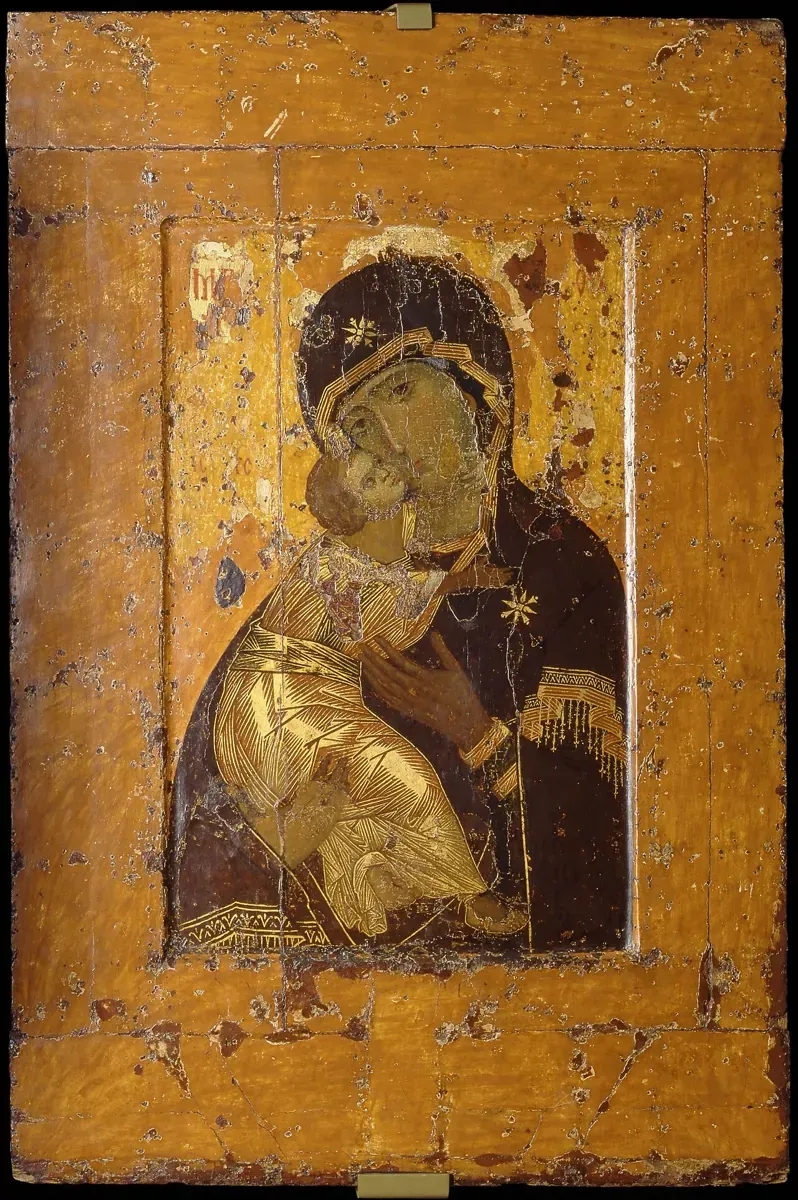
Unknown Byzantine painter, Virgin of Vladimir, about 1130. State Tretyakov Gallery, Moscow. Image: Wikimedia Commons, public domain.
The Virgin of Vladimir, about 1130. Painted in Constantinople and taken to Kyiv and then to Vladimir and Moscow, now at the Tretyakov Gallery. This is the Eleousa, or tenderness, type. Look at the child’s cheek pressed against his mother’s and at her eyes, which look at you, not at him.
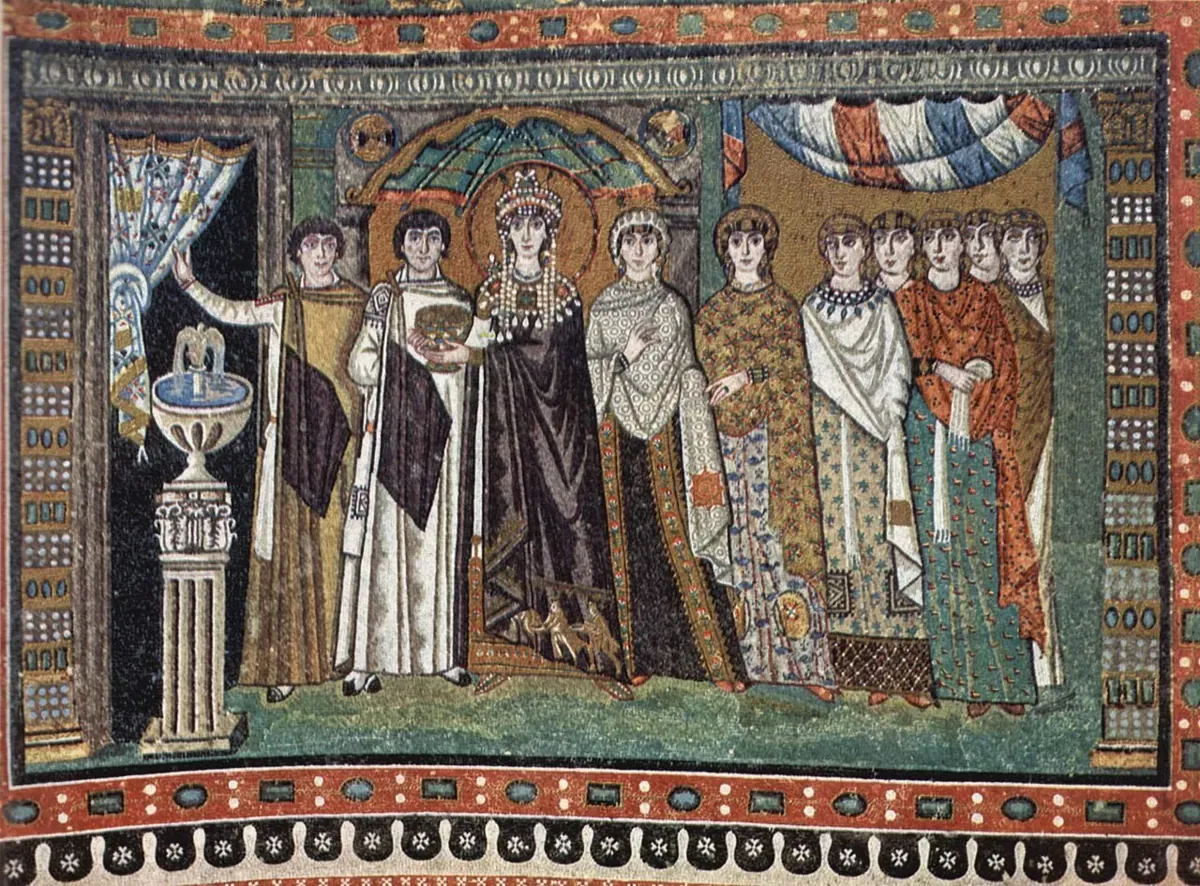
Unknown Byzantine mosaicists, Empress Theodora and her court, about 547. Basilica of San Vitale, Ravenna. Image: Wikimedia Commons, public domain.
Empress Theodora and her court, about 547. In the Basilica of San Vitale, Ravenna. Theodora carries a gift for the church, facing her husband Justinian across the apse. Look at the patterns in the robes, and at the Three Magi embroidered on her hem.
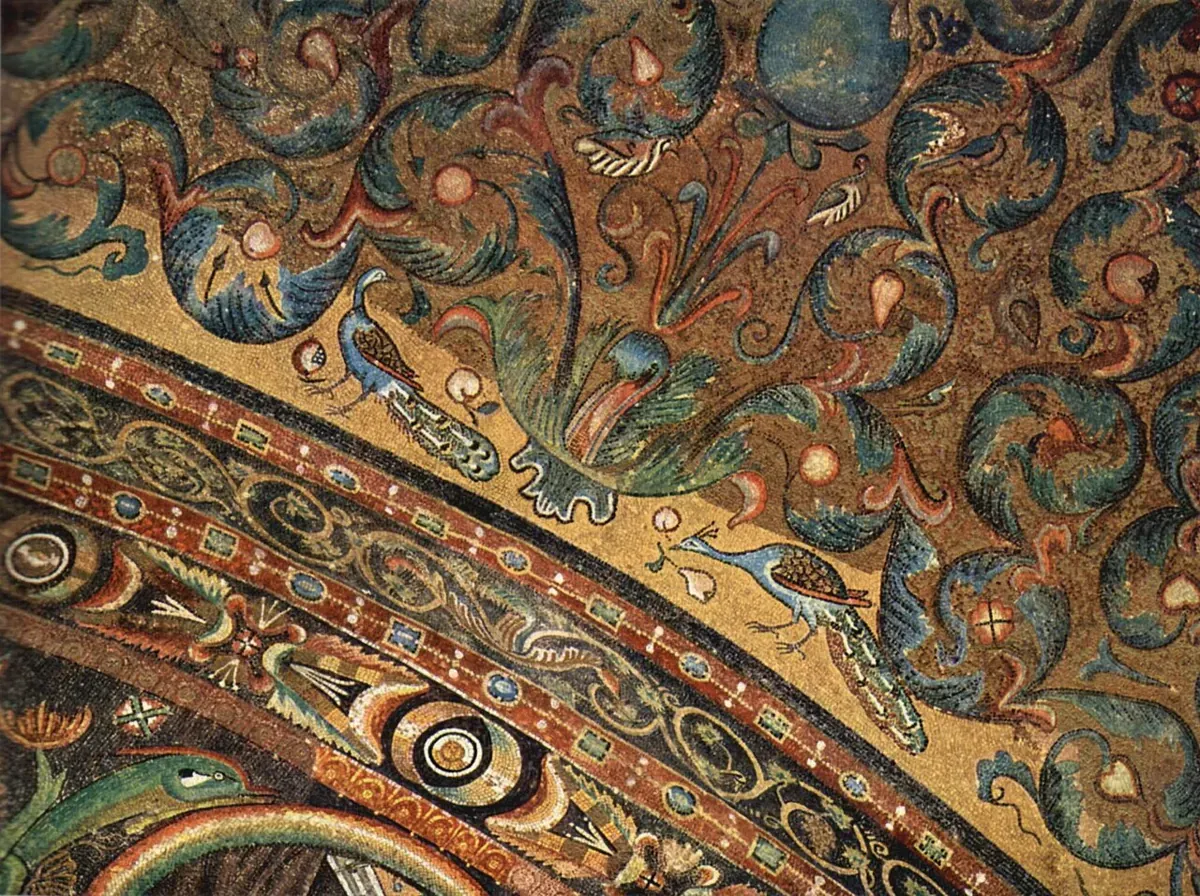
Unknown Byzantine mosaicists, Vault and wall mosaics of the choir, before 547. Basilica of San Vitale, Ravenna. Image: Wikimedia Commons, public domain.
The choir mosaics of San Vitale, before 547. Stand in the middle, if you visit, and turn slowly. The gold and colour wrap around you, which is the whole point: the building becomes a vision.
Byzantine art inherited the forms of late Roman art, shaped early medieval and Romanesque painting in the West, and its gold grounds return in Klimt’s work for the Vienna Secession.
Try this
Find a good image of the Justinian or Theodora mosaic at San Vitale. Look first at the background, then at the faces and the feet. Then write how the scene might look at dawn, at noon and by candlelight, remembering that the gold tesserae were set at angles to catch moving light.
What next
Before this: Ancient Roman art.
After this: Early medieval art.
Also worth reading alongside it: International Gothic.
See every movement in order on the art movements timeline, or learn to look step by step in the free Art History for Beginners course.
If you want to carry this into tarot and practice, these pages connect to it: The Hierophant, the blessing hand and the formal, frontal sacred figure; The World, the oval frame of light around a holy figure, the mandorla; How icons were meant to be windows, not pictures; and The angels and demons of early Christian art.
Sources
- Robin Cormack, Byzantine Art (2000).
- Alois Riegl, Spätrömische Kunstindustrie (Late Roman Art Industry) (1901).
- The Metropolitan Museum of Art, Painted Copy of Deesis Mosaic, 41.137. Open the record
- The Metropolitan Museum of Art, Heilbrunn Timeline of Art History. Visit the website
- E. H. Gombrich, The Story of Art (1950).
- Wikimedia Commons, Painted copy of the Deesis mosaic in Hagia Sophia (hero image record). Open the record
- Robin Cormack, Byzantine Art (2nd edition) (2018).

Questions
What is an icon?
A holy image, usually painted on a wooden panel, of Christ, Mary or a saint, used in prayer. For Orthodox Christians the honor shown to an icon passes to the person it shows. It is venerated, not worshipped.
What was Iconoclasm?
A conflict in the Byzantine Empire over whether holy images were allowed, roughly 726 or 730 to 787 and again from 815 to 843. Many images were destroyed. In 843 the use of icons was restored for good.
Where can I see works of Byzantine art in person?
Good places to start are Ravenna, Istanbul, the Met, the British Museum, and the Benaki Museum in Athens. Museums change their displays, so check the collection page before you travel.
Where can I see Byzantine art in Finland?
The Uspenski Cathedral in Helsinki, consecrated in 1868, and the Orthodox Church Museum Riisa in Kuopio hold icons in the Byzantine tradition, though most are Russian or Karelian rather than from Byzantium itself.
Why are Byzantine backgrounds gold?
Gold stands for divine light. It also reflects candlelight, so a mosaic or icon seems to glow and change as you move.
Get the free Mini-Grimoire
A short printable starter guide to tarot and everyday witchcraft, plus my newsletter. Unsubscribe any time.
Opens Substack in a new tab to confirm. More about the newsletter · Privacy