


| Arcana | Major Arcana |
|---|---|
| Number | X |
| Image | RWS 1909 (PD) |
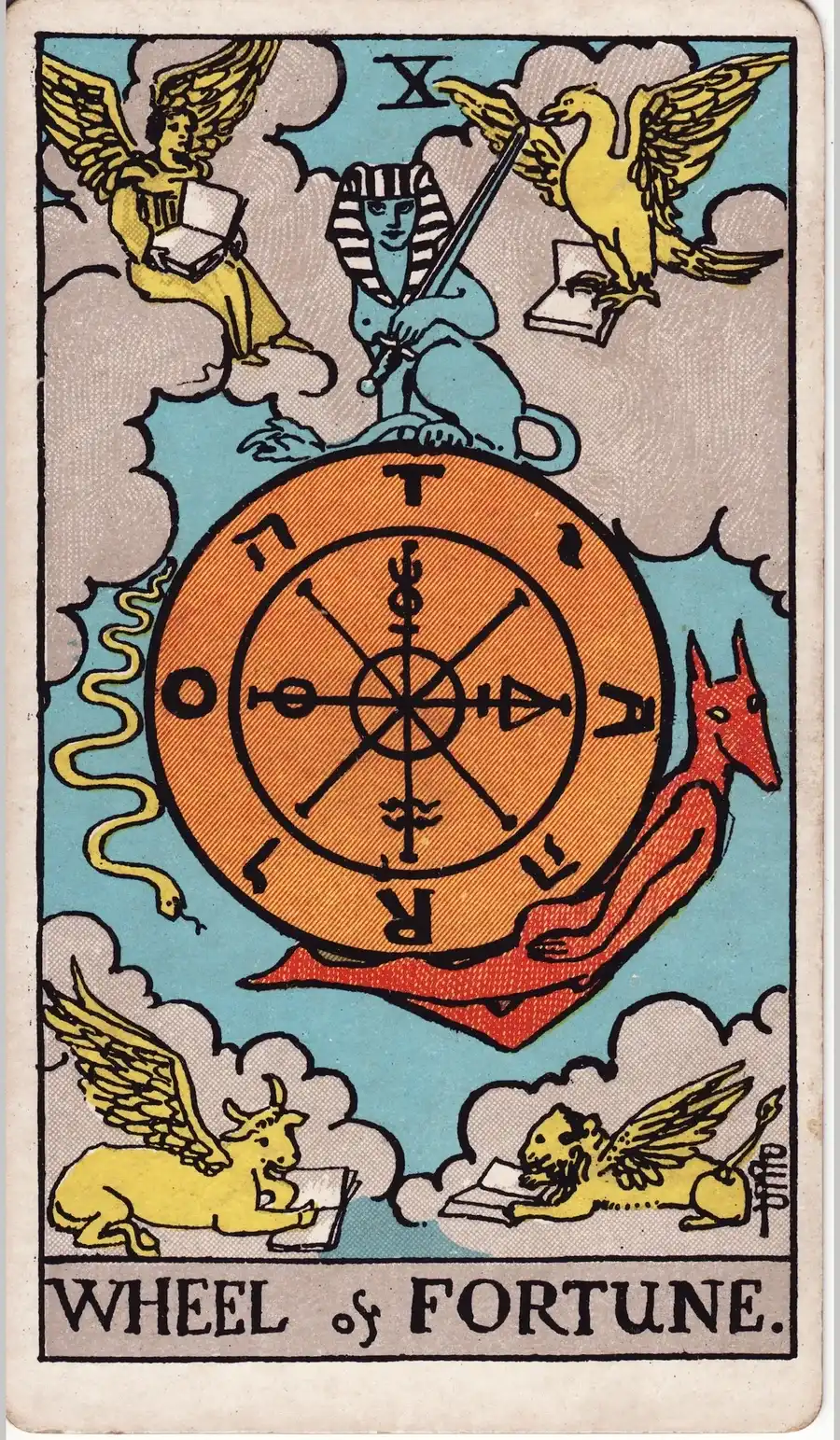
The Wheel of Fortune is card X of the Major Arcana, the card of turning points. A great wheel floats in the clouds, with creatures rising and falling around it.
Fortune goes up and down, and your task is to respond with skill when it turns. This page explains what the Wheel of Fortune means upright and reversed, the symbols in Pamela Colman Smith’s card and the medieval idea behind it.
Here is Wheel of Fortune at a glance.
| At a glance | This card |
|---|---|
| Upright keywords | cycles, change, luck, turning points |
| Reversed keywords | a rough turn, resisting change, bad timing |
| Number | X (10) in the Major Arcana |
| Golden Dawn title | The Lord of the Forces of Life Later tradition |
| Hebrew letter | Kaph (כ), “palm of the hand” Later tradition |
| Tree of Life path | 21, from Chesed to Netzach Later tradition |
| Astrology | Jupiter Later tradition |
| Element | Fire Modern |
| Yes or no | Yes Modern |
The Golden Dawn gave the Wheel the planet Jupiter, the “greater fortune” of traditional astrology, and the letter Kaph, the palm of the hand, which palmists read for fate. The fire element in many modern tables is a later convention, not a Golden Dawn attribution. The image of Fortune’s wheel itself is far older than tarot: medieval writers took it from Boethius’ Consolation of Philosophy, written around 524.
The card: what Pamela Colman Smith drew
This is one of the busiest cards in the deck. Waite wrote that the picture “stands for the perpetual motion of a fluidic universe and for the flux of human life”, and that “the Sphinx is the equilibrium therein”.
The wheel and its letters. The wheel carries the letters T, A, R, O, which can be read as TARO, ROTA (Latin for wheel) or TORA, mixed with Hebrew letters of the name of God. It is a word puzzle that Waite borrowed from the French occultist Éliphas Lévi.
The sphinx, the snake and the jackal. A sphinx with a sword sits on top. A snake slides down one side, and a jackal-headed figure, the Egyptian Anubis, rises on the other. Things go down and come up again. The sphinx in the middle stays still.
The four winged creatures. In the corners are an angel, an eagle, a lion and a bull, each reading a book. They come from the Bible, from the visions of Ezekiel and Revelation, and later stood for the four evangelists. Many readers also link them to the four fixed signs of the zodiac.
The clouds. The wheel floats in a blue sky. The turning is bigger than any one person. You do not spin the wheel, but you choose how you ride it.
Upright meaning
Upright, the Wheel turns. In the 1909 card a great wheel hangs in the sky, marked with letters and alchemical signs. A sphinx sits on top with a sword, a jackal-headed figure rises on the right and a serpent slides down on the left. In the four corners, winged creatures read books in the clouds. Everything is moving except the center.
The card describes change that comes from beyond your control: luck, timing, cycles and turning points. It often marks a shift for the better, especially after a long stuck period. It also reminds you that whatever is up will move, and so will whatever is down.
The calm center of the wheel matters. The card asks you to notice the cycle you are in and to act wisely within it, using good timing rather than fighting the season.
Reversed meaning
Reversed, the turn feels like a setback. Plans fall through, luck seems to run the other way, or the same pattern comes round again. The card does not say you are cursed. It says the wheel is still moving, and you may be clinging to its rim instead of standing near its center.
The reversed Wheel can also point to resisting a change that is already under way, or trying to control what cannot be controlled. Sometimes it marks a repeating cycle, such as the same kind of relationship or crisis, that is asking to be understood rather than endured again.
Ask what repeats, and what you can change about how you meet it.
In love, work and spirituality
In love. Upright: A turning point, a fated-feeling meeting or a new phase in a relationship. Reversed: Old patterns repeating, or a relationship stuck in an on-again, off-again cycle.
At work. Upright: Good timing, new opportunities and a lucky break; ride the momentum. Reversed: A setback or delay; prepare and wait for the next turn.
With money. Upright: Improving fortune, unexpected income, a cycle turning upwards. Reversed: Unpredictable money; build a buffer and avoid gambling.
In spiritual practice. Upright: Insight into cycles, karma and the seasons of a life. Reversed: Feeling at the mercy of fate; look for the still center.
As feelings. A sense of destiny or that things are moving quickly between you.
As a person. Adaptable and lucky, at home with change.
As advice. Notice the cycle you are in and move with its timing.
Reading Wheel of Fortune: positions and yes or no
In the past position: A turning point that changed your direction. In the present position: Things are moving. Adapt to the turn.
In the future position: A change of luck or a new chapter is on its way. As advice: Prepare in quiet times and stay humble in good ones.
When the Wheel of Fortune shows up among mostly Minor cards, give it extra weight: the theme of cycles runs under the whole question.
In modern yes or no readings, the Wheel of Fortune leans yes. It usually means a turn for the better, so it leans yes, though it reminds you that luck turns both ways.
The history and art behind the card
In the Tarot de Marseille pattern the card is called La Roue de Fortune, the Wheel of Fortune. The Wheel of Fortune was one of the best-known images of the Middle Ages.
Manuscripts and church windows showed the goddess Fortuna turning a wheel, with a king on top saying “I reign” and a fallen figure underneath saying “I am without a kingdom”. The early tarot cards borrowed this familiar image directly.
Marseille decks show odd animal figures riding the wheel. The Egyptian figures, the letters and the creatures from Ezekiel came from Éliphas Lévi in the nineteenth century. Waite said openly that he followed Lévi’s design and used Egyptian imagery “provided that no theory of origin is implied”. In other words, he did not claim the card was Egyptian.
When A. E. Waite published The Pictorial Key to the Tarot in 1910, he listed these divinatory meanings for the card: “Destiny, fortune, success, elevation, luck, felicity.” Reversed, he gave: “Increase, abundance, superfluity.”
Waite himself called the fortune-telling meanings of the trumps “artificial and arbitrary”, and on this site I read the picture first and treat lists like this as history.
The Wheel sits at the turning point of the modern Fool’s Journey, the middle of the second stage. The traveler who has learned courage and solitude now meets what no effort controls: timing, luck and the cycles that carry everyone.
Common questions
Is the Wheel of Fortune good or bad? It is mostly a hopeful card about change and luck, but it reminds you that cycles turn both ways.
What does the Wheel of Fortune mean in love? A turning point: a new phase, a lucky meeting or a change in a relationship.
What do the letters on the wheel mean? They can be read as TARO, ROTA or TORA, a word game from Éliphas Lévi that Waite adopted.
Try this
Try this small spread for Wheel of Fortune. Use it when life is changing and you want to understand the turn.
| Card | Question | What it shows |
|---|---|---|
| 1 | What is ending? | The part of the cycle that is passing. |
| 2 | What is beginning? | What is rising into view. |
| 3 | How can I ride the turn? | The attitude or action that helps. |
Affirmation: I meet changing cycles with adaptability and steady character.
Reversed affirmation: I stop clinging to a turn that has already passed.
If you keep a tarot journal, take one of these questions to it: Which cycle in my life is turning now? What did I learn the last time luck turned against me? What can I prepare while things are quiet?
What next
Cards that sit close to this one are Death (another card of endings and new beginnings), The World (the completion of a whole cycle) and Justice (the next card, where cause and effect take over from chance).
Wheel of Fortune is part of the lesson Strength to Temperance in my free Tarot for Beginners course. To keep walking the Major Arcana, read the card before it, The Hermit or the card after it, Justice, or go back to all the card meanings.
For every card with keywords, affirmations and examples, see my book The Novice’s Guide to Tarot. If you would like a printable cheat sheet for all 78 cards, my 45-page Tarot Workbook is on Etsy.
Sources
- A. E. Waite, The Pictorial Key to the Tarot (London: Rider, 1910), Part II and Part III, section 3.
- Pamela Colman Smith and A. E. Waite, the Rider-Waite-Smith tarot (London: Rider, 1909).
- Nicolas Conver, Tarot de Marseille (Marseille, 1760).
- Eden Gray, A Complete Guide to the Tarot (New York: Crown, 1970), epilogue “The Fool’s Journey”.
- Lauri Mukkala, The Novice’s Guide to Tarot, entry for Wheel of Fortune.
- Aleister Crowley, 777 (London: Walter Scott, 1909), columns of the Hebrew letters, paths and Tarot trumps.
- Israel Regardie, ed., The Golden Dawn (Chicago: Aries Press, 1937 to 1940), “Book T” and the titles of the trumps.
All 78 cards
Major Arcana
- The Fool
- The Magician
- The High Priestess
- The Empress
- The Emperor
- The Hierophant
- The Lovers
- The Chariot
- Strength
- The Hermit
- Wheel of Fortune
- Justice
- The Hanged Man
- Death
- Temperance
- The Devil
- The Tower
- The Star
- The Moon
- The Sun
- Judgement
- The World
Wands
- Ace of Wands
- Two of Wands
- Three of Wands
- Four of Wands
- Five of Wands
- Six of Wands
- Seven of Wands
- Eight of Wands
- Nine of Wands
- Ten of Wands
- Page of Wands
- Knight of Wands
- Queen of Wands
- King of Wands
Cups
- Ace of Cups
- Two of Cups
- Three of Cups
- Four of Cups
- Five of Cups
- Six of Cups
- Seven of Cups
- Eight of Cups
- Nine of Cups
- Ten of Cups
- Page of Cups
- Knight of Cups
- Queen of Cups
- King of Cups
Swords
- Ace of Swords
- Two of Swords
- Three of Swords
- Four of Swords
- Five of Swords
- Six of Swords
- Seven of Swords
- Eight of Swords
- Nine of Swords
- Ten of Swords
- Page of Swords
- Knight of Swords
- Queen of Swords
- King of Swords
Pentacles
Get the free Mini-Grimoire
A short printable starter guide to tarot and everyday witchcraft, plus my newsletter. Unsubscribe any time.
Opens Substack in a new tab to confirm. More about the newsletter · Privacy