


| Arcana | Major Arcana |
|---|---|
| Number | IX |
| Image | RWS 1909 (PD) |
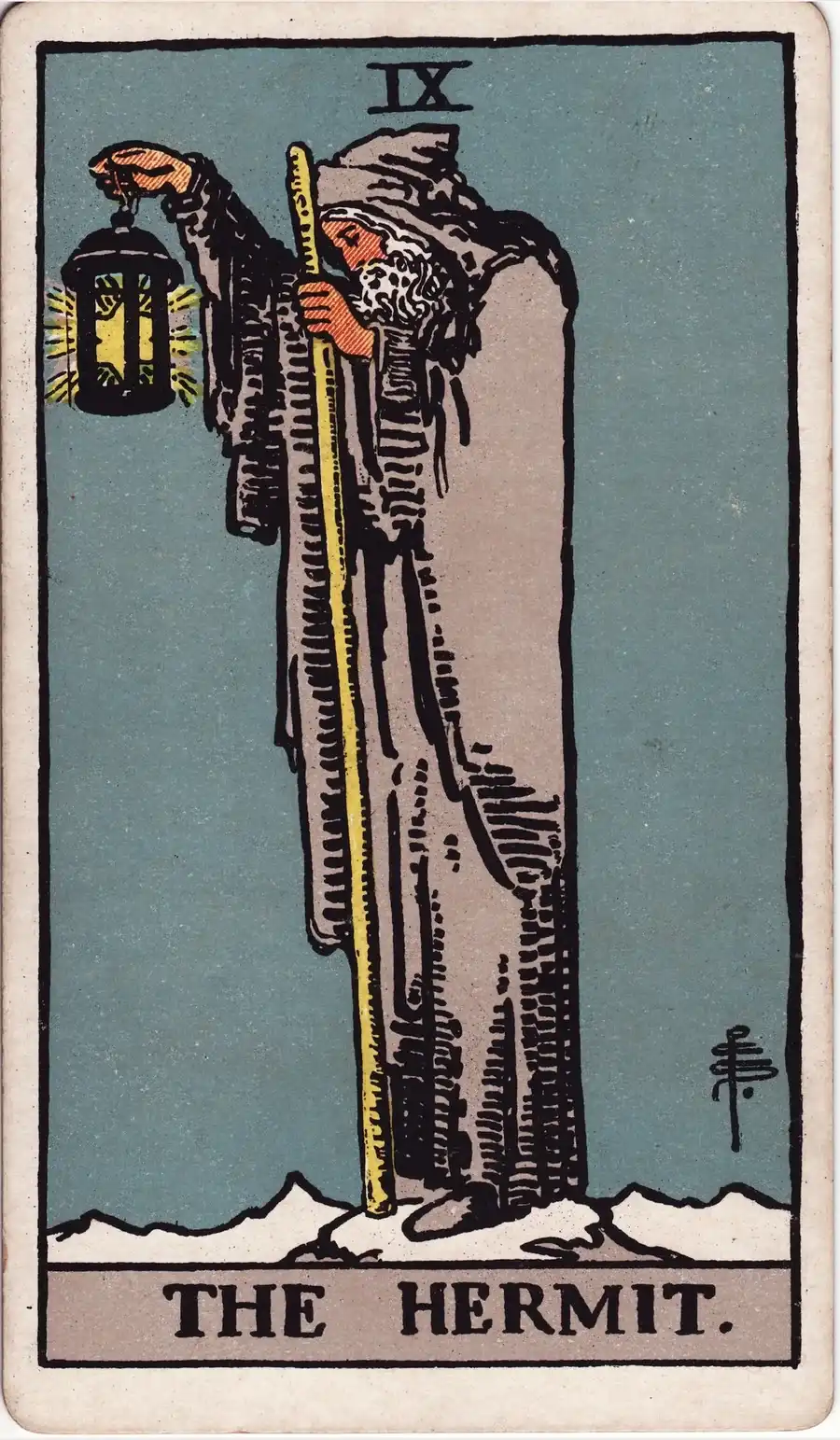
The Hermit is card IX of the Major Arcana, the card of quiet wisdom. An old man stands alone on a cold peak and holds up a lantern. He is not lost.
He has gone somewhere quiet on purpose, so he can see by his own light. Here is what the Hermit means upright and reversed, the symbols in the 1909 card and the history of the lamp.
Here is the Hermit at a glance.
| At a glance | This card |
|---|---|
| Upright keywords | solitude, reflection, inner guidance, wisdom |
| Reversed keywords | isolation, loneliness, withdrawing to hide |
| Number | IX (9) in the Major Arcana |
| Golden Dawn title | The Prophet of the Eternal; the Magus of the Voice of Power Later tradition |
| Hebrew letter | Yod (י), “hand” Later tradition |
| Tree of Life path | 20, from Chesed to Tiphareth Later tradition |
| Astrology | Virgo Later tradition |
| Element | Earth Later tradition |
| Yes or no | Maybe Modern |
The Golden Dawn gave the Hermit the sign Virgo and the letter Yod, the “hand” and the smallest letter of the Hebrew alphabet, from which kabbalists said every other letter is drawn. A tiny seed of light suits a card about the inner lamp. In early Italian decks the figure was often an old man with an hourglass, Time itself; the lantern replaced the hourglass in later French cards.
The card: what Pamela Colman Smith drew
Smith drew the Hermit in gray on a gray and white peak, with only the lantern glowing. Waite wrote that “it is a star which shines in the lantern”, and that the raised light says “where I am, you also may be”.
The lantern and the star. Inside the lantern is a six-pointed star. The Hermit’s light is his own understanding, earned by experience. He holds it up, so the light also guides others who climb after him.
The staff. A long staff supports him on the hard path. Wisdom takes time and steady steps, not leaps.
The snowy peak. He stands high above the world, in cold and quiet. Solitude can be a workshop for clarity, not an exile.
The gray cloak. His cloak is plain and gray. The Hermit does not need to be seen. The work he is doing is inward.
Upright meaning
Upright, the Hermit steps away so that he can see. An old man in a grey cloak stands alone on a snowy peak, holding up a lantern with a six-pointed star inside and leaning on a staff. He has climbed above the noise. The light he carries is not for show; it is enough to see the next few steps.
The card describes solitude chosen for a purpose: reflection, study, recovery or a decision that needs your own judgment rather than everyone else’s advice. It often appears when someone has been busy for too long and needs time alone to hear themselves think. It can also describe a mentor, someone who has walked the hard path first and now holds the lantern for others.
The Hermit does not promise an answer to every question. He promises the next step, seen clearly. That is usually enough.
Reversed meaning
Reversed, solitude curdles into isolation. The card can describe withdrawing because you feel unwelcome, hiding from a problem rather than reflecting on it, or loneliness that has gone on too long. It can also describe the opposite: avoiding any time alone, filling every hour so that no difficult thought can surface.
Sometimes the reversed Hermit points to a teacher who has become distant or a guide who keeps their knowledge to themselves.
Ask whether you need more company or more quiet. If you have been alone too long, reach out to one person. If you have never been alone, take one hour this week with the phone off.
In love, work and spirituality
In love. Upright: A pause to understand what you want, or a quiet, thoughtful relationship. Reversed: Loneliness, emotional distance, or using independence as a wall.
At work. Upright: Research, specialist work, planning in private; a time to work alone or consult an expert. Reversed: Isolation at work, or avoiding a necessary conversation.
With money. Upright: Careful, considered decisions; simplicity and living within your means. Reversed: Withdrawing from money matters you need to face.
In spiritual practice. Upright: Retreat, meditation, study and inner guidance; a good time for a solitary practice. Reversed: Spiritual isolation, or refusing guidance you need.
As feelings. Thoughtful but reserved. The person needs space before they can say what they feel.
As a person. Wise, introverted and independent; a mentor or a seeker.
As advice. Step back, take your own light, and look only at the next step.
Reading the Hermit: positions, pairs and yes or no
In the past position: A time of solitude that taught you something. In the present position: Step back and reflect before you decide.
In the future position: A period of study or retreat, or a mentor appearing. As advice: Make time for quiet, and trust your own light.
When the Hermit shows up among mostly Minor cards, give it extra weight: the theme of solitude runs under the whole question.
Pairs matter too. Next to The Lovers, it can mean needing time alone before a big relationship choice. Next to The Moon, it can mean a confusing time that calls for quiet reflection, not quick answers. Next to The Hierophant, it can mean looking for a teacher, or becoming one.
In modern yes or no readings, the Hermit is a maybe. He asks for more time and reflection before you act, so the honest answer is often wait.
The history and art behind the card
In the Tarot de Marseille pattern the card is called L’Hermite, the Hermit. The earliest Italian cards called him the Old Man or Time, an elderly figure with an hourglass, a reminder that time passes for everyone. Somewhere along the way the hourglass became a lantern, and the old man became a seeker.
Court de Gébelin read the lantern as the lamp of the Greek philosopher Diogenes, who searched for an honest man. Waite disagreed and said the Hermit is not searching at all: he has already found the light and holds it up for others. Smith’s 1909 design follows Waite’s reading.
Waite also rejected a popular nineteenth century idea that the Hermit stands for occult secrecy, wisdom hidden under a cloak away from ordinary people. He blamed Éliphas Lévi for that reading and called it frivolous.
For Waite the lamp is held up, not hidden. That detail turns a lonely card into a generous one: the point of going up the mountain is to light the way for whoever comes next.
When A. E. Waite published The Pictorial Key to the Tarot in 1910, he listed these divinatory meanings for the card: “Prudence, circumspection; also and especially treason, dissimulation, roguery, corruption.”
Reversed, he gave: “Concealment, disguise, policy, fear, unreasoned caution.” Waite himself called the fortune-telling meanings of the trumps “artificial and arbitrary”, and on this site I read the picture first and treat lists like this as history.
In the modern Fool’s Journey, the Hermit is the point where the traveler steps off the road on purpose. Having met the world, they withdraw to ask what all of it means, and come back carrying a small light for others.
Common questions
Is the Hermit a bad card? No. It is a card of reflection and inner wisdom. It can feel lonely, but it is often exactly the pause you need.
What does the Hermit mean in love? Space, slowness and reflection. Upright, take time to understand your feelings. Reversed, do not vanish without explaining.
Is the Hermit a yes or no? Usually a maybe or a not yet. Take time to think before you decide.
Try this
Try this small spread for the Hermit. Use it when you need quiet to find an answer.
| Card | Question | What it shows |
|---|---|---|
| 1 | What do I need to step back from? | The noise to turn down. |
| 2 | What does my inner light show me? | What I already understand. |
| 3 | Who or what can guide me? | A mentor, a book or a practice. |
Affirmation: I seek wise solitude and bring what I learn back to life.
Reversed affirmation: I leave isolation that only hides me and ask for light when I need it.
If you keep a tarot journal, take one of these questions to it: What would I hear if the world went quiet for a day? Who has been a lantern for me? Is my solitude right now chosen, or is it hiding?
What next
Cards that sit close to this one are The High Priestess (another card of quiet inner knowing), The Star (a guiding light after the storm) and The Hanged Man (another pause that changes how you see).
The Hermit is part of the lesson Strength to Temperance in my free Tarot for Beginners course. To keep walking the Major Arcana, read the card before it, Strength or the card after it, Wheel of Fortune, or go back to all the card meanings.
For every card with keywords, affirmations and examples, see my book The Novice’s Guide to Tarot. If you would like a printable cheat sheet for all 78 cards, my 45-page Tarot Workbook is on Etsy.
Sources
- A. E. Waite, The Pictorial Key to the Tarot (London: Rider, 1910), Part II and Part III, section 3.
- Pamela Colman Smith and A. E. Waite, the Rider-Waite-Smith tarot (London: Rider, 1909).
- Nicolas Conver, Tarot de Marseille (Marseille, 1760).
- Eden Gray, A Complete Guide to the Tarot (New York: Crown, 1970), epilogue “The Fool’s Journey”.
- Lauri Mukkala, The Novice’s Guide to Tarot, entry for The Hermit.
- Aleister Crowley, 777 (London: Walter Scott, 1909), columns of the Hebrew letters, paths and Tarot trumps.
- Israel Regardie, ed., The Golden Dawn (Chicago: Aries Press, 1937 to 1940), “Book T” and the titles of the trumps.
All 78 cards
Major Arcana
- The Fool
- The Magician
- The High Priestess
- The Empress
- The Emperor
- The Hierophant
- The Lovers
- The Chariot
- Strength
- The Hermit
- Wheel of Fortune
- Justice
- The Hanged Man
- Death
- Temperance
- The Devil
- The Tower
- The Star
- The Moon
- The Sun
- Judgement
- The World
Wands
- Ace of Wands
- Two of Wands
- Three of Wands
- Four of Wands
- Five of Wands
- Six of Wands
- Seven of Wands
- Eight of Wands
- Nine of Wands
- Ten of Wands
- Page of Wands
- Knight of Wands
- Queen of Wands
- King of Wands
Cups
- Ace of Cups
- Two of Cups
- Three of Cups
- Four of Cups
- Five of Cups
- Six of Cups
- Seven of Cups
- Eight of Cups
- Nine of Cups
- Ten of Cups
- Page of Cups
- Knight of Cups
- Queen of Cups
- King of Cups
Swords
- Ace of Swords
- Two of Swords
- Three of Swords
- Four of Swords
- Five of Swords
- Six of Swords
- Seven of Swords
- Eight of Swords
- Nine of Swords
- Ten of Swords
- Page of Swords
- Knight of Swords
- Queen of Swords
- King of Swords
Pentacles
Get the free Mini-Grimoire
A short printable starter guide to tarot and everyday witchcraft, plus my newsletter. Unsubscribe any time.
Opens Substack in a new tab to confirm. More about the newsletter · Privacy