


How to read the labels Historical what the old sources say. Later tradition what later writers added. Modern modern practice and my own notes.
The Golden Age of Illustration is the period from about 1880 to the 1920s when book and magazine illustration in Britain and the United States reached a peak of quality and popularity. New colour printing methods allowed full-colour plates, and artists such as Arthur Rackham, Edmund Dulac, Howard Pyle, N. C. Wyeth, Jessie Willcox Smith and Pamela Colman Smith became famous names. Luxury gift books of fairy tales and classics were its signature product.
This is the art many of us met first, on the pages of a book, and it is also the world in which the most famous tarot deck was drawn.
Key dates
| When | What happened |
|---|---|
| 1865 | John Tenniel’s pictures appear in the first edition of Alice’s Adventures in Wonderland. |
| 1889 | Andrew Lang’s Blue Fairy Book begins the colored fairy book series. |
| 1905 | Arthur Rackham’s Rip Van Winkle makes the illustrated gift book a fashion. |
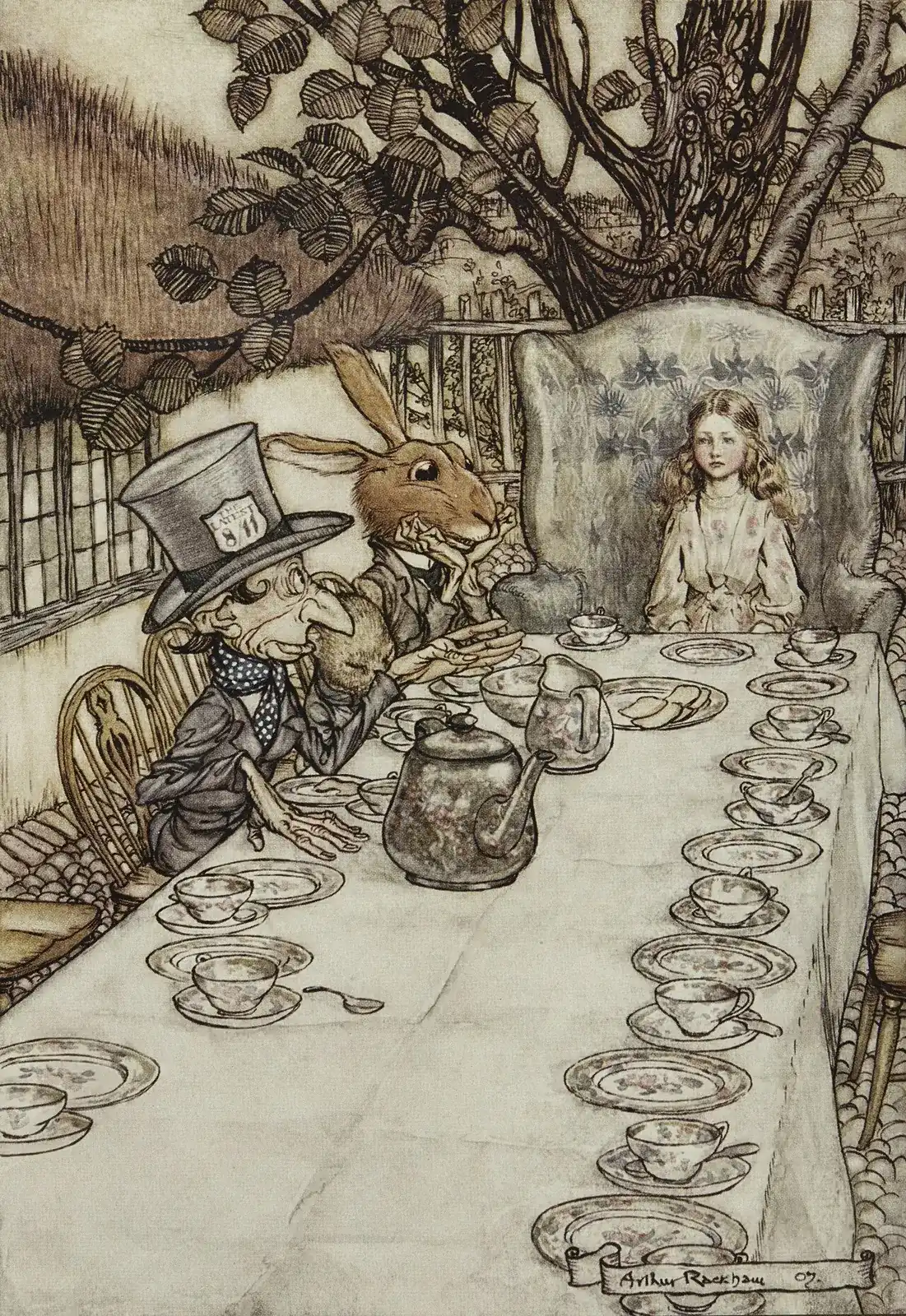
| 1907 | Rackham illustrates Alice’s Adventures in Wonderland. |
| 1909 | Pamela Colman Smith draws the Rider-Waite-Smith tarot deck. |
| 1914 to 1918 | The First World War ends the market for luxury gift books. |
What is the Golden Age of Illustration?
The Golden Age of Illustration is a period, not a style: decades in which printing technology, a large reading public and gifted artists made the illustrated book an art form.
Throughout this page I mark three layers. Historical What buildings, objects and texts of the time show. Later tradition What later centuries read into them. Modern How people use these images today.
Historical Pictures for the printing press. For most of the nineteenth century book pictures were cut into wood by engravers who translated the artist’s drawing.
From the 1880s photographic line blocks and halftones could reproduce drawings directly, and around 1900 the three-color process made it possible to print watercolors. In the 1870s the printer Edmund Evans had already shown what color could do with picture books by Walter Crane, Kate Greenaway and Randolph Caldecott.
Historical Rackham’s twisted trees. Arthur Rackham made his name with Rip Van Winkle in 1905, an expensive gift book with tipped-in color plates. Peter Pan in Kensington Gardens followed in 1906, Alice’s Adventures in Wonderland in 1907 and A Midsummer Night’s Dream in 1908.
His trees have faces, his goblins have knobbly knees and his colors are soft browns and greens. Each year the originals were sold at an exhibition in London when the book came out.
Historical Dulac and the East. Edmund Dulac, born in Toulouse and working in London, painted in deep blues and golds inspired by Persian and Indian miniatures. His Rubáiyát of Omar Khayyám of 1909 and his fairy tale books were Rackham’s main competition at Christmas.
Historical Pyle and the American school. In the United States Howard Pyle wrote and illustrated Robin Hood and King Arthur and taught a whole generation at his school in Wilmington, Delaware. His students included N. C. Wyeth, Jessie Willcox Smith, Elizabeth Shippen Green and Violet Oakley. Magazines such as Harper’s and Scribner’s brought their pictures into millions of homes.
Historical Pamela Colman Smith. Pamela Colman Smith, born in London to American parents, was an illustrator, storyteller and stage designer who published her own magazine, The Green Sheaf, in 1903 and 1904.
In 1909 she drew the seventy-eight cards of the tarot deck devised by Arthur Edward Waite and published by Rider. She is the Golden Age illustrator whose work is most seen today, in almost every tarot reading in the English-speaking world.
Key artists
| Artist | Lived | Why they matter |
|---|---|---|
| Arthur Rackham | 1867 to 1939 | The English master of twisted trees, goblins and fairies. |
| Edmund Dulac | 1882 to 1953 | The French-born illustrator of jewel-colored Eastern tales. |
| Howard Pyle | 1853 to 1911 | The American teacher of a whole school of illustrators. |
| Jessie Willcox Smith | 1863 to 1935 | The American illustrator of childhood. |
| Pamela Colman Smith | 1878 to 1951 | Illustrator, storyteller and artist of the Rider-Waite-Smith tarot. |
How do you recognise the Golden Age of Illustration?
Look for pictures made to be printed: pen line with soft watercolor washes, tipped-in color plates and decorated title pages. Subjects are fairy tales, myths, legends and children’s classics. Trees have faces, fairies have wings and every page invites you into a story.
Common misconceptions. One is that illustration was a lesser art. Original drawings by Rackham and Dulac were shown and sold at London’s Leicester Galleries, and collectors paid serious prices for them.
Another is that this was only a British story. In the United States, Howard Pyle’s students at the Brandywine school, including N. C. Wyeth, Jessie Willcox Smith, Elizabeth Shippen Green and Violet Oakley, shaped American magazines. A third is that these books were for children. Many of the deluxe editions, such as Dulac’s Stories from Hans Andersen of 1911, were expensive gift books for adults.
Esoteric themes
Historical Fairy tales and folklore were serious study in these years. W. B. Yeats published Fairy and Folk Tales of the Irish Peasantry in 1888, and Pamela Colman Smith joined the Golden Dawn in 1901, where she met Waite.
In 1917 two girls in Cottingley, Yorkshire, took photographs of fairies that were later shown to be paper cut-outs; Arthur Conan Doyle championed them in The Strand Magazine in 1920.
Later tradition The idea that illustrators like Rackham or Smith secretly encoded occult teachings in their pictures is mostly later speculation. Smith’s tarot does use Golden Dawn symbolism, which Waite describes in his Pictorial Key to the Tarot of 1910.
Modern Countless oracle and tarot decks today are drawn in a Rackham or Smith style. If you read with the Rider-Waite-Smith deck, you already hold a masterpiece of this period; start with The Hermit.
Works to see
| Work | Artist | Date | Where to see it |
|---|---|---|---|
| A Mad Tea-Party, from Alice’s Adventures in Wonderland | Arthur Rackham | 1907 | Published book illustration |
| The Rider-Waite-Smith tarot | Pamela Colman Smith | 1909 | Published deck, many collections |
| The Flying Dutchman | Howard Pyle | 1900 | Delaware Art Museum, Wilmington |
| Illustrations to the Rubáiyát of Omar Khayyám | Edmund Dulac | 1909 | Published book illustration |
Every work in this list is free of nudity, so you can look them up with confidence. Works still in copyright are named but not shown here.
How to look at a Golden Age illustration
Read the line before the colour. Rackham’s work starts with a sepia ink drawing; the colour is washed on thinly afterward. Dulac, by contrast, built glowing, jewel-like colour inspired by Persian and Japanese art. Then look for the moment the artist chose: rarely the obvious climax, often the uncanny moment just before.
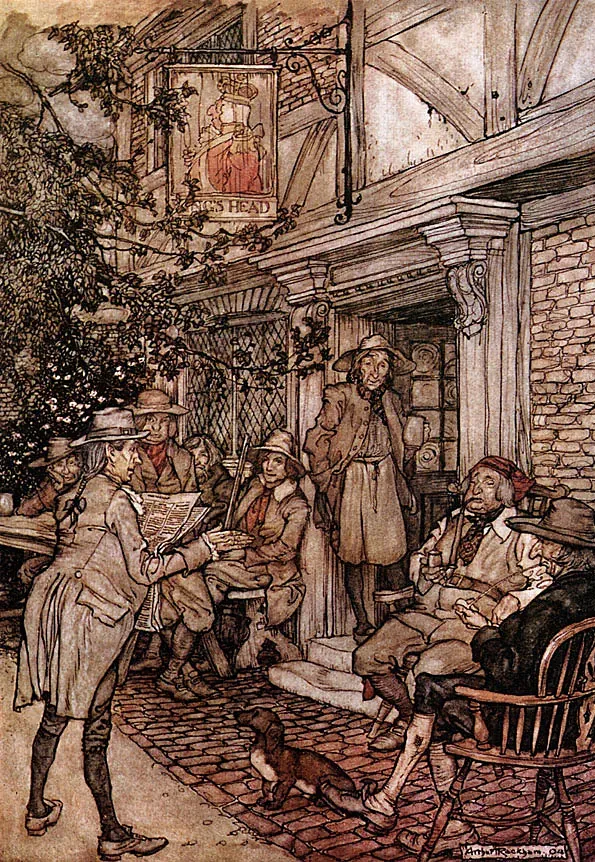
Arthur Rackham, Rip Van Winkle illustration, 1905. Book illustration. Image: Wikimedia Commons, public domain.
Arthur Rackham, Rip Van Winkle, 1905. The book that made Rackham famous, published by Heinemann. Look at the faces of the villagers, each a small caricature, and the soft sepia and grey colour. Rackham’s gnarled people and trees became his trademark and influenced fantasy art for a century.
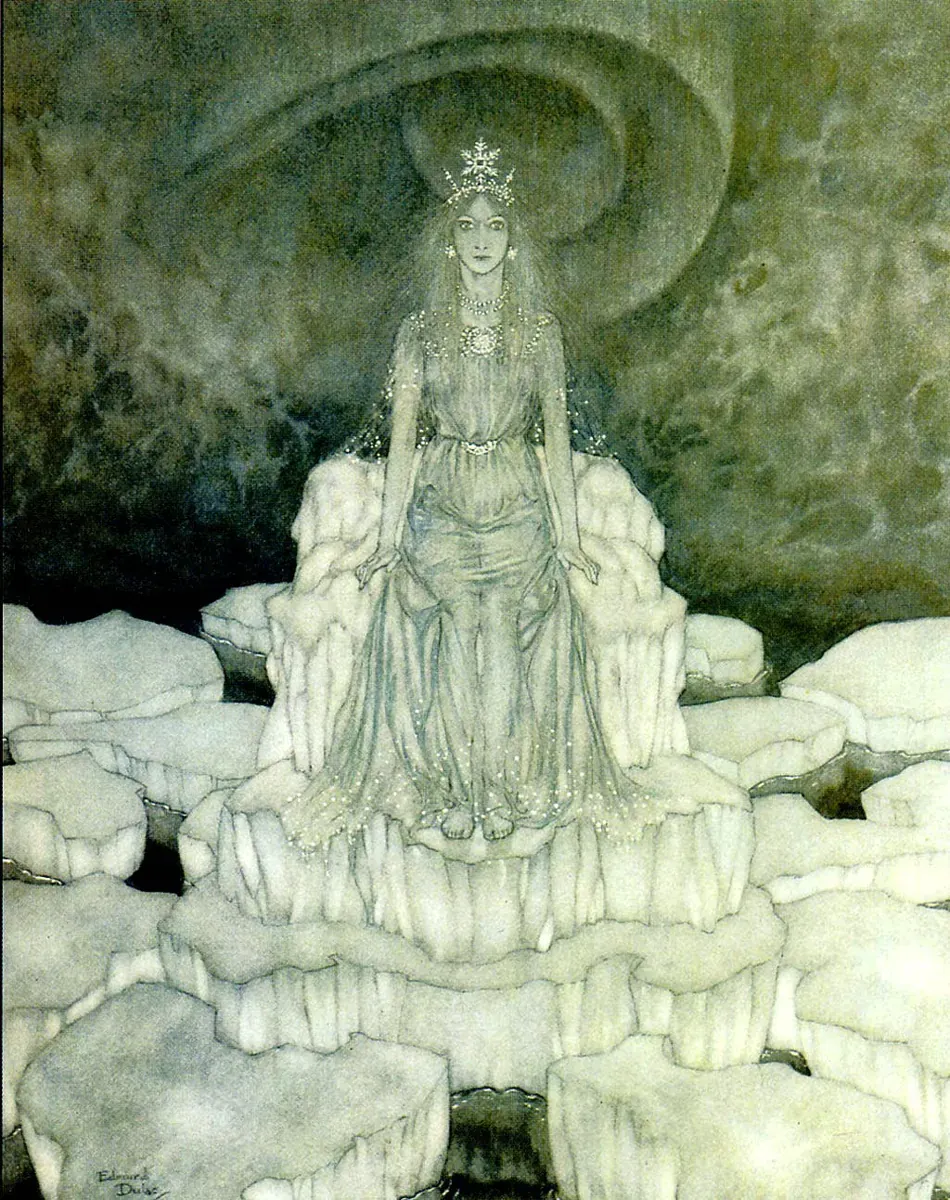
Edmund Dulac, The Snow Queen (Stories from Hans Andersen), 1911. Book illustration. Image: Wikimedia Commons, public domain.
Edmund Dulac, The Snow Queen, 1911. From Stories from Hans Andersen. Look at how many whites and pale blues Dulac finds in one cold scene, printed with the three-colour halftone process that made such plates possible.
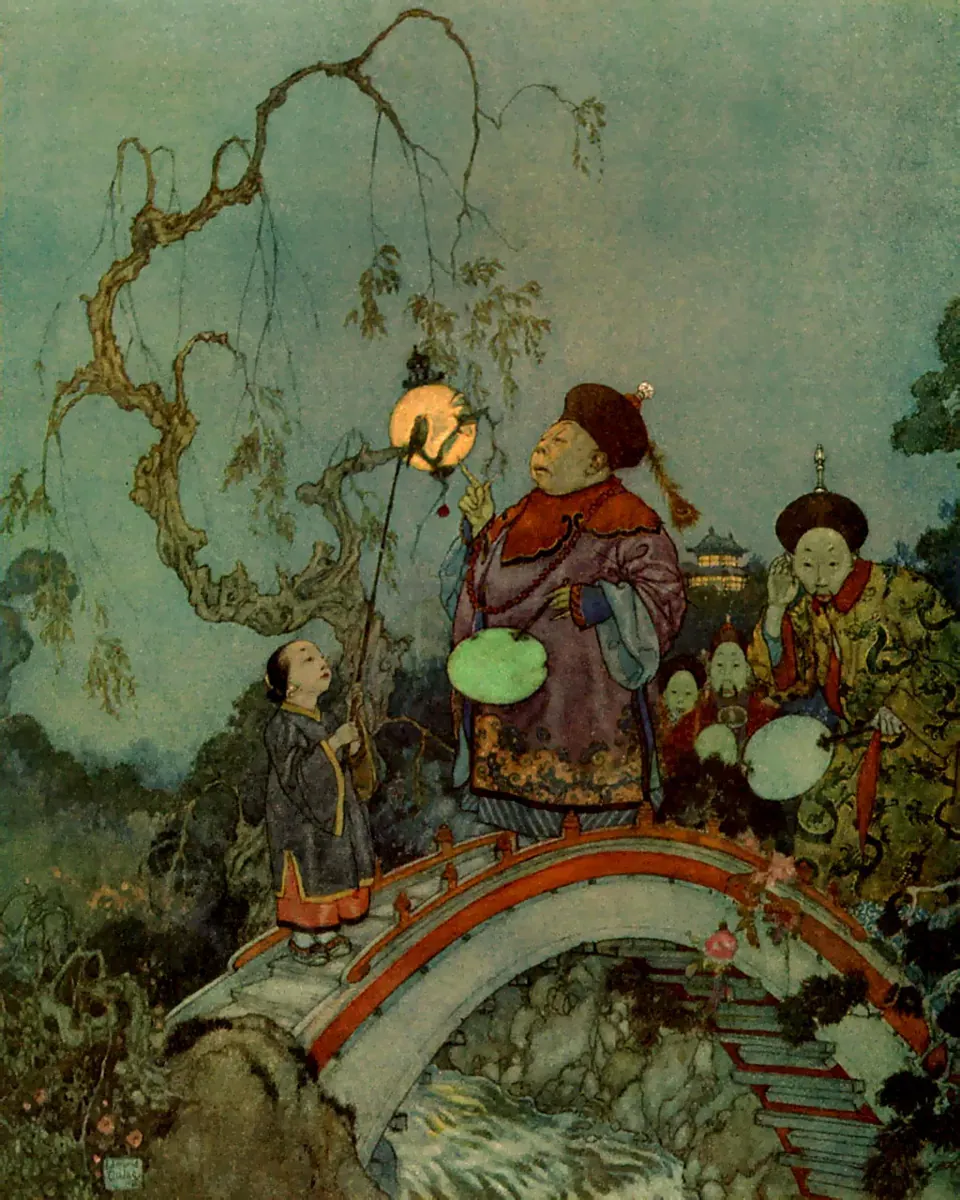
Edmund Dulac, The Nightingale (Stories from Hans Andersen), 1911. Book illustration. Image: Wikimedia Commons, public domain.
Edmund Dulac, The Nightingale, 1911. From the same book. Here Dulac borrows from Chinese and Japanese prints: the high viewpoint, the bridge, the decorative branch in the corner. Count how many small stories the scene holds.
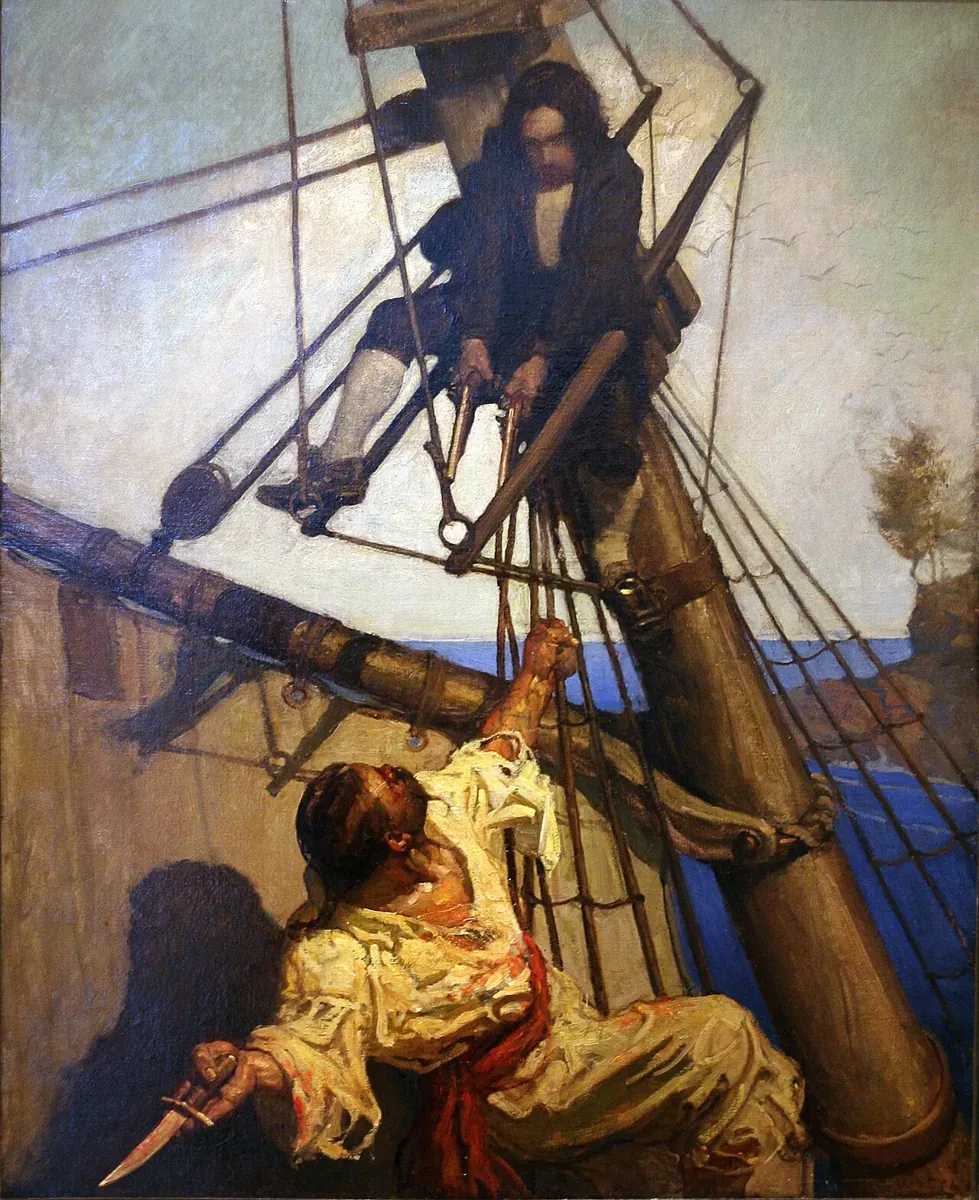
N. C. Wyeth, “One more step, Mr. Hands,” illustration for Treasure Island, 1911. New Britain Museum of American Art. Image: Wikimedia Commons, public domain.
N. C. Wyeth, “One more step, Mr. Hands,” 1911. From Scribner’s edition of Treasure Island, now at the New Britain Museum of American Art. Wyeth was Howard Pyle’s student. See how he uses a dramatic angle from below and a strong diagonal mast to put you in the rigging with Jim.
The Golden Age grew from the Pre-Raphaelites, the book design of the Arts and Crafts movement and the lines of Art Nouveau. Its most famous offspring for this site is the 1909 tarot deck drawn by Pamela Colman Smith.
Try this
Find an old illustrated edition of a fairy tale, in a library, a secondhand shop or an online archive. Choose one color plate and compare it with a card from your tarot deck. Write down three things the illustrator and the card artist both do to tell a story in a single image.
What next
Before this: Arts and Crafts.
After this: Fauvism.
Also worth reading alongside it: Pre-Raphaelites.
See every movement in order on the art movements timeline, or learn to look step by step in the free Art History for Beginners course.
If you want to carry this into tarot and practice, these pages connect to it: The Hermit, the card Pamela Colman Smith drew in the same years as Rackham and Dulac; The Fool, the traveler stepping into a story; The life and work of Pamela Colman Smith; and How her deck shaped modern tarot.
Sources
- Lewis Carroll, Alice’s Adventures in Wonderland, illustrated by Arthur Rackham (1907).
- Arthur Edward Waite, The Pictorial Key to the Tarot (1910).
- James Hamilton, Arthur Rackham: A Life with Illustration (1990).
- Stuart R. Kaplan, Mary K. Greer, Elizabeth Foley O’Connor and Melinda Boyd Parsons, Pamela Colman Smith: The Untold Story (2018).
- Joe Cooper, The Case of the Cottingley Fairies (1990).
- Delaware Art Museum, Howard Pyle collection. Visit the website
- Wikimedia Commons, A Mad Tea-Party, from Alice’s Adventures in Wonderland (hero image record). Open the record
- James Hamilton, Arthur Rackham: A Life with Illustration (1990).

Questions
What was the Golden Age of Illustration?
The period from about 1880 to 1920 when new printing methods allowed rich color illustration in books and magazines, and illustrators such as Arthur Rackham, Edmund Dulac and Howard Pyle became famous.
Is Pamela Colman Smith part of the Golden Age of Illustration?
Yes. She was a working illustrator and designer in London and New York, and her 1909 tarot cards are among the most reproduced images of the period.
Where can I see works of the Golden Age of Illustration in person?
Good places to start are London (the V&A), Wilmington (Delaware Art Museum), New York (the Morgan, the New York Public Library), and any good collection of old illustrated books. Museums change their displays, so check the collection page before you travel.
Who were the most important illustrators of the Golden Age?
In Britain, Arthur Rackham, Edmund Dulac, Kay Nielsen, Walter Crane and W. Heath Robinson; in the United States, Howard Pyle, N. C. Wyeth, Jessie Willcox Smith and Maxfield Parrish.
Why did the Golden Age of Illustration end?
After the First World War, the market for luxury gift books shrank, paper and labour became expensive, and photography and film took over much of the work of illustration.
Get the free Mini-Grimoire
A short printable starter guide to tarot and everyday witchcraft, plus my newsletter. Unsubscribe any time.
Opens Substack in a new tab to confirm. More about the newsletter · Privacy