


How to read the labels Historical what the old sources say. Later tradition what later writers added. Modern modern practice and my own notes.
Art Nouveau, French for “new art”, was an international style of design and decoration that flourished from about 1890 to 1910, from Brussels and Paris to Barcelona, Glasgow, Vienna and Helsinki. It is recognised by long, flowing “whiplash” curves, plant and flower forms and women with streaming hair. Its leading names include Alphonse Mucha, Victor Horta, Hector Guimard, Antoni Gaudí and Louis Comfort Tiffany.
The style had many names, Art Nouveau in France and Belgium, Jugendstil in Germany, Secession style in Vienna, but one dream: to make everyday life beautiful, from posters and jewellery to metro gates and whole buildings.
Key dates
| When | What happened |
|---|---|
| 1893 | Victor Horta builds the Hôtel Tassel in Brussels. |
| 1894 to 1895 | Mucha’s poster for Sarah Bernhardt in Gismonda covers Paris. |
| 1895 | Siegfried Bing opens his shop, the Maison de l’Art Nouveau, in Paris. |
| 1900 | The Paris World’s Fair and Guimard’s Métro entrances. |
| 1904 to 1906 | Gaudí remodels the Casa Batlló in Barcelona. |
What is Art Nouveau?
Art Nouveau is a turn-of-the-century style that tried to bring art into every part of life, from posters and jewellery to metro stations and whole houses, using curving forms taken from nature.
Throughout this page I mark three layers. Historical What the works and records show. Later tradition What later admirers made of it. Modern How it lives on.
Historical A line from nature. Art Nouveau designers studied plants, insects and waves and turned them into ornament. In Brussels, Victor Horta’s Hôtel Tassel (1893) let iron stems and painted tendrils climb its stairwell. In Paris, Hector Guimard’s cast-iron entrances for the new Métro, from 1900, still sprout like green stalks.
René Lalique made jewelry of dragonflies and women with wings, and in New York Louis Comfort Tiffany made lamps and windows of glowing glass. The name came from Siegfried Bing’s Paris shop, the Maison de l’Art Nouveau, opened in 1895.
Historical Mucha and the poster. Alphonse Mucha (1860 to 1939), a Czech artist in Paris, became famous overnight with his poster Gismonda for the actress Sarah Bernhardt, printed at the very end of 1894.
His tall women with halos of hair and flowers sold everything from biscuits to bicycles. Later he returned to Bohemia and spent nearly twenty years on The Slav Epic, twenty huge canvases of Slavic history.
Historical Vienna: the Secession and Klimt. In 1897 Gustav Klimt and other young Viennese artists broke away from the official academy and founded the Secession. Their exhibition hall bears the motto “To every age its art, to art its freedom”.
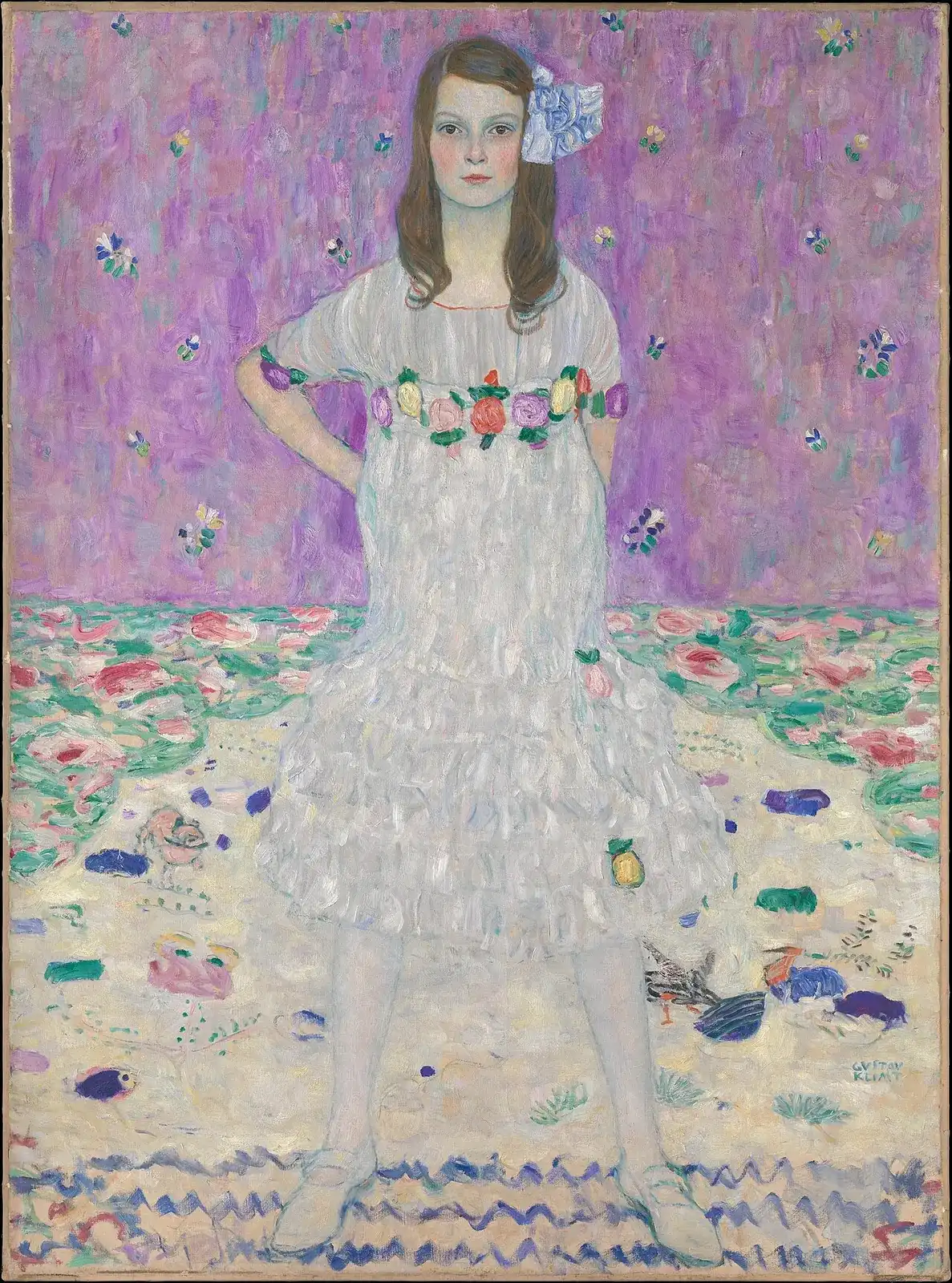
Klimt’s golden period is full of gold leaf and pattern. This portrait of nine-year-old Mäda Primavesi, 1912 to 1913, shows a banker’s daughter standing firm and frank, legs planted, before a field of flowers. I find her one of the most confident children in art.
Historical Gaudí and the North. In Barcelona, Antoni Gaudí built undulating, organic buildings, such as the Casa Batlló and the Casa Milà, and from 1883 led the work on the basilica of the Sagrada Família, still under construction a century after his death in 1926.
The style traveled north too. In Riga, whole streets of apartment houses were built in Jugendstil. In Finland it merged with national romanticism: Eliel Saarinen designed Helsinki Central Station, opened in 1919, with its granite giants holding lamps, and Lars Sonck built Tampere Cathedral with its stone and its frescoes by Hugo Simberg.
Simberg’s paintings there include a garland of twelve boys carrying a thorny vine, and a Garden of Death tended by skeleton gardeners. These buildings still feel like forest made into stone.
Key artists
| Artist | Lived | Why they matter |
|---|---|---|
| Alphonse Mucha | 1860 to 1939 | The Czech poster artist of women framed by halos and flowers. |
| Victor Horta | 1861 to 1947 | The Belgian architect of whiplash iron and glass. |
| Hector Guimard | 1867 to 1942 | Designer of the Paris Métro entrances. |
| Antoni Gaudí | 1852 to 1926 | The Catalan architect of organic, colorful buildings. |
| Louis Comfort Tiffany | 1848 to 1933 | The American master of glass. |
| René Lalique | 1860 to 1945 | Jeweler and glassmaker. |
How do you recognise Art Nouveau?
Look for the whiplash curve: long, flowing lines taken from stems, hair, waves and insects. Ornament covers everything, buildings, posters, jewelry, lamps. Women with flowing hair, dragonflies, peacocks and lilies are favorite motifs, and the boundary between fine art and design disappears.
Common misconceptions. People often confuse Art Nouveau with Art Deco. Art Nouveau is curving and organic and belongs to the years around 1900. Art Deco, from the 1920s and 1930s, is geometric, streamlined and fond of zigzags and sunbursts.
Another is that Art Nouveau was only French. It had many names: Jugendstil in Germany, Sezessionsstil in Austria, Modernisme in Catalonia, Stile Liberty in Italy. A third is that it was all made by famous men. Many of Tiffany’s best-known lamps were designed by Clara Driscoll and the women of her department, and Margaret Macdonald Mackintosh was an equal partner in the Glasgow style.
Esoteric themes
Historical Mucha was a Freemason and took part in spiritualist séances in Paris. In 1899 he published Le Pater, an illustrated Lord’s Prayer full of mystical light and Masonic symbolism, which he considered one of his most important works.
Klimt’s Beethoven Frieze (1902), painted for a Secession exhibition, shows humanity’s longing for happiness passing hostile powers to reach the redeeming kiss of art. I describe it in words, since it contains nudity.
Later tradition In the 1960s, Mucha’s posters came back as psychedelic art, and his women became icons of a new spiritual counterculture.
Modern Many modern tarot decks borrow Mucha’s halos and frames. Our site uses the original 1909 tarot images instead; you can see them in the 1909 tarot gallery.
Works to see
| Work | Artist | Date | Where to see it |
|---|---|---|---|
| Mäda Primavesi | Gustav Klimt | 1912 to 1913 | The Metropolitan Museum of Art, New York |
| Autumn Landscape window | Tiffany Studios | 1923 | The Metropolitan Museum of Art, New York |
| Gismonda poster | Alphonse Mucha | 1894 | Many collections, including the Mucha Museum, Prague |
| Casa Batlló | Antoni Gaudí | 1904 to 1906 | Barcelona |
Every work in this list is free of nudity, so you can look them up with confidence. Works still in copyright are named but not shown here.
How to look at an Art Nouveau poster or building
Follow a single line. In Art Nouveau, the outline often keeps going: from a woman’s hair into a scroll of smoke, from a stem into a frame. Then look at how the border and lettering are part of the design, not added afterwards. In buildings, look at the ironwork, glass and door handles, because the designers wanted every detail to belong to one idea.
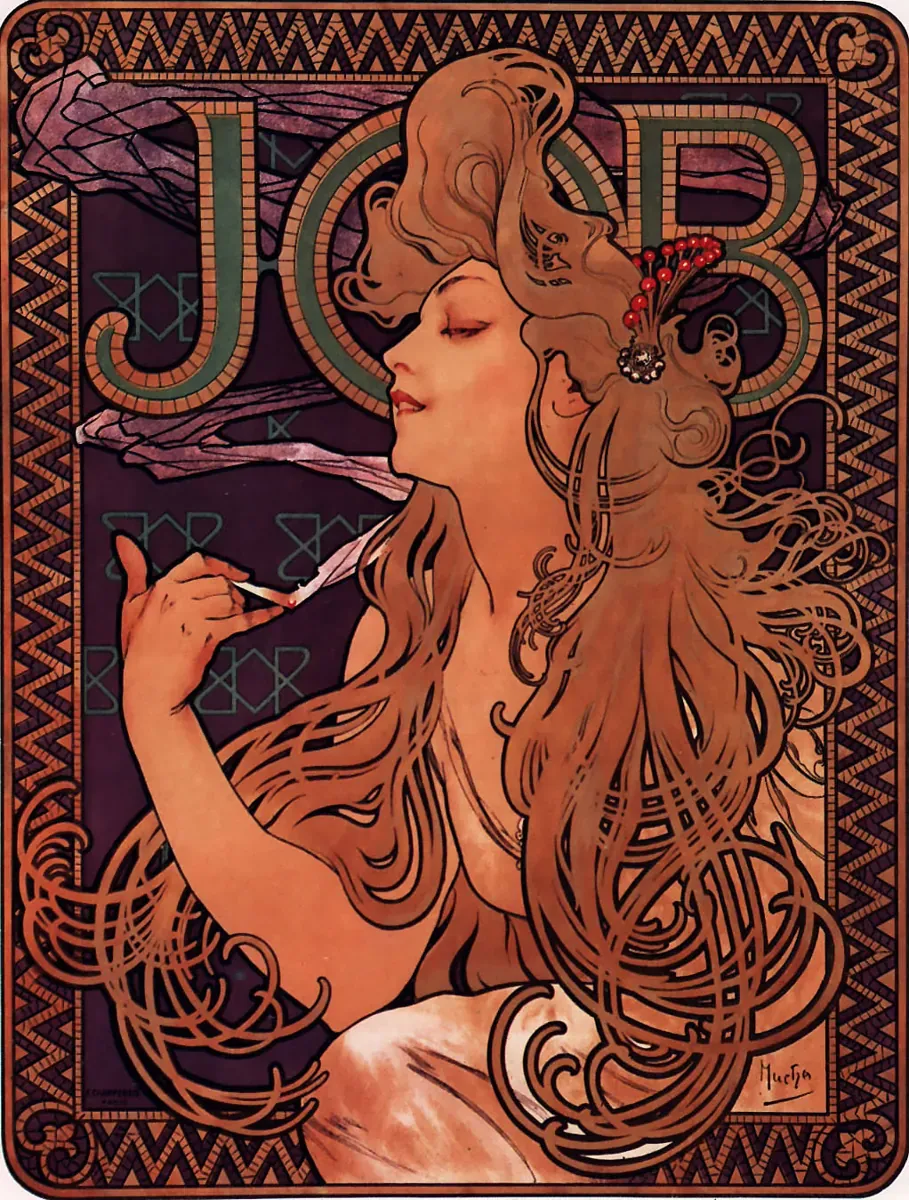
Alphonse Mucha, Job (cigarette paper poster), 1896. Prints in many collections. Image: Wikimedia Commons, public domain.
Alphonse Mucha, JOB, 1896. A poster for cigarette papers. Watch how the smoke and the hair make one pattern with the letters J-O-B. Mucha’s halo-like circle behind the head, borrowed from Byzantine icons, became his trademark.
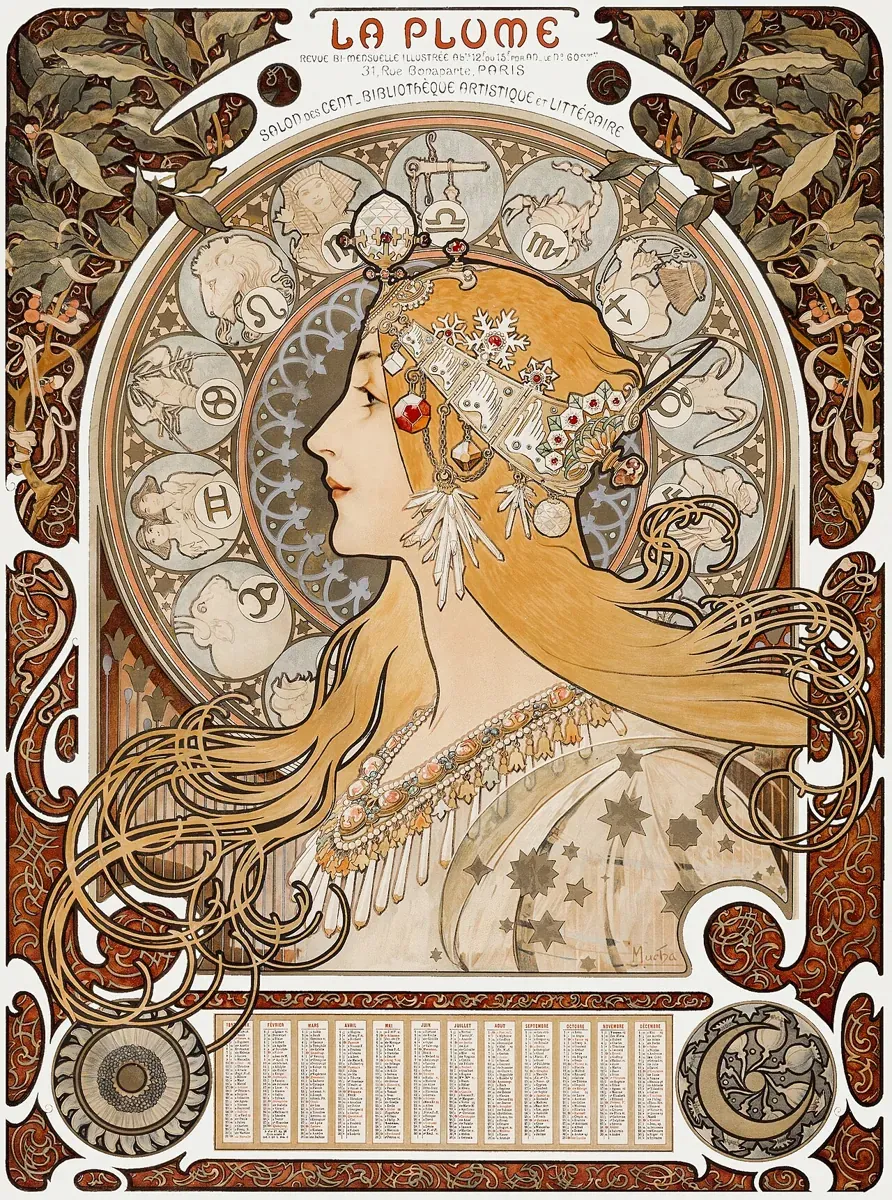
Alphonse Mucha, Zodiac (calendar for La Plume), 1896. Mucha Museum, Prague (prints in many collections). Image: Wikimedia Commons, public domain.
Alphonse Mucha, Zodiac, 1896. Made as a calendar for the magazine La Plume. Count the twelve signs around the head, and notice the flat, outlined colour, which comes from Japanese woodblock prints. You can see Mucha’s work at the Mucha Museum in Prague.
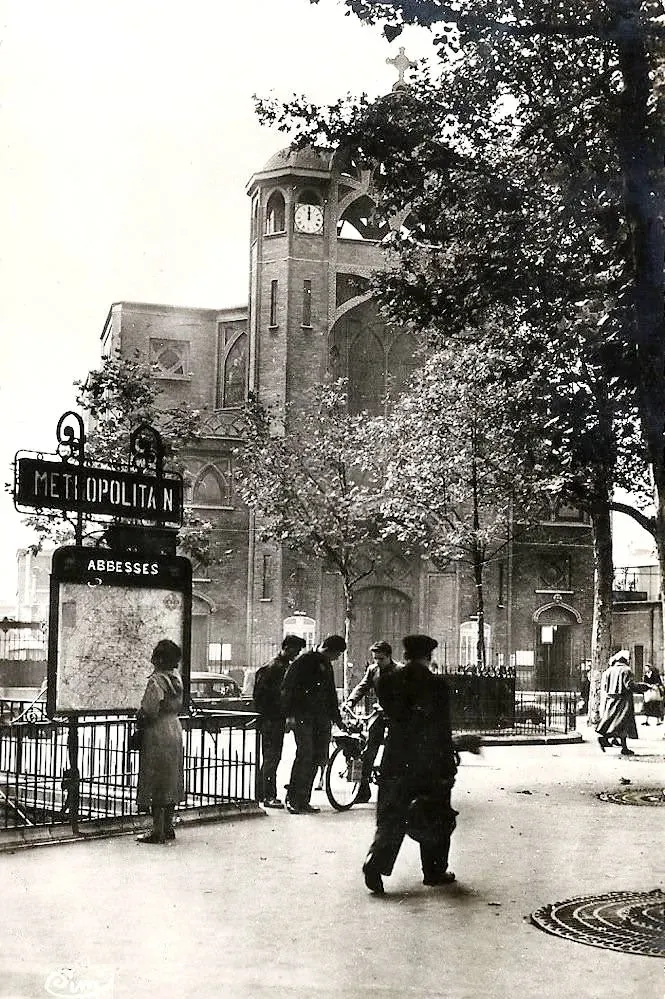
Hector Guimard, Original Guimard entrance, Abbesses station (photographed 1950), about 1900. Paris, Abbesses station. Image: Wikimedia Commons, public domain.
Hector Guimard, Paris metro entrance, about 1900. Guimard designed these cast-iron entrances for the new Paris metro, which opened in 1900. The one at Abbesses, moved there in 1974, is one of the few that keeps its glass canopy. Look for the stalks, buds and leaves.
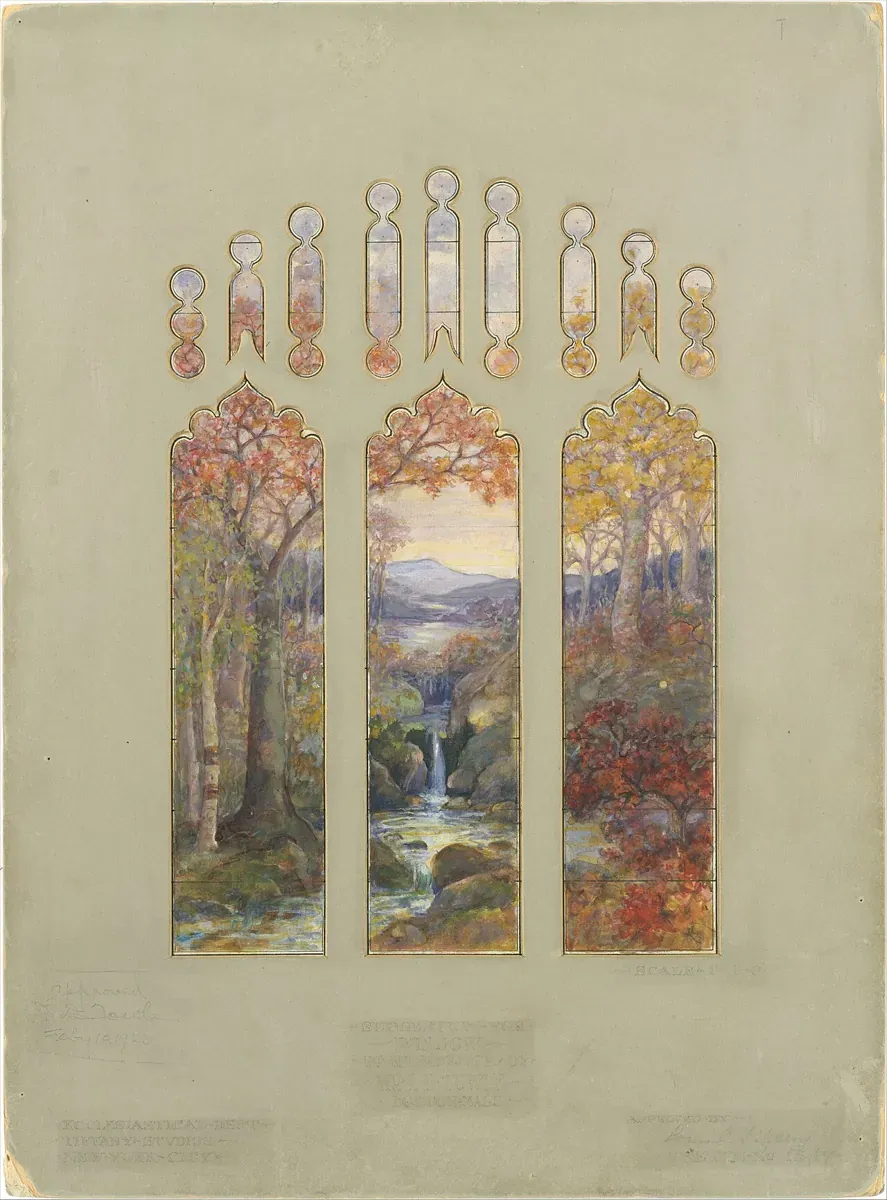
Tiffany Studios (design attributed to Agnes Northrop), Autumn Landscape window, 1923 to 1924. The Metropolitan Museum of Art, New York. Image: Wikimedia Commons, public domain.
Tiffany Studios, Autumn Landscape, 1923 to 1924. At the Metropolitan Museum of Art, designed by Agnes Northrop, another of Tiffany’s leading women designers. It is late, but shows the Tiffany idea that glass itself can be painterly. Look for the rippled and layered glass that makes the water move.
Art Nouveau grew out of the Arts and Crafts movement, Aestheticism and the dreams of Symbolism. In Vienna it became the stricter style of the Secession, and in Finland it merged with National Romanticism.
Try this
Find an Art Nouveau building or metro entrance in a city near you, or online. Draw only its main line, the one curve that the whole design seems to grow from. What plant or animal does it remind you of?
What next
Before this: National Romanticism.
After this: Vienna Secession.
Also worth reading alongside it: Arts and Crafts.
See every movement in order on the art movements timeline, or learn to look step by step in the free Art History for Beginners course.
If you want to carry this into tarot and practice, these pages connect to it: The Empress, nature, growth and abundant beauty; The Star, flowing hair and water, the Art Nouveau goddess; The occult revival in design; and Pamela Colman Smith, who worked in this style.
Sources
- Paul Greenhalgh (ed.), Victoria and Albert Museum, Art Nouveau 1890 to 1914 (exhibition catalogue) (2000).
- The Metropolitan Museum of Art, Mäda Primavesi, 64.148. Open the record
- Alphonse Mucha, Le Pater (1899).
- Mucha Foundation, Mucha Foundation. Visit the website
- E. H. Gombrich, The Story of Art (1950).
- Wikimedia Commons, Mäda Primavesi (hero image record). Open the record
- Stephen Escritt, Art Nouveau (2000).

Questions
What does Art Nouveau mean?
New Art, after a Paris shop called Maison de l'Art Nouveau opened by Siegfried Bing in 1895. The style was called Jugendstil in Germany and Secession style in Vienna.
Was Alphonse Mucha an occultist?
He was a Freemason and took part in spiritualist séances, and in 1899 he published Le Pater, a mystical illustrated Lord's Prayer. His famous posters, though, were commercial work.
Where can I see works of Art Nouveau in person?
Good places to start are Brussels, Paris, Vienna, Prague, Barcelona, Riga, Helsinki, and the Met. Museums change their displays, so check the collection page before you travel.
What is the difference between Art Nouveau and Art Deco?
Art Nouveau (about 1890 to 1910) uses flowing, plant-like curves. Art Deco (about 1920 to 1940) uses geometric shapes, straight lines and machine-age polish.
When did Art Nouveau end?
It faded around 1910, and the First World War ended it. Designers turned to simpler, more geometric forms that led to Art Deco and modernism.
Get the free Mini-Grimoire
A short printable starter guide to tarot and everyday witchcraft, plus my newsletter. Unsubscribe any time.
Opens Substack in a new tab to confirm. More about the newsletter · Privacy