


How to read the labels Historical what the old sources say. Later tradition what later writers added. Modern modern practice and my own notes.
The Arts and Crafts movement was a design reform movement that began in Britain in the 1860s and spread to Europe and North America by 1910. Inspired by John Ruskin and led by William Morris, it argued that everyday objects should be handmade, honest and beautiful, and that the people who made them deserved satisfying work. Its wallpapers, textiles, books and furniture still shape how we decorate homes.
Look around your home. Is there a cushion, a mug or a curtain with a pattern you love, made by someone who cared? The Arts and Crafts movement would approve.
Key dates
| When | What happened |
|---|---|
| 1853 | Ruskin publishes “The Nature of Gothic” in The Stones of Venice. |
| 1861 | William Morris and friends found Morris, Marshall, Faulkner and Co. |
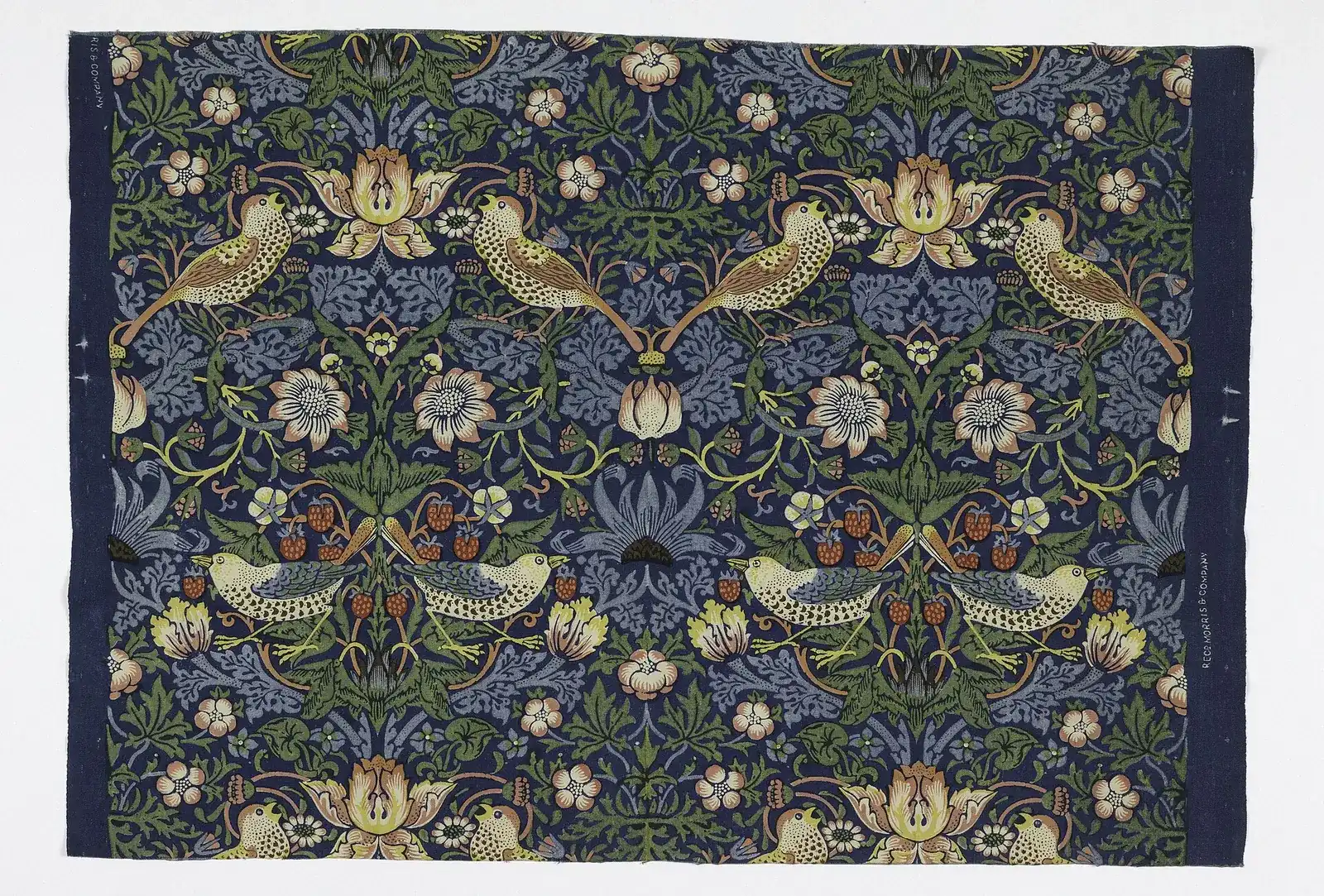
| 1883 | Morris designs the Strawberry Thief textile. |
| 1887 | The Arts and Crafts Exhibition Society is founded and gives the movement its name. |
| 1896 | The Kelmscott Press prints its great Chaucer. |
What is the Arts and Crafts movement?
The Arts and Crafts movement was a reaction against cheap factory goods, which tried to revive handwork, simple materials and medieval-style workshops, with a strong social message.
Throughout this page I mark three layers. Historical What the works and writings show. Later tradition What later designers made of them. Modern How the ideas live in craft and witchcraft today.
Historical Ruskin and the honest workman. The critic John Ruskin argued in “The Nature of Gothic” (1853) that medieval builders had been free to carve with joy, while factory workers were reduced to machines. William Morris read it as a student at Oxford and never forgot it.
Morris and the firm. 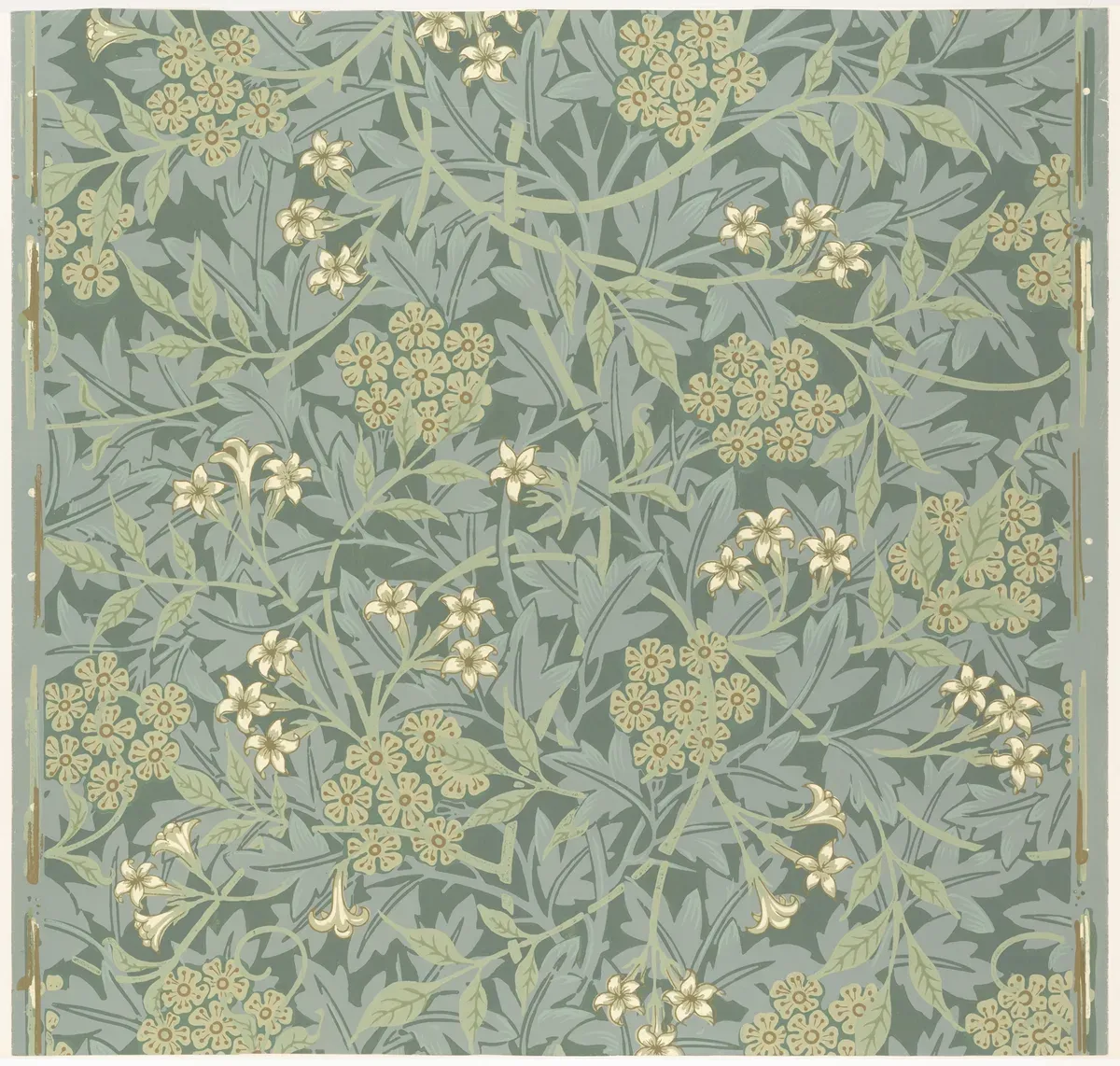
William Morris, Jasmine, 1872. The Metropolitan Museum of Art (23.163.4j). Image: Open Access, public domain (CC0).
Historical In 1859 and 1860 the architect Philip Webb built the Red House for Morris and his wife Jane, and friends decorated it together.
In 1861 Morris and his partners founded a firm, later Morris and Co., that made stained glass, furniture, textiles and wallpaper. Jasmine, designed in 1872, winds its flowers over the wall like a garden in summer.
In an 1880 lecture he gave the movement its motto: “Have nothing in your houses that you do not know to be useful, or believe to be beautiful.”
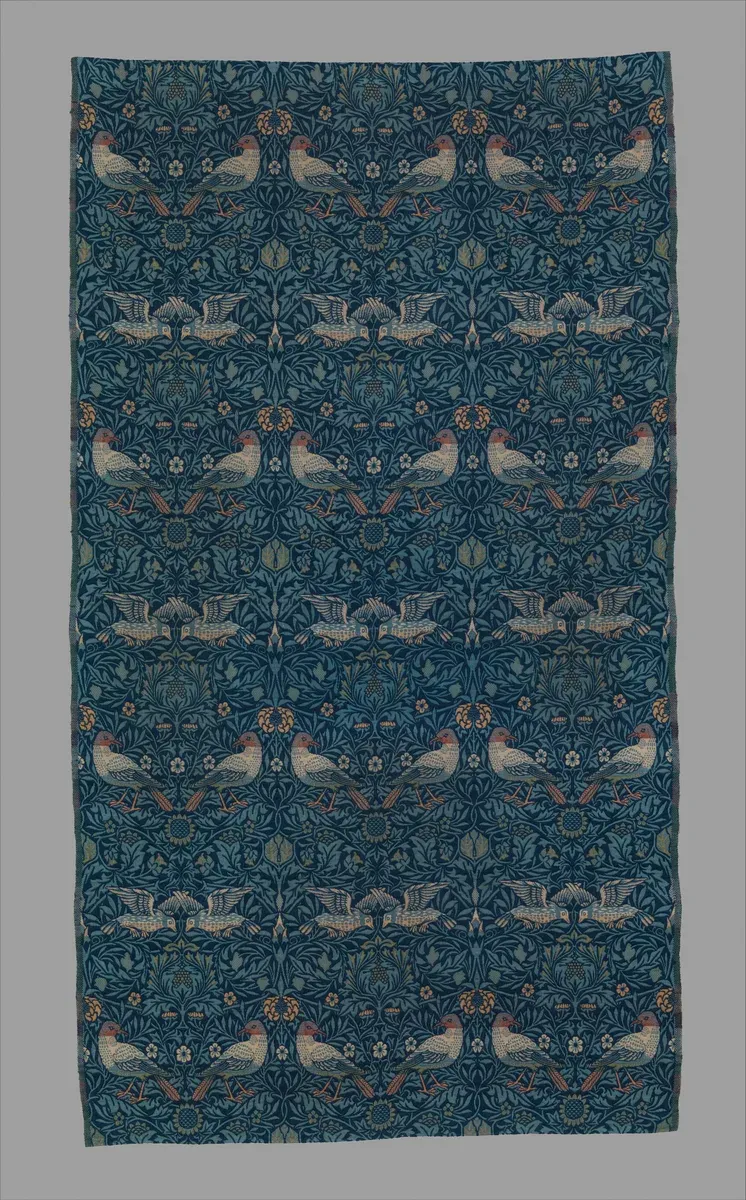
William Morris, Bird, designed 1878. The Metropolitan Museum of Art (23.163.15). Image: Open Access, public domain (CC0).
His woven Bird textile, designed in 1878, hung in his own drawing room. Morris taught himself dyeing with natural dyes like indigo and madder, often ending the day with blue hands.
Historical Books and women’s work. In 1891 Morris founded the Kelmscott Press, and in 1896 it printed the great Kelmscott Chaucer with woodcuts after Burne-Jones.
His daughter May Morris ran the firm’s embroidery department from 1885, designed some of its best-known patterns and lectured on embroidery in Britain and America. In Edinburgh, Phoebe Anna Traquair painted murals and illuminated manuscripts.
In Glasgow, Charles Rennie Mackintosh designed the Glasgow School of Art, built between 1897 and 1909, while Margaret Macdonald, his wife and partner, made gesso panels of dreamlike, elongated women. Their tall, straight-backed chairs and stylized roses sit halfway between Arts and Crafts and Art Nouveau, and Vienna’s Secession artists invited them to exhibit in 1900.
Historical Finland and the North. In Finland, the Friends of Finnish Handicraft was founded in 1879 by the painter Fanny Churberg to preserve and renew textile traditions. Finnish rugs and woven wall hangings became part of a shared Nordic love of craft.
Key artists
| Artist | Lived | Why they matter |
|---|---|---|
| John Ruskin | 1819 to 1900 | The critic who argued that joyful handwork makes good art and good lives. |
| William Morris | 1834 to 1896 | Designer, poet, printer and socialist. |
| May Morris | 1862 to 1938 | Embroiderer and leader of the firm’s embroidery work. |
| Phoebe Anna Traquair | 1852 to 1936 | The Irish-born Scottish artist of murals, enamels and embroidery. |
| C. R. Ashbee | 1863 to 1942 | Founder of the Guild of Handicraft. |
How do you recognise the Arts and Crafts movement?
Look for honest materials and visible handwork: oak, hand-woven cloth, hand-printed paper and hammered metal. Patterns come from English gardens, birds and medieval sources. Books are designed as whole objects. The aim is beauty in everyday things, made by people who enjoy the work.
Common misconceptions. One is that Arts and Crafts objects were cheap and for everyone. Morris wanted that, and was frustrated that handmade work was so expensive that mostly wealthy people could buy it. He famously complained of “ministering to the swinish luxury of the rich”.
Another is that it was a men’s movement. May Morris ran the embroidery department of Morris & Co. from 1885, Phoebe Anna Traquair painted the interiors of Edinburgh buildings, and many women worked in its embroidery, bookbinding and metalwork guilds. A third is that it hated all machines. Several later members, including C. R. Ashbee, came to accept machines for some tasks.
Esoteric themes
Historical Morris was a socialist, not an occultist. Yet the movement’s world shaped the most famous tarot deck. Pamela Colman Smith studied design at the Pratt Institute with Arthur Wesley Dow, who taught flat color and strong lines, and in 1903 she published her own small press magazine, The Green Sheaf.
Her 1909 tarot, which this site shows in its original printing, has the bold outline and handmade feeling of that design culture. See Pamela Colman Smith.
Later tradition Morris’s dream of the Middle Ages and his translations of Icelandic sagas fed later fantasy, and through it much modern pagan imagery.
Modern The craft revival, hand-dyeing, embroidery and bookbinding, is part of many witches’ practice.
Works to see
| Work | Artist | Date | Where to see it |
|---|---|---|---|
| Strawberry Thief textile | William Morris | designed 1883 | Cooper Hewitt, Smithsonian Design Museum, New York, and the V&A, London |
| The Works of Geoffrey Chaucer (Kelmscott Chaucer) | William Morris and Edward Burne-Jones | 1896 | The Metropolitan Museum of Art, New York, and many libraries |
| Trellis wallpaper | William Morris | 1862 | Victoria and Albert Museum, London |
| Red House | Philip Webb and William Morris | 1859 to 1860 | Bexleyheath, London |
Every work in this list is free of nudity, so you can look them up with confidence. Works still in copyright are named but not shown here.
How to look at an Arts and Crafts design
Start with the pattern. Morris designs repeat, but they are built so that you do not notice where the repeat begins. Find one bird or flower and try to see where it appears again. Then look for the materials and the hand: woodblock printing, natural dyes, visible joints in furniture.
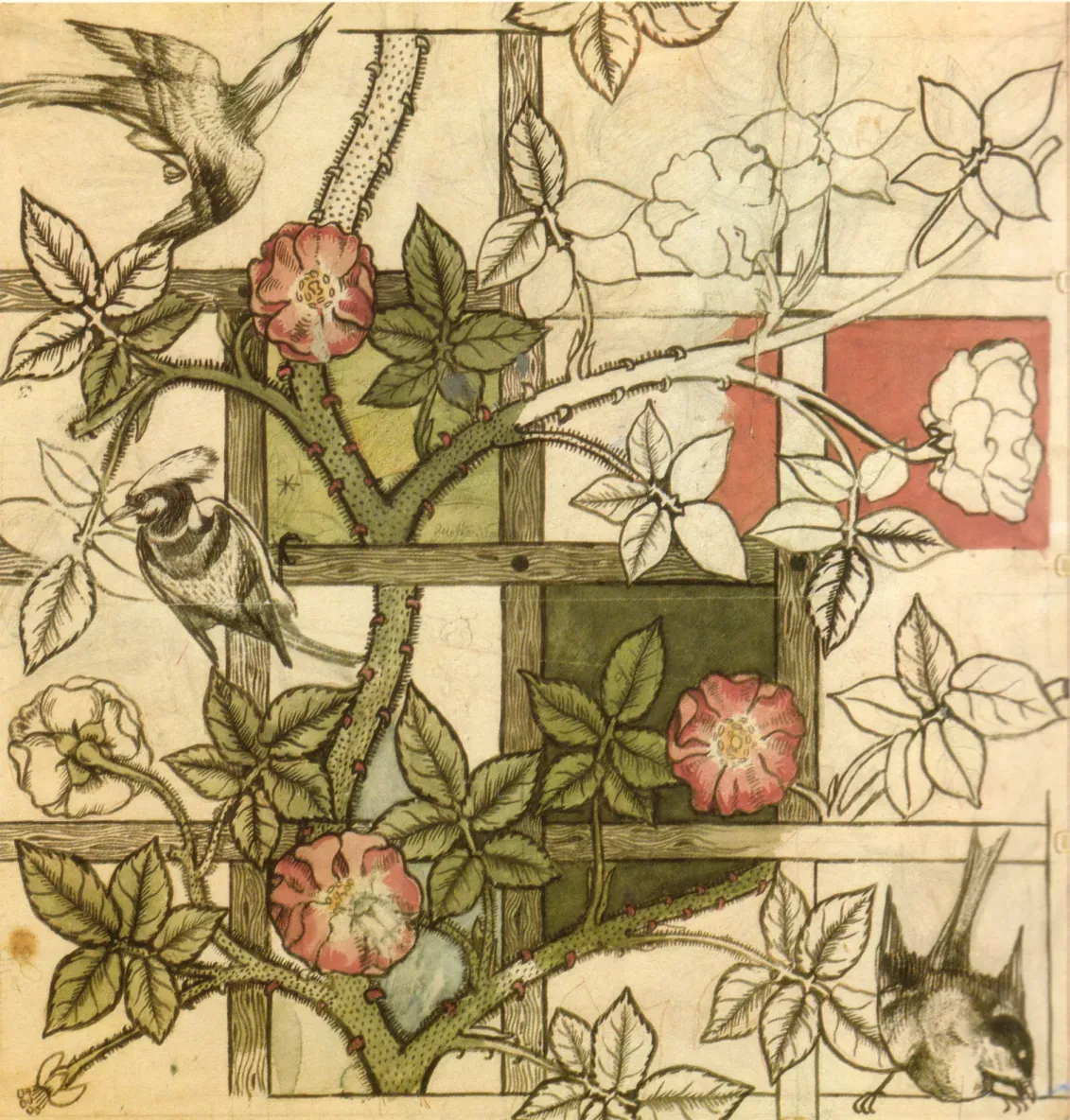
William Morris and Philip Webb, Trellis wallpaper, 1862. Victoria and Albert Museum, London. Image: Wikimedia Commons, public domain.
William Morris and Philip Webb, Trellis, designed 1862. Morris’s first wallpaper design, issued in 1864. The birds were drawn by his friend, the architect Philip Webb. It was inspired by the rose trellis in the garden of Red House, the home Webb built for Morris. You can see it at the Victoria and Albert Museum in London.
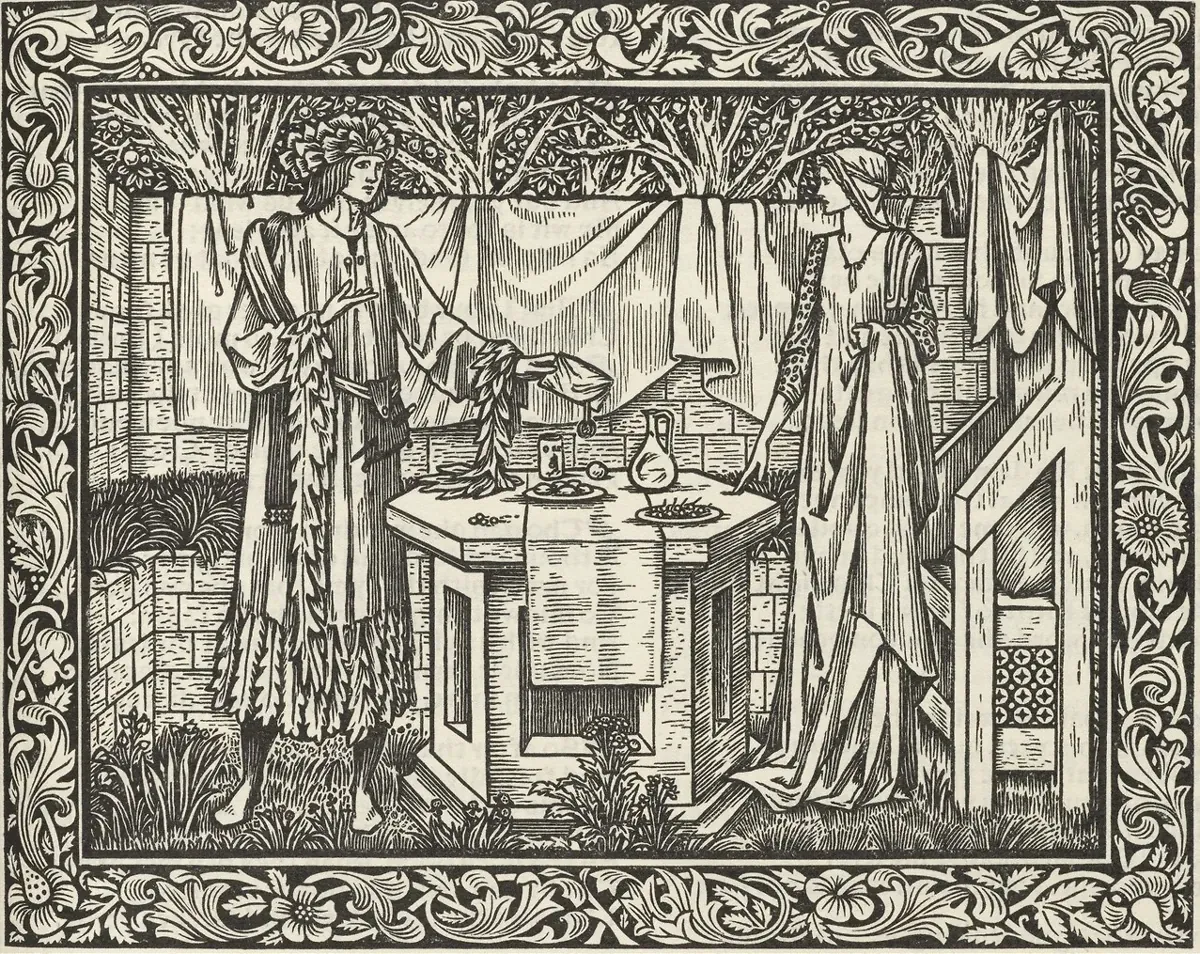
William Morris and Edward Burne-Jones, The Works of Geoffrey Chaucer (Kelmscott Chaucer), 1896. British Library and many libraries. Image: Wikimedia Commons, public domain.
The Kelmscott Chaucer, 1896. Printed by Morris’s Kelmscott Press with woodcut illustrations after Edward Burne-Jones. It took years to make, and only 425 paper copies and 13 on vellum were printed. Look at how the borders, the initial letters and the type form one dark, rich page, like a medieval manuscript.
The movement drew on the Pre-Raphaelites and on Gothic art, and it fed directly into Art Nouveau, the workshops of the Vienna Secession and the handmade spirit of Finnish National Romanticism. In Finland, the Iris factory in Porvoo, founded in 1897, brought the same ideas into furniture and ceramics.
Try this
Take one object in your home that you love. Ask Morris’s two questions: do I know it to be useful, do I believe it to be beautiful? Then ask a third of your own: who made it, and how?
What next
Before this: Vienna Secession.
After this: Golden Age of Illustration.
Also worth reading alongside it: Pre-Raphaelites.
See every movement in order on the art movements timeline, or learn to look step by step in the free Art History for Beginners course.
If you want to carry this into tarot and practice, these pages connect to it: Three of Pentacles, the workshop and shared craft; The Empress, the garden turned into pattern; Making your own tools by hand; and The circle around Morris and Burne-Jones.
Sources
- William Morris, The Beauty of Life (lecture, 1880), in Hopes and Fears for Art (1882).
- Fiona MacCarthy, William Morris: A Life for Our Time (1994).
- The Metropolitan Museum of Art, Jasmine, 23.163.4j. Open the record
- The Metropolitan Museum of Art, Bird, 23.163.15. Open the record
- E. H. Gombrich, The Story of Art (1950).
- Wikimedia Commons, Strawberry Thief textile (hero image record). Open the record
- Rosalind P. Blakesley, The Arts and Crafts Movement (2006).

Questions
What did the Arts and Crafts movement believe?
That handmade, honest design could make life better, for the worker who made a thing and for the person who used it. It rejected cheap machine-made goods and the split between fine art and craft.
Where does the name come from?
From the Arts and Crafts Exhibition Society, founded in London in 1887, which held its first exhibition in 1888. The bookbinder T. J. Cobden-Sanderson suggested the name.
Where can I see works of Arts and Crafts in person?
Good places to start are London (the V&A, the William Morris Gallery), Kelmscott Manor, Glasgow, and the Met. Museums change their displays, so check the collection page before you travel.
What is the most famous William Morris design?
Strawberry Thief, a printed textile of 1883 showing thrushes stealing strawberries in Morris's garden at Kelmscott Manor, is probably the best known, together with the Willow Bough and Trellis wallpapers.
What is the difference between Arts and Crafts and Art Nouveau?
Arts and Crafts came first and focused on honest handwork and social reform. Art Nouveau, around 1890 to 1910, took its love of nature and turned it into a more luxurious, curving and international style.
Get the free Mini-Grimoire
A short printable starter guide to tarot and everyday witchcraft, plus my newsletter. Unsubscribe any time.
Opens Substack in a new tab to confirm. More about the newsletter · Privacy