


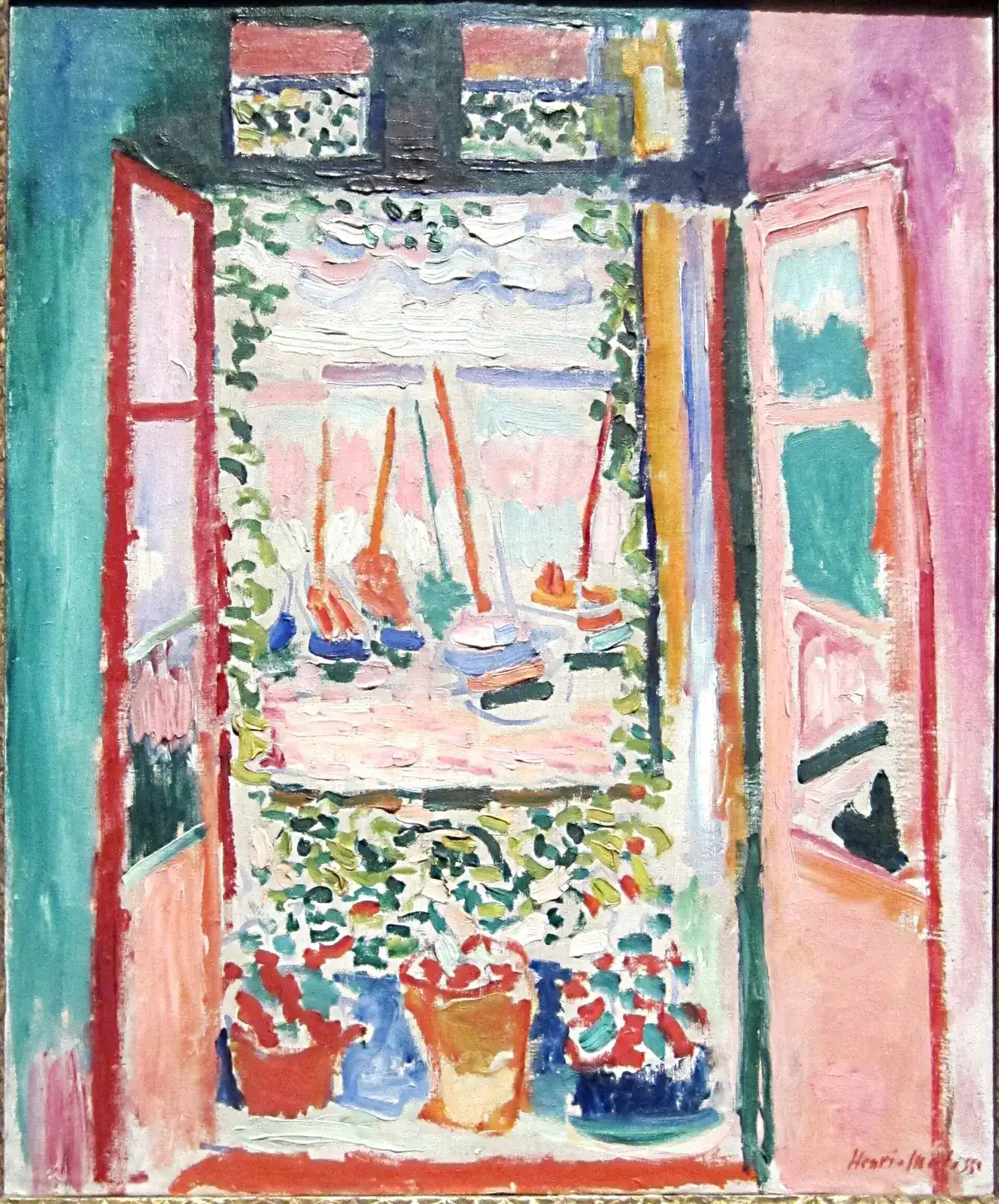
How to read the labels Historical what the old sources say. Later tradition what later writers added. Modern modern practice and my own notes.
Fauvism was a short, explosive movement in French painting, from about 1905 to 1908, led by Henri Matisse and André Derain. Its name comes from the Salon d’Automne in Paris in 1905, where the critic Louis Vauxcelles called the painters “fauves”, wild beasts. The Fauves used pure, unmixed colour, often straight from the tube, to build pictures of light and feeling rather than to copy nature.
Visitors to that Salon walked into a room that seemed to be on fire. Faces had green shadows. Trees were red. Roads were purple. The group lasted only a few years, but its lesson spread from Paris to Dresden, Munich and Moscow within a decade.
Key dates
| When | What happened |
|---|---|
| Summer 1905 | Matisse and Derain paint together at Collioure. |
| Autumn 1905 | At the Salon d’Automne the critic Louis Vauxcelles calls them “fauves”, wild beasts. |
| 1906 | Derain paints his London views for the dealer Ambroise Vollard. |
| 1907 to 1908 | The painters move on, many toward Cubism. |
What is Fauvism?
Fauvism is painting in which colour is freed from description: trees can be red, faces green and the sea pink, if that is what the picture needs.
Throughout this page I mark three layers. Historical What the works and records show. Later tradition The legends. Modern How we use color today.
Historical The cage of wild beasts. Matisse, Derain and others had been working through Post-Impressionism: Van Gogh’s strokes, Gauguin’s flat color, Seurat’s dots. In the summer of 1905 Matisse and Derain painted together in the fishing port of Collioure, near the Spanish border, and pushed color as far as it would go.
At the Salon, the critic Louis Vauxcelles saw a small classical sculpture in the middle of their room and joked about “Donatello among the wild beasts”.
Historical Matisse. Henri Matisse (1869 to 1954) had studied with the Symbolist Gustave Moreau. His Woman with a Hat (1905), now in the San Francisco Museum of Modern Art, shows his wife Amélie with a face streaked green and violet under an enormous hat. Visitors laughed. The American collectors Leo and Gertrude Stein bought it.
In 1908 Matisse wrote that he dreamed of “an art of balance, of purity and serenity”, something like a good armchair for a tired mind. He went on to a long career of color and pattern, ending with paper cut-outs made when illness kept him from painting.
I describe his works in words here, because I could not find a public domain image file of the right quality; the museum websites show them well.
Derain in London. 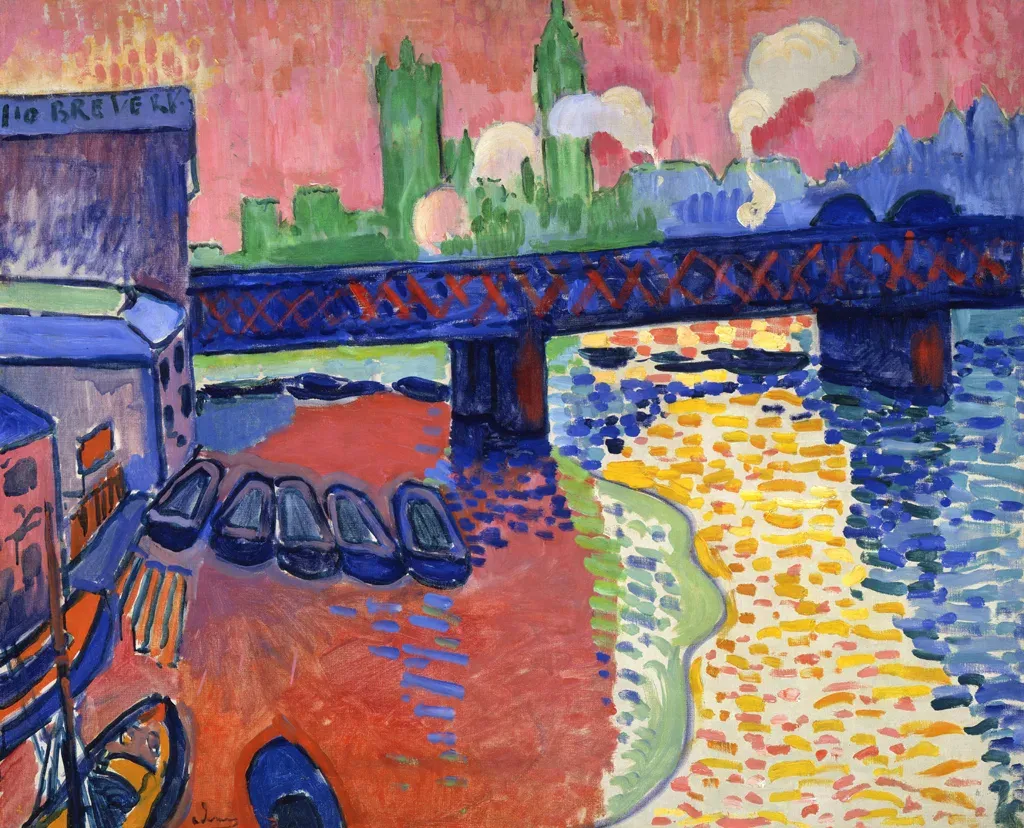
André Derain, Charing Cross Bridge, London, 1906. National Gallery of Art, Washington. Image: Wikimedia Commons, public domain.
Historical In 1906 the dealer Ambroise Vollard sent André Derain to London to paint the city, as Monet had done a few years before. Monet’s Thames was fog and pearl. Derain’s Charing Cross Bridge is blue, orange, green and pink, the water broken into bright tiles of color. It is the same river seen by a completely different temperament.
Historical Color and the brain. The Fauves built on color theory from Chevreul to the Neo-Impressionists, and on the experience of the Mediterranean sun. Their colors are not random. Complementary pairs, red against green and orange against blue, make each other vibrate.
Key artists
| Artist | Lived | Why they matter |
|---|---|---|
| Henri Matisse | 1869 to 1954 | The leader of the group, a former student of Gustave Moreau. |
| André Derain | 1880 to 1954 | Matisse’s partner at Collioure and painter of London in flames of color. |
| Maurice de Vlaminck | 1876 to 1958 | The self-taught painter of hot, thick color. |
| Raoul Dufy | 1877 to 1953 | Later famous for light, decorative scenes. |
| Georges Braque | 1882 to 1963 | A brief Fauve before he invented Cubism with Picasso. |
How do you recognise Fauvism?
Look for color used straight from the tube, in flat patches that do not describe the real colors of things: a red tree, a green face, a pink sea. Brushwork is quick and visible. Compositions are simple and full of light, and the canvas often shows through.
Common misconceptions. “Fauvism was chaos” is the common one. Matisse planned his colour carefully, and his famous aim was an art of “balance, purity and serenity”, written in his “Notes of a Painter” of 1908.
Another is that Fauvism was a formal group with a programme. It had no manifesto, and its painters went separate ways by 1908, with Braque turning to Cubism. A third is that only men took part. Émilie Charmy and Jacqueline Marval exhibited at the Salons beside the Fauves, and Charmy’s bold paintings were admired by critics of the time.
Esoteric themes
Historical Fauvism has little direct esoteric content, and I will not invent any. But Derain and Vlaminck were among the first Paris artists to collect African masks around 1905 and 1906, and Matisse’s teacher Moreau had been a leading Symbolist.
The idea that color acts on us directly, without a story, was in the air, and Kandinsky would soon make it spiritual.
Later tradition Matisse’s late chapel at Vence (1949 to 1951), with its stained glass of yellow, green and blue, is often described as a place of quiet light. That is how visitors experience it; Matisse called it the result of a lifetime of work.
Modern Color magic, from candle colors to altar cloths, is the most Fauve part of a witch’s practice. See Candle colours.
Works to see
| Work | Artist | Date | Where to see it |
|---|---|---|---|
| Open Window, Collioure | Henri Matisse | 1905 | National Gallery of Art, Washington |
| Woman with a Hat | Henri Matisse | 1905 | San Francisco Museum of Modern Art |
| Charing Cross Bridge, London | André Derain | 1906 | National Gallery of Art, Washington |
| Mountains at Collioure | André Derain | 1905 | National Gallery of Art, Washington |
Every work in this list is free of nudity, so you can look them up with confidence. Works still in copyright are named but not shown here.
How to look at a Fauve painting
Look for the opposites. Fauve painters loved complementary colours side by side, red against green, orange against blue, so that each makes the other brighter. Then look for empty canvas between strokes: the white gaps let the colours breathe.
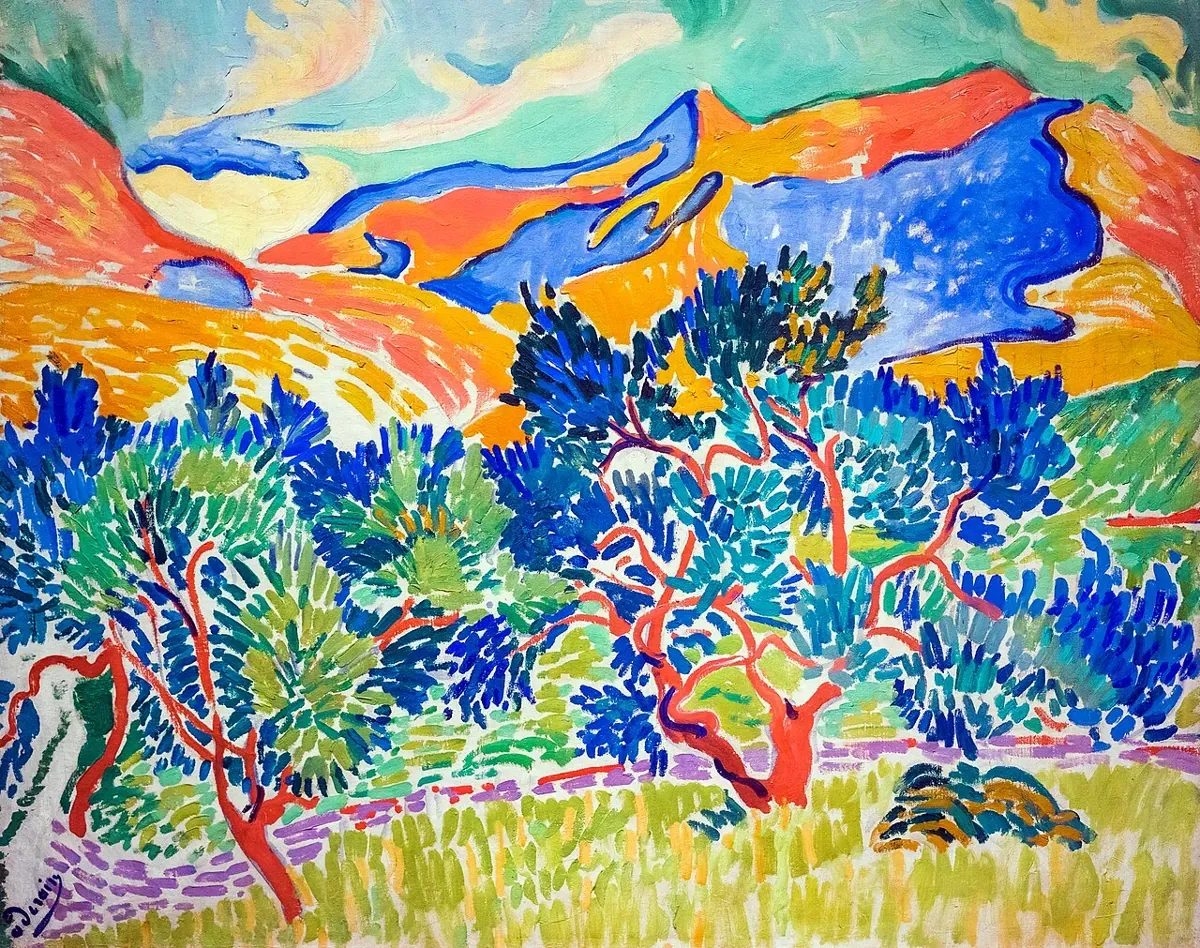
André Derain, Mountains at Collioure, 1905. National Gallery of Art, Washington. Image: Wikimedia Commons, public domain.
André Derain, Mountains at Collioure, 1905. At the National Gallery of Art in Washington. Painted in the fishing village where Derain and Matisse spent the summer of 1905. Trace the curving trunks: blue, red, black. The landscape becomes a pattern of colour, close to the flat curves of Art Nouveau.
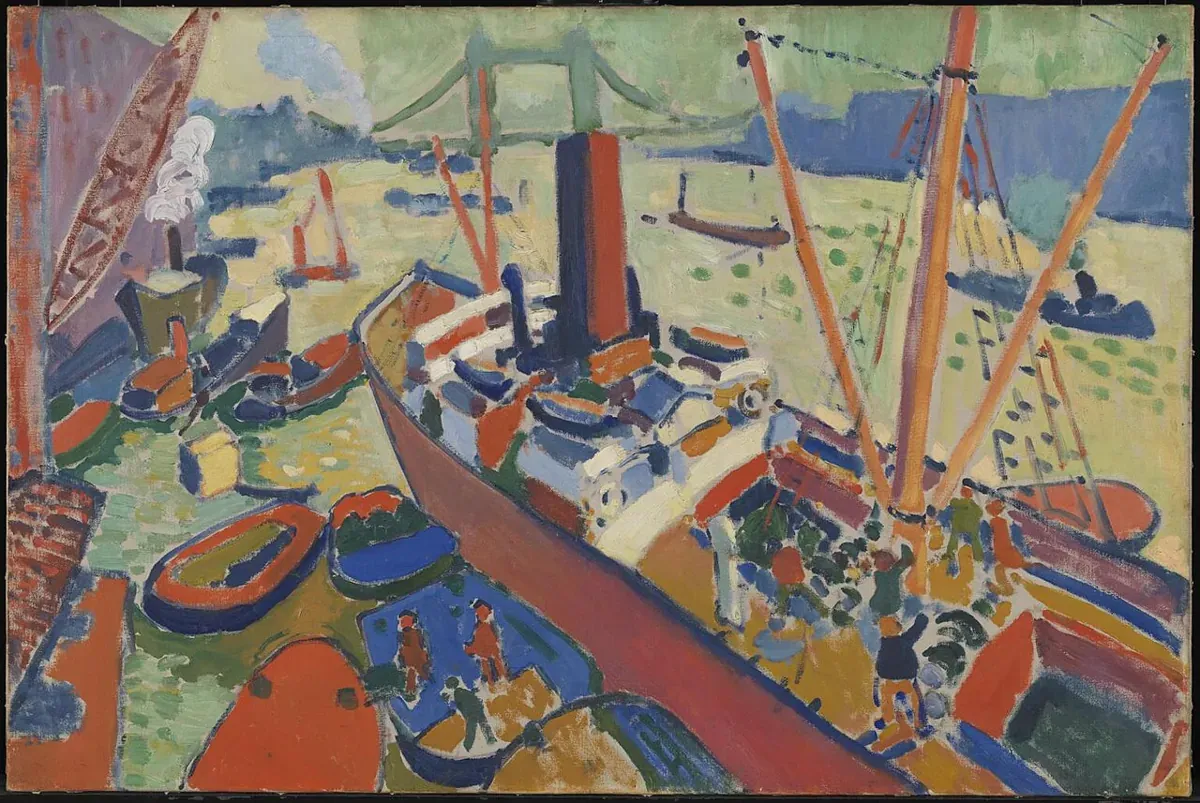
André Derain, The Pool of London, 1906. Tate, London. Image: Wikimedia Commons, public domain.
André Derain, The Pool of London, 1906. At Tate in London. The dealer Ambroise Vollard sent Derain to London to paint the river, hoping for a modern answer to Monet’s London views. Compare it with Monet: Derain trades mist for blocks of hot colour.
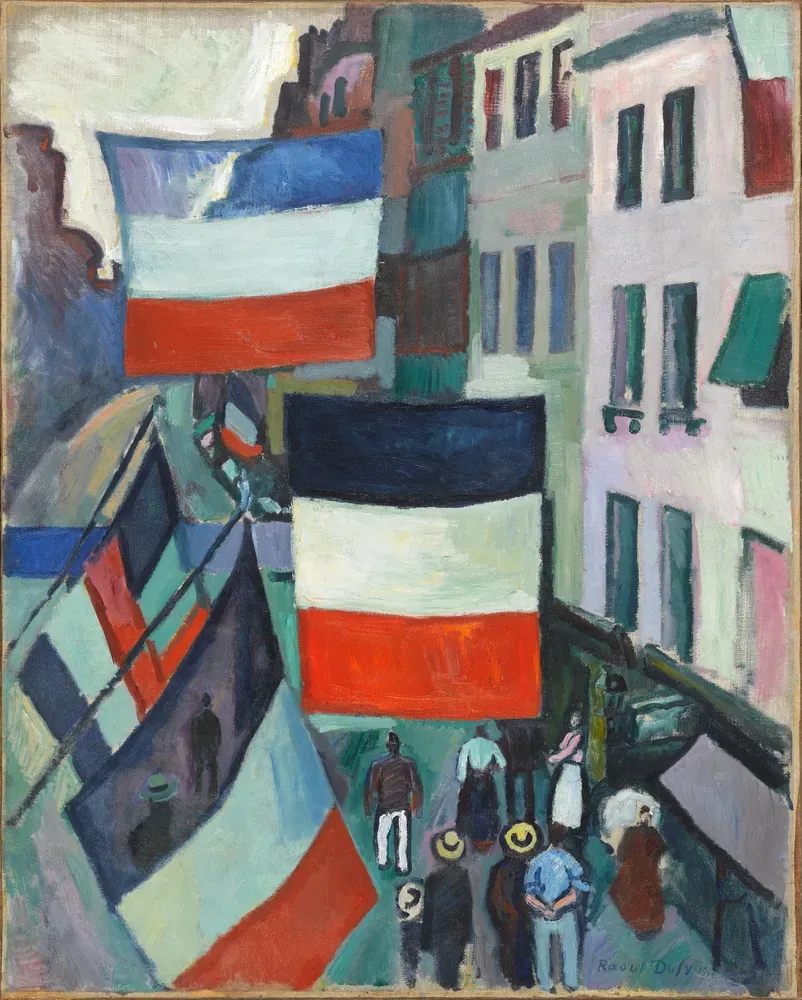
Raoul Dufy, Rue pavoisée (Street Decked with Flags), 1906. Centre Pompidou, Paris. Image: Wikimedia Commons, public domain.
Raoul Dufy, Rue pavoisée (Street Decked with Flags), 1906. At the Centre Pompidou in Paris. A street in Le Havre on Bastille Day, 14 July. The flags turn the scene into a rhythm of red, white and blue. Monet had painted a flag-filled Paris street in 1878, but Dufy flattens it into pure pattern.
Fauvism grew from Post-Impressionism, especially Van Gogh, Gauguin and the dots of Seurat and Signac. It fed Expressionism in Germany and the colour of early abstraction, and Braque carried its lessons into Cubism.
Try this
Find Derain’s Charing Cross Bridge and one of Monet’s London paintings of the Thames online. Write down the three main colors in each. Then paint or color a view from your own window twice: once in its real colors, once in colors that show how you feel about it.
What next
Before this: Golden Age of Illustration.
After this: Expressionism.
Also worth reading alongside it: Post-Impressionism.
See every movement in order on the art movements timeline, or learn to look step by step in the free Art History for Beginners course.
If you want to carry this into tarot and practice, these pages connect to it: The Sun, pure color and joy; The Fool, the bold first step, breaking the rules; Color as feeling in modern art; and Working with color in the mind.
Sources
- Henri Matisse, Notes of a Painter (Notes d’un peintre), La Grande Revue (1908).
- Judi Freeman (ed.), Los Angeles County Museum of Art, The Fauve Landscape (exhibition catalogue) (1990).
- National Gallery of Art, Washington, Charing Cross Bridge, London. Open the record
- San Francisco Museum of Modern Art, Woman with a Hat. Open the record
- E. H. Gombrich, The Story of Art (1950).
- Wikimedia Commons, Open Window, Collioure (hero image record). Open the record
- Sarah Whitfield, Fauvism (1991).

Questions
Why are they called the Fauves?
At the 1905 Salon d'Automne in Paris, the critic Louis Vauxcelles saw a classical-style sculpture in a room of blazing paintings and joked about Donatello among the wild beasts, les fauves. The name stuck.
How long did Fauvism last?
Only about three years as a group, from 1905 to around 1908. But it freed color from describing nature, and every later colorist owes it something.
Where can I see works of Fauvism in person?
Good places to start are Paris (the Centre Pompidou, the Musée d'Art Moderne), San Francisco, Washington, and Nice. Museums change their displays, so check the collection page before you travel.
Who was the leader of Fauvism?
Henri Matisse is usually seen as its leader, with André Derain as his closest partner. Maurice de Vlaminck, Raoul Dufy, Albert Marquet, Henri Manguin and Georges Braque also took part.
What is the most famous Fauve painting?
Matisse's Woman with a Hat (1905, San Francisco Museum of Modern Art), shown at the 1905 Salon d'Automne, is the painting that caused the scandal.
Get the free Mini-Grimoire
A short printable starter guide to tarot and everyday witchcraft, plus my newsletter. Unsubscribe any time.
Opens Substack in a new tab to confirm. More about the newsletter · Privacy