


How to read the labels Historical what the old sources say. Later tradition what later writers added. Modern modern practice and my own notes.
Impressionism is the movement of French painters who, from the first independent exhibition in Paris in April 1874, painted modern life and the passing effects of light with quick, visible brushstrokes. Its core members included Claude Monet, Pierre-Auguste Renoir, Edgar Degas, Camille Pissarro, Berthe Morisot, Mary Cassatt and Gustave Caillebotte. They held eight group exhibitions until 1886 and changed what a finished painting could look like.
The first show opened on 15 April 1874 in the former studio of the photographer Nadar, outside the official Salon. A critic mocked one picture, a misty harbour at sunrise, and called the whole group “Impressionists”. The name stuck. Their work looked shockingly unfinished at the time; today it is among the most loved painting in the world.
Key dates
| When | What happened |
|---|---|
| 1863 | The Salon des Refusés shows works rejected by the official Salon. |
| 1872 | Monet paints Impression, Sunrise. |
| 1874 | The first independent exhibition opens in Nadar’s former studio. |
| 1886 | The eighth and last group exhibition. |
| 1890 to 1894 | Monet paints his series of grainstacks and Rouen Cathedral. |
What is Impressionism?
Impressionism is painting that tries to catch a moment, the light, the weather, a crowd, with broken colour and loose brushwork rather than smooth, detailed finish.
Throughout this page I mark three layers. Historical What the works and records show. Later tradition The myths. Modern How we use these paintings now.
Historical A new Paris and an old Salon. In the 1860s Napoleon III and Baron Haussmann rebuilt Paris with boulevards, parks, cafés and railway stations. The official Salon still favored polished history paintings.
In 1863 the jury rejected so many works that the emperor allowed a Salon des Refusés, where Édouard Manet’s Luncheon on the Grass caused a scandal. Manet never showed with the Impressionists but was their hero. Practical changes mattered too: the collapsible paint tube (1841) and bright new pigments let painters work outdoors.
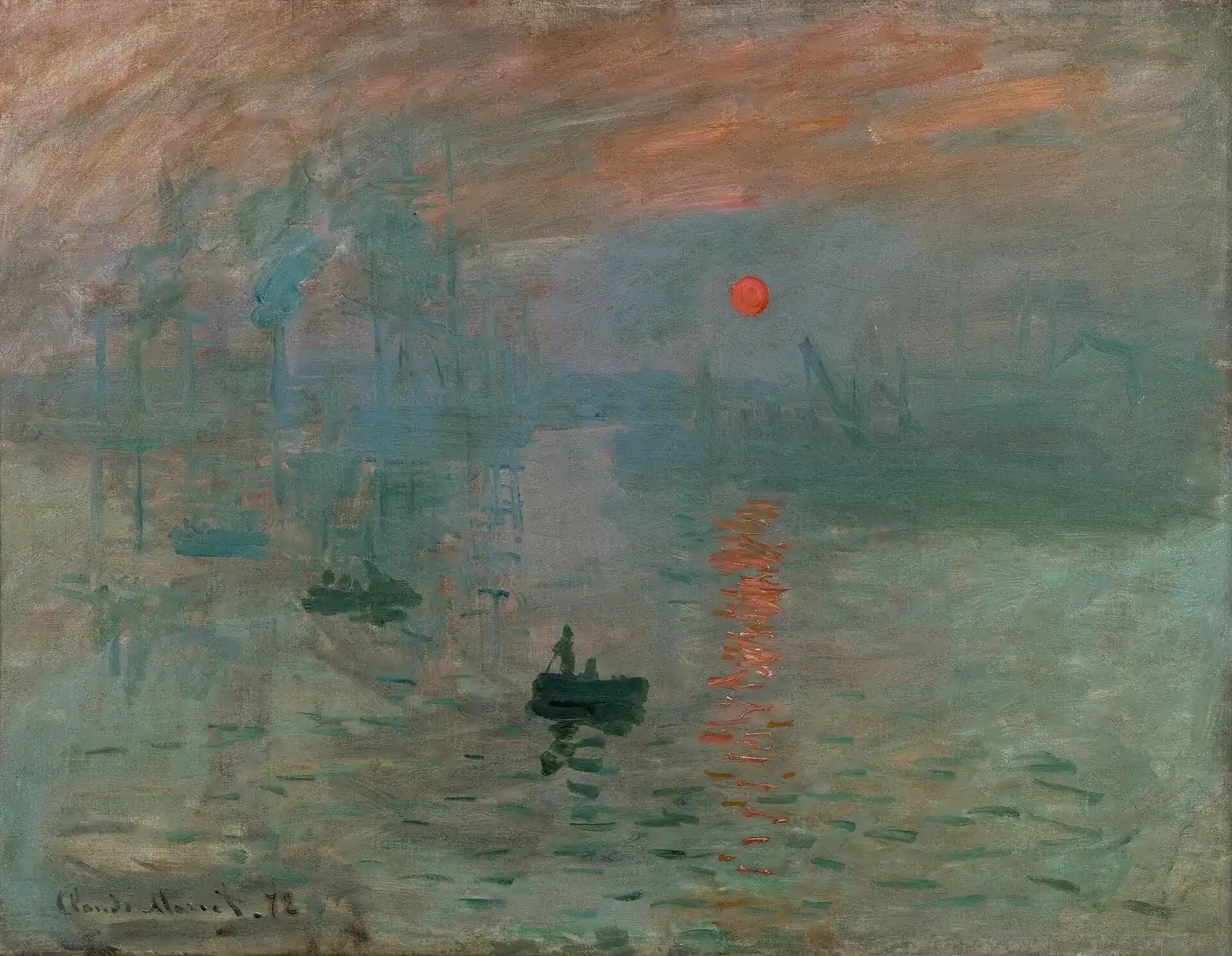
Historical The first exhibition. Monet’s Impression, Sunrise (1872) shows the port of Le Havre in fog, with a small orange sun and its broken reflection.
The critic Louis Leroy used its title to mock the show in Le Charivari. Eight Impressionist exhibitions followed until 1886, and in 2024 the Musée d’Orsay and the National Gallery of Art marked the 150th anniversary with Paris 1874.
Historical Monet and the series. Claude Monet (1840 to 1926) painted the same subject again and again in different light: haystacks, poplars, Rouen Cathedral, the Thames and finally his water garden at Giverny. The series make time itself the subject. He had cataract surgery in 1923; claims that he could see ultraviolet light afterward are speculation.
Morisot, Cassatt and the spaces of women. 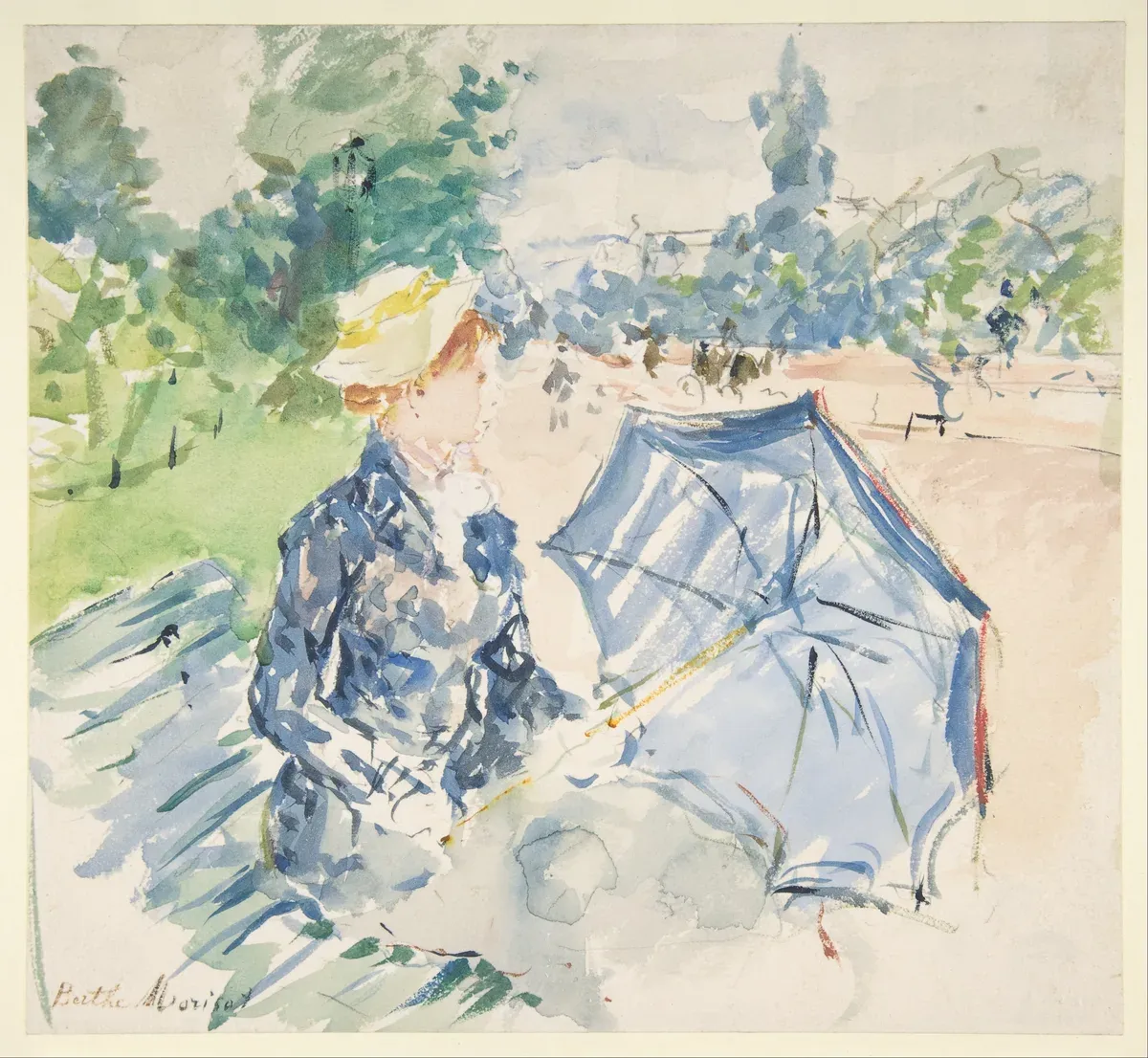
Berthe Morisot, A Woman Seated at a Bench on the Avenue du Bois, 1885. The Metropolitan Museum of Art (48.10.8). Image: Open Access, public domain (CC0).
Historical Berthe Morisot (1841 to 1895) showed in seven of the eight exhibitions, with rapid, feathery strokes. In 1988 Griselda Pollock pointed out that women Impressionists painted mainly the spaces they could enter: homes, gardens, parks, theater boxes. Mary Cassatt (1844 to 1926), an American invited by Degas in 1877, painted mothers and children without sentimentality.
Degas. 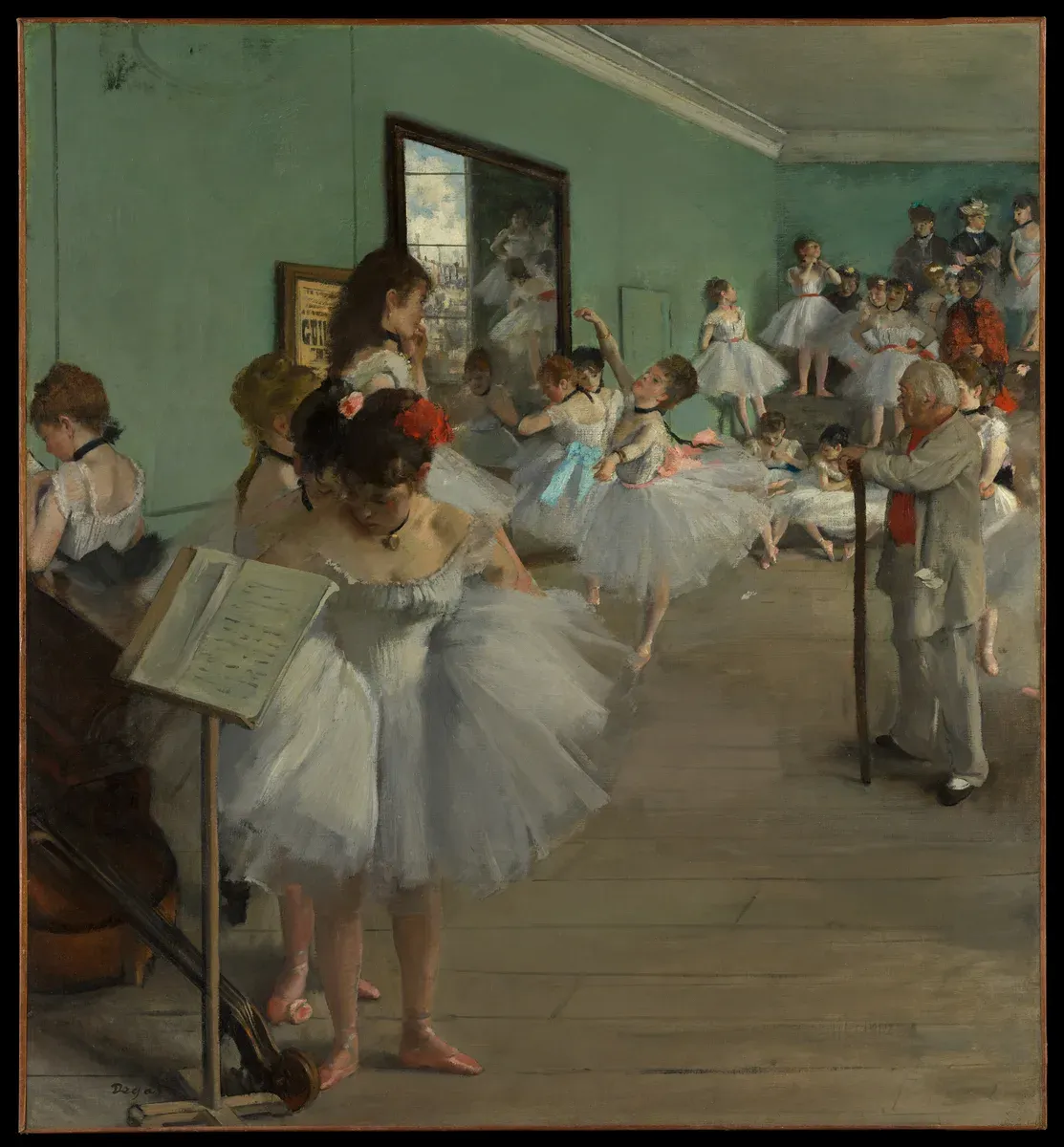
Edgar Degas, The Dance Class, 1874. The Metropolitan Museum of Art (1987.47.1). Image: Open Access, public domain (CC0).
Historical Edgar Degas (1834 to 1917) disliked the label and called himself a Realist. He painted dancers, racehorses and laundresses from odd angles, figures cut by the frame, influenced by photography and Japanese prints. In The Dance Class (1874) dancers wait, stretch and scratch their backs while the ballet master leans on his stick.
Historical Japonisme. After Japan opened to Western trade in the 1850s, prints, fans and ceramics flooded Paris. Japanese prints taught flat color, bold outlines, unusual viewpoints and everyday subjects. It is a clear case of influence flowing from East to West.
Key artists
| Artist | Lived | Why they matter |
|---|---|---|
| Claude Monet | 1840 to 1926 | The painter whose Impression, Sunrise gave the movement its name. |
| Berthe Morisot | 1841 to 1895 | A founding member who showed in almost every exhibition. |
| Camille Pissarro | 1830 to 1903 | The only artist to show in all eight exhibitions. |
| Edgar Degas | 1834 to 1917 | The painter of dancers, cafés and odd viewpoints. |
| Mary Cassatt | 1844 to 1926 | The American painter of women’s lives. |
| Pierre-Auguste Renoir | 1841 to 1919 | The painter of sunlit crowds. |
How do you recognise Impressionism?
Look for broken, visible brushstrokes, bright unmixed color and colored shadows. Paintings are made outdoors or look as if they were. Subjects are modern Paris, cafés, railway stations, gardens and the seaside. Edges are soft and the moment matters more than the outline.
Common misconceptions. One is that Impressionism was mostly about landscapes. Degas, Caillebotte and Cassatt painted streets, cafés, theatres, homes and work, and Renoir loved crowds.
Another is that all the Impressionists painted outdoors. Degas worked mostly in the studio and disliked plein air painting. A third is that women were on the edges. Berthe Morisot exhibited in seven of the eight Impressionist exhibitions, more than Renoir or Monet, and Mary Cassatt was invited to join by Degas in 1877.
Esoteric themes
Historical I will be honest: Impressionism has little esoteric content. It is about seeing. But seeing is where every practice begins. Monet’s last great water lily panels were installed in the Orangerie in Paris in 1927, after his death, in two oval rooms meant as a place of peace.
Later tradition Later writers called the Orangerie a “Sistine Chapel of Impressionism”. That is praise, not history, but the rooms do feel like a temple.
Modern Many people now use Monet’s water lilies for slow-looking meditation.
Works to see
| Work | Artist | Date | Where to see it |
|---|---|---|---|
| Impression, Sunrise | Claude Monet | 1872 | Musée Marmottan Monet, Paris |
| Garden at Sainte-Adresse | Claude Monet | 1867 | The Metropolitan Museum of Art, New York |
| The Cradle | Berthe Morisot | 1872 | Musée d’Orsay, Paris |
| Lady at the Tea Table | Mary Cassatt | 1883 to 1885 | The Metropolitan Museum of Art, New York |
Every work in this list is free of nudity, so you can look them up with confidence. Works still in copyright are named but not shown here.
How to look at an Impressionist painting
Stand back first, then walk slowly toward the painting until the image dissolves into strokes. Find the spot where it does. Then look at the shadows: Impressionists painted them blue or violet, not brown or black. Finally, ask what time of day it is and what the weather is doing.
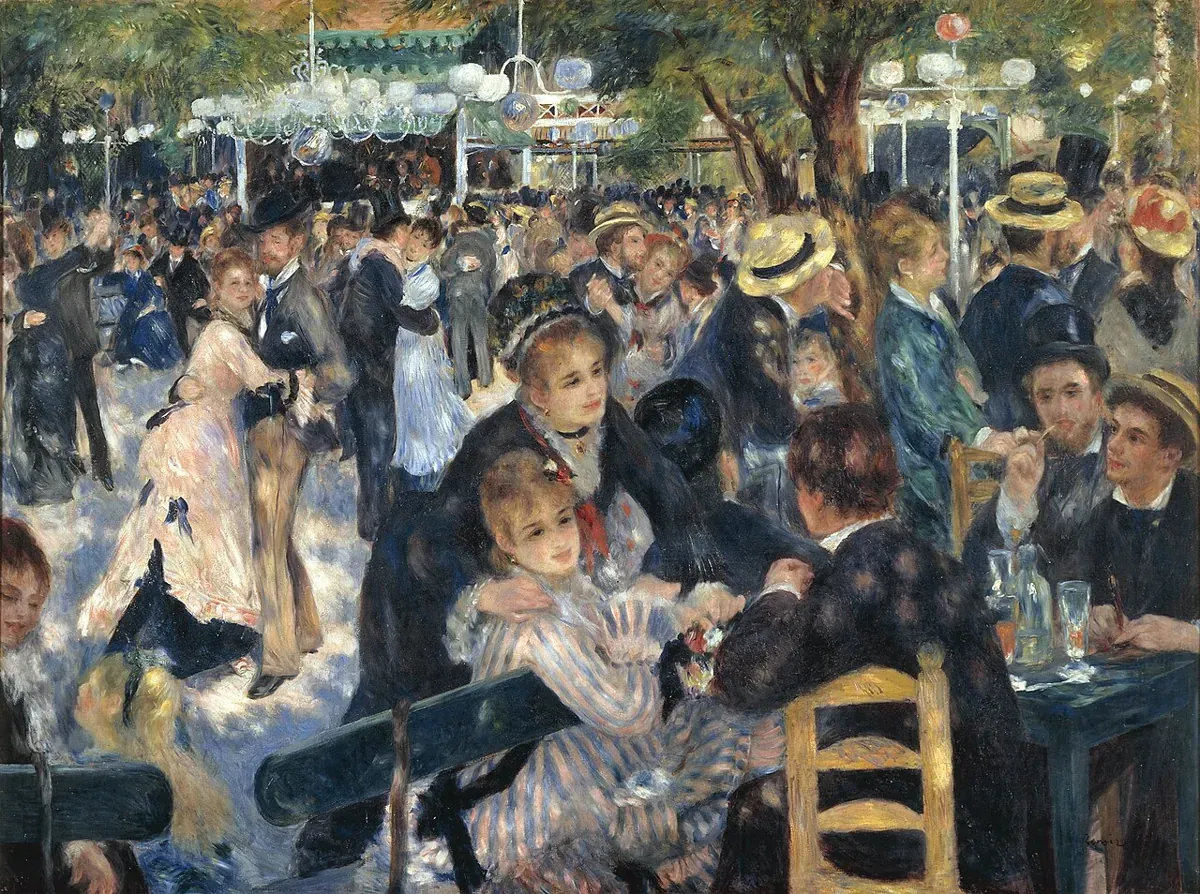
Pierre-Auguste Renoir, Bal du moulin de la Galette, 1876. Musée d’Orsay, Paris. Image: Wikimedia Commons, public domain.
Pierre-Auguste Renoir, Bal du moulin de la Galette, 1876. At the Musée d’Orsay in Paris. A Sunday dance in Montmartre. Look at the spots of sunlight falling through the leaves onto hats, jackets and the ground. Many of the people are Renoir’s friends.
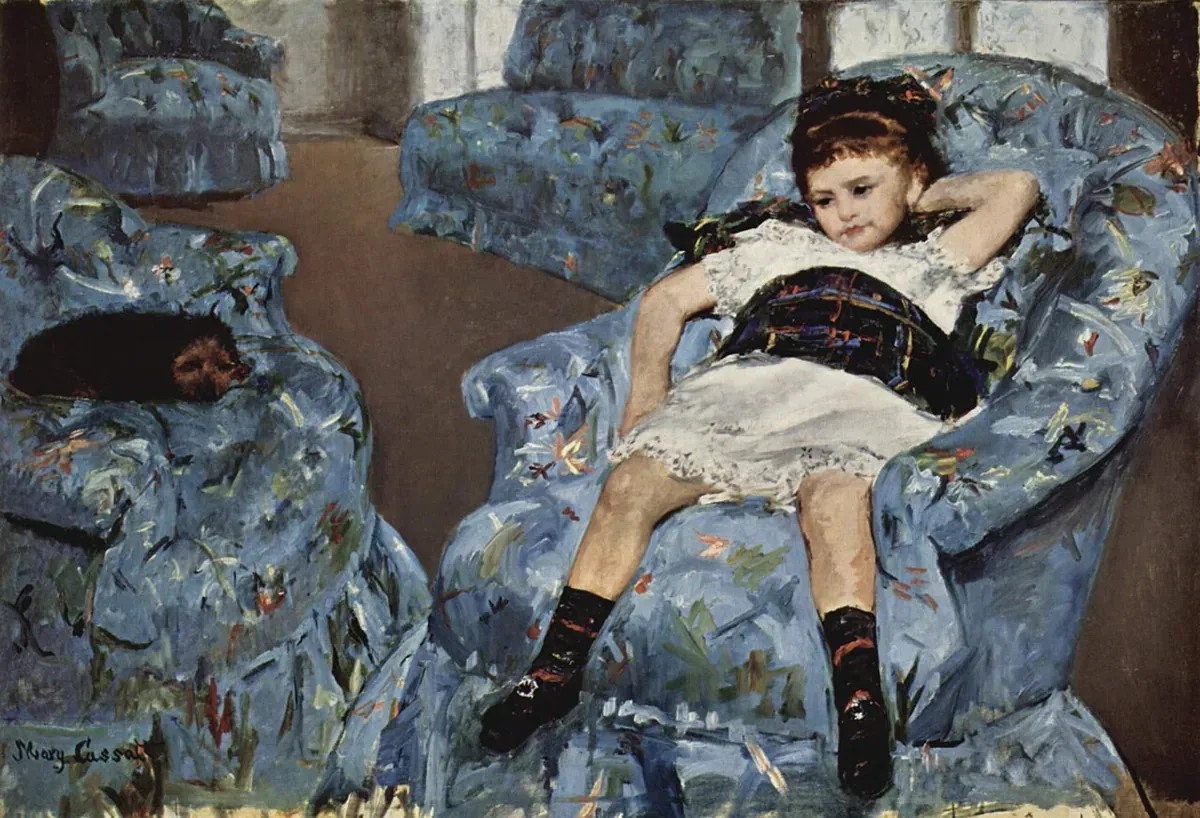
Mary Cassatt, Little Girl in a Blue Armchair, 1878. National Gallery of Art, Washington. Image: Wikimedia Commons, public domain.
Mary Cassatt, Little Girl in a Blue Armchair, 1878. At the National Gallery of Art in Washington. A child slumped in a chair, bored, as children are. The unusual low viewpoint and cut-off composition come from Japanese prints. Cassatt later wrote that Degas helped with the background.
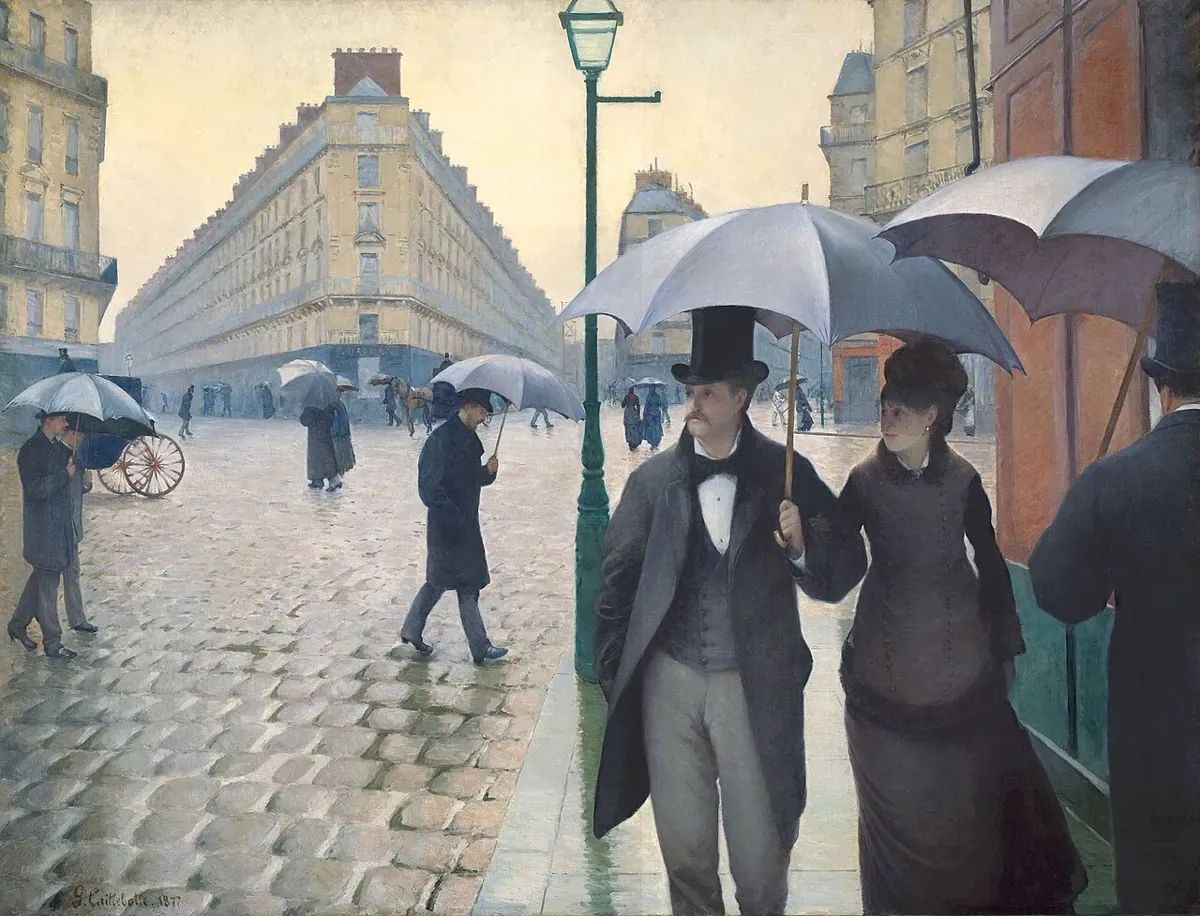
Gustave Caillebotte, Paris Street; Rainy Day, 1877. Art Institute of Chicago. Image: Wikimedia Commons, public domain.
Gustave Caillebotte, Paris Street; Rainy Day, 1877. At the Art Institute of Chicago. Baron Haussmann’s new boulevards, wet and gleaming. Look at the lamp post that splits the picture in two and the couple walking toward you, about to step out of the frame.
Impressionism learned from Realism, from the landscapes of Romanticism such as Constable’s and Turner’s, and from Japanese prints. It led directly to Post-Impressionism, and Monet’s late water lilies were later seen as an ancestor of Abstract Expressionism.
Try this
Find three paintings from one Monet series online, such as the wheat stacks or Rouen Cathedral. For each, guess the time of day and season, and list the colors in the shadows. Then look at real shadows at two times of day. Are they gray?
What next
Before this: Realism.
After this: Aestheticism.
Also worth reading alongside it: Post-Impressionism.
See every movement in order on the art movements timeline, or learn to look step by step in the free Art History for Beginners course.
If you want to carry this into tarot and practice, these pages connect to it: The Sun, light, warmth and the joy of being outdoors; The Star, the calm after the night, light on water; Looking with the senses, the skill the Impressionists trained; and What came next.
Sources
- Griselda Pollock, Modernity and the Spaces of Femininity (1988).
- Musée d’Orsay and National Gallery of Art, Paris 1874: Inventing Impressionism (exhibition) (2024).
- The Metropolitan Museum of Art, A Woman Seated at a Bench on the Avenue du Bois, 48.10.8. Open the record
- The Metropolitan Museum of Art, The Dance Class, 1987.47.1. Open the record
- E. H. Gombrich, The Story of Art (1950).
- Wikimedia Commons, Impression, Sunrise (hero image record). Open the record
- John Rewald, The History of Impressionism (1946).

Questions
Where does the name Impressionism come from?
From a mocking review by the critic Louis Leroy of the 1874 exhibition. He took his title from Monet's painting Impression, Sunrise. The painters adopted the name.
Why did Impressionists paint outdoors?
To catch changing light directly. The collapsible metal paint tube, patented in 1841, and new bright pigments made painting outdoors, en plein air, practical.
Where can I see works of Impressionism in person?
Good places to start are Paris (the Musée d'Orsay, the Marmottan Monet, the Orangerie), Chicago, the Met, and Washington. Museums change their displays, so check the collection page before you travel.
Who are the most famous Impressionist painters?
Claude Monet, Pierre-Auguste Renoir, Edgar Degas, Camille Pissarro, Alfred Sisley, Berthe Morisot, Mary Cassatt and Gustave Caillebotte.
What is the difference between Impressionism and Post-Impressionism?
Impressionists tried to capture fleeting light and modern life. Post-Impressionists such as Cézanne, Van Gogh, Gauguin and Seurat kept the bright colour but wanted more structure, symbolism or emotion.
Get the free Mini-Grimoire
A short printable starter guide to tarot and everyday witchcraft, plus my newsletter. Unsubscribe any time.
Opens Substack in a new tab to confirm. More about the newsletter · Privacy