


| Arcana | Major Arcana |
|---|---|
| Number | XIX |
| Image | RWS 1909 (PD) |
The Sun is card XIX of the Major Arcana, and it may be the happiest card in the deck. After the uncertain night of the Moon comes full daylight.
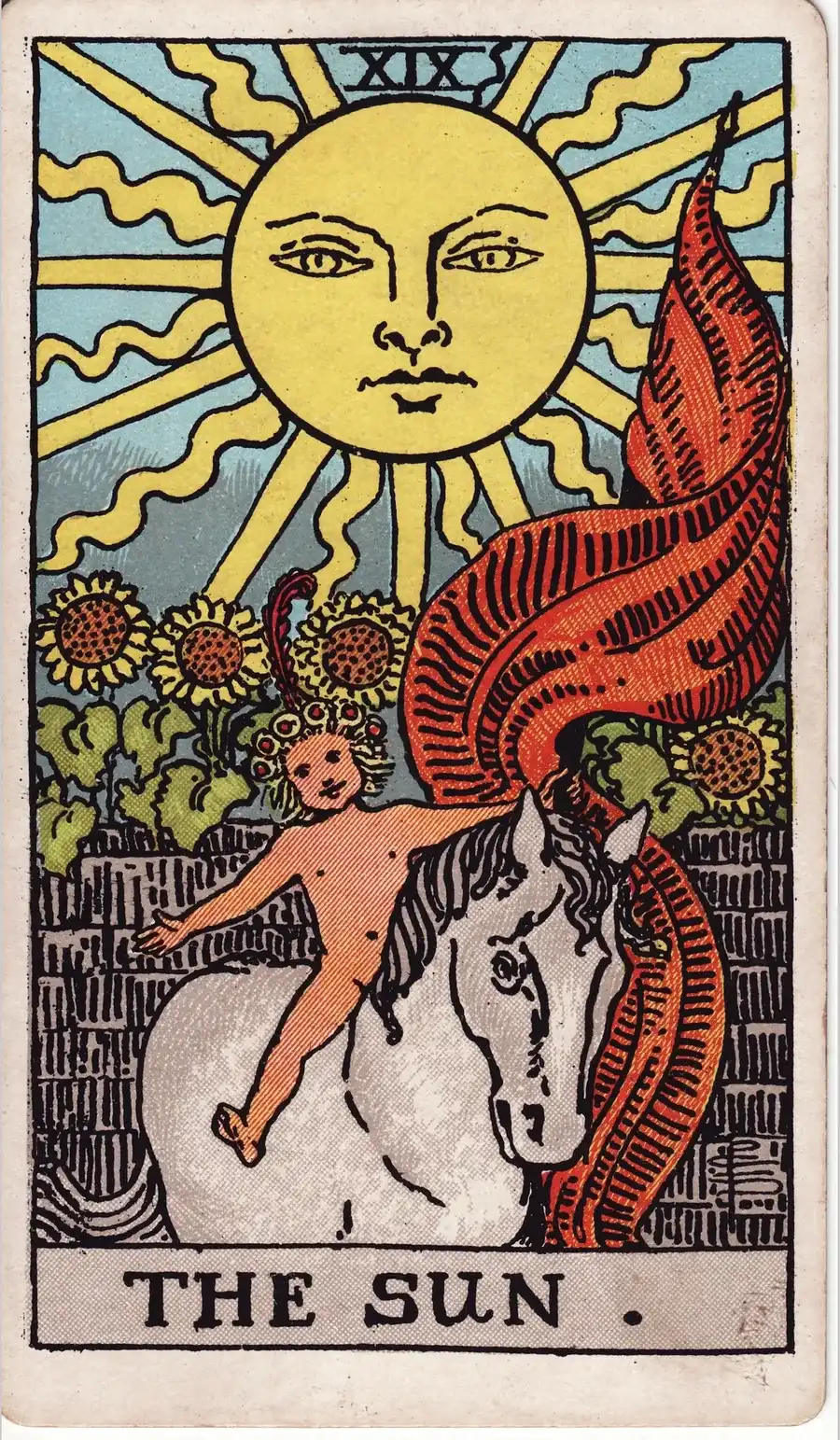
In the 1909 card a child rides a white horse under a huge smiling sun, with sunflowers growing over a wall. The card is about joy, success and warmth. Here is what the Sun means upright and reversed, the symbols in the card and its history.
Here is the Sun at a glance.
| At a glance | This card |
|---|---|
| Upright keywords | joy, success, vitality, clarity |
| Reversed keywords | muted joy, delayed success, forced positivity |
| Number | XIX (19) in the Major Arcana |
| Golden Dawn title | The Lord of the Fire of the World Later tradition |
| Hebrew letter | Resh (ר), “head” Later tradition |
| Tree of Life path | 30, from Hod to Yesod Later tradition |
| Astrology | The Sun Later tradition |
| Element | Fire Modern |
| Yes or no | Yes Modern |
The Golden Dawn gave the Sun card the Sun and the letter Resh, the “head”, seat of the conscious mind. Older Marseille cards show two children holding hands in front of a wall; Waite and Smith replaced them with a single child on a white horse, carrying a red banner. Fire as the element follows from the Sun and is a modern convention.
The card: what Pamela Colman Smith drew
The 1909 card shows a naked child on a white horse holding a red banner, under a large smiling sun and in front of a wall of sunflowers. Waite described “the naked child mounted on a white horse and displaying a red standard”, and wrote that the child is “a child in the sense of simplicity and innocence in the sense of wisdom”.
The sun. A huge sun with a face shines over everything, its rays alternating straight and wavy. Nothing is hidden in this light. What was complicated under the Moon becomes simple enough to celebrate.
The child on the white horse. A child rides a white horse without a saddle, arms open. It is joy without fear, trust and freedom. Waite saw the child as the restored, simple heart.
The sunflowers and the wall. Four sunflowers grow over a gray wall behind the child. The wall is the safe garden of the past, and the child has ridden out of it. The sunflowers turn toward the light, as we do.
The red banner. The child carries a long red flag. Red is life and action. It is a banner of celebration, held high.
Upright meaning
Upright, the Sun is joy without conditions. A naked child rides a white horse in front of a garden wall lined with sunflowers. The child holds a large red banner, arms spread wide, and a huge sun with a face shines above. Everything is open, visible and warm.
The card describes success, vitality, clarity and happiness. It is one of the most positive cards in the deck. In a reading it often means things are working out, a difficulty is resolved or a period of confidence and good health is beginning. It favors honesty, play and being seen as you are.
The Sun also speaks of simple pleasure: time outdoors, children, celebration and the energy to do what you love. Let yourself enjoy it.
Reversed meaning
Reversed, the sun is still shining, just behind a cloud. The card rarely turns fully negative. It can describe a delay in success, a temporary loss of confidence, or happiness that is there but hard to feel. It can also describe overconfidence or forced cheerfulness, smiling through something that needs attention.
Ask what is blocking the light: tiredness, worry or a small problem that is growing because nobody mentions it. Deal with that, and the warmth usually returns.
In love, work and spirituality
In love. Upright: Happiness, warmth and openness; a relationship that brings joy. Good news about family. Reversed: Temporary clouds, or a relationship that looks happier than it feels.
At work. Upright: Success, recognition and confidence; a project that shines. Reversed: Delays, or overconfidence that overlooks details.
With money. Upright: Prosperity, good fortune and comfort. Reversed: Minor setbacks, or optimism that runs ahead of the numbers.
In spiritual practice. Upright: Clarity, vitality and joyful practice; feeling alive and connected. Reversed: Low energy; a reminder to go outside and rest.
As feelings. Joy, warmth and openness. The person is happy with you.
As a person. Cheerful, confident and generous; someone who lights up a room.
As advice. Step into the light, and let yourself be seen and happy.
Reading the Sun: positions, pairs and yes or no
In the past position: A happy time that still warms you. In the present position: Joy and success. Enjoy it.
In the future position: Brighter days, success and energy. As advice: Let yourself shine and share your light.
When the Sun shows up among mostly Minor cards, give it extra weight: the theme of joy runs under the whole question.
Pairs matter too. Next to The Star, it can mean hope fulfilled: joy and healing. Next to The World, it can mean great success and completion. Next to The Empress, it can mean growth, creativity and, for some, family joy.
In modern yes or no readings, the Sun leans yes. It is the brightest card in the deck, so it is a clear yes.
The history and art behind the card
In the Tarot de Marseille pattern the card is called Le Soleil, the Sun. The early Italian Sun cards show a winged child holding up a sun’s face, or a figure spinning thread under the sun. The Marseille pattern shows two children standing together in front of a low wall under a sun dropping colored tears.
Waite and Smith changed it to a single child on a horse. Waite wrote that the child on the white horse was “the better symbolism connected with this card”.
The children by the wall in the Marseille pattern are often read as twins, perhaps Gemini, and the change to one child on a horse is one of Smith’s most loved designs.
For most modern readers the Sun is simply the most positive card in tarot. Many beginners find it a relief to learn one card that needs no softening at all.
When A. E. Waite published The Pictorial Key to the Tarot in 1910, he listed these divinatory meanings for the card: “Material happiness, fortunate marriage, contentment.” Reversed, he gave: “The same in a lesser sense.”
Waite himself called the fortune-telling meanings of the trumps “artificial and arbitrary”, and on this site I read the picture first and treat lists like this as history.
The Sun is the clearing of the modern Fool’s Journey. After the Moon’s night road, the traveler arrives in plain daylight, and things are simply what they are: warm, visible and alive.
Common questions
Is the Sun always a positive card? Almost always. Even reversed, it usually means joy delayed or muted rather than gone.
Is the Sun a yes or no? Yes. It is one of the clearest yes cards in the deck.
Try this
Try this small spread for the Sun. Use it when you want to celebrate and build on what is going well.
| Card | Question | What it shows |
|---|---|---|
| 1 | What is shining? | What is going well right now. |
| 2 | What helps it grow? | What feeds my energy and joy. |
| 3 | How can I share it? | Who or what I can bring into the light. |
Affirmation: I welcome clarity, vitality and joy I can stand in openly.
Reversed affirmation: I honor sadness where it is real and still turn toward available light.
If you keep a tarot journal, take one of these questions to it: What is going well in my life right now? When did I last feel simple joy? How can I share my light this week?
What next
Cards that sit close to this one are The Moon (the night before the Sun), The Star (hope that grows into joy) and The World (completion and celebration).
The Sun is part of the lesson The Devil to the World in my free Tarot for Beginners course. To keep walking the Major Arcana, read the card before it, The Moon or the card after it, Judgement, or go back to all the card meanings.
For every card with keywords, affirmations and examples, see my book The Novice’s Guide to Tarot. If you would like a printable cheat sheet for all 78 cards, my 45-page Tarot Workbook is on Etsy.
Sources
- A. E. Waite, The Pictorial Key to the Tarot (London: Rider, 1910), Part II and Part III, section 3.
- Pamela Colman Smith and A. E. Waite, the Rider-Waite-Smith tarot (London: Rider, 1909).
- Nicolas Conver, Tarot de Marseille (Marseille, 1760).
- Eden Gray, A Complete Guide to the Tarot (New York: Crown, 1970), epilogue “The Fool’s Journey”.
- Lauri Mukkala, The Novice’s Guide to Tarot, entry for The Sun.
- Aleister Crowley, 777 (London: Walter Scott, 1909), columns of the Hebrew letters, paths and Tarot trumps.
- Israel Regardie, ed., The Golden Dawn (Chicago: Aries Press, 1937 to 1940), “Book T” and the titles of the trumps.
All 78 cards
Major Arcana
- The Fool
- The Magician
- The High Priestess
- The Empress
- The Emperor
- The Hierophant
- The Lovers
- The Chariot
- Strength
- The Hermit
- Wheel of Fortune
- Justice
- The Hanged Man
- Death
- Temperance
- The Devil
- The Tower
- The Star
- The Moon
- The Sun
- Judgement
- The World
Wands
- Ace of Wands
- Two of Wands
- Three of Wands
- Four of Wands
- Five of Wands
- Six of Wands
- Seven of Wands
- Eight of Wands
- Nine of Wands
- Ten of Wands
- Page of Wands
- Knight of Wands
- Queen of Wands
- King of Wands
Cups
- Ace of Cups
- Two of Cups
- Three of Cups
- Four of Cups
- Five of Cups
- Six of Cups
- Seven of Cups
- Eight of Cups
- Nine of Cups
- Ten of Cups
- Page of Cups
- Knight of Cups
- Queen of Cups
- King of Cups
Swords
- Ace of Swords
- Two of Swords
- Three of Swords
- Four of Swords
- Five of Swords
- Six of Swords
- Seven of Swords
- Eight of Swords
- Nine of Swords
- Ten of Swords
- Page of Swords
- Knight of Swords
- Queen of Swords
- King of Swords
Pentacles
Get the free Mini-Grimoire
A short printable starter guide to tarot and everyday witchcraft, plus my newsletter. Unsubscribe any time.
Opens Substack in a new tab to confirm. More about the newsletter · Privacy