


In this lesson: the Pre-Raphaelites and their sorceresses, Symbolist dreams, the Rose+Croix salons and Pamela Colman Smith’s tarot of 1909.
If you read tarot with a Rider-Waite-Smith style deck, you are already looking at late nineteenth-century art. The long robes, enclosed gardens and objects heavy with meaning come from a world of Pre-Raphaelite painters, Symbolist dreamers, decorative designers and occult societies, all working within a few decades of one another. This lesson introduces that world, from London to Paris, Vienna and Helsinki, and shows how it produced the tarot images many of us read today.
The Pre-Raphaelites
Historical In 1848, three young students at the Royal Academy in London, Dante Gabriel Rossetti, John Everett Millais and William Holman Hunt, formed the Pre-Raphaelite Brotherhood. They rejected the smooth academic style they blamed on Raphael’s followers, and looked back to medieval and early Renaissance art for bright color, sharp detail and serious feeling. A second wave followed, including Edward Burne-Jones and the designer William Morris, who turned the dream of the Middle Ages into tapestries, books and wallpaper.
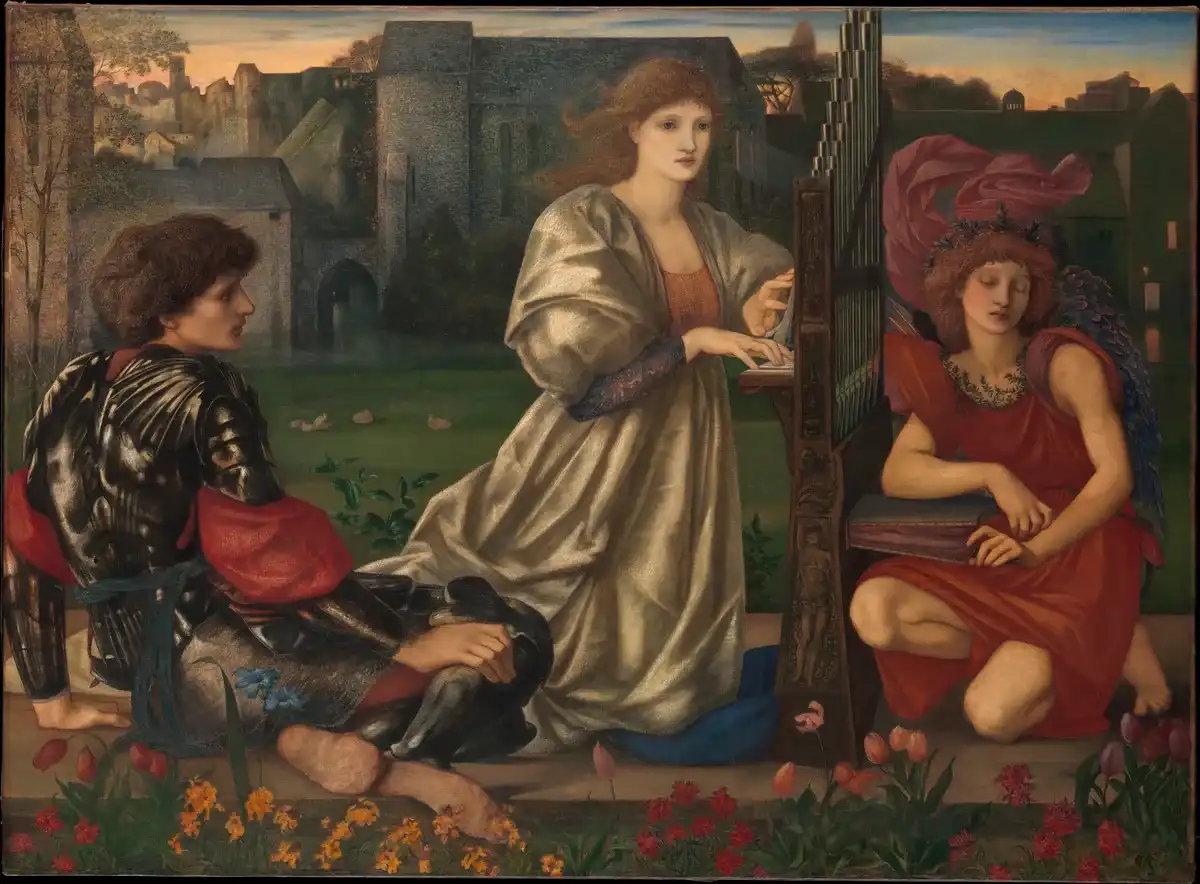
Their subjects came from legend, poetry and the Bible: Arthurian knights, Tennyson’s Lady of Shalott, saints and enchantresses. Burne-Jones’s The Love Song, at the Met, shows a knight, a musician and a winged figure in a twilight garden, a mood more than a story. Alongside them, the Aesthetic movement argued for “art for art’s sake”: beauty, color harmony and mood, with no moral lesson required.
Sorceresses and Lilith
Historical The painter John William Waterhouse, who admired the Pre-Raphaelites, painted The Magic Circle in 1886: a robed woman draws a circle of fire around herself with a wand, while ravens and a toad wait outside. Rossetti painted Lady Lilith (1866 to 1868), a woman combing her long hair before a mirror, with his sonnet “Body’s Beauty” on the frame. I describe that painting in words only, because it shows bare shoulders and I do not choose artworks with nudity for these lessons; you can see it on the Delaware Art Museum’s website.
Later tradition Rossetti’s Lilith comes from Jewish folklore, but his version is a Victorian fantasy of the dangerous, beautiful woman. If you are taking the Lilith course, notice how far this image is from the ancient sources.
Rossetti’s sonnet, quoted
Historical Rossetti wrote a sonnet to go with Lady Lilith, later called “Body’s Beauty” and published in his Poems of 1870. It opens: “Of Adam’s first wife, Lilith, it is told / (The witch he loved before the gift of Eve,) / That, ere the snake’s, her sweet tongue could deceive”. Notice how quickly the poem calls Lilith a witch and a deceiver. That is a nineteenth-century poet’s image, built on medieval Jewish folklore, and it says a great deal about Victorian fears and fantasies of women.
Symbolism: the inner world
Historical In 1886 the poet Jean Moréas published a Symbolist manifesto in the Paris newspaper Le Figaro. Symbolist artists turned away from what the eye sees toward dreams, myth, mysticism and the inner life. Gustave Moreau painted jeweled saints and sphinxes; Odilon Redon drew floating eyes and strange creatures in charcoal, then late in life burst into color with glowing flowers.
In Paris a group of young painters who called themselves the Nabis, Hebrew for “prophets”, carried these ideas into flat, decorative color. In Vienna the Secession of 1897 and in Finland the painters of National Romanticism used myth and symbol to speak about their own times and peoples.
Historical Esoteric groups were close to this world. From 1892 to 1897 the writer Joséphin Péladan, who called himself “Sâr”, organized six Salons de la Rose+Croix in Paris, exhibitions of idealist and mystical art. His Rosicrucianism was his own invention, not a survival of the seventeenth-century manifestos. In London, the Hermetic Order of the Golden Dawn was founded in 1888, and it shaped modern ceremonial magic and tarot.
Symbolism in Finland
Historical Finnish art of the 1890s and 1900s offers some of the most haunting Symbolist works anywhere, and they are easy to see online at the Finnish National Gallery. Akseli Gallen-Kallela painted scenes from the Kalevala, such as The Defence of the Sampo (1896) and Lemminkäinen’s Mother (1897), where a mother gathers her son’s body from the river of Tuonela, the land of the dead.
Hugo Simberg painted The Garden of Death (1896), with gentle skeletons tending plants, and The Wounded Angel (1903), in which two boys carry a blindfolded, injured angel. In a 2006 poll by the Ateneum art museum, The Wounded Angel was voted Finland’s national painting. Simberg refused to explain it, saying viewers should find their own meaning.
A tarot deck as art
Historical In 1909 the London publisher William Rider and Son issued a tarot deck designed by A. E. Waite, a Golden Dawn member, and illustrated by the artist Pamela Colman Smith. Smith drew a full scene for every one of the 78 cards, including the 56 Minor Arcana, which in most older decks showed only patterns of suit symbols.
Those scenes are why so many beginners can read her cards from the pictures. Smith worked in the golden age of book illustration, alongside artists such as Arthur Rackham and Edmund Dulac, and her cards share their clear outlines and storytelling.
Modern Today we often call the deck Rider-Waite-Smith, to credit the woman who drew it. That is a modern correction, and a fair one.
Pamela Colman Smith’s life
Historical Pamela Colman Smith (1878 to 1951), nicknamed “Pixie”, was an American-born artist, illustrator, storyteller and stage designer who lived in London. She was a member of the Golden Dawn and showed her paintings at Alfred Stieglitz’s gallery in New York in 1907.
She was paid a flat fee for the tarot designs and received no royalties from a deck that has sold millions. She died poor in Cornwall. It is often suggested that some of her Minor Arcana scenes were inspired by photographs of the fifteenth-century Sola Busca tarot shown at the British Museum in 1907; several cards, such as the Three of Swords, are strikingly close.
William Morris and beauty at home
Historical The Pre-Raphaelite dream did not stay on gallery walls. William Morris, a friend of Rossetti and Burne-Jones, wanted beautiful things in ordinary homes, made with care. In his lecture “The Beauty of Life”, published in Hopes and Fears for Art (1882), he offered what he called a golden rule “that will fit everybody”: “Have nothing in your houses that you do not know to be useful or believe to be beautiful.”
That idea, that a chair, a book or a wallpaper deserves as much thought as a painting, shaped the Arts and Crafts movement and, a generation later, the look of illustrated books and cards. When you hold a tarot deck with clear outlines, patterned borders and decorative lettering, you are holding a small descendant of Morris’s workshop.
Reading a card as a stage
Historical Pamela Colman Smith worked in the theatre as well as in illustration, designing for productions and touring with the Lyceum Theatre company of Henry Irving and Ellen Terry. Many of her tarot scenes look like small stage sets, and noticing this is a good exercise in looking.
Take any of her Minor Arcana cards, for example the Three of Cups or the Six of Swords, and ask three questions. Where is the “floor” of the stage, the strip of ground on which the figures stand? Is there a backdrop, often a flat sky or a simple landscape, rather than deep space? Do the figures pose as if facing an audience, with clear gestures you could read from the back row? You will find that most cards answer yes to all three. That theatrical clarity is one reason her scenes are so easy to read.
A practice variation: compare Smith’s Three of Swords with the Three of Swords from the fifteenth-century Sola Busca deck, both easy to find online. Describe each in three sentences before deciding how close they are. The comparison is a fine exercise in the patient looking of lesson 1.
Questions beginners ask
Were the Pre-Raphaelites occultists? Mostly not. They loved legend and medieval mood, but only a few artists of the period were members of occult orders.
Why so many dangerous women in this art? Many male artists of the time projected fears about women’s independence onto enchantresses and femmes fatales. You can enjoy the paintings and still notice that.
Are the RWS images still copyrighted? The original 1909 images are public domain in many countries, though later recolored editions may be protected.
Myths to drop: Rossetti’s Lilith is not the ancient Lilith. Péladan’s Rose+Croix was not an ancient order. And the RWS deck was not the first tarot; it was the first popular deck with full scenes on every card.
A worked example
Imagine laying Smith’s Hermit card next to Waterhouse’s The Magic Circle. Both show a single robed figure in a dark, empty place. Both hold a tool of power: the Hermit a lantern and staff, the sorceress a wand. Both are defined by light: the Hermit’s lantern holds a six-pointed star, the sorceress’s circle burns on the ground.
Both seem to keep the world at a distance. Neither image explains itself in words; you have to read the objects. That shared way of thinking in symbols is what connects a London tarot deck of 1909 to the painting galleries of the 1880s, and it is why Pre-Raphaelite and Symbolist art makes such good study for tarot readers.
Try this
Look at Waterhouse’s The Magic Circle on the artwork page for ten minutes. Name every object and creature inside and outside the circle in your notebook. Then write one sentence on what the circle separates, and mark it as your interpretation.
A variation: compare Simberg’s The Wounded Angel with a tarot card you know, using the ten-minute method. Write which details carry the most feeling.
Recap
The Pre-Raphaelites of 1848 looked back to medieval art for color, detail and legend, and the Aesthetic movement prized beauty for its own sake. Waterhouse and Rossetti painted sorceresses and Lilith as Victorian fantasies. Symbolism, announced in 1886, turned toward dreams and the inner life, and spread through the Nabis, the Vienna Secession and Nordic National Romanticism, while Péladan’s Rose+Croix salons and the Golden Dawn linked art with occultism. Pamela Colman Smith’s 1909 tarot deck grew out of this world and the golden age of illustration.
What next
Press “Mark as done” and continue with Modern art and the spiritual. Read about Pamela Colman Smith, her card The Hermit and The Magic Circle. Each movement has its own page: Pre-Raphaelites, Aestheticism, Arts and Crafts, Symbolism, the Nabis, Art Nouveau, Vienna Secession, National Romanticism and the golden age of illustration.
Further reading: Mary K. Greer, articles on Pamela Colman Smith; Stuart R. Kaplan and others, Pamela Colman Smith: The Untold Story (U.S. Games, 2018). The Finnish National Gallery’s online collection.
Sources
- E. H. Gombrich, The Story of Art (London: Phaidon, 1950).
- Jean Moréas, Le Symbolisme, Le Figaro, 18 September 1886.
- A. E. Waite, The Pictorial Key to the Tarot (London: William Rider and Son, 1910).
- The Metropolitan Museum of Art, The Love Song, Edward Burne-Jones, accession 47.26.
Quick check
Go deeper: the art movements timeline and art history pages on this site
Get the free Mini-Grimoire
A short printable starter guide to tarot and everyday witchcraft, plus my newsletter. Unsubscribe any time.
Opens Substack in a new tab to confirm. More about the newsletter · Privacy
Comments
Questions and notes from readers. Anyone with a free account can comment, and I reply when I can. Please read the community guidelines.
Comments load from Google Firebase (EU) when you ask for them. Nothing is stored on your device. Privacy