


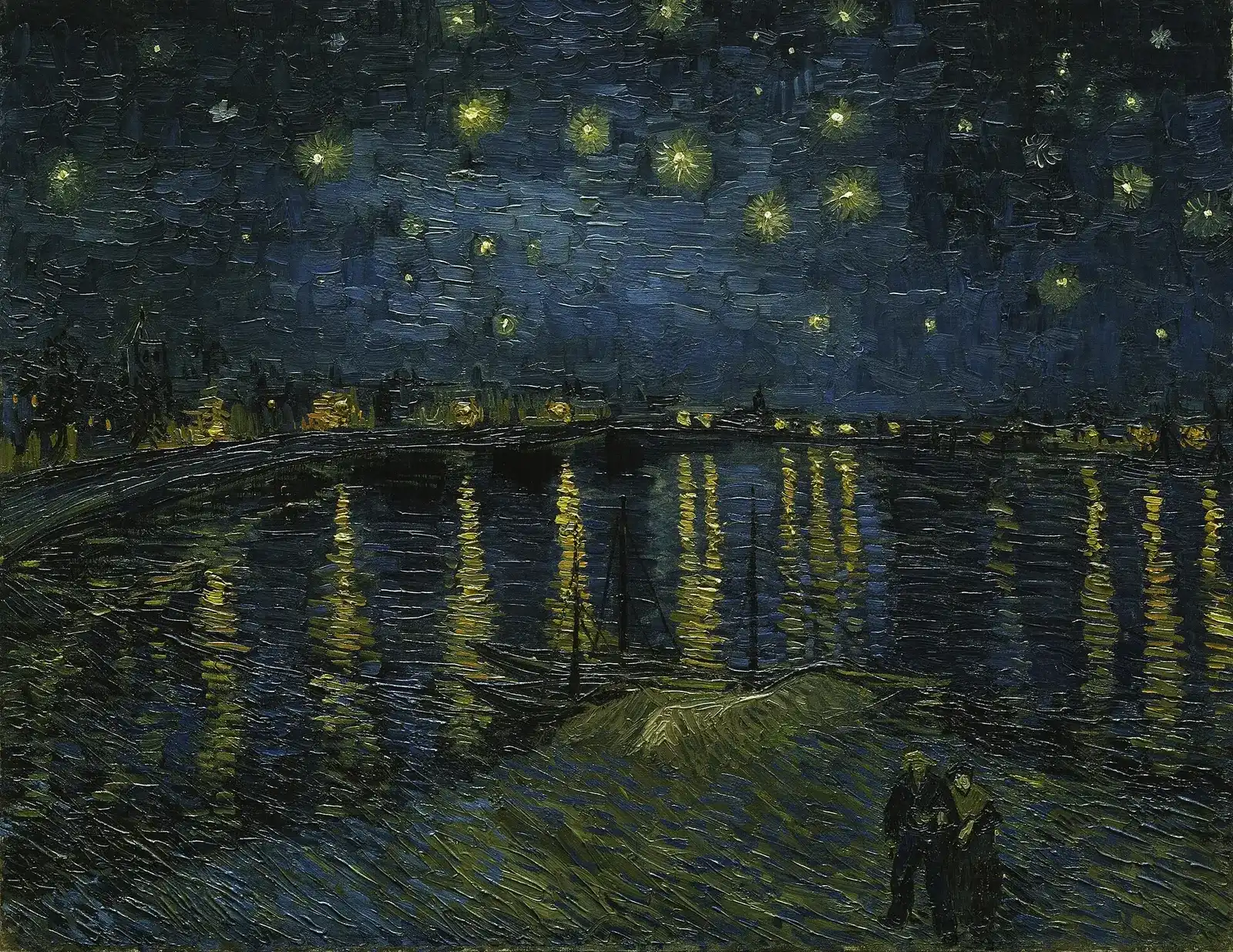
How to read the labels Historical what the old sources say. Later tradition what later writers added. Modern modern practice and my own notes.
Post-Impressionism is the name for the very different paths French and French-based painters took after Impressionism, roughly from 1886 to 1905. Paul Cézanne, Vincent van Gogh, Paul Gauguin, Georges Seurat and Henri de Toulouse-Lautrec kept the bright colour of the Impressionists but added structure, symbol or strong emotion. The term was coined by the English critic Roger Fry for his London exhibition Manet and the Post-Impressionists in 1910.
Fry gave one name to painters who had little in common except a starting point. They had all learned from Impressionism and then gone their own way, toward science, structure, emotion or myth. Between them, they opened almost every door that modern art would walk through.
Key dates
| When | What happened |
|---|---|
| 1884 to 1886 | Seurat paints A Sunday on La Grande Jatte. |
| 1888 | Van Gogh moves to Arles and paints Starry Night over the Rhône; Gauguin visits. |
| 1889 | Van Gogh paints The Starry Night at Saint-Rémy. |
| 1895 | The dealer Ambroise Vollard gives Cézanne his first solo show. |
| 1910 | Roger Fry’s London show “Manet and the Post-Impressionists” names the group. |
What is Post-Impressionism?
Post-Impressionism is not one style but a label for artists who moved beyond Impressionism in personal ways, each laying a road into modern art.
Throughout this page I mark three layers. Historical What the works and letters show. Later tradition The legends. Modern How we use the images today.
Seurat’s dots. 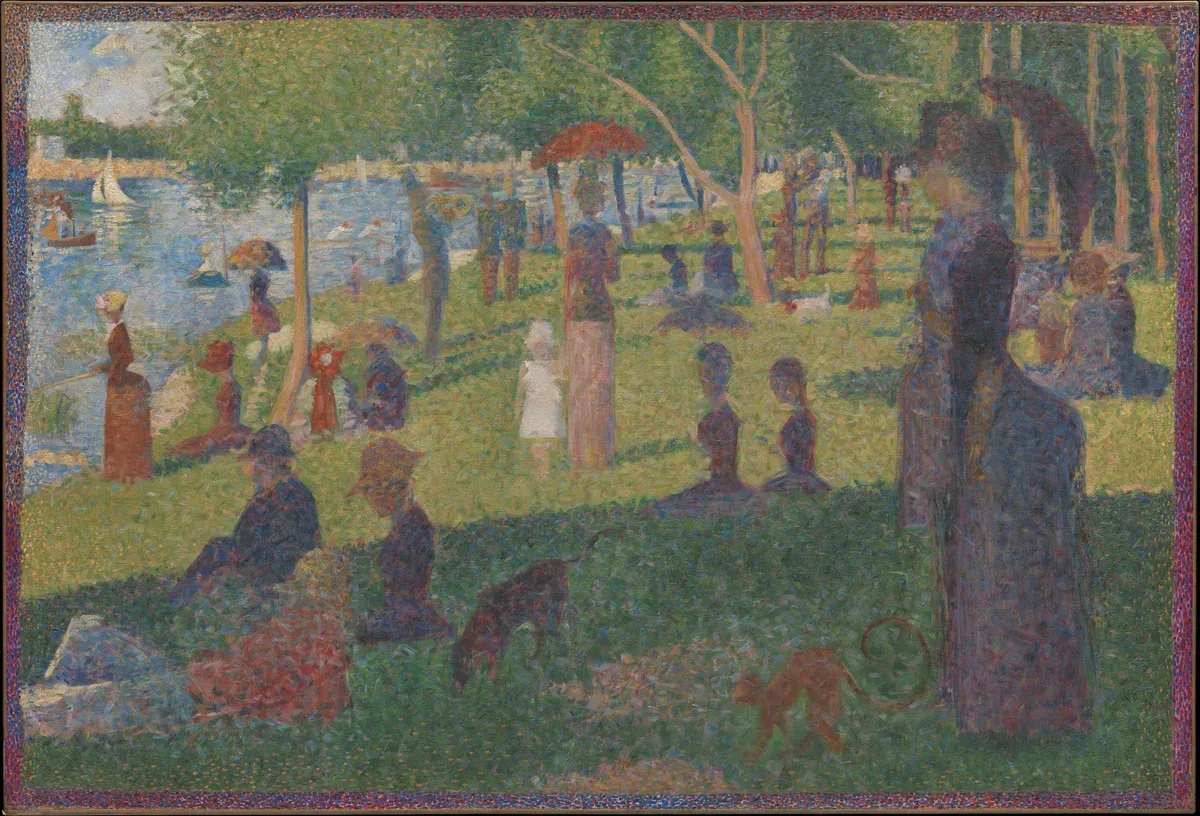
Georges Seurat, Study for “A Sunday on La Grande Jatte”, 1884. The Metropolitan Museum of Art (51.112.6). Image: Open Access, public domain (CC0).
Historical Georges Seurat (1859 to 1891) wanted to make Impressionism scientific. Drawing on the color theories of Michel-Eugène Chevreul and Ogden Rood, he set small dots of pure color side by side to mix in the viewer’s eye: pointillism.
This small study of 1884 prepares his huge A Sunday on La Grande Jatte in Chicago, where Parisians relax on an island in the Seine, frozen in stiff, solemn poses.
Historical Cézanne’s solid world. Paul Cézanne (1839 to 1906), in Provence, wanted to give Impressionism the solidity of museum art. He built forms from patches of color and let tabletops tip, seeing objects from several angles at once.
In a 1904 letter to Émile Bernard he advised treating nature by the cylinder, the sphere and the cone. In The Card Players, 1890 to 1892, peasants sit as still and solid as buildings. The Cubists would take his lesson literally.
Van Gogh. 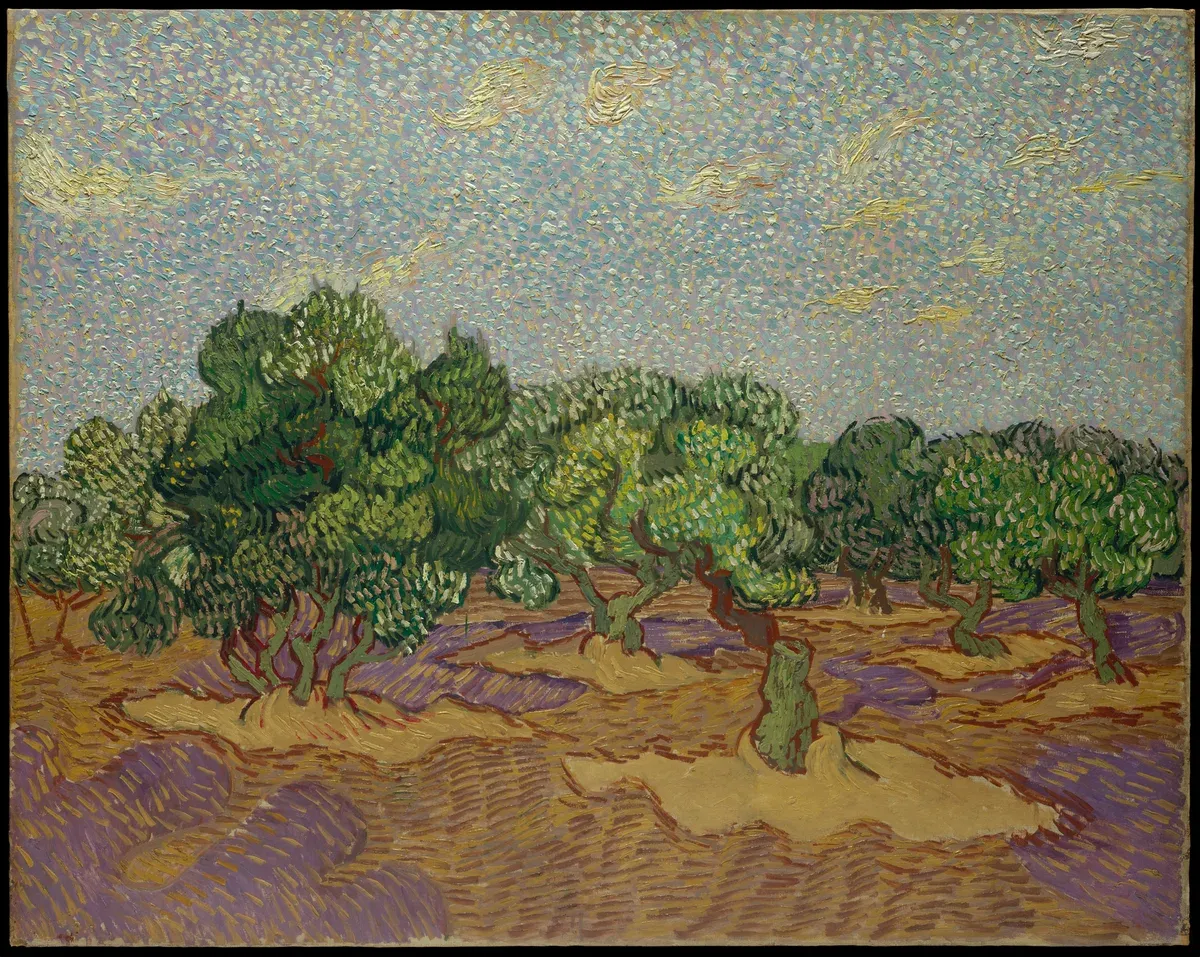
Vincent van Gogh, Olive Trees, 1889. The Metropolitan Museum of Art (1998.325.1). Image: Open Access, public domain (CC0).
Historical Vincent van Gogh (1853 to 1890) painted for only about ten years. In the south of France he developed thick, rhythmic strokes and intense color. He painted olive groves near the asylum at Saint-Rémy in 1889.
His letters, mostly to his brother Theo, are published in full by the Van Gogh Museum, and I quote him only from that edition, because many lines attributed to him online are not in his letters.
He suffered severe crises. In December 1888 in Arles he cut off his ear; Bernadette Murphy’s research (2016) argues that he removed the whole ear. He died of a gunshot wound in 1890.
Later tradition The mad genius story overshadows his careful, thoughtful practice.
Historical Gauguin and the Nabis. Paul Gauguin (1848 to 1903) left his work as a stockbroker and his family to paint, first in Brittany and then in Tahiti from 1891. He used flat areas of strong, unnatural color.
His life in Polynesia included sexual relationships with girls as young as thirteen, whom he also painted, and his “primitive paradise” ignored the colonial reality around him. Recent exhibitions address both directly.
Key artists
| Artist | Lived | Why they matter |
|---|---|---|
| Paul Cézanne | 1839 to 1906 | The painter who built nature out of planes of color. |
| Georges Seurat | 1859 to 1891 | Inventor of pointillism, painting in dots. |
| Vincent van Gogh | 1853 to 1890 | The painter of swirling skies and burning color. |
| Paul Gauguin | 1848 to 1903 | The painter of flat color and symbolic dreams. |
| Henri de Toulouse-Lautrec | 1864 to 1901 | The painter and poster artist of Montmartre. |
How do you recognise Post-Impressionism?
Look for artists going past Impressionism in different directions: Seurat’s science of dots, Cézanne’s solid geometry, Van Gogh’s emotional brushstrokes and Gauguin’s flat, symbolic color. Outlines return. Color expresses feeling rather than describing light.
Common misconceptions. One is that the Post-Impressionists formed a group. They did not. Cézanne worked mostly alone in Provence, Gauguin in Brittany and Tahiti, and Seurat in Paris; the label was given afterwards.
Another is that they rejected Impressionism. Most of them learned from it, and Cézanne and Gauguin exhibited at Impressionist shows. A third is that women had no part. Suzanne Valadon, a former model encouraged by Degas, who bought her drawings, painted bold portraits and figures, and Marie Bracquemond worked in a related bright manner.
Esoteric themes
Historical In 1888 Paul Sérusier painted a small landscape under Gauguin’s direction in Brittany, in pure flat color.
Back in Paris, he and his friends, including Maurice Denis, Pierre Bonnard and Édouard Vuillard, formed a group called the Nabis, from the Hebrew word for prophets. Some of them, Sérusier above all, were drawn to Theosophy and mystical theories of number and color.
Later tradition Van Gogh’s starry skies are often read as mystical. He did write about religion and the stars, but how far to read his paintings as visions is debated.
Modern The Nabis’ idea that color itself carries spirit leads straight to Kandinsky. See Early abstraction.
Works to see
| Work | Artist | Date | Where to see it |
|---|---|---|---|
| Starry Night over the Rhône | Vincent van Gogh | 1888 | Musée d’Orsay, Paris |
| Wheat Field with Cypresses | Vincent van Gogh | 1889 | The Metropolitan Museum of Art, New York |
| A Sunday on La Grande Jatte | Georges Seurat | 1884 to 1886 | The Art Institute of Chicago |
| Mont Sainte-Victoire | Paul Cézanne | 1902 to 1906 | The Metropolitan Museum of Art, New York |
Every work in this list is free of nudity, so you can look them up with confidence. Works still in copyright are named but not shown here.
How to look at a Post-Impressionist painting
Ask what the artist added to Impressionism. With Cézanne, look for structure: blocks of colour that build a mountain. With Van Gogh, look for feeling in the brushstroke. With Gauguin, look for flat symbolic colour. With Seurat, look for dots and order.
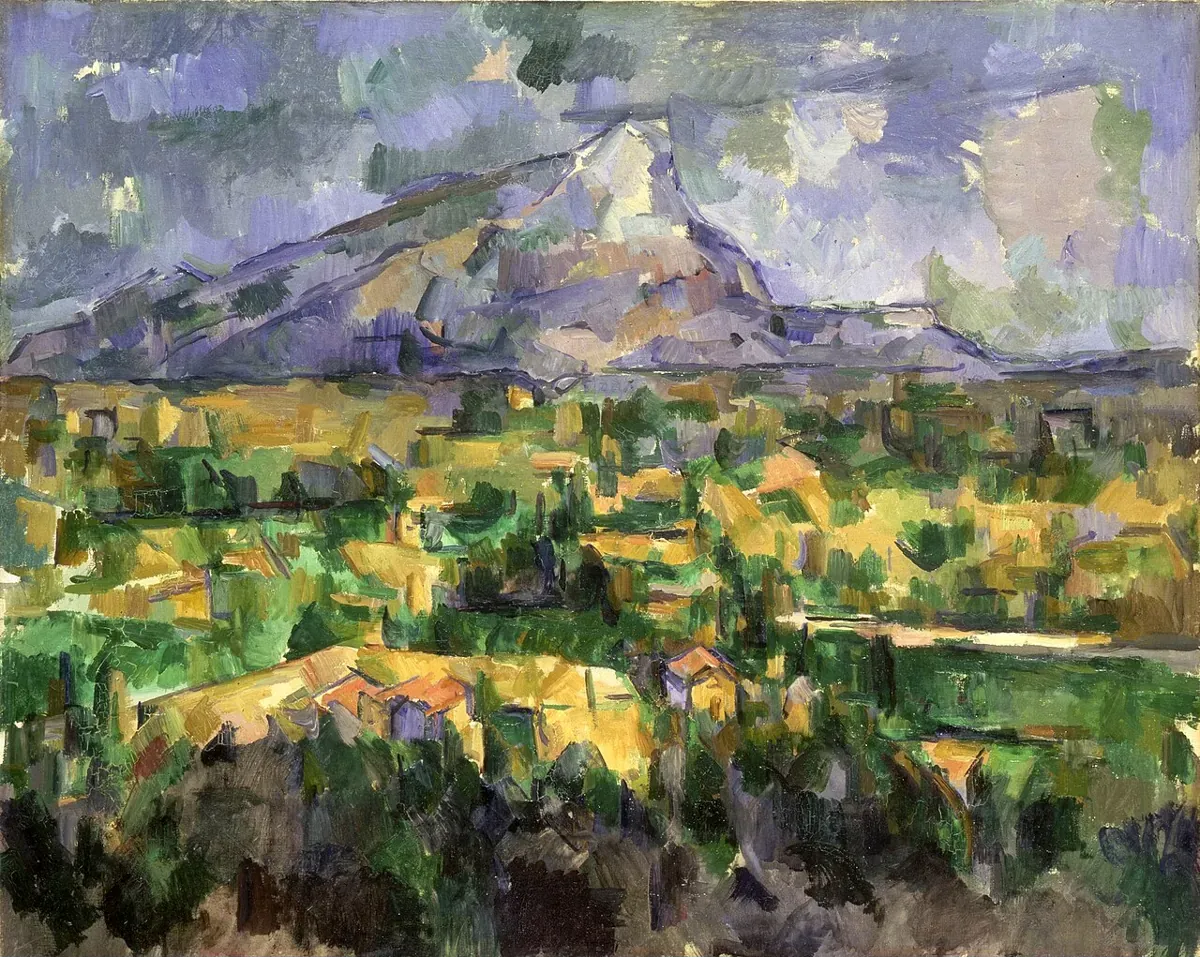
Paul Cézanne, Mont Sainte-Victoire, 1902 to 1904. Philadelphia Museum of Art. Image: Wikimedia Commons, public domain.
Paul Cézanne, Mont Sainte-Victoire, 1902 to 1904. At the Philadelphia Museum of Art. Cézanne painted this mountain near Aix-en-Provence dozens of times. Notice how each patch of colour is a small plane, so the landscape seems built rather than seen.
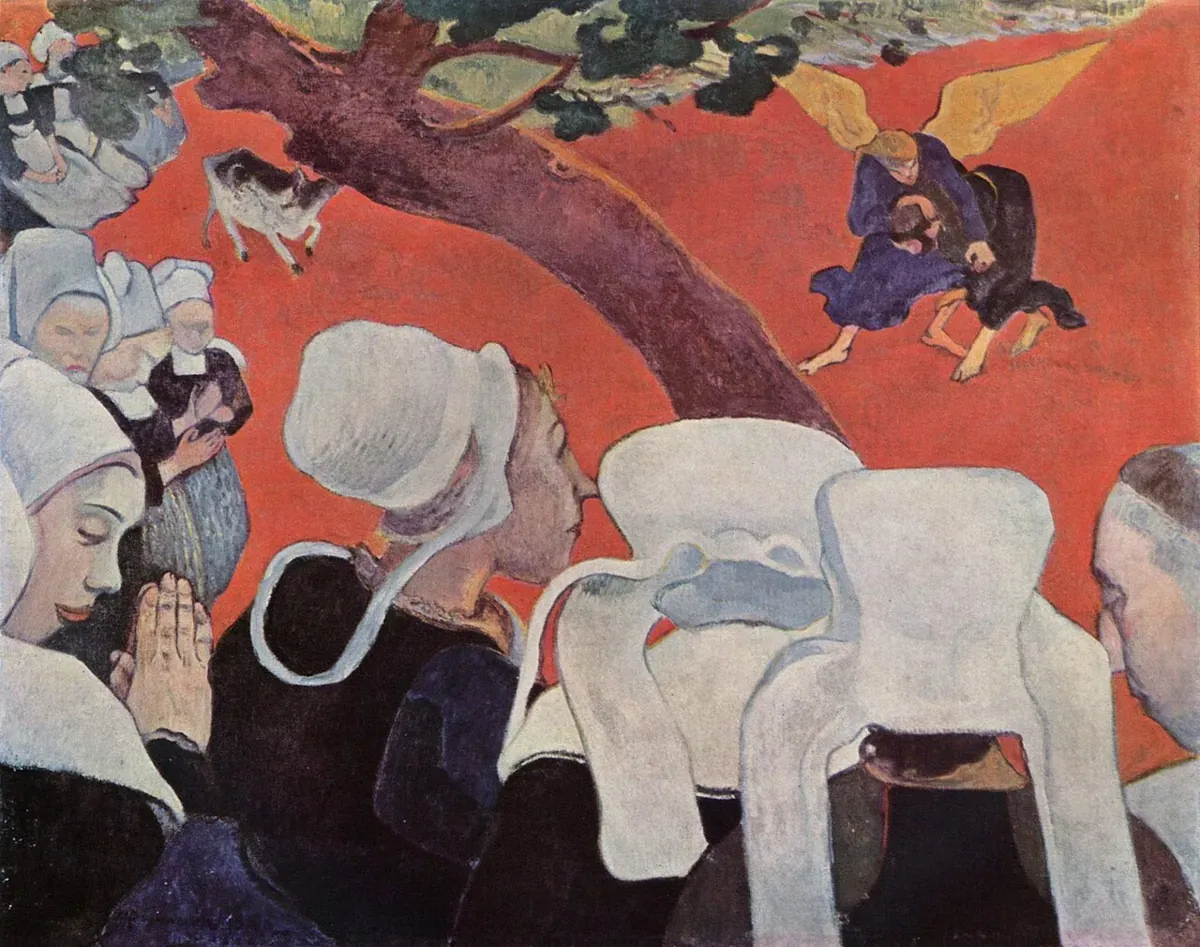
Paul Gauguin, Vision after the Sermon (Jacob Wrestling with the Angel), 1888. Scottish National Gallery, Edinburgh. Image: Wikimedia Commons, public domain.
Paul Gauguin, Vision after the Sermon, 1888. At the Scottish National Gallery in Edinburgh. Painted in Pont-Aven, Brittany. The women have just heard a sermon, and the red field shows the vision in their minds, not a real place.
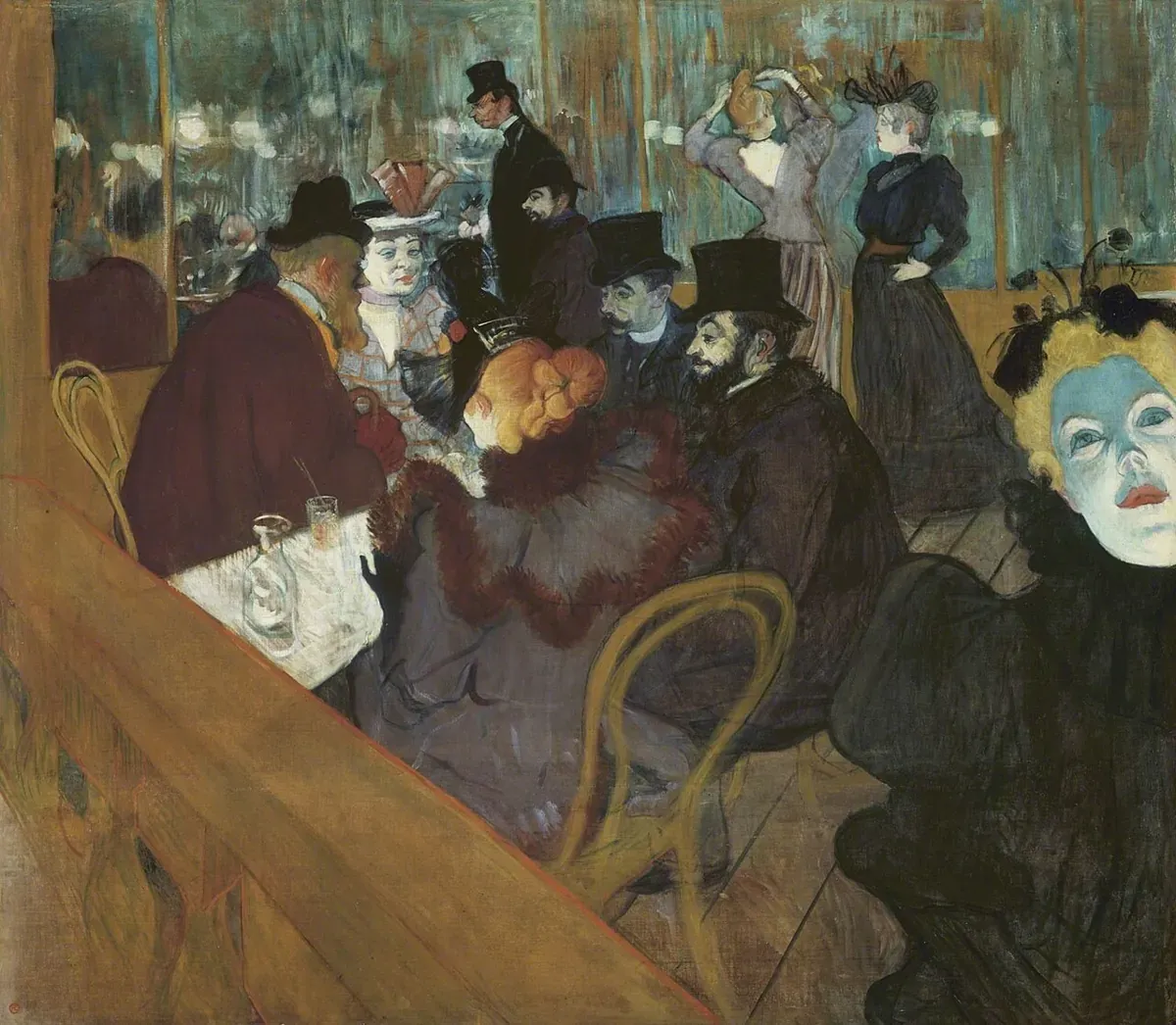
Henri de Toulouse-Lautrec, At the Moulin Rouge, 1892 to 1895. Art Institute of Chicago. Image: Wikimedia Commons, public domain.
Henri de Toulouse-Lautrec, At the Moulin Rouge, 1892 to 1895. At the Art Institute of Chicago. Look at the green-lit face cut off at the right, and find the small figure of Lautrec himself in the background with his taller cousin.
Post-Impressionism grew from Impressionism, fed directly into the Nabis and Symbolism, and opened the way for Fauvism, Expressionism and Cubism, which owed much to Cézanne.
Try this
Find a high-resolution image of Seurat’s La Grande Jatte (Art Institute of Chicago 1926.224). Zoom into one shadow on the grass and list every color you see. Then zoom out until it looks like one color. Name it.
What next
Before this: Aestheticism.
After this: Symbolism.
Also worth reading alongside it: Impressionism, The Nabis.
See every movement in order on the art movements timeline, or learn to look step by step in the free Art History for Beginners course.
If you want to carry this into tarot and practice, these pages connect to it: The Star, stars over water, hope in the dark; The Sun, Van Gogh’s sunflowers and the burning yellow of Arles; Gauguin, the Nabis and the Symbolists; and What modern art took from them.
Sources
- Van Gogh Museum and Huygens ING, Vincent van Gogh: The Letters. Visit the website
- Bernadette Murphy, Van Gogh’s Ear: The True Story (2016).
- The Metropolitan Museum of Art, The Card Players, 61.101.1. Open the record
- The Metropolitan Museum of Art, Olive Trees, 1998.325.1. Open the record
- The Metropolitan Museum of Art, Study for A Sunday on La Grande Jatte, 51.112.6. Open the record
- E. H. Gombrich, The Story of Art (1950).
- Wikimedia Commons, Starry Night over the Rhône (hero image record). Open the record
- John Rewald, Post-Impressionism: From Van Gogh to Gauguin (1956).

Questions
Who invented the term Post-Impressionism?
The English critic Roger Fry, for his 1910 London exhibition Manet and the Post-Impressionists. It groups very different artists who started from Impressionism.
Did Van Gogh sell only one painting?
The Red Vineyard is the one documented sale of an oil painting in his lifetime, but he also sold or traded other works, so the famous claim is too simple.
Where can I see works of Post-Impressionism in person?
Good places to start are Amsterdam (the Van Gogh Museum), Paris (the Musée d'Orsay), Chicago, London, and the Met. Museums change their displays, so check the collection page before you travel.
Who are the main Post-Impressionist artists?
Paul Cézanne, Vincent van Gogh, Paul Gauguin, Georges Seurat, Paul Signac, Henri de Toulouse-Lautrec, Suzanne Valadon and Émile Bernard.
What is the difference between Impressionism and Post-Impressionism?
Impressionism tried to capture a passing moment of light. Post-Impressionism kept the colour but added lasting structure, symbolism or personal emotion.
Get the free Mini-Grimoire
A short printable starter guide to tarot and everyday witchcraft, plus my newsletter. Unsubscribe any time.
Opens Substack in a new tab to confirm. More about the newsletter · Privacy