


How to read the labels Historical what the old sources say. Later tradition what later writers added. Modern modern practice and my own notes.
Realism is the art movement that arose in France around 1848, when painters such as Gustave Courbet, Jean-François Millet, Rosa Bonheur and Honoré Daumier chose to paint ordinary people, work and the countryside at full scale and without idealising them. It peaked between about 1848 and 1880, and Courbet’s Burial at Ornans, shown at the Paris Salon of 1850 to 1851, became its manifesto. Its key works are now mostly in the Musée d’Orsay in Paris.
They rejected both the noble Greeks of Neoclassicism and the moonlit dreams of Romanticism, and painted farm workers, stone breakers, train passengers and a village funeral. In the same decades, a new invention, photography, changed what pictures could be for, and gave Spiritualism its most famous fakes.
Key dates
| When | What happened |
|---|---|
| 1849 | Courbet paints The Stonebreakers. |
| 1852 to 1855 | Rosa Bonheur paints The Horse Fair. |
| 1855 | Courbet opens his own Pavilion of Realism. |
| 1857 | Millet paints The Gleaners. |
| About 1862 to 1864 | Daumier paints The Third-Class Carriage. |
What is Realism?
Realism is art that shows the world, and especially working life, as the artist actually sees it, rather than as myth, history or ideal.
Throughout this page I mark three layers. Historical What the works and records show. Later tradition What later admirers made of Realism. Modern How the ideas live on.
Historical Courbet’s protest. Gustave Courbet (1819 to 1877) painted the burial of an ordinary villager at the huge scale once reserved for history painting, and men breaking stones by the road. When some of his works were refused for the Paris World’s Fair in 1855, he built his own Pavilion of Realism next door and published a manifesto.
It was one of the first exhibitions an artist organized for himself, and it set an example the Impressionists would follow twenty years later. A line often attributed to Courbet, that he would paint an angel when someone showed him one, sums up the whole movement, even if the exact words are uncertain.
Historical Millet and the dignity of work. Jean-François Millet (1814 to 1875) painted French peasants sowing, gleaning and resting.
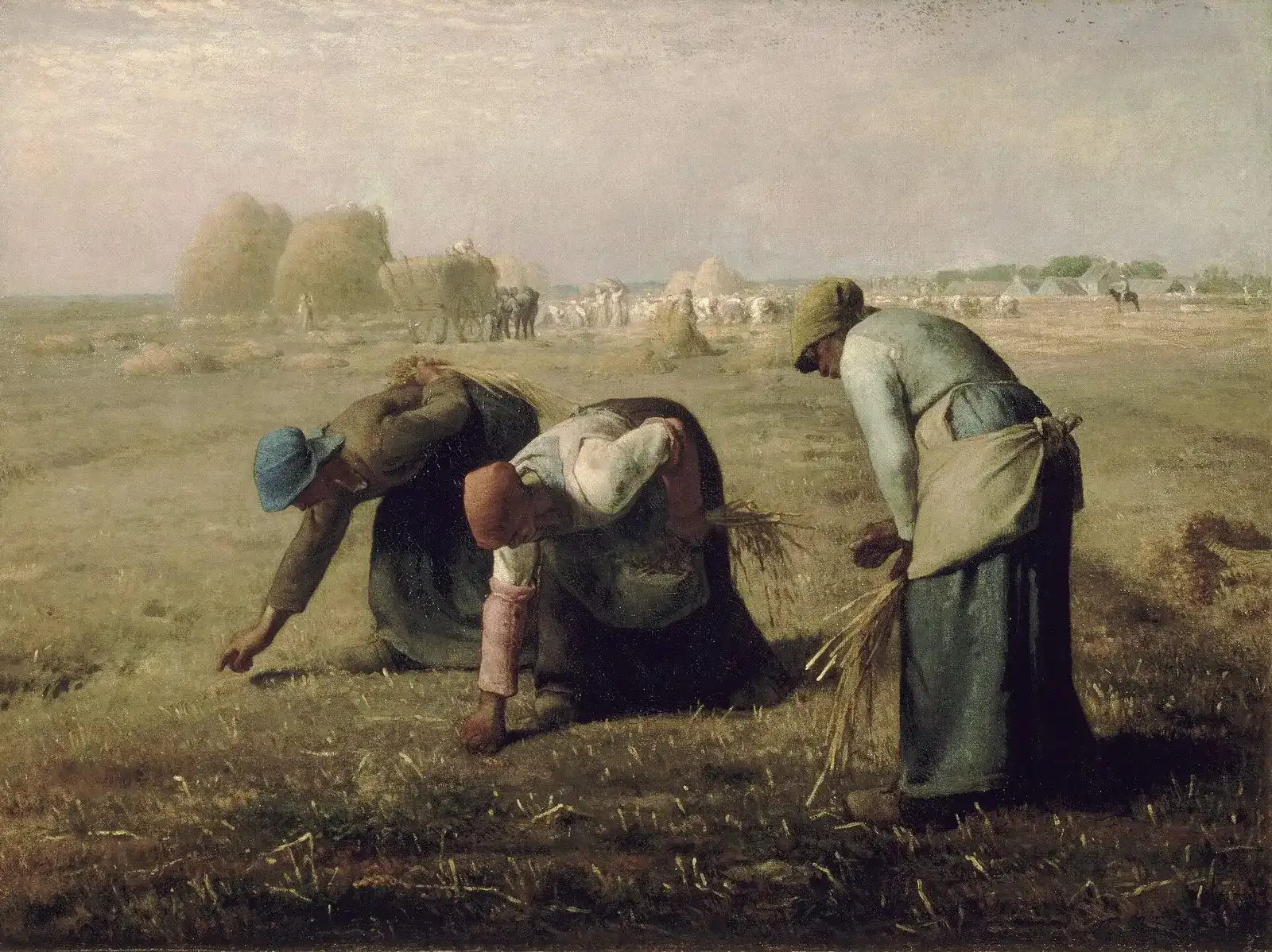
To some critics his patient laborers looked dangerously political, as if they were asking for something. The Gleaners (1857), in the Musée d’Orsay, shows three women bent double, picking up the last stalks after the harvest, while a rich farm glows in the distance.
Daumier on the train. 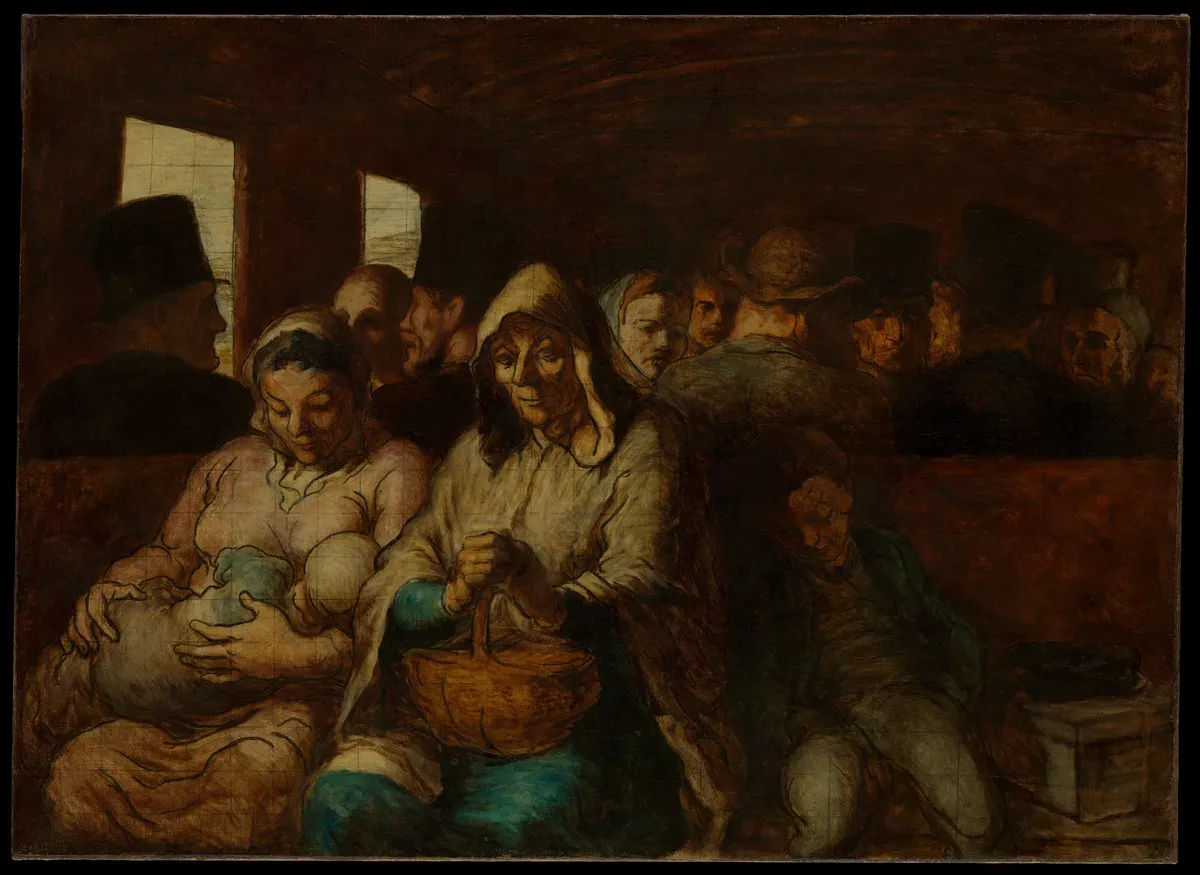
Honoré Daumier, The Third-Class Carriage, 1864. The Metropolitan Museum of Art (29.100.129). Image: Open Access, public domain (CC0).
Historical Honoré Daumier (1808 to 1879) drew thousands of satirical lithographs for Paris newspapers and was once jailed for a caricature of the king.
In The Third-Class Carriage (1864) he paints a poor family on a hard bench: an old woman with a basket, a mother holding her baby, a sleeping boy, and behind them a crowd of strangers. Nobody talks. The modern city has arrived, and with it a new kind of loneliness.
Historical Rosa Bonheur. Rosa Bonheur (1822 to 1899) was one of the most famous painters of her time. To study animals in horse markets and slaughterhouses, she got official police permission to wear trousers. Her enormous Horse Fair (1852 to 1855), in the Met, shows powerful horses paraded at a Paris market, full of muscle and dust.
Historical Photography arrives. Photography was announced to the world in 1839. Daguerreotypes, unique mirror-like images on silvered plates, filled studios in every city; the Boston studio of Southworth and Hawes made portraits of striking directness.
The English botanist Anna Atkins used blue cyanotype prints to record algae, published from 1843 in Photographs of British Algae, often called the first book illustrated with photographs. Photography took over the job of recording likenesses, and painters began to explore what a camera could not do: color, brushwork, a personal way of seeing.
Key artists
| Artist | Lived | Why they matter |
|---|---|---|
| Gustave Courbet | 1819 to 1877 | The painter who said he would paint only what he could see. |
| Jean-François Millet | 1814 to 1875 | The painter of peasant labor at Barbizon. |
| Honoré Daumier | 1808 to 1879 | Caricaturist and painter of ordinary travelers. |
| Rosa Bonheur | 1822 to 1899 | The most famous woman painter of her day, a painter of animals. |
| Ilya Repin | 1844 to 1930 | The Russian realist of the Barge Haulers. |
How do you recognise Realism?
Look for ordinary people at work, painted life size and without flattery. Colors are earthy, the light plain. There are no gods or heroes, just laborers, villagers and travelers. Photography is arriving at the same time and changing how painters see.
Common misconceptions. One is that Realism just means painting realistically. As a movement it meant a choice of subject: peasants, labourers and provincial funerals painted with the seriousness once kept for kings and saints.
Another is that it was neutral. Critics in 1850s Paris saw Courbet’s work as political, and Courbet himself took part in the Paris Commune of 1871. A third is that women were absent. Rosa Bonheur was one of the most famous painters in Europe, and she held a police permit allowing her to wear trousers, which she said she needed for working in horse markets and abattoirs.
Esoteric themes
Historical Spiritualism, the belief that the dead can speak through mediums, spread from the United States after 1848. In the 1860s the Boston photographer William Mumler sold “spirit photographs” with ghostly figures beside living sitters. He was tried for fraud in New York in 1869 and acquitted for lack of proof, but the images were double exposures.
Later tradition Spirit photography grew into a whole industry, with fairy and ghost photos into the twentieth century. It is real history and not evidence of spirits.
Modern I find these photos moving, because they show how badly grieving people wanted a sign. In lesson 7 of the course I follow Spiritualism into the art of Hilma af Klint.
Works to see
| Work | Artist | Date | Where to see it |
|---|---|---|---|
| The Gleaners | Jean-François Millet | 1857 | Musée d’Orsay, Paris |
| The Horse Fair | Rosa Bonheur | 1852 to 1855 | The Metropolitan Museum of Art, New York |
| The Third-Class Carriage | Honoré Daumier | about 1862 to 1864 | The Metropolitan Museum of Art, New York |
| Young Ladies of the Village | Gustave Courbet | 1851 to 1852 | The Metropolitan Museum of Art, New York |
Every work in this list is free of nudity, so you can look them up with confidence. Works still in copyright are named but not shown here.
How to look at a Realist painting
Ask who is being shown and how big they are. Realists gave ordinary people the huge canvases of history painting. Then look at the surface: earth colours, heavy paint, little prettiness.
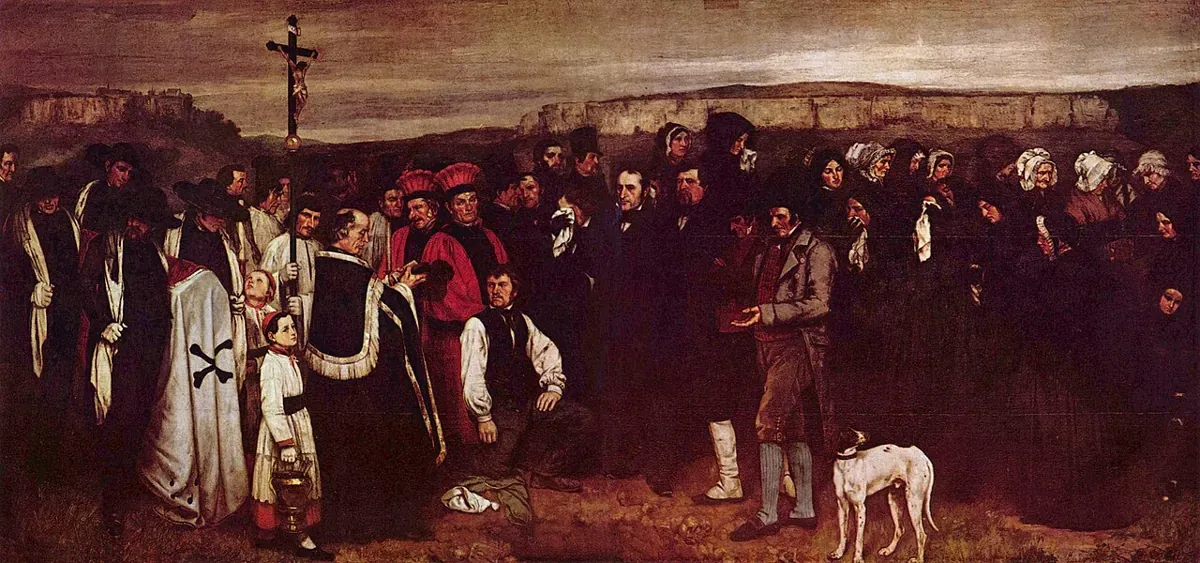
Gustave Courbet, A Burial at Ornans, 1849 to 1850. Musée d’Orsay, Paris. Image: Wikimedia Commons, public domain.
Gustave Courbet, A Burial at Ornans, 1849 to 1850. At the Musée d’Orsay. More than six metres wide, the size of a history painting, for a funeral in Courbet’s home village. The villagers posed for him. There is no hero, and that was the scandal.
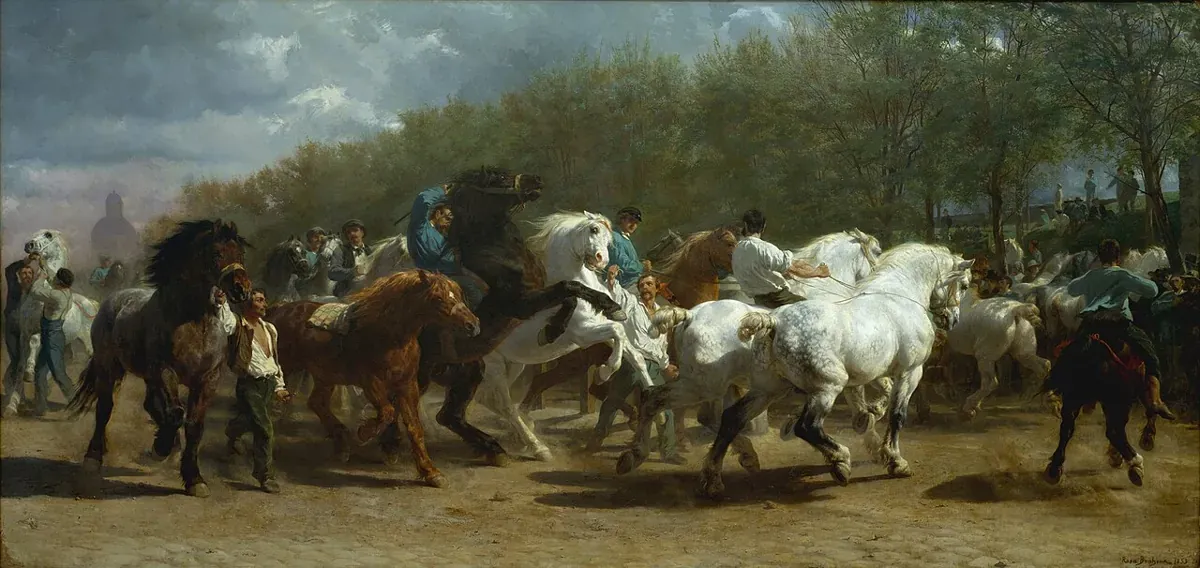
Rosa Bonheur, The Horse Fair, 1852 to 1855. The Metropolitan Museum of Art, New York. Image: Wikimedia Commons, public domain.
Rosa Bonheur, The Horse Fair, 1852 to 1855. At the Metropolitan Museum of Art. First shown at the Salon of 1853. Bonheur sketched at the horse market in Paris for many months. Look at the muscles and the motion; she has included herself among the riders, according to tradition.
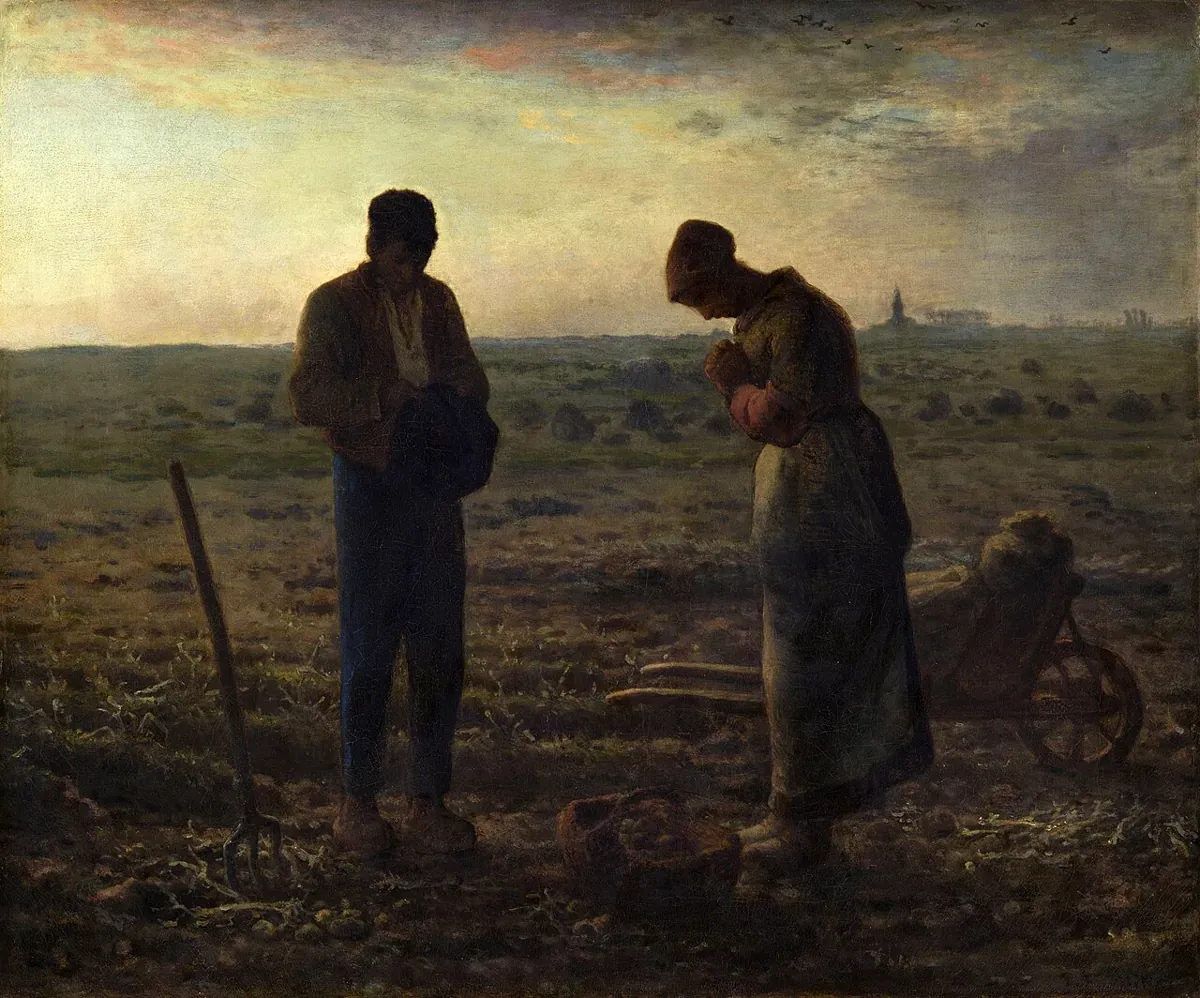
Jean-François Millet, The Angelus, 1857 to 1859. Musée d’Orsay, Paris. Image: Wikimedia Commons, public domain.
Jean-François Millet, The Angelus, 1857 to 1859. At the Musée d’Orsay. Two farm workers stop to pray as the evening bell rings. It became one of the most reproduced pictures of the 19th century, and later fascinated Salvador Dalí.
Realism reacted against Romanticism and Neoclassicism, looked back to the everyday scenes of the Dutch Golden Age, and led directly to Impressionism and to National Romanticism in the north.
Try this
Compare a daguerreotype portrait by Southworth and Hawes in the Met’s online collection with a painted portrait from the same decade. What can the photo show that the painting cannot? Sitters had to hold still for many seconds; how does that show in their faces?
What next
Before this: Pre-Raphaelites.
After this: Impressionism.
Also worth reading alongside it: Romanticism.
See every movement in order on the art movements timeline, or learn to look step by step in the free Art History for Beginners course.
If you want to carry this into tarot and practice, these pages connect to it: Eight of Pentacles, patient, honest work; Five of Pentacles, poverty seen without sentiment; What came just before Realism; and Spiritualism, which grew up in the same years.
Sources
- Linda Nochlin, Realism (1971).
- The Metropolitan Museum of Art, The Third-Class Carriage, 29.100.129. Open the record
- The Metropolitan Museum of Art, The Horse Fair, 87.25. Open the record
- Clément Chéroux and others, The Perfect Medium: Photography and the Occult (2005).
- E. H. Gombrich, The Story of Art (1950).
- Wikimedia Commons, The Gleaners (hero image record). Open the record
- Linda Nochlin, Realism (1971).

Questions
What did Realism mean in art?
Painting contemporary life without idealizing it, including working people and subjects the academies thought too low for serious art. The movement took shape around 1848.
Were spirit photographs real?
No. William Mumler's ghostly figures of the 1860s were double exposures. He was tried for fraud in New York in 1869 and acquitted for lack of proof, but the images are a chapter in the history of Spiritualism, not evidence of spirits.
Where can I see works of Realism in person?
Good places to start are Paris (the Musée d'Orsay), the Met, Baltimore (the Walters), and London. Museums change their displays, so check the collection page before you travel.
Who are the main Realist painters?
Gustave Courbet, Jean-François Millet, Rosa Bonheur, Honoré Daumier, Jules Breton, Ilya Repin in Russia and Thomas Eakins in the United States.
What is the difference between Realism and Impressionism?
Realism focused on serious subjects from ordinary life, often in earthy tones. Impressionism, which grew from it, focused on light, colour and fleeting moments, painted in quick broken strokes.
Get the free Mini-Grimoire
A short printable starter guide to tarot and everyday witchcraft, plus my newsletter. Unsubscribe any time.
Opens Substack in a new tab to confirm. More about the newsletter · Privacy