


How to read the labels Historical what the old sources say. Later tradition what later writers added. Modern modern practice and my own notes.
Aestheticism, or the Aesthetic Movement, was a British and American movement of the 1860s to the 1890s that put beauty before stories and morals. Its slogan was “art for art’s sake”. Painters such as James McNeill Whistler and Albert Moore, and writers such as Walter Pater and Oscar Wilde, wanted paintings, rooms and even lives to be arranged like music.
In Victorian Britain most people expected a picture to tell a story or teach a lesson. I find this movement a useful counterweight on a site about meaning and symbols, because it reminds us that some art asks only to be looked at.
Key dates
| When | What happened |
|---|---|
| 1835 | Théophile Gautier argues that art need not be useful, the idea behind “art for art’s sake”. |
| 1862 | The Royal Academy rejects Whistler’s The White Girl. |
| 1873 | Walter Pater publishes Studies in the History of the Renaissance. |
| 1876 to 1877 | Whistler paints the Peacock Room in London. |
| 1877 | The Grosvenor Gallery opens and becomes the home of the movement. |
| 1878 | Whistler sues John Ruskin for libel and wins one farthing in damages. |
What is Aestheticism?
Aestheticism is the idea that art does not need to teach or tell a story to be valuable; beauty of colour, line and arrangement is enough. It touched painting, design, fashion and literature.
Throughout this page I mark three layers. Historical What buildings, objects and texts of the time show. Later tradition What later centuries read into them. Modern How people use these images today.
Historical Art for art’s sake. In 1835 the French writer Théophile Gautier argued that only useless things can be truly beautiful.
In England the critic Walter Pater took the idea further in 1873, in the famous conclusion to his book on the Renaissance, where he urged readers “to burn always with this hard, gem-like flame”, to live for intense moments of beauty.
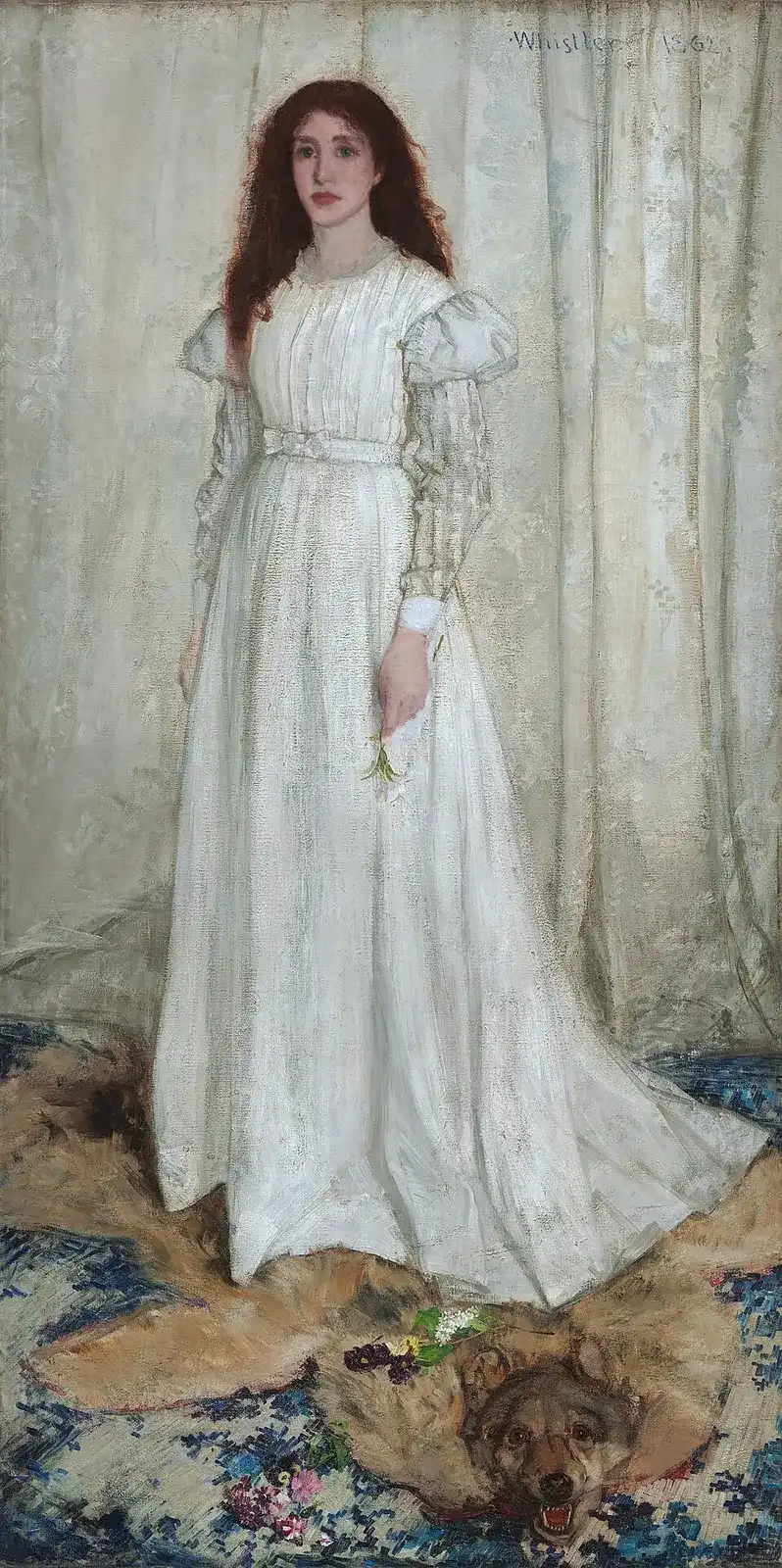
Historical Whistler and The White Girl. James McNeill Whistler, an American in London and Paris, painted a young woman in a white dress against a white curtain, standing on a wolf skin. The Royal Academy rejected it in 1862 and the Paris Salon in 1863, and it caused a stir at the Salon des Refusés that year.
Whistler later called it Symphony in White, No. 1, and from then on gave his paintings musical titles: symphonies, harmonies, nocturnes and arrangements. His portrait of his mother is called Arrangement in Grey and Black No. 1.
Historical The house beautiful. Aesthetes wanted beauty everywhere. In 1876 and 1877 Whistler painted the dining room of the shipping magnate Frederick Leyland in blue and gold, with fighting peacocks on one wall, without asking permission.
Leyland was furious. The Peacock Room is now in the Freer Gallery in Washington. Frederic Leighton built his London house around an Arab Hall of tiles from Damascus. Japanese prints, fans, sunflowers, lilies and blue-and-white porcelain filled fashionable homes.
Historical Whistler against Ruskin. In 1877 the critic John Ruskin saw Whistler’s Nocturne in Black and Gold: The Falling Rocket, a dark painting of fireworks, and accused him of “flinging a pot of paint in the public’s face”.
Whistler sued for libel. In November 1878 the jury found for Whistler but awarded him one farthing in damages, and the legal costs helped bankrupt him. The trial was really a fight over what art is for.
Key artists
| Artist | Lived | Why they matter |
|---|---|---|
| James McNeill Whistler | 1834 to 1903 | The American painter who named his pictures like music: symphonies, nocturnes, arrangements. |
| Albert Moore | 1841 to 1893 | The painter of calm women in draped robes, arranged for color alone. |
| Frederic Leighton | 1830 to 1896 | President of the Royal Academy, whose house in London is a temple to beauty. |
| E. W. Godwin | 1833 to 1886 | The architect and designer of Japanese-inspired furniture. |
| Oscar Wilde | 1854 to 1900 | The writer who became the public face of the movement. |
How do you recognise Aestheticism?
Look for harmony of color more than story: whites on white, greys on grey, blue and gold. Titles borrow from music. Japanese prints, fans, blue-and-white porcelain and peacock feathers are everywhere. Women in loose, flowing dresses stand still, as if listening.
Common misconceptions. People often think Aestheticism was only about decadent dandies. In fact much of it happened in ordinary middle-class homes, through wallpaper, blue-and-white china, peacock feathers and Japanese prints sold in London shops such as Liberty, which opened in 1875.
Another misconception is that it was the same as the Pre-Raphaelite Brotherhood. Rossetti links the two, but the early Pre-Raphaelites wanted moral truth and detail, while the Aesthetes wanted mood and harmony. A third is that “art for art’s sake” means “art about nothing”. Whistler’s nocturnes are full of looking at real places; they simply care more about atmosphere than about facts.
Esoteric themes
Historical The Aesthetic world overlapped with the occult revival in London. W. B. Yeats joined the Hermetic Order of the Golden Dawn in 1890, and the actress Florence Farr, a leading member, moved in the same theatrical and artistic circles.
Oscar Wilde’s mother, Lady Jane Wilde, published Ancient Legends, Mystic Charms, and Superstitions of Ireland in 1887, a collection of folk charms and fairy lore.
Later tradition Wilde’s novel The Picture of Dorian Gray (1890, expanded 1891), in which a portrait ages while its sitter stays young, gave the world one of its most famous images of a cursed or magical painting. It is fiction, but it shaped how many people imagine portraits and souls.
Modern “Aesthetic” is now a social media word for a curated look, and witchy aesthetics are everywhere. The Victorian movement is a good reminder to ask what a look is for, and who it serves.
Works to see
| Work | Artist | Date | Where to see it |
|---|---|---|---|
| Symphony in White, No. 1: The White Girl | James McNeill Whistler | 1861 to 1863 | National Gallery of Art, Washington |
| Nocturne in Black and Gold: The Falling Rocket | James McNeill Whistler | 1875 | Detroit Institute of Arts |
| Harmony in Blue and Gold: The Peacock Room | James McNeill Whistler | 1876 to 1877 | Freer Gallery of Art, Smithsonian, Washington |
| Arrangement in Grey and Black No. 1 | James McNeill Whistler | 1871 | Musée d’Orsay, Paris |
Every work in this list is free of nudity, so you can look them up with confidence. Works still in copyright are named but not shown here.
How to look at an Aesthetic painting
Aesthetic paintings reward slow looking. Start by reading the title as a clue: Whistler named his works like pieces of music, symphonies, nocturnes, arrangements, to tell you to look at colour and rhythm first. Then find the two or three colours that the whole picture is built on, and notice how they repeat.
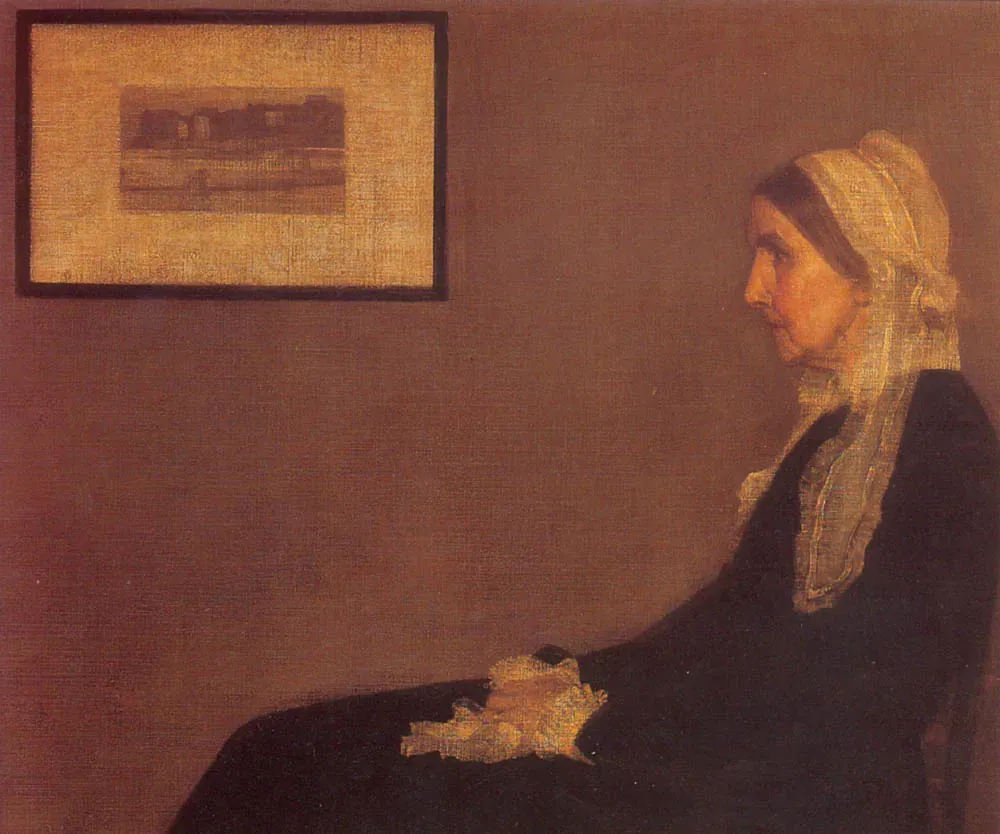
James McNeill Whistler, Arrangement in Grey and Black No. 1, 1871. Musée d’Orsay, Paris. Image: Wikimedia Commons, public domain.
Whistler, Arrangement in Grey and Black No. 1, 1871. Most people call it “Whistler’s Mother”, and it is a portrait of Anna Whistler. But look at it as he asked: a dark shape against grey, a white cap and cuffs, a framed print and a curtain making rectangles. The design is almost abstract. The French state bought it in 1891, and it is now at the Musée d’Orsay.
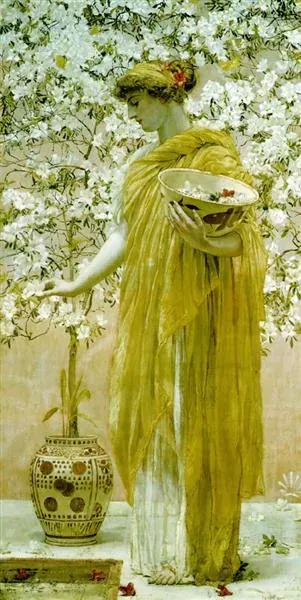
Albert Moore, Azaleas, 1868. Hugh Lane Gallery, Dublin. Image: Wikimedia Commons, public domain.
Albert Moore, Azaleas, 1868. Moore painted women in classical dress, but there is no story here at all. Look for the rhyme between the pink flowers, the pale gown and the patterned ground. Whistler and Moore were close friends in the 1860s and shared this idea of painting as decorative harmony.
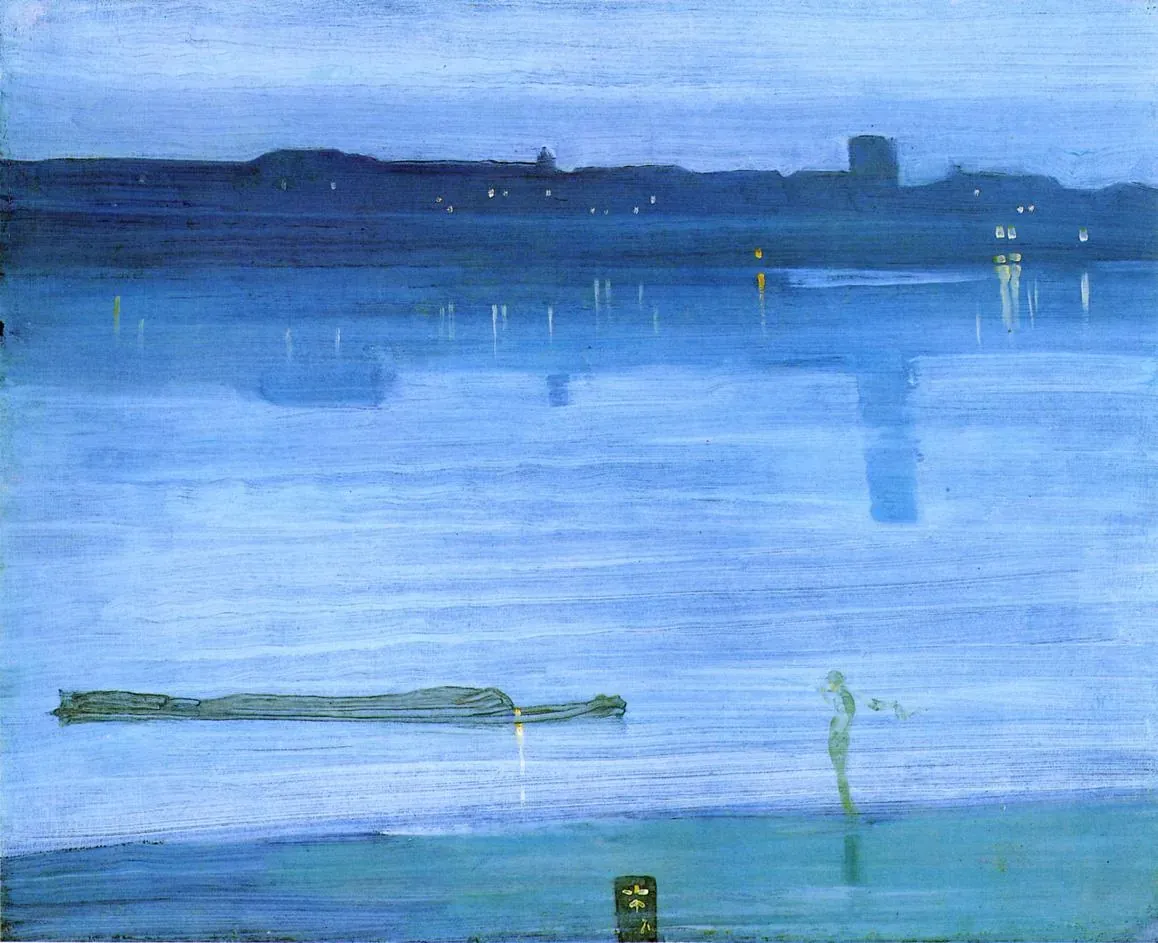
James McNeill Whistler, Nocturne: Blue and Silver, Chelsea, 1871. Tate Britain, London. Image: Wikimedia Commons, public domain.
Whistler, Nocturne: Blue and Silver, Chelsea, 1871. One of the first of the night river scenes, now at Tate Britain. The paint is so thin it is almost a stain. See how a single yellow light and a small dark figure are enough to hold the whole blue field together.
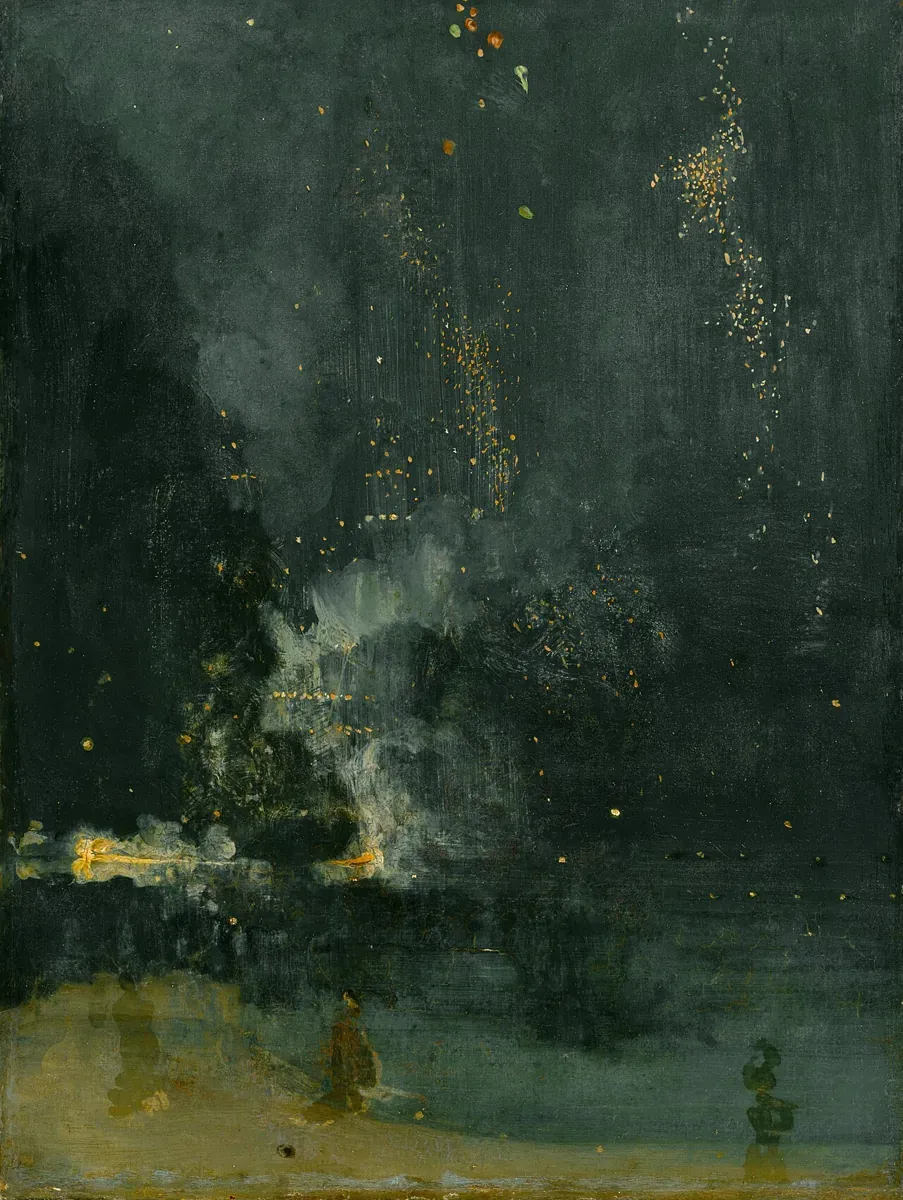
James McNeill Whistler, Nocturne in Black and Gold: The Falling Rocket, about 1875. Detroit Institute of Arts. Image: Wikimedia Commons, public domain.
Whistler, Nocturne in Black and Gold: The Falling Rocket, about 1875. Fireworks over Cremorne Gardens in London dissolve into sparks. This is the painting that John Ruskin accused of “flinging a pot of paint in the public’s face”, which led to the famous libel trial of 1878. Stand back and the mist, the spectators and the falling light come together.
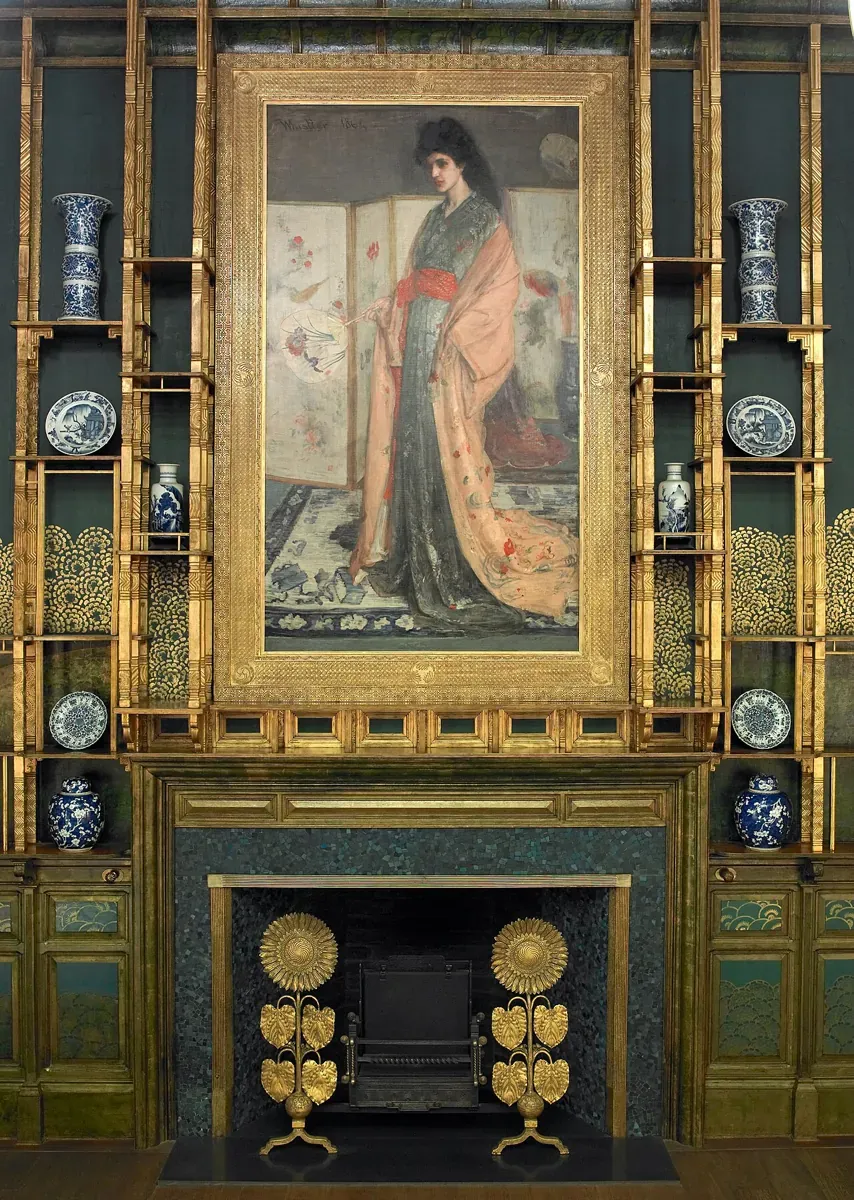
James McNeill Whistler, Harmony in Blue and Gold: The Peacock Room, 1876 to 1877. National Museum of Asian Art (Freer Gallery), Washington. Image: Wikimedia Commons, public domain.
Whistler, Harmony in Blue and Gold: The Peacock Room, 1876 to 1877. A London dining room built to show a collection of Chinese porcelain, painted over by Whistler in blue and gold peacocks. It is now in the Freer Gallery in Washington. It shows the Aesthetic dream that a whole room could be a work of art.
Aestheticism grew beside the Pre-Raphaelites and the Arts and Crafts movement, and it flowed into the long curves of Art Nouveau and the dreams of Symbolism.
Try this
Choose one corner of your room, an altar, a shelf or a desk, and arrange it for color alone, the way Whistler named his paintings. Pick two or three colors and remove anything that does not belong. Give it a musical title, like “Harmony in Green and Silver”, and notice how it changes the way you use the space.
What next
Before this: Impressionism.
After this: Post-Impressionism.
Also worth reading alongside it: Pre-Raphaelites, Symbolism.
See every movement in order on the art movements timeline, or learn to look step by step in the free Art History for Beginners course.
If you want to carry this into tarot and practice, these pages connect to it: The Star, stillness, purity of color and quiet hope; The Empress, beauty for its own sake, the house as a work of art; Aestheticism alongside the occult revival; and Color as a way into a mood.
Sources
- Walter Pater, Studies in the History of the Renaissance (1873).
- Théophile Gautier, Mademoiselle de Maupin (preface) (1835).
- Stephen Calloway and Lynn Federle Orr (eds), The Cult of Beauty: The Aesthetic Movement 1860 to 1900 (2011). Victoria and Albert Museum exhibition catalogue.
- Lady Jane Wilde, Ancient Legends, Mystic Charms, and Superstitions of Ireland (1887).
- National Gallery of Art, Washington, Symphony in White, No. 1: The White Girl.
- National Museum of Asian Art, Smithsonian, Harmony in Blue and Gold: The Peacock Room. Freer Gallery of Art, Washington.
- Wikimedia Commons, Symphony in White, No. 1: The White Girl (hero image record). Open the record
- Elizabeth Prettejohn, Art for Art’s Sake: Aestheticism in Victorian Painting (2007).

Questions
What does art for art's sake mean?
The idea that art does not need a moral, political or religious purpose; its beauty is reason enough. It was the central idea of Aestheticism.
Who won the Whistler v. Ruskin trial?
Whistler won in 1878, but the jury awarded him only one farthing in damages, and the costs contributed to his bankruptcy in 1879.
Where can I see works of Aestheticism in person?
Good places to start are Washington (the Freer and the National Gallery of Art), London (Tate, Leighton House, the V&A), Paris (Musée d'Orsay), and Detroit. Museums change their displays, so check the collection page before you travel.
What is the difference between Aestheticism and the Arts and Crafts movement?
Both cared about beautiful homes. Arts and Crafts, led by William Morris, tied beauty to honest handwork and social reform. Aestheticism cared about beauty for its own sake, without a moral or social programme.
Was Oscar Wilde part of the Aesthetic Movement?
Yes. Wilde became its most famous public voice in the late 1870s and 1880s, and his lecture tour of the United States in 1882 spread its ideas, although he did not invent them.
Get the free Mini-Grimoire
A short printable starter guide to tarot and everyday witchcraft, plus my newsletter. Unsubscribe any time.
Opens Substack in a new tab to confirm. More about the newsletter · Privacy