


How to read the labels Historical what the old sources say. Later tradition what later writers added. Modern modern practice and my own notes.
Symbolism is the European movement in art and poetry of about 1886 to 1910 that turned away from realism to express dreams, myths, mysticism and inner states. The poet Jean Moréas named it in a manifesto in Le Figaro on 18 September 1886. Its painters include Gustave Moreau and Odilon Redon in France, Arnold Böcklin in Switzerland, Fernand Khnopff in Belgium and Hugo Simberg in Finland.
By the 1880s Impressionism had captured light, Realism had captured work, and photography could record anything. Symbolists wanted the soul and the invisible. Of all the art movements, this is the one that feels most like a séance, and it is the one in which occultists and painters worked most closely together.
Key dates
| When | What happened |
|---|---|
| 1880 to 1886 | Böcklin paints five versions of the Isle of the Dead. |
| 1886 | Jean Moréas publishes the Symbolist manifesto in Le Figaro. |
| About 1890 | Redon turns from charcoal noirs to color. |
| 1892 to 1897 | Joséphin Péladan holds six Salons de la Rose+Croix in Paris. |
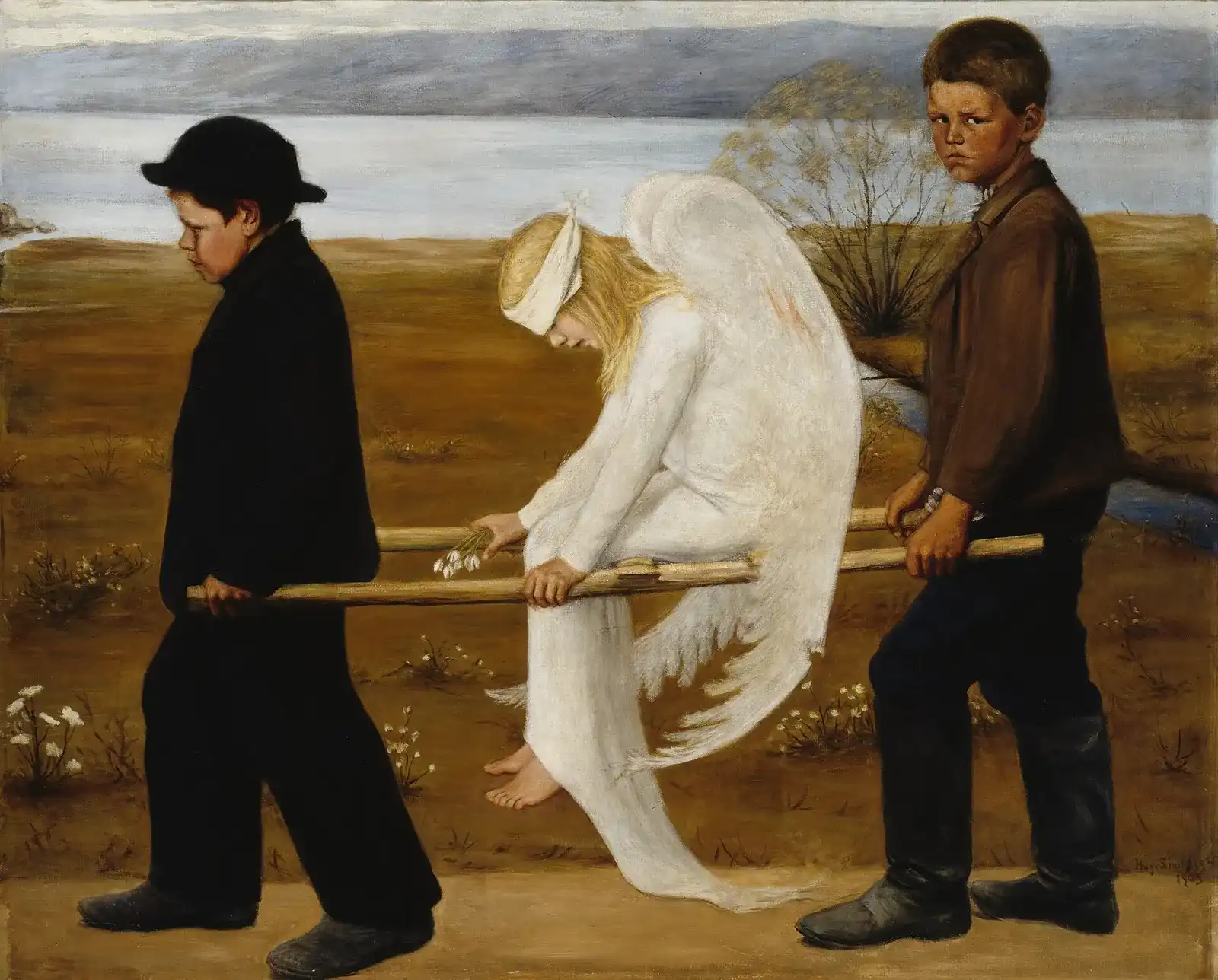
| 1903 | Hugo Simberg paints The Wounded Angel. |
What is Symbolism?
Symbolism is art that suggests ideas and feelings beyond words, through dream images, myth and mood, rather than showing the outer world.
Throughout this page I mark three layers. Historical What the works and records show. Later tradition The myths of the circle. Modern How witches use Symbolist images now.
Historical A manifesto for dreams. On 18 September 1886 the poet Jean Moréas published a Symbolist manifesto in Le Figaro. The idea was that art should clothe ideas in visible form, not copy nature. Painters across Europe answered: Arnold Böcklin with his Isle of the Dead, Fernand Khnopff with sphinxes and silent women, Jean Delville with visions of souls.
Böcklin painted his Isle of the Dead in five versions between 1880 and 1886: a rowing boat carries a white-shrouded figure toward a rocky island of cypresses. Copies hung in middle-class homes across Germany, and Sergei Rachmaninoff wrote a tone poem after it in 1909.
Khnopff’s I Lock My Door upon Myself (1891), in Munich, takes its title from a poem by Christina Rossetti, the sister of the Pre-Raphaelite painter, and shows a woman lost in thought among symbols of sleep.
Moreau’s jewels. 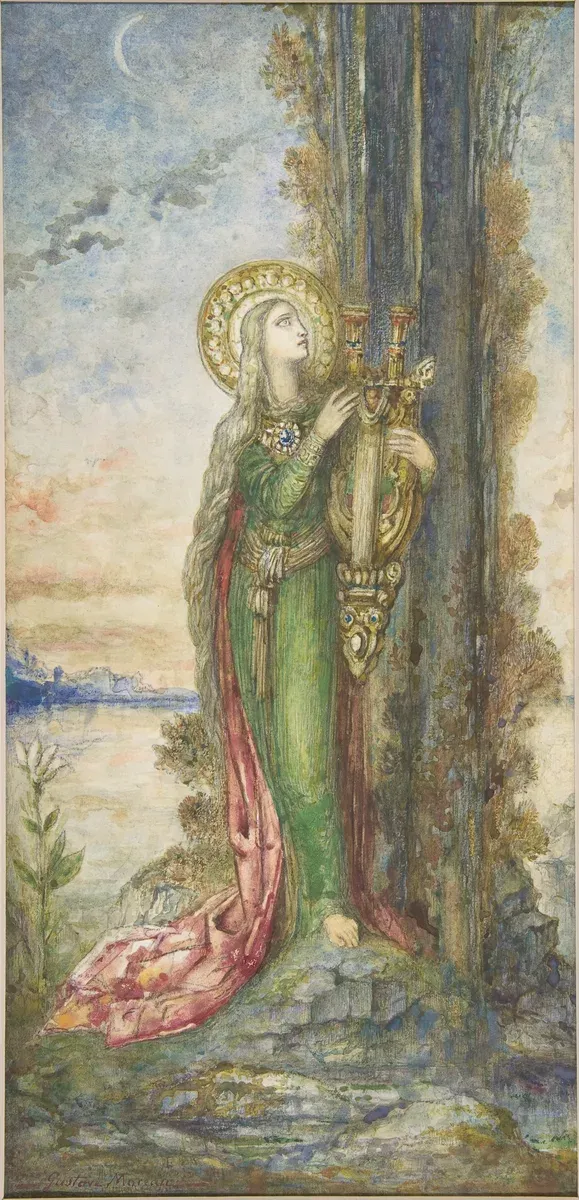
Gustave Moreau, Saint Cecilia, about 1890 to 1895. The Metropolitan Museum of Art (2004.475.3). Image: Open Access, public domain (CC0).
Historical Gustave Moreau (1826 to 1898) painted saints, sphinxes and Salome in a glitter of jeweled detail. In this late picture, Saint Cecilia, patron saint of music, stands barefoot by a lake at dusk and plays a jeweled lyre, with a thin crescent moon above her and a white lily at her feet.
Moreau taught at the École des Beaux-Arts, where his students included Henri Matisse and Georges Rouault, and he left his house in Paris to the nation as a museum.
Redon from black to color. 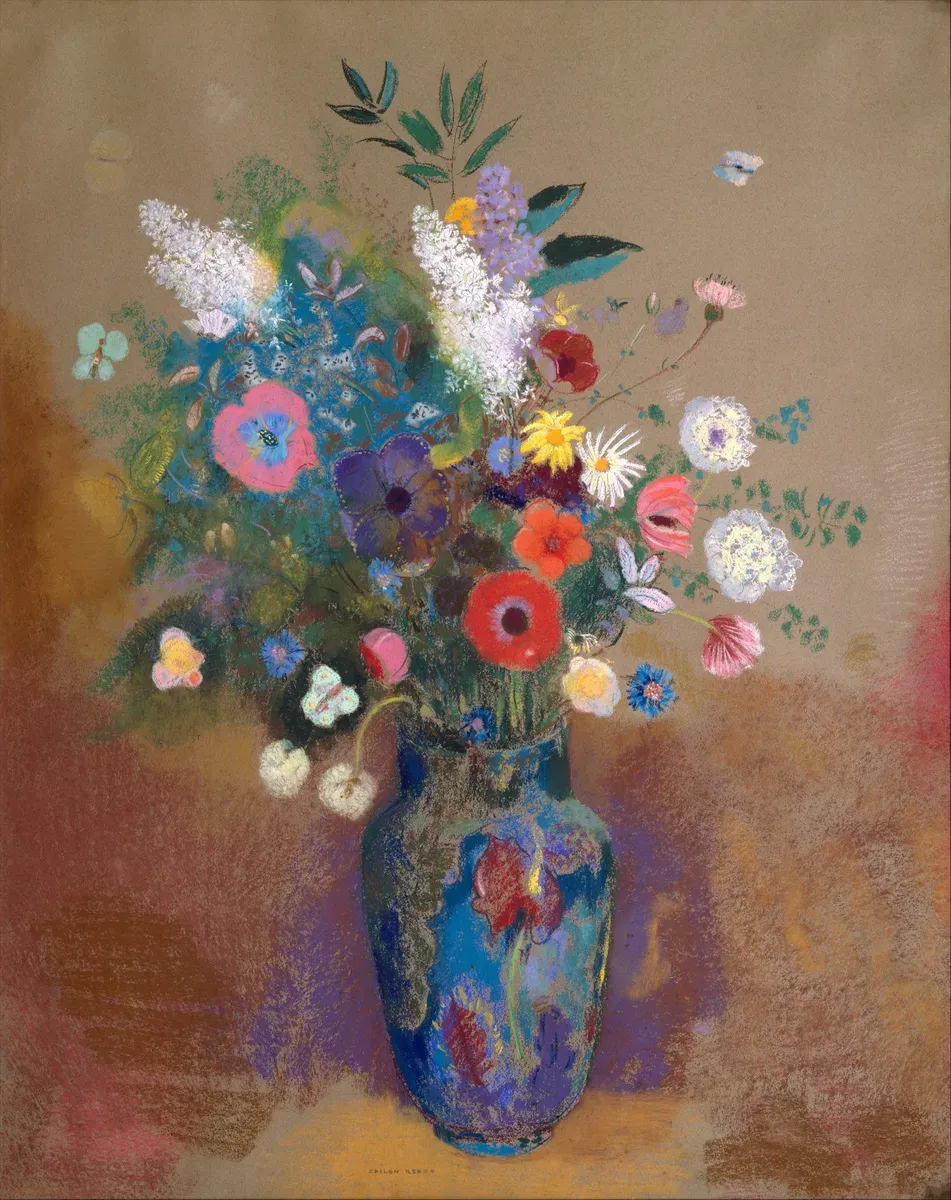
Odilon Redon, Bouquet of Flowers, about 1900 to 1905. The Metropolitan Museum of Art (56.50). Image: Open Access, public domain (CC0).
Historical Odilon Redon (1840 to 1916) spent his first decades drawing in charcoal: his “noirs”, with floating eyes, spiders with human faces and balloons rising into darkness. Around 1890 he turned to color, and his late pastels and oils of flowers glow as if lit from inside.
Historical Finland and the Kalevala. In Finland, Akseli Gallen-Kallela turned in the 1890s to the national epic, the Kalevala, painting its heroes and magic with Symbolist intensity and national feeling.
Hugo Simberg painted The Wounded Angel (1903), now in the Ateneum in Helsinki: two solemn boys carry a girl angel with a bandaged eye on a stretcher through a bleak landscape. Finns voted it their national painting in 2006. Simberg never explained it, and I love that.
Key artists
| Artist | Lived | Why they matter |
|---|---|---|
| Gustave Moreau | 1826 to 1898 | The painter of jeweled saints and sphinxes, teacher of Matisse. |
| Odilon Redon | 1840 to 1916 | From floating eyes in charcoal to glowing flowers. |
| Arnold Böcklin | 1827 to 1901 | The Swiss painter of the Isle of the Dead. |
| Fernand Khnopff | 1858 to 1921 | The Belgian painter of silent women and sphinxes. |
| Hugo Simberg | 1873 to 1917 | The Finnish painter of The Wounded Angel and gentle devils. |
How do you recognise Symbolism?
Look for dreams, myths and symbols instead of observed life: sphinxes, angels, islands of the dead, closed eyes, lilies and the moon. The mood is still and mysterious. Color can be jeweled or muted, and the meaning is felt more than explained.
Common misconceptions. One is that every symbol has a fixed meaning. Symbolists wanted suggestion, not code. Redon said his drawings “inspire and are not to be defined”.
Another is that it was only French. Symbolism flourished in Belgium, Germany, Austria, Scandinavia, Russia and Finland. A third is that it was only men painting women as dreams. Women artists such as Jeanne Jacquemin in France and, in the wider occult circles of the time, Hilma af Klint in Sweden worked with Symbolist ideas.
Esoteric themes
Historical From 1892 to 1897 the writer Joséphin Péladan, who called himself “Sâr”, organized six Salons de la Rose+Croix in Paris, exhibitions of idealist and mystical art with strict rules against realistic subjects. His Rosicrucianism was his own invention.
Delville and Khnopff showed there, and the young composer Erik Satie wrote music for the order in 1892. In London, the Hermetic Order of the Golden Dawn was founded in 1888 and shaped modern tarot.
Later tradition Symbolist femmes fatales, Salome, the Sphinx, Lilith, became fixed images of dangerous female power. I discuss how that happened to Lilith in the Lilith course.
Modern Symbolist art fills witchy social media today. See Esoteric art for more.
Works to see
| Work | Artist | Date | Where to see it |
|---|---|---|---|
| The Wounded Angel | Hugo Simberg | 1903 | Ateneum, Finnish National Gallery, Helsinki |
| Saint Cecilia | Gustave Moreau | about 1890 to 1895 | The Metropolitan Museum of Art, New York |
| Bouquet of Flowers | Odilon Redon | about 1900 to 1905 | The Metropolitan Museum of Art, New York |
| Island of the Dead | Arnold Böcklin | 1880 | The Metropolitan Museum of Art, New York |
Every work in this list is free of nudity, so you can look them up with confidence. Works still in copyright are named but not shown here.
How to look at a Symbolist painting
Slow down. Notice the mood first: silence, twilight, stillness. Then look for the strange detail that keeps the picture from being a simple scene. Ask what it suggests rather than what it means.
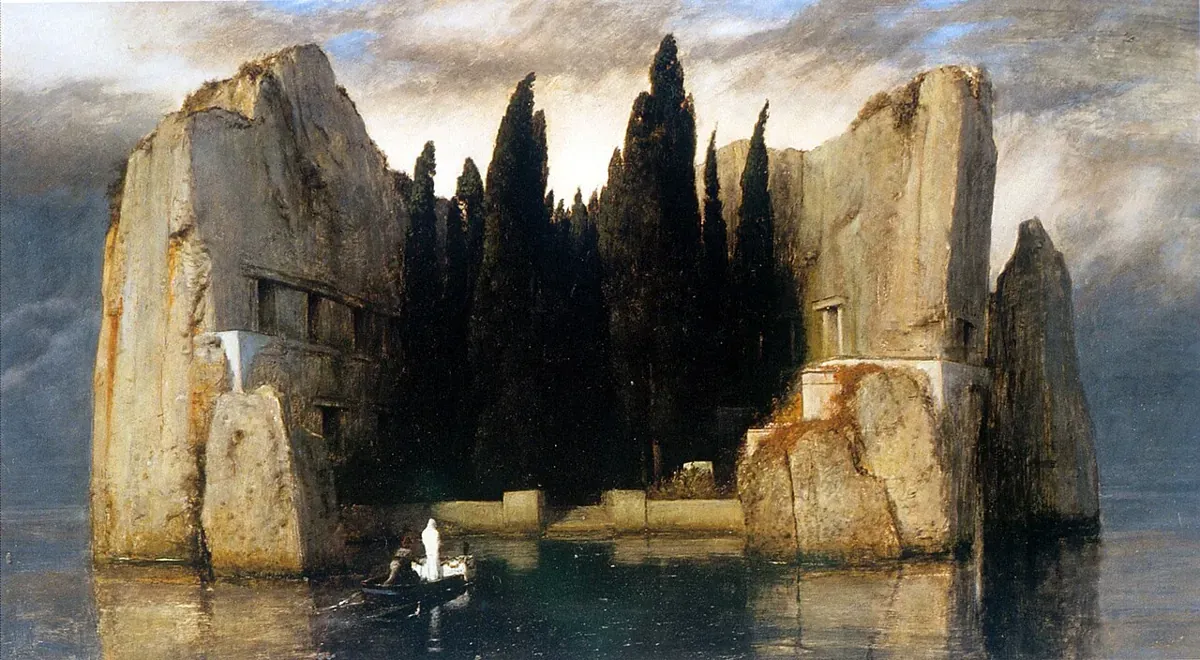
Arnold Böcklin, Isle of the Dead (third version), 1883. Alte Nationalgalerie, Berlin. Image: Wikimedia Commons, public domain.
Arnold Böcklin, Isle of the Dead, third version, 1883. At the Alte Nationalgalerie in Berlin. Böcklin painted five versions between 1880 and 1886. The composer Sergei Rachmaninoff wrote a tone poem after it in 1909.
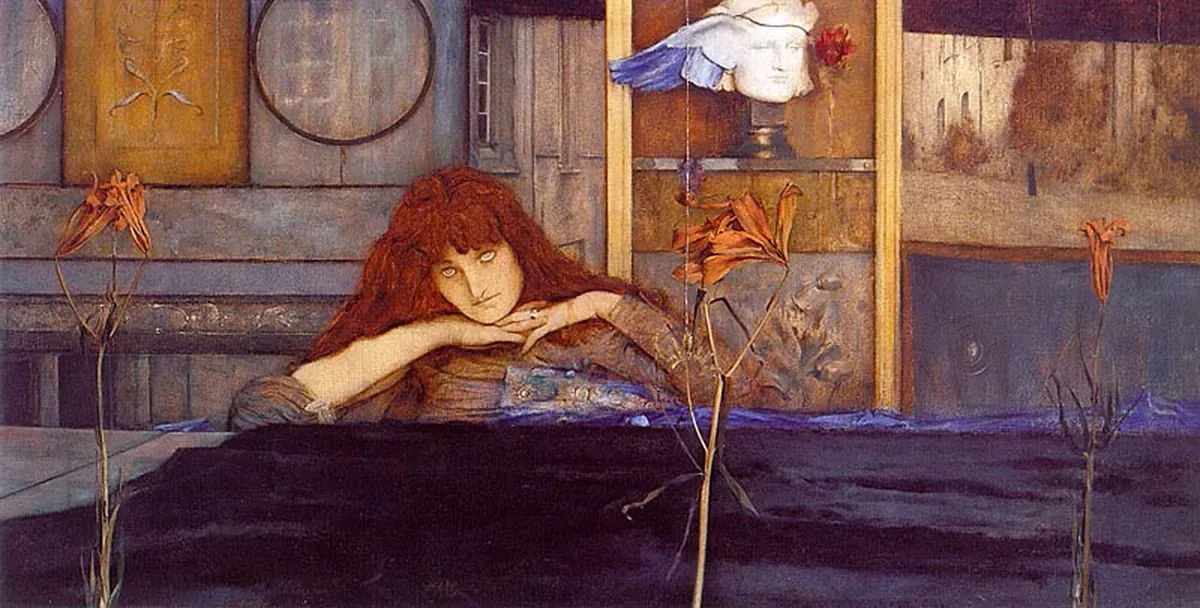
Fernand Khnopff, I Lock My Door Upon Myself, 1891. Neue Pinakothek, Munich. Image: Wikimedia Commons, public domain.
Fernand Khnopff, I Lock My Door Upon Myself, 1891. At the Neue Pinakothek in Munich. The title is a line from Christina Rossetti’s poem Who Shall Deliver Me? Look at the head of Hypnos, god of sleep, on the shelf, and the lilies wilting at different stages.
Symbolism grew from Romanticism and the Pre-Raphaelites, overlapped with the Nabis, Art Nouveau and the Vienna Secession, and led into early abstraction and Surrealism.
Try this
Find Redon’s charcoal noirs in an online collection, then his late flowers. Write one sentence for each about how it makes you feel. Then write a third: what changed in him, do you think, between the two?
What next
Before this: Post-Impressionism.
After this: The Nabis.
Also worth reading alongside it: National Romanticism.
See every movement in order on the art movements timeline, or learn to look step by step in the free Art History for Beginners course.
If you want to carry this into tarot and practice, these pages connect to it: The Moon, dream, mystery and the unconscious; Death, the boat to the island of the dead, transition rather than ending; Péladan, the Golden Dawn and Symbolist art; and The occult revival that fed Symbolism.
Sources
- Jean Moréas, Le Symbolisme (manifesto), Le Figaro, 18 September 1886 (1886).
- Edward Lucie-Smith, Symbolist Art (1972).
- The Metropolitan Museum of Art, Saint Cecilia, 2004.475.3. Open the record
- The Metropolitan Museum of Art, Bouquet of Flowers, 56.50. Open the record
- Finnish National Gallery, Ateneum, The Wounded Angel. Open the record
- E. H. Gombrich, The Story of Art (1950).
- Wikimedia Commons, The Wounded Angel (hero image record). Open the record
- Robert Goldwater, Symbolism (1979).

Questions
What is Symbolism in art?
A movement of the 1880s and 1890s in which artists and poets turned away from the visible world toward dreams, myth, mysticism and the inner life. The poet Jean Moréas published its manifesto in 1886.
Were the Salons de la Rose+Croix run by real Rosicrucians?
No. Joséphin Péladan's Rosicrucianism was his own creation, separate from the seventeenth-century manifestos and from later Rosicrucian orders.
Where can I see works of Symbolism in person?
Good places to start are Paris (the Musée Gustave Moreau, the Musée d'Orsay), Brussels, Helsinki (the Ateneum), and the Met. Museums change their displays, so check the collection page before you travel.
Who are the main Symbolist artists?
Gustave Moreau, Odilon Redon, Pierre Puvis de Chavannes, Arnold Böcklin, Fernand Khnopff, Jean Delville, Hugo Simberg, Mikhail Vrubel and Jan Toorop.
What is the difference between Symbolism and Surrealism?
Symbolism, about 1886 to 1910, used dream and myth to suggest spiritual ideas. Surrealism, from 1924, used dreams and chance to reveal the unconscious, drawing on Freud.
Where can I see Symbolist art?
The Musée Gustave Moreau and the Musée d'Orsay in Paris, the Royal Museums of Fine Arts of Belgium in Brussels for Khnopff, the Kunstmuseum Basel for Böcklin and the Ateneum in Helsinki for Hugo Simberg's The Wounded Angel of 1903.
Get the free Mini-Grimoire
A short printable starter guide to tarot and everyday witchcraft, plus my newsletter. Unsubscribe any time.
Opens Substack in a new tab to confirm. More about the newsletter · Privacy