


| Arcana | Major Arcana |
|---|---|
| Number | II |
| Image | RWS 1909 (PD) |
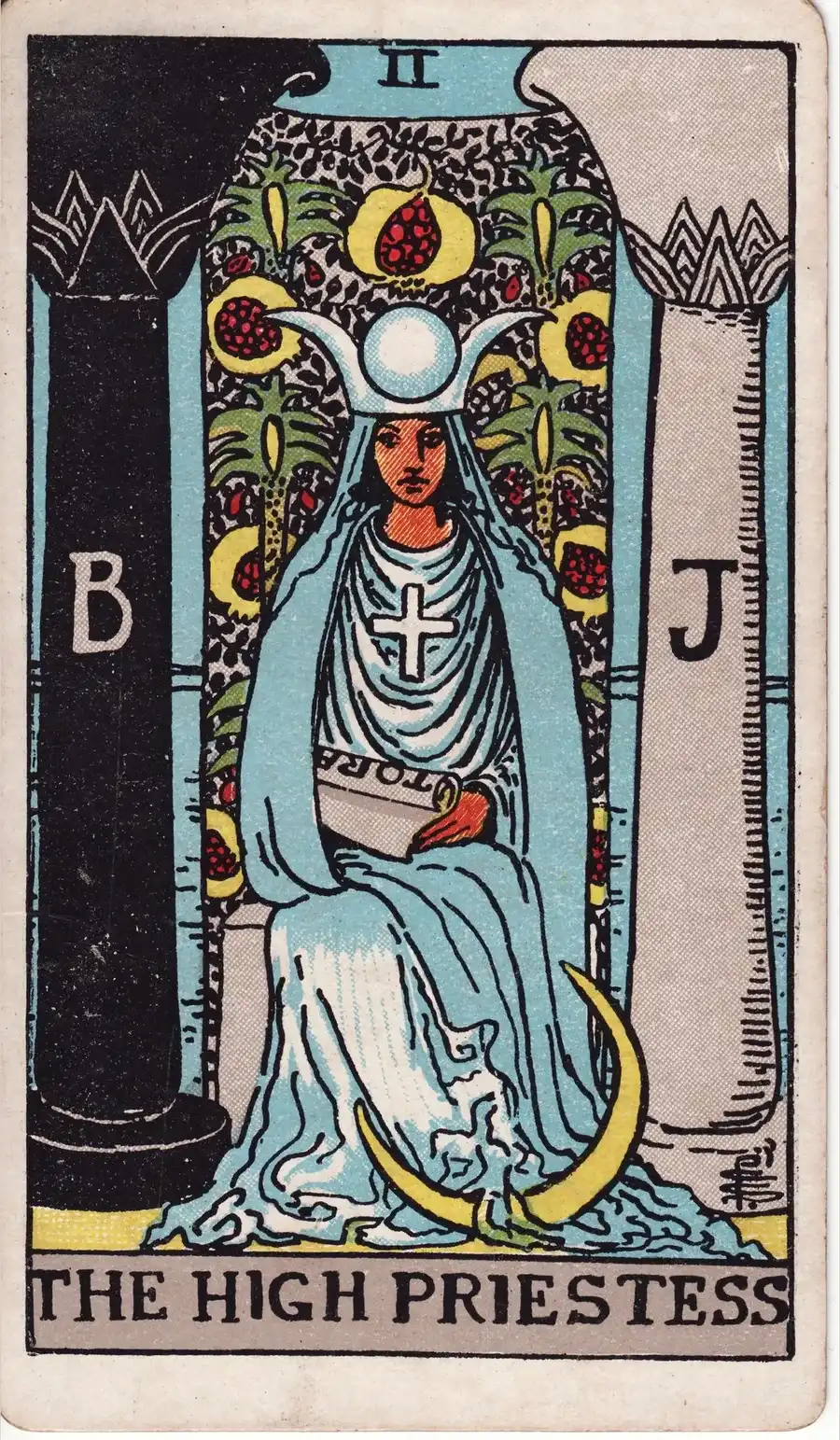
The High Priestess is card II of the Major Arcana, the quiet card after the busy Magician. She sits between two pillars with a half-hidden scroll in her lap and says nothing.
Her lesson is that silence can be information. This page explains what the High Priestess means upright and reversed, the symbols Pamela Colman Smith drew, and how a fifteenth century Popess became a priestess of mysteries.
Here is the High Priestess at a glance.
| At a glance | This card |
|---|---|
| Upright keywords | intuition, mystery, patience, inner knowing |
| Reversed keywords | repressed knowing, harmful secrets, noise |
| Number | II (2) in the Major Arcana |
| Golden Dawn title | The Priestess of the Silver Star Later tradition |
| Hebrew letter | Gimel (ג), “camel” Later tradition |
| Tree of Life path | 13, from Kether to Tiphareth Later tradition |
| Astrology | The Moon Later tradition |
| Element | Water Modern |
| Yes or no | Maybe Modern |
The Golden Dawn gave the High Priestess the Moon and the letter Gimel, the “camel” that crosses the desert on the longest path of the Tree of Life, from the crown to the heart. Waite’s picture carries the same idea: she sits between the pillars of the Temple with the Moon at her feet. In older decks she is La Papesse, the Female Pope, and the lunar meaning is a later layer laid over that picture.
The card: what Pamela Colman Smith drew
Smith drew a still, cool card in blues and whites. Waite described the scroll in her hands as “partly covered by her mantle, to show that some things are implied and some spoken”. That one line is a good key to the whole card.
The two pillars. She sits between a black pillar marked B and a white pillar marked J, the two pillars of Solomon’s Temple in the Bible, Boaz and Jachin. They stand for opposites held in balance: dark and light, unknown and known. She sits in the space between.
The veil of pomegranates. Behind her hangs a veil decorated with palms and pomegranates. You cannot see what is behind it, only glimpses of water. It is a picture of knowledge that is not ready to be shown yet.
The scroll. The scroll is marked TORA, which Waite read as the hidden law. It is partly covered. The card is about what you sense but cannot fully put into words.
The moon. A crescent moon lies at her feet and a lunar crown sits on her head. The moon reflects light rather than making it, and the card links her to cycles, dreams and the slow tides of intuition.
Upright meaning
Upright, the High Priestess asks you to listen before you act. She sits between a black pillar and a white one, marked B and J for Boaz and Jachin, the two pillars of Solomon’s Temple, and behind her hangs a veil decorated with pomegranates. She does not open it. The card is about knowledge that comes when you wait, not when you push.
In a reading, she often points to intuition you have been talking yourself out of: a sense that something is off, or the quiet certainty that a choice is right before you can explain it. She also speaks of what is not yet visible. The scroll in her lap is only partly shown, marked TORA. Some information is still developing, and it is wiser to observe than to force a conclusion.
The High Priestess is also the card of study, dreams and inner life. She favors journaling, meditation, reading the old texts and keeping your own counsel for a while.
Reversed meaning
Reversed, the veil is either torn too soon or drawn too tight. In the first case you may be ignoring your own intuition because someone louder has an opinion, or rushing to tell a secret that was not yours to share. In the second, the card describes withdrawal so complete that you lose touch with others, or a feeling pushed down so firmly that it comes back as anxiety.
The reversed High Priestess can also point to hidden agendas: something being kept from you, or gossip moving behind the scenes. Do not turn that into suspicion of everyone. Ask instead what you already sense and have not acted on.
Her remedy is simple and slow. Spend some quiet time alone, write down a dream, and ask yourself one honest question with no audience.
In love, work and spirituality
In love. Upright: Attraction that runs deep and unspoken, or a time to let a relationship reveal itself slowly. Reversed: Secrets, mixed signals or emotional distance; a feeling nobody is naming.
At work. Upright: Research, confidential projects and trusting your read of a situation before the data confirms it. Reversed: Information withheld, or ignoring a gut warning about a colleague or contract.
With money. Upright: Keep plans private for now and gather information before you commit. Reversed: Hidden costs or financial secrets in a household. Read the small print.
In spiritual practice. Upright: Inner work: meditation, dream journals, study of a tradition, and listening more than asking. Reversed: Disconnection from your own practice, or looking for answers only outside yourself.
As feelings. Quiet, private attraction. The person feels more than they show.
As a person. Reserved, perceptive and self-contained; a good listener who keeps confidences.
As advice. Wait, watch and trust what you already know.
Reading the High Priestess: positions and yes or no
In the past position: Something you sensed before you could explain it. In the present position: Not everything is known yet. Listen and gather information.
In the future position: Answers will come in their own time, often through dreams or quiet moments. As advice: Wait, study and trust the quiet signal before you speak.
When the High Priestess shows up among mostly Minor cards, give it extra weight: the theme of intuition runs under the whole question.
In modern yes or no readings, the High Priestess is a maybe. She points to information that is not yet known, so the honest answer is often “not yet”.
The history and art behind the card
In the Tarot de Marseille pattern the card is called La Papesse, the Popess. On fifteenth century Italian cards she is la Papessa, the female Pope, a crowned woman holding a book.
One of the oldest surviving examples, in the Visconti-Sforza deck, may portray a real woman, Manfreda da Pirovano, a relative of the Visconti family who was linked with a small religious sect, though historians debate this. Later Protestant decks sometimes replaced her with Juno to avoid the Catholic image.
Occult writers of the nineteenth century reimagined the Popess as a priestess of hidden wisdom, and Waite renamed her the High Priestess. Smith’s design gathers that later layer: the temple pillars, the Torah scroll and the moon all come from the Golden Dawn’s world of symbols, not from the Renaissance card game.
When A. E. Waite published The Pictorial Key to the Tarot in 1910, he listed these divinatory meanings for the card: “Secrets, mystery, the future as yet unrevealed; the woman who interests the Querent, if male; the Querent herself, if female; silence, tenacity; mystery, wisdom, science.”
Reversed, he gave: “Passion, moral or physical ardor, conceit, surface knowledge.” Waite himself called the fortune-telling meanings of the trumps “artificial and arbitrary”, and on this site I read the picture first and treat lists like this as history.
On the modern Fool’s Journey, the traveler meets the High Priestess straight after the Magician, and the pairing is the point: outward skill needs an inner listening to balance it. She is the quiet half of the first stage, becoming a self.
Common questions
Is the High Priestess a yes or no? She is usually a maybe or a not yet. Something is still unknown, so wait for more information before you decide.
What does the High Priestess mean in love? A slow, private or mysterious connection, or a reminder to trust your quiet sense of the person. Reversed, look at what you have been ignoring.
Who is the High Priestess based on? Early decks called her the Popess. Waite renamed her in 1909 and gave her temple pillars and a scroll.
Try this
Try this small spread for the High Priestess. Use it when you have a feeling you cannot quite explain.
| Card | Question | What it shows |
|---|---|---|
| 1 | What do I already sense? | The quiet knowledge under the noise. |
| 2 | What is still hidden? | What I cannot see yet, and should not force. |
| 3 | How can I listen better? | One practice that gives my intuition more room. |
Affirmation: I honor what I know inwardly and give it time to become clear.
Reversed affirmation: I stop burying what I sense and face hidden motives with care.
If you keep a tarot journal, take one of these questions to it: What do I know about this that I have not said out loud? When did my intuition turn out to be right, and how did it feel? What would change if I waited one more week?
What next
Cards that sit close to this one are The Magician (outer action, the partner to her inner knowing), The Moon (intuition again, but in the dark and uncertain) and The Hermit (another card of quiet and inner wisdom).
The High Priestess is part of the lesson The Fool to the Chariot in my free Tarot for Beginners course. To keep walking the Major Arcana, read the card before it, The Magician or the card after it, The Empress, or go back to all the card meanings.
For every card with keywords, affirmations and examples, see my book The Novice’s Guide to Tarot. If you would like a printable cheat sheet for all 78 cards, my 45-page Tarot Workbook is on Etsy.
Sources
- A. E. Waite, The Pictorial Key to the Tarot (London: Rider, 1910), Part II and Part III, section 3.
- Pamela Colman Smith and A. E. Waite, the Rider-Waite-Smith tarot (London: Rider, 1909).
- Nicolas Conver, Tarot de Marseille (Marseille, 1760).
- Eden Gray, A Complete Guide to the Tarot (New York: Crown, 1970), epilogue “The Fool’s Journey”.
- Lauri Mukkala, The Novice’s Guide to Tarot, entry for The High Priestess.
- Aleister Crowley, 777 (London: Walter Scott, 1909), columns of the Hebrew letters, paths and Tarot trumps.
- Israel Regardie, ed., The Golden Dawn (Chicago: Aries Press, 1937 to 1940), “Book T” and the titles of the trumps.
All 78 cards
Major Arcana
- The Fool
- The Magician
- The High Priestess
- The Empress
- The Emperor
- The Hierophant
- The Lovers
- The Chariot
- Strength
- The Hermit
- Wheel of Fortune
- Justice
- The Hanged Man
- Death
- Temperance
- The Devil
- The Tower
- The Star
- The Moon
- The Sun
- Judgement
- The World
Wands
- Ace of Wands
- Two of Wands
- Three of Wands
- Four of Wands
- Five of Wands
- Six of Wands
- Seven of Wands
- Eight of Wands
- Nine of Wands
- Ten of Wands
- Page of Wands
- Knight of Wands
- Queen of Wands
- King of Wands
Cups
- Ace of Cups
- Two of Cups
- Three of Cups
- Four of Cups
- Five of Cups
- Six of Cups
- Seven of Cups
- Eight of Cups
- Nine of Cups
- Ten of Cups
- Page of Cups
- Knight of Cups
- Queen of Cups
- King of Cups
Swords
- Ace of Swords
- Two of Swords
- Three of Swords
- Four of Swords
- Five of Swords
- Six of Swords
- Seven of Swords
- Eight of Swords
- Nine of Swords
- Ten of Swords
- Page of Swords
- Knight of Swords
- Queen of Swords
- King of Swords
Pentacles
Get the free Mini-Grimoire
A short printable starter guide to tarot and everyday witchcraft, plus my newsletter. Unsubscribe any time.
Opens Substack in a new tab to confirm. More about the newsletter · Privacy