


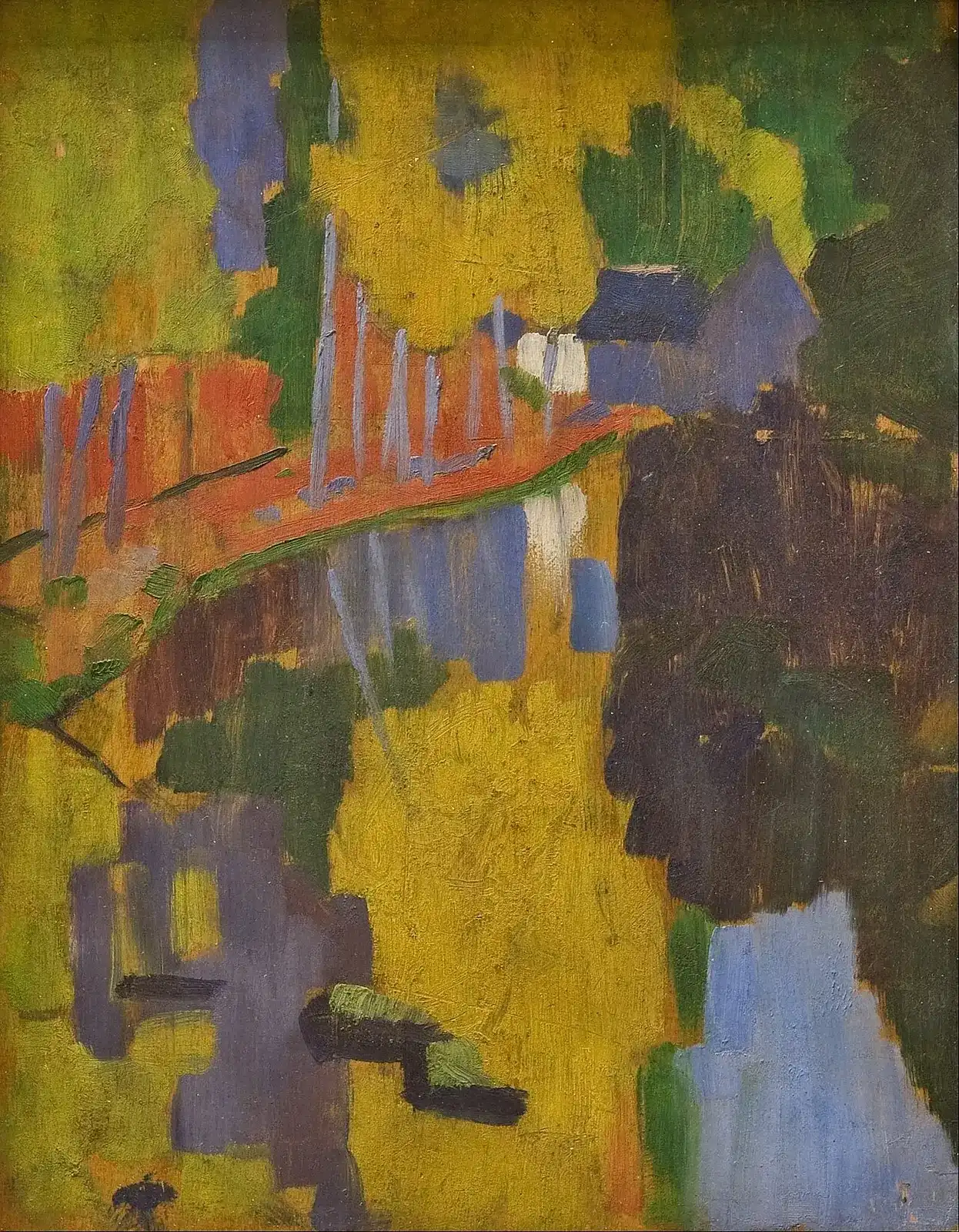
How to read the labels Historical what the old sources say. Later tradition what later writers added. Modern modern practice and my own notes.
The Nabis were a group of young painters in Paris, active from 1888 to about 1900, who took Paul Gauguin’s flat, expressive colour and turned it into intimate scenes, decorative screens, prints and theatre designs. Their name comes from the Hebrew word for prophets. Members included Paul Sérusier, Maurice Denis, Pierre Bonnard, Édouard Vuillard, Félix Vallotton, Paul Ranson and Ker-Xavier Roussel.
It began in 1888 with a small landscape painted on the lid of a cigar box, hardly more than patches of pure colour. Sérusier’s friends called it The Talisman, and it turned a group of art students into a brotherhood. They meant the name seriously: many of them looked for a new art in religion, mysticism and the occult.
Key dates
| When | What happened |
|---|---|
| October 1888 | At Pont-Aven, Paul Sérusier paints The Talisman under Gauguin’s direction. |
| 1888 to 1889 | Sérusier shows it to his friends at the Académie Julian, and the Nabis form. |
| 1890 | Maurice Denis writes that a picture is “essentially a flat surface covered with colors assembled in a certain order”. |
| 1891 | The group shows at the gallery of Le Barc de Boutteville in Paris. |
| 1893 to 1896 | The Nabis design sets and programs for the Théâtre de l’Œuvre. |
| About 1900 | The members go their separate ways. |
What is the Nabis?
The Nabis were a brotherhood of Post-Impressionist painters who treated a painting as a flat, decorative surface and mixed everyday life with mysticism and pattern.
Throughout this page I mark three layers. Historical What buildings, objects and texts of the time show. Later tradition What later centuries read into them. Modern How people use these images today.
Historical The Talisman. In October 1888, at Pont-Aven in Brittany, Paul Sérusier painted a riverside wood under the direction of Paul Gauguin. According to Maurice Denis, Gauguin asked him how he saw the trees, and told him that if a tree looked yellow, he should put down the most beautiful yellow on his palette.
The result, now in the Musée d’Orsay, is a picture made of flat shapes of color. Sérusier showed it to his friends at the Académie Julian, and they treated it almost as a sacred object.
Historical A brotherhood of prophets. The name Nabis was suggested by the poet Henri Cazalis. The members gave each other nicknames, Bonnard was “the very Japanese Nabi” because of his love of Japanese prints, and met for dinners and in Paul Ranson’s studio, which they called the Temple.
In 1890 Denis wrote the sentence every art student still learns, that a picture, before it is a war horse or a nude or an anecdote, is “essentially a flat surface covered with colors assembled in a certain order”.
Historical Rooms, screens and theater. Bonnard and Vuillard painted intimate rooms where wallpaper, dresses and tablecloths melt into one pattern.
The Nabis also made folding screens, posters, prints and stained glass designs, and worked for the avant-garde Théâtre de l’Œuvre, designing programs and sets, including for Alfred Jarry’s scandalous Ubu Roi in 1896. By about 1900 the members had gone their own ways.
Key artists
| Artist | Lived | Why they matter |
|---|---|---|
| Paul Sérusier | 1864 to 1927 | Painter of The Talisman and the group’s theorist. |
| Maurice Denis | 1870 to 1943 | Painter of religious scenes and author of the group’s famous definition. |
| Paul Ranson | 1861 to 1909 | Host of the weekly meetings in his studio, which they called the Temple. |
| Pierre Bonnard | 1867 to 1947 | The “very Japanese Nabi”, painter of patterned interiors. |
| Édouard Vuillard | 1868 to 1940 | The painter of quiet, pattern-filled rooms. |
| Félix Vallotton | 1865 to 1925 | The Swiss member, master of black-and-white woodcuts. |
How do you recognise the Nabis?
Look for flat areas of color with dark outlines, as in stained glass or Japanese prints. Patterns of wallpaper, dresses and tablecloths melt together. Scenes are intimate rooms, gardens and streets, or religious and mystical subjects. The Nabis also painted screens, posters, theater sets and book designs.
Common misconceptions. One is that the Nabis were a mystical sect. Some were deeply spiritual, like Maurice Denis and Paul Sérusier, and Ranson had an interest in Theosophy. But Bonnard and Vuillard mostly painted streets, gardens and family rooms, and the “prophet” name was partly a private joke.
Another is that they were only painters. They designed posters, books, stained glass, screens and sets for the Théâtre de l’Œuvre. A third is that women were only their subjects. Vuillard’s mother, a corset-maker who ran her workshop at home, and Misia Natanson, a pianist and patron, shaped the world they painted, and the Nabis showed work alongside women designers in the decorative arts.
Esoteric themes
Historical Several Nabis were drawn to mysticism. Sérusier was deeply moved by Édouard Schuré’s The Great Initiates (1889), a popular book presenting Rama, Krishna, Hermes, Moses, Orpheus, Pythagoras, Plato and Jesus as initiates of one hidden wisdom, and pressed it on his friends.
Paul Ranson was interested in Theosophy and painted subjects such as Witches around the Fire (1891). Maurice Denis was a devout Catholic who saw painting as a religious calling. Later in life Sérusier studied the sacred geometry of the Beuron school of monk-painters and wrote an ABC of painting (1921).
Later tradition Some later writers describe the Nabis as a secret occult order. They were a circle of friends with private rituals and nicknames, not an initiatory society, and their beliefs ranged from Catholicism to Theosophy.
Modern The idea of a painting as a talisman, an object charged with intention, is very much alive in modern witchcraft. The Nabis are a good historical example of artists who already thought this way.
Works to see
| Work | Artist | Date | Where to see it |
|---|---|---|---|
| The Talisman | Paul Sérusier | 1888 | Musée d’Orsay, Paris |
| Interior, Mother and Sister of the Artist | Édouard Vuillard | 1893 | The Museum of Modern Art, New York |
| The Checkered Blouse | Pierre Bonnard | 1892 | Musée d’Orsay, Paris |
| The Muses | Maurice Denis | 1893 | Musée d’Orsay, Paris |
Every work in this list is free of nudity, so you can look them up with confidence. Works still in copyright are named but not shown here.
How to look at a Nabi painting
Remember Maurice Denis’s famous sentence of 1890: a picture is “essentially a flat surface covered with colours assembled in a certain order”. So look at the pattern first, then find the people in it. Often a dress, a wallpaper and a bush are made of the same kind of marks.
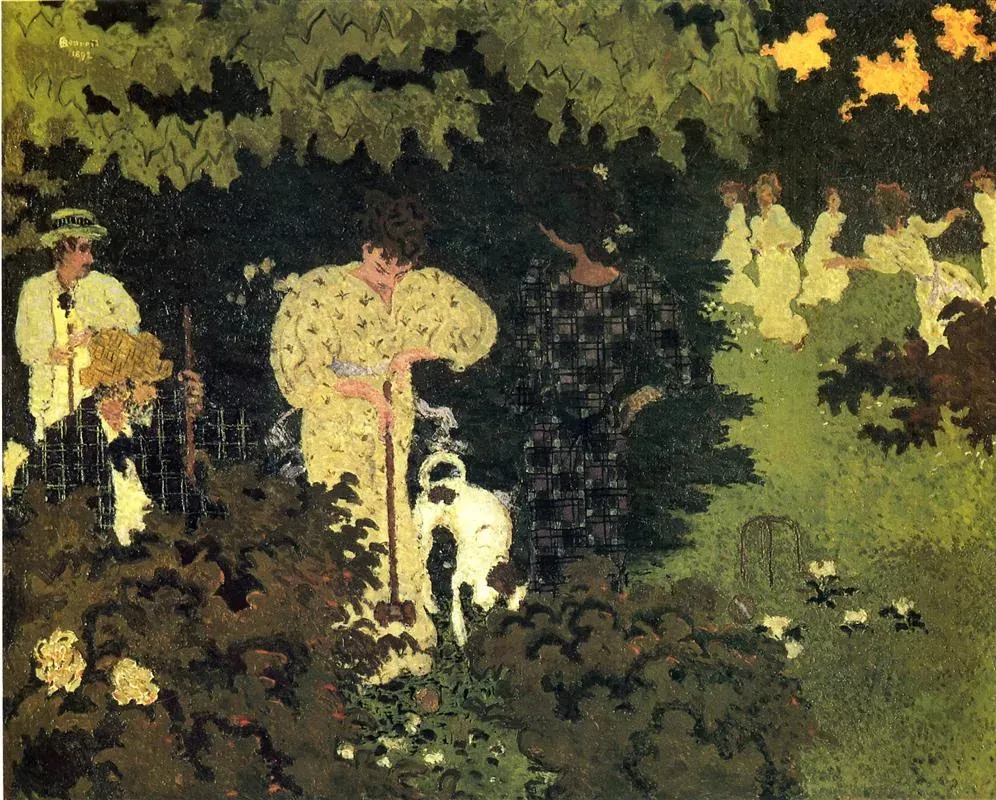
Pierre Bonnard, The Croquet Game, 1892. Musée d’Orsay, Paris. Image: Wikimedia Commons, public domain.
Pierre Bonnard, The Croquet Game, 1892. At the Musée d’Orsay. Bonnard’s family in the garden. The checked dress, the dark foliage and the white dancing figures are all flat patterns, a lesson from Japanese prints, which earned Bonnard the nickname “the very Japanese Nabi”.
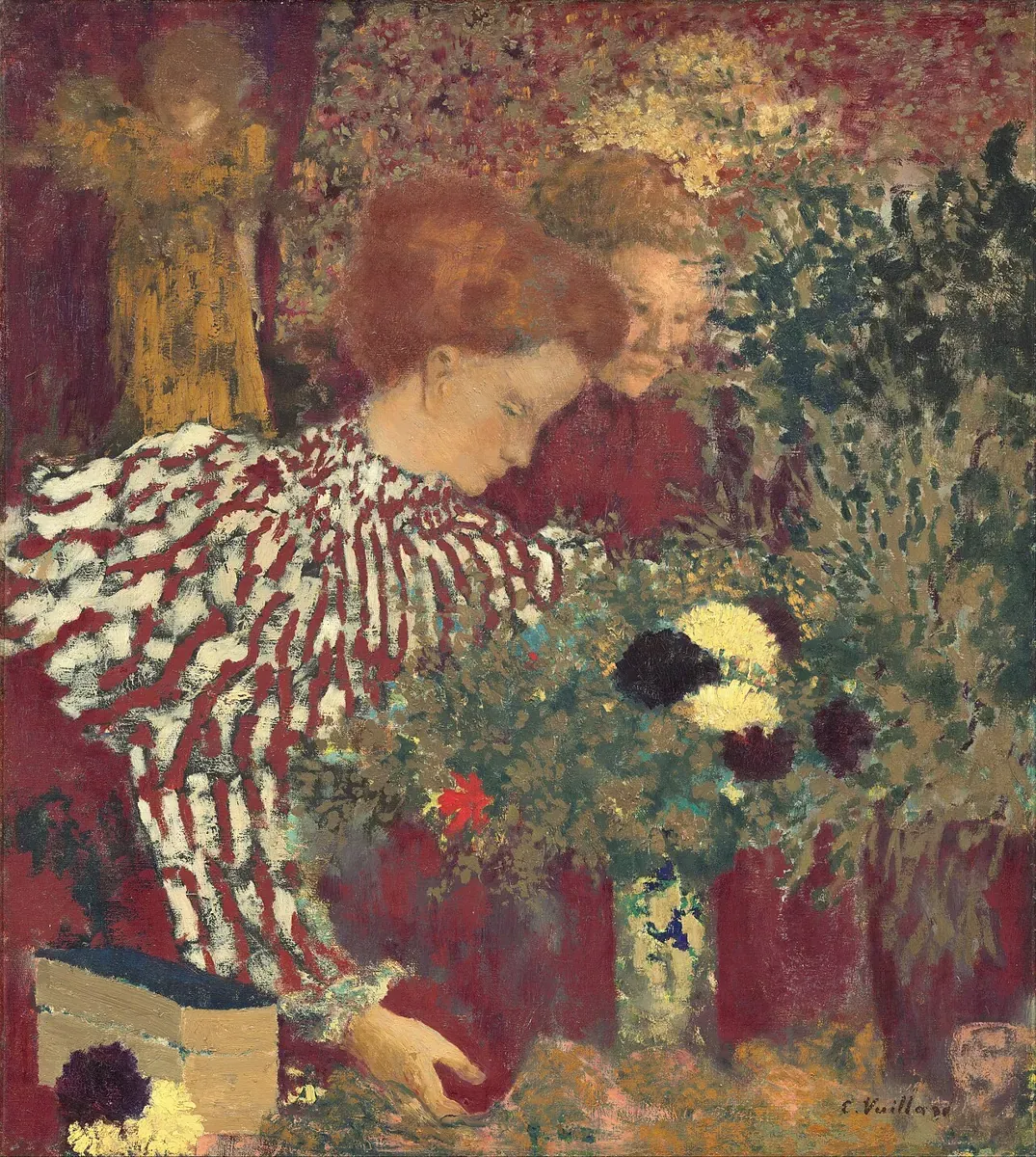
Édouard Vuillard, Woman in a Striped Dress, 1895. National Gallery of Art, Washington. Image: Wikimedia Commons, public domain.
Édouard Vuillard, Woman in a Striped Dress, 1895. At the National Gallery of Art in Washington. One of a set of decorative panels for the Natanson family. Find where the woman ends and the flowers begin. Vuillard dissolves people into their rooms.
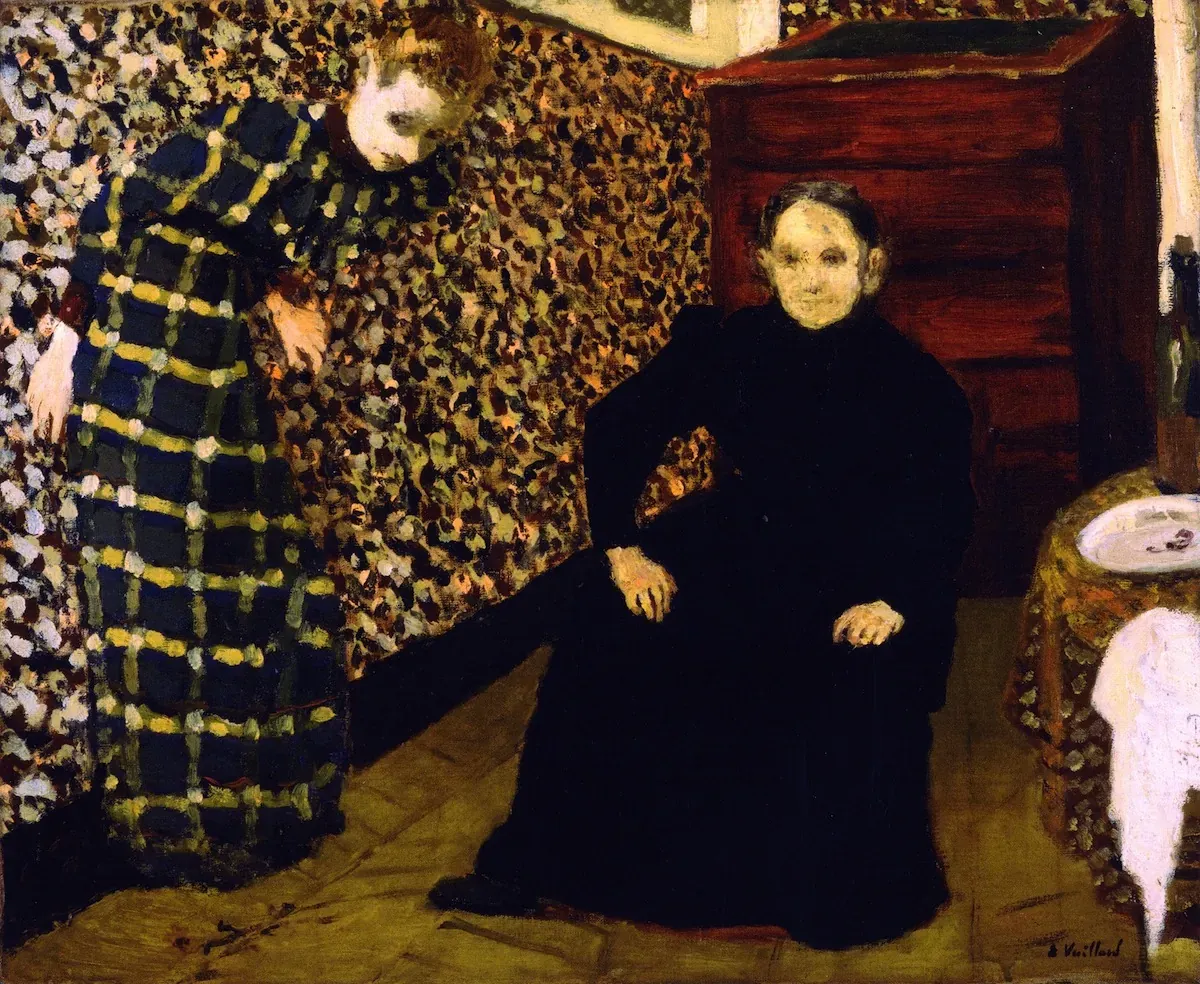
Édouard Vuillard, Mother and Sister of the Artist, about 1893. Museum of Modern Art, New York. Image: Wikimedia Commons, public domain.
Édouard Vuillard, Mother and Sister of the Artist, about 1893. At the Museum of Modern Art. The mother sits solidly, while the sister, Marie, seems to be pressed into the wallpaper. Many viewers feel the family tension in the room.
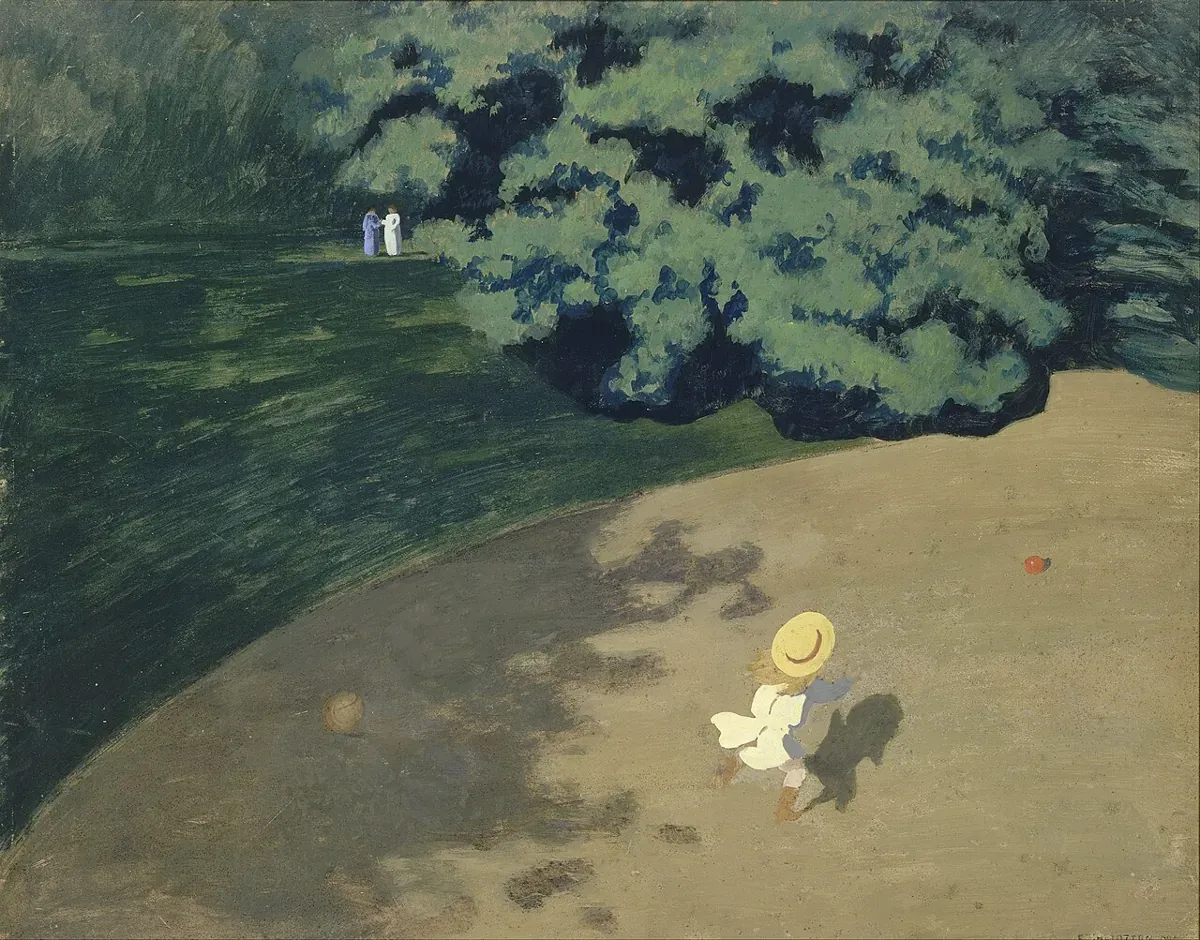
Félix Vallotton, The Ball (Le Ballon), 1899. Musée d’Orsay, Paris. Image: Wikimedia Commons, public domain.
Félix Vallotton, The Ball, 1899. At the Musée d’Orsay. Seen from above, a child runs into a sunlit space while a dark shadow creeps toward her from the trees. A simple scene that feels uneasy.
The Nabis grew out of Post-Impressionism and the circle of Gauguin, shared ideas with Symbolism and Art Nouveau, and handed their flat colour on to Fauvism and Matisse.
Try this
Take a photo of a tree or a corner of your garden. Then, with colored pencils or paints, make a small “talisman” of it on a scrap of card no bigger than your hand: use only flat areas of the most beautiful version of each color you see.
Keep it somewhere you will see it for a week and notice what it comes to mean to you.
What next
Before this: Symbolism.
After this: National Romanticism.
Also worth reading alongside it: Post-Impressionism.
See every movement in order on the art movements timeline, or learn to look step by step in the free Art History for Beginners course.
If you want to carry this into tarot and practice, these pages connect to it: The Hierophant, the group of initiates with their own secret names and rites; The Magician, The Talisman itself, a painting treated as a magical object; The Nabis among the Symbolists; and The Paris occult revival of the 1880s.
Sources
- Maurice Denis, Définition du néo-traditionnisme, Art et critique (1890).
- Paul Sérusier, ABC de la peinture (1921).
- Édouard Schuré, Les Grands Initiés (1889).
- Patricia Eckert Boyer (ed.), The Nabis and the Parisian Avant-Garde (1988).
- Musée d’Orsay, The Talisman, the Aven at the Bois d’Amour.
- Wikimedia Commons, The Talisman (hero image record). Open the record
- Claire Frèches-Thory and Ursula Perucchi-Petri (eds), Nabis 1888 to 1900 (1993).

Questions
What does Nabis mean?
It comes from the Hebrew word navi, prophet. The young painters took the name around 1889 because they saw themselves as prophets of a new art.
Why is Sérusier's painting called The Talisman?
Because his friends treated the small painting, made under Gauguin's guidance, as a magical object that showed them the way to a new kind of art.
Where can I see works of the Nabis in person?
Good places to start are Paris (Musée d'Orsay), Saint-Germain-en-Laye (Musée Maurice Denis), and New York (MoMA, the Met). Museums change their displays, so check the collection page before you travel.
Who were the members of the Nabis?
The core members were Paul Sérusier, Maurice Denis, Pierre Bonnard, Édouard Vuillard, Paul Ranson, Ker-Xavier Roussel and Henri-Gabriel Ibels, joined later by Félix Vallotton, Jan Verkade, József Rippl-Rónai and the sculptors Georges Lacombe and Aristide Maillol.
What is intimism?
Intimism is a name for the quiet, small-scale domestic scenes of Bonnard and Vuillard: rooms, lamps, meals and family members painted with warm, patterned colour.
Get the free Mini-Grimoire
A short printable starter guide to tarot and everyday witchcraft, plus my newsletter. Unsubscribe any time.
Opens Substack in a new tab to confirm. More about the newsletter · Privacy