


| Arcana | Major Arcana |
|---|---|
| Number | V |
| Image | RWS 1909 (PD) |
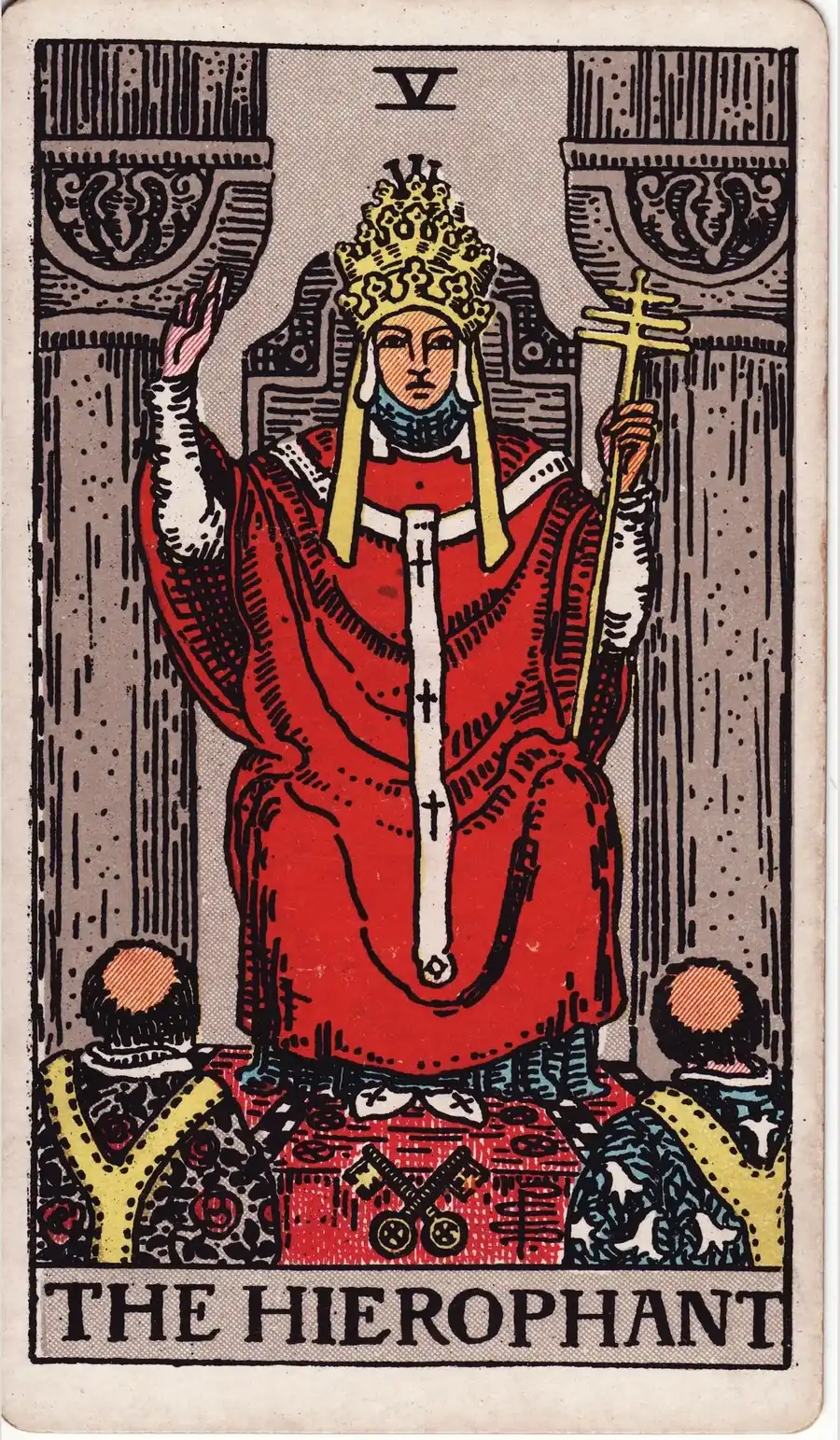
The Hierophant is card V of the Major Arcana, the card of teachers, traditions and the wisdom we inherit. A religious leader sits between two pillars and raises his hand in blessing over two students.
For many beginners it is the hardest card to love. Here is what the Hierophant means upright and reversed, the symbols in the 1909 card, and why the oldest decks simply called him the Pope.
Here is the Hierophant at a glance.
| At a glance | This card |
|---|---|
| Upright keywords | tradition, teaching, mentors, shared values |
| Reversed keywords | blind conformity, empty authority, a needed break |
| Number | V (5) in the Major Arcana |
| Golden Dawn title | The Magus of the Eternal Later tradition |
| Hebrew letter | Vav (ו), “nail” Later tradition |
| Tree of Life path | 16, from Chokmah to Chesed Later tradition |
| Astrology | Taurus Later tradition |
| Element | Earth Later tradition |
| Yes or no | Maybe Modern |
The Golden Dawn gave the Hierophant the sign Taurus and the letter Vav, the “nail” or hook that joins things together, which suits a card about teaching handed from one generation to the next. In Marseille decks this is Le Pape, the Pope; Waite’s deck uses the Greek title Hierophant, “one who shows sacred things”, the name of the chief priest of the Eleusinian mysteries, which moves the card away from one particular church.
The card: what Pamela Colman Smith drew
Smith drew a formal, symmetrical card: a seated leader, two pillars, two students, two keys. Waite said the raised hand is “the well-known ecclesiastical sign” that distinguishes “between the manifest and concealed part of doctrine”, and he called the Hierophant “the ruling power of external religion”.
The raised hand. His right hand gives a blessing. It is the gesture of a teacher passing on what he was taught. The card is about learning from those who came before.
The two students. Two figures kneel before him, their robes decorated with roses and lilies. They are learning inside a tradition. The card often points to a class, a mentor or a community.
The crossed keys. Two crossed keys lie at his feet, the old symbol of the papacy, the keys of heaven. They also stand for access: a tradition can open doors you could not open alone.
The pillars and the triple crown. He sits between two gray pillars, a public temple rather than the hidden one of the High Priestess. His triple crown and staff with three crossbars are signs of rank in an institution.
Upright meaning
Upright, the Hierophant is learning inside a tradition. A religious teacher sits between two pillars, raising his hand in blessing over two kneeling students, with crossed keys at his feet. The picture is about transmission: knowledge, rites and values passed from someone who holds them to someone ready to receive them.
In a reading the card often points to formal learning, mentors, ceremonies such as weddings and graduations, and institutions that hold shared rules. It can be a reminder that you do not have to invent everything yourself. Others have walked this way and left a path.
The Hierophant also asks about belonging. What community, lineage or set of values do you stand in? It does not insist that tradition is always right. It insists that you know what you inherited before you decide what to keep.
Reversed meaning
Reversed, the keys stop turning. The card can describe questioning the rules, leaving a church or school of thought, or feeling that an institution has failed you. That can be healthy. Not every tradition deserves loyalty, and the reversed Hierophant sometimes marks the moment you start thinking for yourself.
It can also warn of the opposite problem: conformity kept out of fear, a teacher who demands obedience, or a group that treats doubt as betrayal. In spiritual settings this is the card to remember when someone claims to be the only door to the sacred.
Ask whether you are being asked to follow or to think. Then find one source outside the usual one, and compare.
In love, work and spirituality
In love. Upright: Commitment in a traditional form, shared values, meeting families, or marriage. Reversed: Relationships shaped by others’ expectations, or a clash of values and backgrounds.
At work. Upright: Training, qualifications, mentorship and established organizations. Follow the process. Reversed: Rigid hierarchy, or a sense that the rules no longer fit the work.
With money. Upright: Conventional, well-tested choices: banks, pensions and advice from qualified people. Reversed: Following financial advice blindly, or rejecting all advice on principle.
In spiritual practice. Upright: Studying with a teacher or tradition; ritual, liturgy and lineage. Reversed: Leaving a tradition, or a teacher who controls rather than guides.
As feelings. Respect and serious intent. The person thinks about the relationship in terms of commitment.
As a person. Knowledgeable, principled and conventional; a teacher, counselor or keeper of rules.
As advice. Learn the tradition thoroughly, then decide what is yours.
Reading the Hierophant: positions and yes or no
In the past position: A teacher, a school or a tradition that shaped you. In the present position: Learning from others, or a question about whether to follow the usual path.
In the future position: A commitment, a class or a mentor who will matter. As advice: Learn from the tradition, and keep your own conscience awake.
When the Hierophant shows up among mostly Minor cards, give it extra weight: the theme of tradition runs under the whole question.
In modern yes or no readings, the Hierophant is a maybe. It depends on whether the question fits the usual rules. Following a proven path leans yes. Breaking with convention leans no, or not yet.
The history and art behind the card
In the Tarot de Marseille pattern the card is called Le Pape, the Pope. Read against that French name, the Italian Papa and the Popess form a pair. In a fifteenth century card game the Pope was simply one of the ranks of the world, between the Emperor and the Lovers.
Protestant and later French decks sometimes swapped the Pope for Jupiter or Bacchus to avoid religious offense. Court de Gébelin called him the Hierophant, an ancient Greek word for a priest who reveals sacred things, and Waite kept that name for his 1909 deck.
When A. E. Waite published The Pictorial Key to the Tarot in 1910, he listed these divinatory meanings for the card: “Marriage, alliance, captivity, servitude; by another account, mercy and goodness; inspiration; the man to whom the Querent has recourse.”
Reversed, he gave: “Society, good understanding, concord, over-kindness, weakness.” Waite himself called the fortune-telling meanings of the trumps “artificial and arbitrary”, and on this site I read the picture first and treat lists like this as history.
On the modern Fool’s Journey the Hierophant is the traveler’s first teacher in the formal sense: the place where a person inherits a tradition, a language and a set of shared values before deciding which of them to keep.
Common questions
What does the Hierophant mean in love? Usually commitment and shared values, sometimes marriage. Reversed, a relationship that feels too scripted or a need to set your own rules.
Is the Hierophant about religion? It can be, but it covers any tradition or institution: a school, a profession, a family custom or a teacher.
Why was the Hierophant called the Pope? In the old Italian card game he was the Pope. Later writers renamed him to make the card less tied to one church.
Try this
Try this small spread for the Hierophant. Use it when you are deciding whether to follow a path or a tradition.
| Card | Question | What it shows |
|---|---|---|
| 1 | What does this tradition offer me? | What I can learn by staying. |
| 2 | What does it ask of me? | The price of belonging. |
| 3 | What does my own conscience say? | The voice that has the final word. |
Affirmation: I learn from living tradition and keep my own conscience awake.
Reversed affirmation: I question empty authority and choose the teaching I can stand behind.
If you keep a tarot journal, take one of these questions to it: Who taught me something I still use every day? Which tradition in my life feels alive, and which feels empty? What would I teach a beginner?
What next
Cards that sit close to this one are The High Priestess (the hidden, inner side of spiritual wisdom), The Emperor (authority in the world, the card before) and The Lovers (the next card, where personal choice comes in).
The Hierophant is part of the lesson The Fool to the Chariot in my free Tarot for Beginners course. To keep walking the Major Arcana, read the card before it, The Emperor or the card after it, The Lovers, or go back to all the card meanings.
For every card with keywords, affirmations and examples, see my book The Novice’s Guide to Tarot. If you would like a printable cheat sheet for all 78 cards, my 45-page Tarot Workbook is on Etsy.
Sources
- A. E. Waite, The Pictorial Key to the Tarot (London: Rider, 1910), Part II and Part III, section 3.
- Pamela Colman Smith and A. E. Waite, the Rider-Waite-Smith tarot (London: Rider, 1909).
- Nicolas Conver, Tarot de Marseille (Marseille, 1760).
- Eden Gray, A Complete Guide to the Tarot (New York: Crown, 1970), epilogue “The Fool’s Journey”.
- Lauri Mukkala, The Novice’s Guide to Tarot, entry for The Hierophant.
- Aleister Crowley, 777 (London: Walter Scott, 1909), columns of the Hebrew letters, paths and Tarot trumps.
- Israel Regardie, ed., The Golden Dawn (Chicago: Aries Press, 1937 to 1940), “Book T” and the titles of the trumps.
All 78 cards
Major Arcana
- The Fool
- The Magician
- The High Priestess
- The Empress
- The Emperor
- The Hierophant
- The Lovers
- The Chariot
- Strength
- The Hermit
- Wheel of Fortune
- Justice
- The Hanged Man
- Death
- Temperance
- The Devil
- The Tower
- The Star
- The Moon
- The Sun
- Judgement
- The World
Wands
- Ace of Wands
- Two of Wands
- Three of Wands
- Four of Wands
- Five of Wands
- Six of Wands
- Seven of Wands
- Eight of Wands
- Nine of Wands
- Ten of Wands
- Page of Wands
- Knight of Wands
- Queen of Wands
- King of Wands
Cups
- Ace of Cups
- Two of Cups
- Three of Cups
- Four of Cups
- Five of Cups
- Six of Cups
- Seven of Cups
- Eight of Cups
- Nine of Cups
- Ten of Cups
- Page of Cups
- Knight of Cups
- Queen of Cups
- King of Cups
Swords
- Ace of Swords
- Two of Swords
- Three of Swords
- Four of Swords
- Five of Swords
- Six of Swords
- Seven of Swords
- Eight of Swords
- Nine of Swords
- Ten of Swords
- Page of Swords
- Knight of Swords
- Queen of Swords
- King of Swords
Pentacles
Get the free Mini-Grimoire
A short printable starter guide to tarot and everyday witchcraft, plus my newsletter. Unsubscribe any time.
Opens Substack in a new tab to confirm. More about the newsletter · Privacy