


| Arcana | Major Arcana |
|---|---|
| Number | I |
| Image | RWS 1909 (PD) |
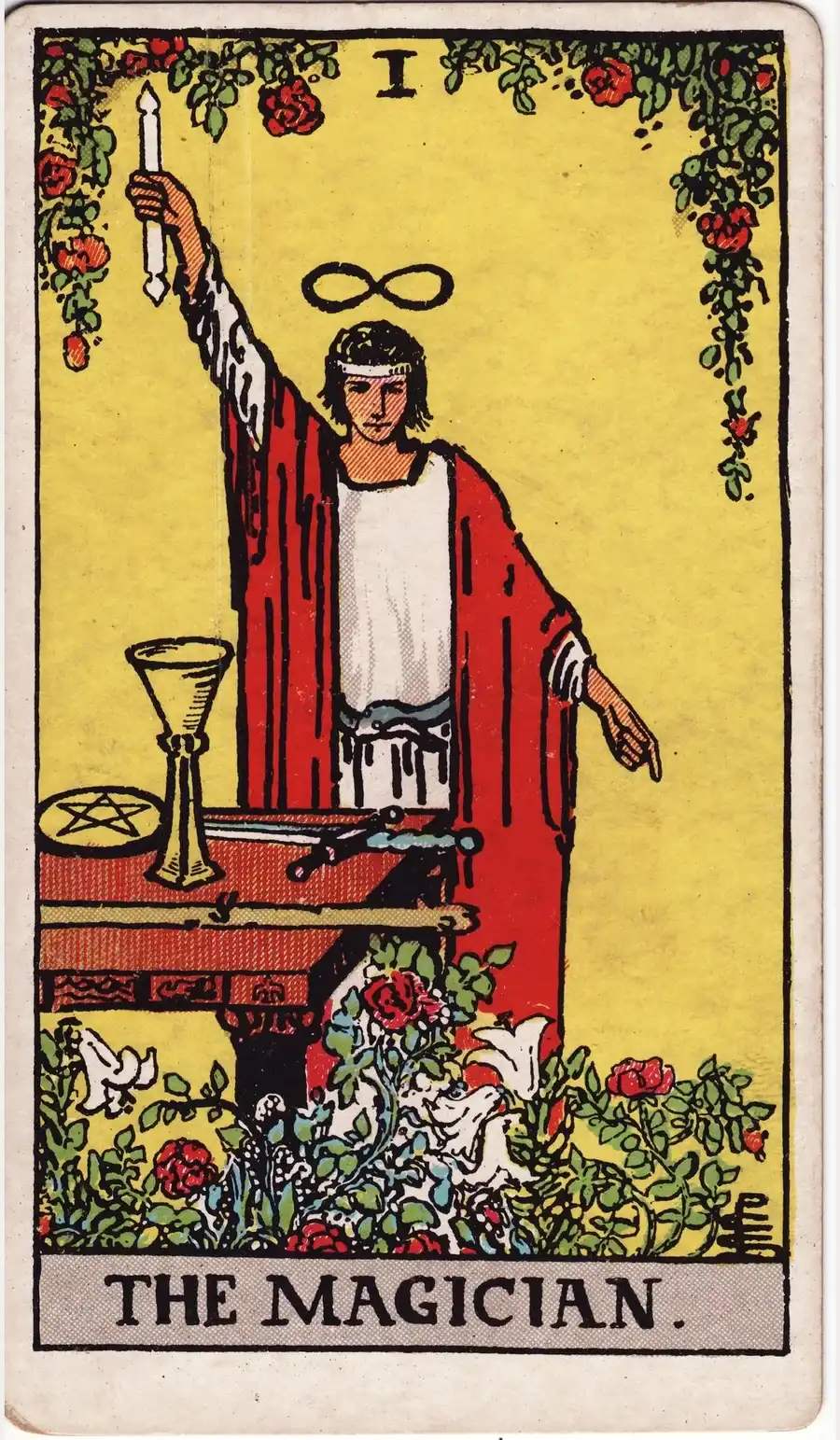
The Magician is card I of the Major Arcana, the first step after the Fool. A figure in a red robe stands at a table with all four tarot suits laid out before him. One hand points up, one points down.
The message is simple and practical: you already have the tools, so use them on purpose. Here is what the Magician means upright and reversed, the symbols in the 1909 card and its surprising history as a street performer.
Here is the Magician at a glance.
| At a glance | This card |
|---|---|
| Upright keywords | skill, willpower, focus, resourcefulness |
| Reversed keywords | manipulation, illusion, scattered talent |
| Number | I (1) in the Major Arcana |
| Golden Dawn title | The Magus of Power Later tradition |
| Hebrew letter | Beth (ב), “house” Later tradition |
| Tree of Life path | 12, from Kether to Binah Later tradition |
| Astrology | Mercury Later tradition |
| Element | Air Modern |
| Yes or no | Yes Modern |
In the Golden Dawn system the Magician is Mercury, the planet of skill, speech and exchange, and the letter Beth, the “house” in which power can be held. This matches the older picture, too: the Marseille Bateleur is a street conjurer whose trade depends on quick hands and quicker talk. The element shown in many modern tables, air, follows from Mercury and is not in the nineteenth-century sources.
The card: what Pamela Colman Smith drew
Pamela Colman Smith drew the Magician as calm and confident, standing in a garden of roses and lilies.
Waite wrote that the raised wand and the lowered hand show “the descent of grace, virtue and light, drawn from things above and derived to things below”. You do not need that mystical layer to read the card, but it explains the pose.
The raised wand and the pointing hand. One hand lifts a wand toward the sky, the other points at the ground. Many readers sum it up as “as above, so below”: an idea becomes real when it is brought down to earth. For a beginner, it is a good picture of turning a plan into action.
The four tools on the table. A cup, a sword, a pentacle and a wand lie on the table. These are the four suits of the Minor Arcana: feelings, thoughts, the material world and drive. Waite said they lie “like counters before the adept”. Everything you need is already there.
The infinity sign and the snake belt. Above his head floats a sideways figure eight, the infinity sign. Around his waist is a snake biting its own tail, an old symbol of eternity. Both say that this energy renews itself when you keep using it.
Roses and lilies. Red roses and white lilies grow around him. Waite called them garden flowers that show “the culture of aspiration”. In plain words: wishes become flowers when you tend them.
Upright meaning
Upright, the Magician says that the means are already on the table. In Pamela Colman Smith’s picture a cup, a wand, a sword and a pentacle lie in front of the figure: feeling, will, thought and matter, the four suits of the whole deck. Nothing needs to be fetched. What is missing is the decision to use them together.
This is the card of skill applied with intention. It turns up when a plan needs a first concrete act, such as sending the email, booking the room or writing the opening page. The raised wand and the hand pointing down describe a channel: an idea taken from the air and grounded in something you can touch. The lemniscate over the head, the figure-eight of infinity, is often read as focus that renews itself as long as it is used.
The Magician also speaks of communication. Mercury rules words, trade and persuasion, so the card can point to a pitch, an interview, a negotiation or a conversation in which how you say something matters as much as what you say.
Reversed meaning
Reversed, the same skills point the wrong way or not at all. The old conjurer at his table could entertain an audience, and he could also pick its pockets. The reversed Magician warns of manipulation, spin, half-truths or a sales pitch that promises more than it can deliver, whether you are hearing it or making it.
The other reversed reading is quieter: talent left unused. All four tools are on the table, but the figure keeps rearranging them instead of starting. Perfectionism, scattered attention and trying to do everything at once can all look like this.
Ask whose hands are moving. If someone else’s, check the details. If yours, choose one tool and one task.
In love, work and spirituality
In love. Upright: Confident, honest attraction; a partner who knows what they want and says it. A good time to make a move. Reversed: Charm used as a tactic, or a relationship that lives more in words than in action.
At work. Upright: A strong position to launch, pitch or apply. Your skills match the task in front of you. Reversed: Overselling, office politics, or spreading yourself across too many projects to finish one.
With money. Upright: Resourcefulness: making something from what you already have, such as a side income or a skill you can sell. Reversed: A deal that sounds too good, or money lost through disorganization.
In spiritual practice. Upright: Ritual with clear intention. The card favors practical magic and a focused daily practice. Reversed: Using spiritual language to impress others, or collecting tools instead of practicing.
As feelings. Strong interest and confidence. The person feels capable and drawn to act.
As a person. Articulate, skilled and persuasive; someone who makes things happen, for good or ill.
As advice. Use what you already have, and use it now, for one clear purpose.
Reading the Magician: positions and yes or no
In the past position: A time you used your skills well, or a person who showed you what you could do. In the present position: You have the tools. Focus them on one aim.
In the future position: A chance to show what you can make. Prepare your tools now. As advice: Pick one task, say clearly what you want, and act on it this week.
When the Magician shows up among mostly Minor cards, give it extra weight: the theme of skill runs under the whole question.
In modern yes or no readings, the Magician leans yes. It says the means are in your hands, so the answer depends on whether you act.
The history and art behind the card
In the Tarot de Marseille pattern the card is called Le Bateleur, the juggler or street performer. That French name is telling.
On the earliest cards the figure is a street conjurer or juggler doing tricks with cups and balls at a market table. Waite listed “the Magus, Magician, or Juggler” among the trumps, and many older decks still show a trickster rather than a wizard.
The occult revival turned the juggler into a magus. Writers of the nineteenth century linked the four objects on his table to the four elements, and the Golden Dawn tied the card to Mercury, the planet of skill, speech and trade. Smith’s 1909 design draws on that later layer, which is why the table now holds the four suit symbols.
When A. E. Waite published The Pictorial Key to the Tarot in 1910, he listed these divinatory meanings for the card: “Skill, diplomacy, address, subtlety; sickness, pain, loss, disaster, snares of enemies; self-confidence, will; the Querent, if male.”
Reversed, he gave: “Physician, Magus, mental disease, disgrace, disquiet.” Waite himself called the fortune-telling meanings of the trumps “artificial and arbitrary”, and on this site I read the picture first and treat lists like this as history.
In the modern teaching map called the Fool’s Journey, the Magician is the traveler’s first lesson after setting out: before you can become anyone, you have to notice the tools already on your table. It opens the first stage, becoming a self, which runs roughly to the Chariot.
Common questions
Is the Magician a yes or no card? Usually yes. The Magician says you have what you need, so the outcome depends on your focus and your first action.
What does the Magician mean for feelings? The person feels confident and interested and wants to act. Reversed, check whether their words match their actions.
Is the Magician about real magic? Not necessarily. The card is about skill and intention. In the oldest decks the figure was a street performer, not a wizard.
Try this
Try this small spread for the Magician. Use it when you have an idea and want to turn it into action.
| Card | Question | What it shows |
|---|---|---|
| 1 | What do I want to create? | The clearest form of my aim. |
| 2 | Which tool should I use first? | The skill or resource to pick up now. |
| 3 | What stands between the idea and the deed? | The block to name and work around. |
Affirmation: I direct my skills toward what I actually intend to create.
Reversed affirmation: I drop illusion and put my will behind honest work.
If you keep a tarot journal, take one of these questions to it: Which of my four tools (feeling, thought, body, drive) am I ignoring? What one thing could I make real this week? Where am I performing instead of practicing?
What next
Cards that sit close to this one are The Fool (the open beginning that comes right before the Magician), The High Priestess (the quiet inner knowing that balances his outward action) and The Chariot (will and focus again, now moving forward).
The Magician is part of the lesson The Fool to the Chariot in my free Tarot for Beginners course. To keep walking the Major Arcana, read the card before it, The Fool or the card after it, The High Priestess, or go back to all the card meanings.
For every card with keywords, affirmations and examples, see my book The Novice’s Guide to Tarot. If you would like a printable cheat sheet for all 78 cards, my 45-page Tarot Workbook is on Etsy.
Sources
- A. E. Waite, The Pictorial Key to the Tarot (London: Rider, 1910), Part II and Part III, section 3.
- Pamela Colman Smith and A. E. Waite, the Rider-Waite-Smith tarot (London: Rider, 1909).
- Nicolas Conver, Tarot de Marseille (Marseille, 1760).
- Eden Gray, A Complete Guide to the Tarot (New York: Crown, 1970), epilogue “The Fool’s Journey”.
- Lauri Mukkala, The Novice’s Guide to Tarot, entry for The Magician.
- Aleister Crowley, 777 (London: Walter Scott, 1909), columns of the Hebrew letters, paths and Tarot trumps.
- Israel Regardie, ed., The Golden Dawn (Chicago: Aries Press, 1937 to 1940), “Book T” and the titles of the trumps.
All 78 cards
Major Arcana
- The Fool
- The Magician
- The High Priestess
- The Empress
- The Emperor
- The Hierophant
- The Lovers
- The Chariot
- Strength
- The Hermit
- Wheel of Fortune
- Justice
- The Hanged Man
- Death
- Temperance
- The Devil
- The Tower
- The Star
- The Moon
- The Sun
- Judgement
- The World
Wands
- Ace of Wands
- Two of Wands
- Three of Wands
- Four of Wands
- Five of Wands
- Six of Wands
- Seven of Wands
- Eight of Wands
- Nine of Wands
- Ten of Wands
- Page of Wands
- Knight of Wands
- Queen of Wands
- King of Wands
Cups
- Ace of Cups
- Two of Cups
- Three of Cups
- Four of Cups
- Five of Cups
- Six of Cups
- Seven of Cups
- Eight of Cups
- Nine of Cups
- Ten of Cups
- Page of Cups
- Knight of Cups
- Queen of Cups
- King of Cups
Swords
- Ace of Swords
- Two of Swords
- Three of Swords
- Four of Swords
- Five of Swords
- Six of Swords
- Seven of Swords
- Eight of Swords
- Nine of Swords
- Ten of Swords
- Page of Swords
- Knight of Swords
- Queen of Swords
- King of Swords
Pentacles
Get the free Mini-Grimoire
A short printable starter guide to tarot and everyday witchcraft, plus my newsletter. Unsubscribe any time.
Opens Substack in a new tab to confirm. More about the newsletter · Privacy