


How to read the labels Historical what the old sources say. Later tradition what later writers added. Modern modern practice and my own notes.
National Romanticism is the movement in which artists, architects and designers sought a national identity in folklore, landscape, epic poetry and rural life, strongest in the Nordic countries and Russia from about 1840 to 1910. In Finland it centred on the Kalevala, the national epic compiled by Elias Lönnrot, and on painters such as Akseli Gallen-Kallela, Pekka Halonen and Eero Järnefelt, and architects such as Eliel Saarinen. It peaked in Finland in the 1890s and at the Paris World Exhibition of 1900.
In Finland this meant the Kalevala, a poem of singers, smiths and sorcerers. National Romanticism is where I see folk magic and fine art meet most clearly, and the pictures are full of spells.
Key dates
| When | What happened |
|---|---|
| 1835 | Elias Lönnrot publishes the Kalevala, expanded in 1849. |
| 1890 | Akseli Gallen-Kallela and his wife spend their honeymoon in Karelia collecting songs and images. |
| 1892 | Jean Sibelius premieres Kullervo, based on the Kalevala. |
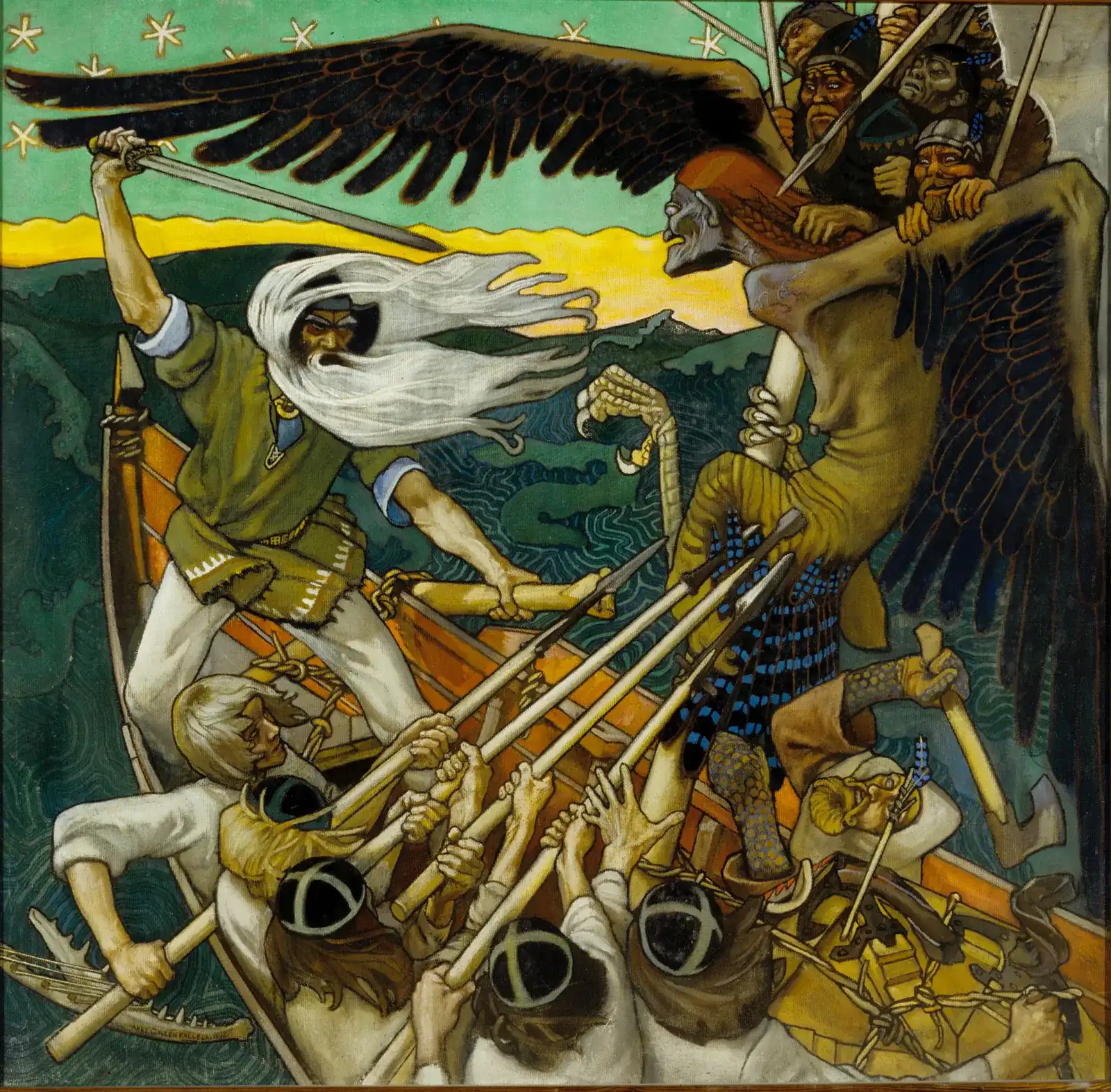
| 1896 | Gallen-Kallela paints The Defence of the Sampo. |
| 1900 | Finland’s pavilion at the Paris World’s Fair shows the style to Europe. |
| 1901 to 1903 | Gesellius, Lindgren and Saarinen build Hvitträsk near Helsinki. |
What is National Romanticism?
National Romanticism is art that uses a country’s myths, folk culture and landscape to express and strengthen a sense of nationhood.
Throughout this page I mark three layers. Historical What buildings, objects and texts of the time show. Later tradition What later centuries read into them. Modern How people use these images today.
Historical A nation looks for its past. Finland was a Grand Duchy of the Russian Empire from 1809. In 1835 the doctor Elias Lönnrot published the Kalevala, built from songs he and others had collected from singers in Karelia and edited into one long epic; an expanded version followed in 1849.
When Russia began to tighten its control in 1899, the Kalevala and the art it inspired became a quiet form of resistance.
Historical Karelianism. In the 1890s Finnish artists, writers and composers traveled to Karelia, the eastern borderland, looking for an untouched old Finland. Akseli Gallen-Kallela spent his honeymoon there in 1890. Jean Sibelius premiered his Kullervo, based on the Kalevala, in 1892 and wrote his Karelia music the following year. The movement is called Karelianism.
Historical Gallen-Kallela’s Kalevala. Gallen-Kallela painted The Defence of the Sampo in 1896, now in the Turku Art Museum. The old singer Väinämöinen raises his sword in a boat, while Louhi, the Mistress of the North, has turned herself into a giant bird with iron claws to win back the Sampo, a magic mill that grinds out wealth.
He built a wilderness studio at Ruovesi and in 1900 painted Kalevala frescoes for Finland’s pavilion at the Paris World’s Fair. His Lake Keitele of 1905, in the National Gallery in London, shows the same feeling in a landscape: a still lake crossed by silver zigzags of wind.
Historical Granite and log. Architects wanted buildings that looked as if they grew out of the land.
Herman Gesellius, Armas Lindgren and Eliel Saarinen built their home and studio Hvitträsk near Helsinki from 1901 to 1903, with log walls and steep roofs, and designed the National Museum of Finland. Lars Sonck built Tampere Cathedral in rough granite. Bears, squirrels and trolls were carved into doorways.
Historical Across the North. In Norway Theodor Kittelsen painted trolls and the folk tale castle of Soria Moria. In Russia Ivan Bilibin illustrated fairy tales with patterns from folk embroidery. In Hungary the artists’ colony at Gödöllő wove and painted a Magyar past. The same longing for roots runs through all of them.
Key artists
| Artist | Lived | Why they matter |
|---|---|---|
| Akseli Gallen-Kallela | 1865 to 1931 | The painter of the Kalevala, of Lake Keitele and of Finland’s Paris pavilion frescoes. |
| Eero Järnefelt | 1863 to 1937 | The painter of Koli and of Under the Yoke. |
| Pekka Halonen | 1865 to 1933 | The painter of Finnish winters and farm life. |
| Eliel Saarinen | 1873 to 1950 | The architect of Hvitträsk and Helsinki Central Station. |
| Theodor Kittelsen | 1857 to 1914 | The Norwegian painter of trolls and folk spirits. |
| Ivan Bilibin | 1876 to 1942 | The Russian illustrator of folk tales. |
How do you recognise National Romanticism?
Look for national epics, folk costume, log buildings and wild landscapes painted as a homeland. Heroes come from sung poetry and fairy tales. Patterns borrow from folk textiles, carving and runic-looking ornament. In architecture, rough granite, steep roofs and carved animals stand for a national past.
Common misconceptions. One is that it was purely Finnish. Norway’s version began in the 1840s, as in Tidemand and Gude’s Bridal Procession, and Russian painters such as Viktor Vasnetsov drew on folk epics in the same decades.
Another is that the Kalevala images are ancient. They are modern reinventions of the 1890s, made by artists who travelled to Karelia looking for an “original” Finland. A third is that women were absent. Venny Soldan-Brofeldt and Maria Wiik painted in Finland in these years, Frida Hansen revived tapestry weaving in Norway, and Elena Polenova led the craft workshops at Abramtsevo near Moscow.
Esoteric themes
Historical In the Kalevala, magic is sung. The wise man, the tietäjä, gains power by singing the origin of a thing, the birth of iron or of fire, and Väinämöinen sings his rival Joukahainen into a swamp. Louhi is a shape-shifting sorceress. Lönnrot drew these scenes from real charm songs collected from rune singers.
Later tradition For a long time the Kalevala was read as a single ancient mythology preserved intact. Scholars now stress how much Lönnrot arranged and joined the songs himself, so the epic is both old and new.
Modern Today some Finnish pagans and many folk musicians draw on the Kalevala and the old runo singing tradition. If you want to explore northern divination with care, my runes lesson separates evidence from later invention.
Works to see
| Work | Artist | Date | Where to see it |
|---|---|---|---|
| The Defence of the Sampo | Akseli Gallen-Kallela | 1896 | Turku Art Museum, Turku |
| Lake Keitele | Akseli Gallen-Kallela | 1905 | The National Gallery, London |
| Under the Yoke (Burning the Brushwood) | Eero Järnefelt | 1893 | Ateneum, Finnish National Gallery, Helsinki |
| Soria Moria | Theodor Kittelsen | 1900 | National Museum, Oslo |
Every work in this list is free of nudity, so you can look them up with confidence. Works still in copyright are named but not shown here.
How to look at a National Romantic painting
Ask what makes the scene national. Is it the landscape, the costume, the work, the epic hero? Then look at the light. Many Nordic painters chose winter light or long summer evenings to make their pictures unmistakably northern.
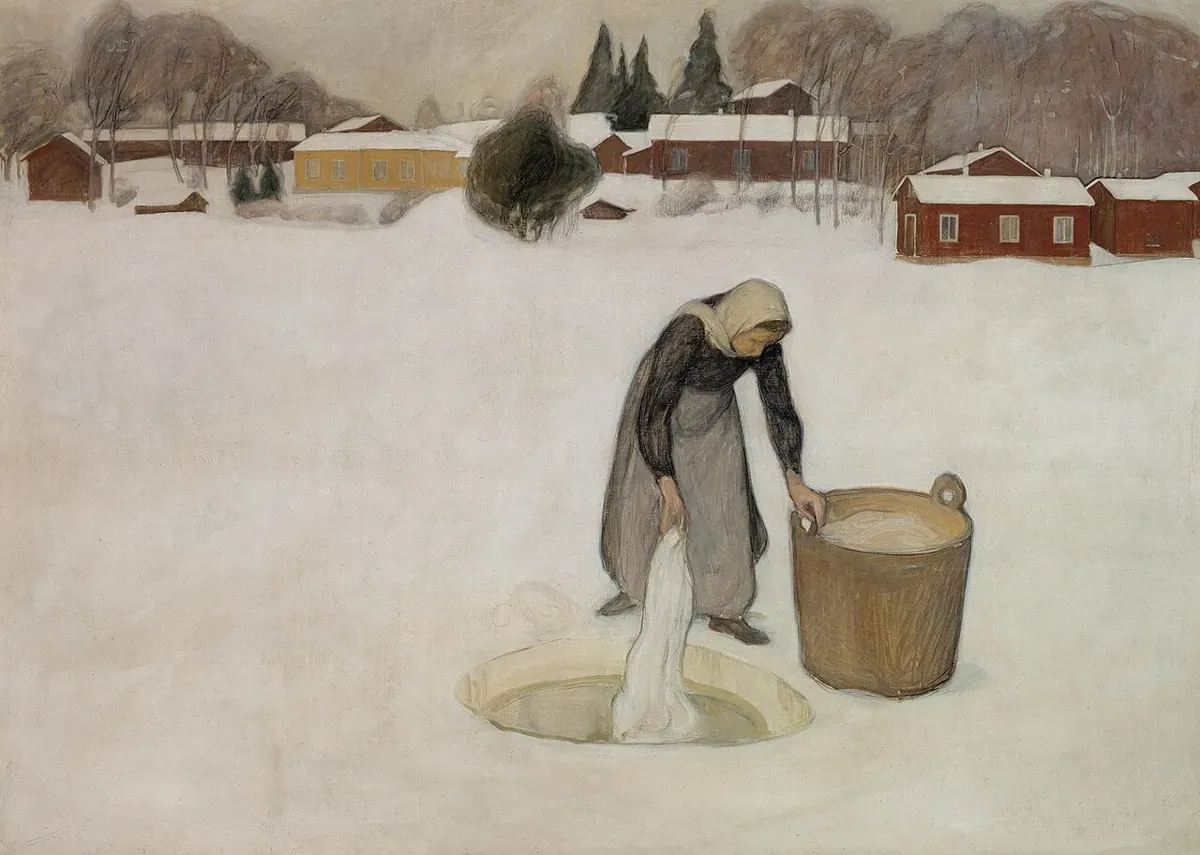
Pekka Halonen, Washing on the Ice, 1900. Ateneum, Helsinki. Image: Wikimedia Commons, public domain.
Pekka Halonen, Washing on the Ice, 1900. At the Ateneum in Helsinki. Ordinary winter work becomes almost monumental. Look at how few colours Halonen uses and at the blue of the water in the ice hole.
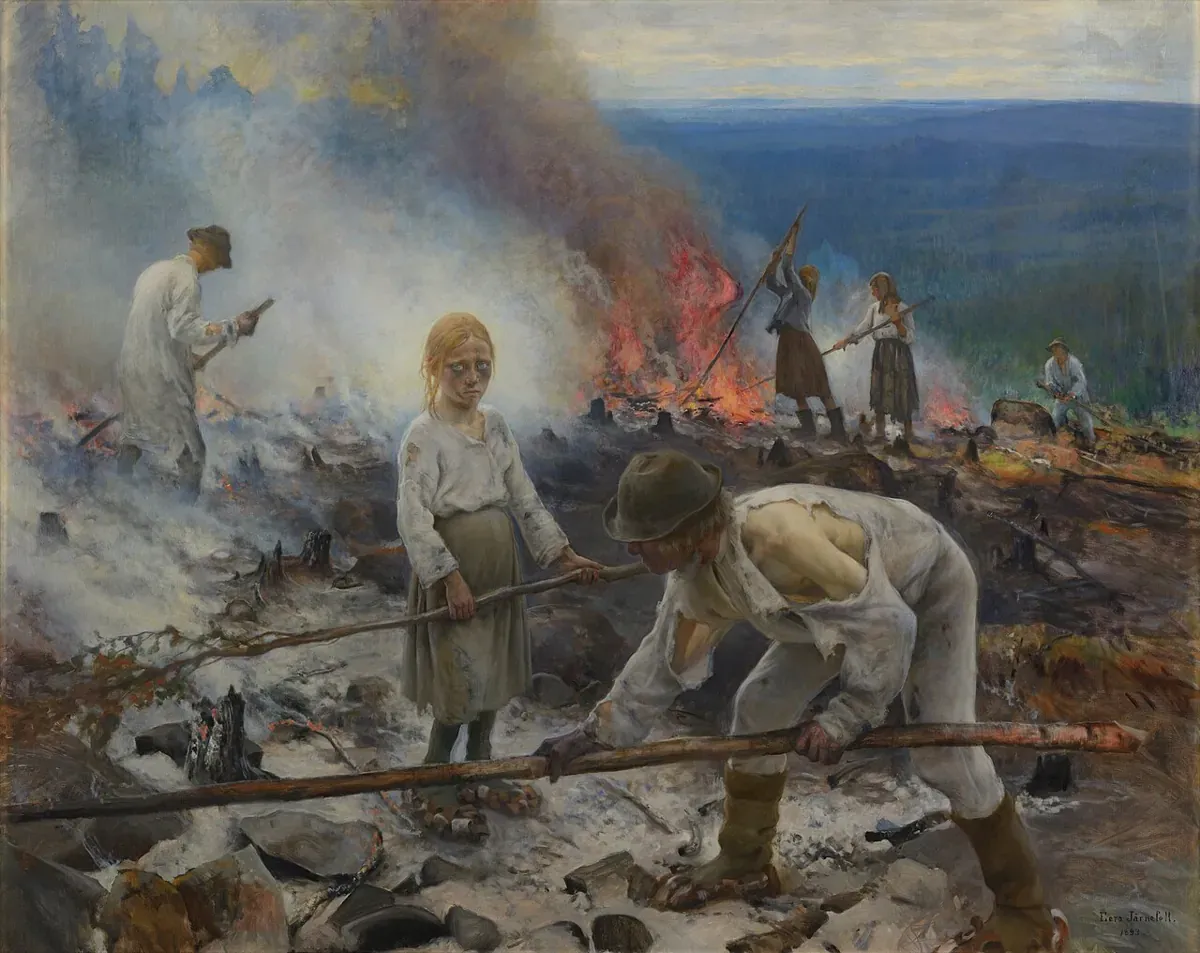
Eero Järnefelt, Under the Yoke (Burning the Brushwood), 1893. Ateneum, Helsinki. Image: Wikimedia Commons, public domain.
Eero Järnefelt, Under the Yoke (Burning the Brushwood), 1893. At the Ateneum. Slash-and-burn clearing was hard, paid labour. The girl’s direct gaze makes it a picture of social conscience as well as of Finnish landscape.
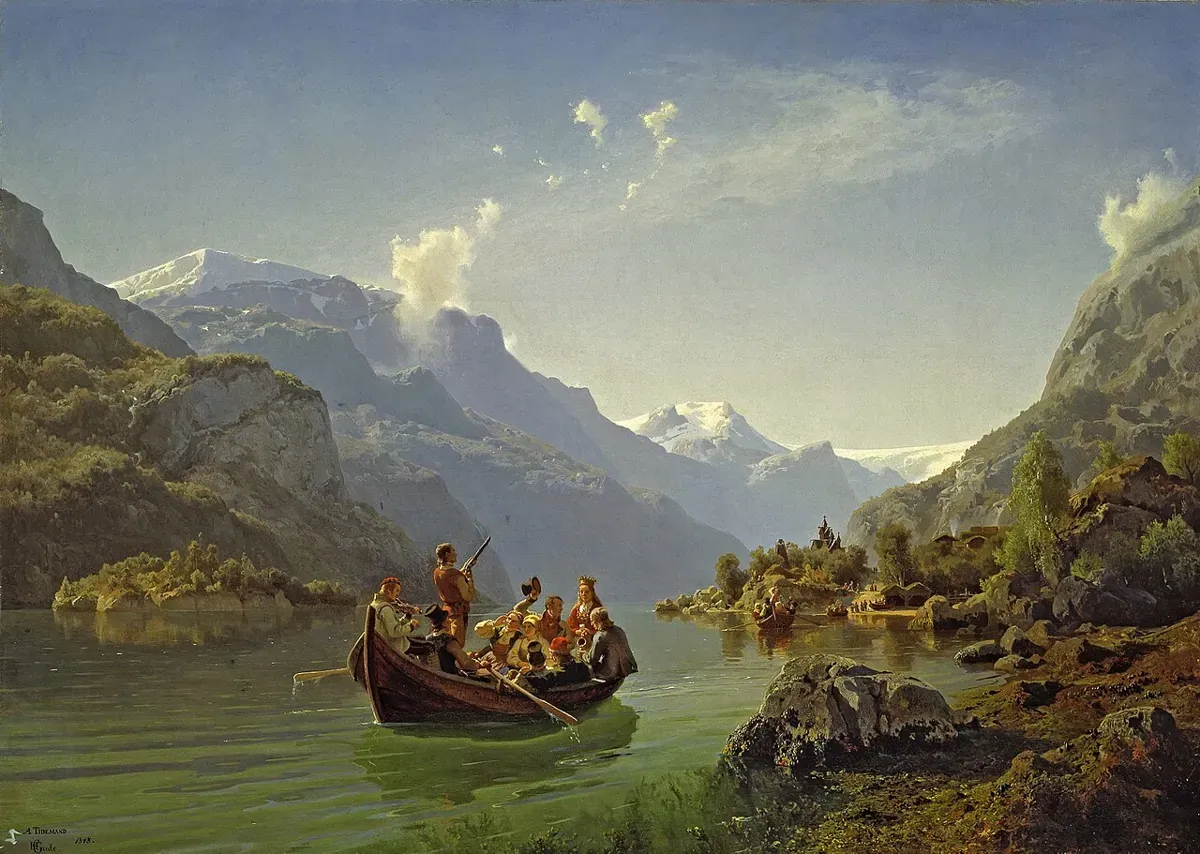
Adolph Tidemand and Hans Gude, Bridal Procession on the Hardangerfjord, 1848. National Museum, Oslo. Image: Wikimedia Commons, public domain.
Adolph Tidemand and Hans Gude, Bridal Procession on the Hardangerfjord, 1848. At the National Museum in Oslo. Gude painted the landscape and Tidemand the people. It became a symbol of Norway.
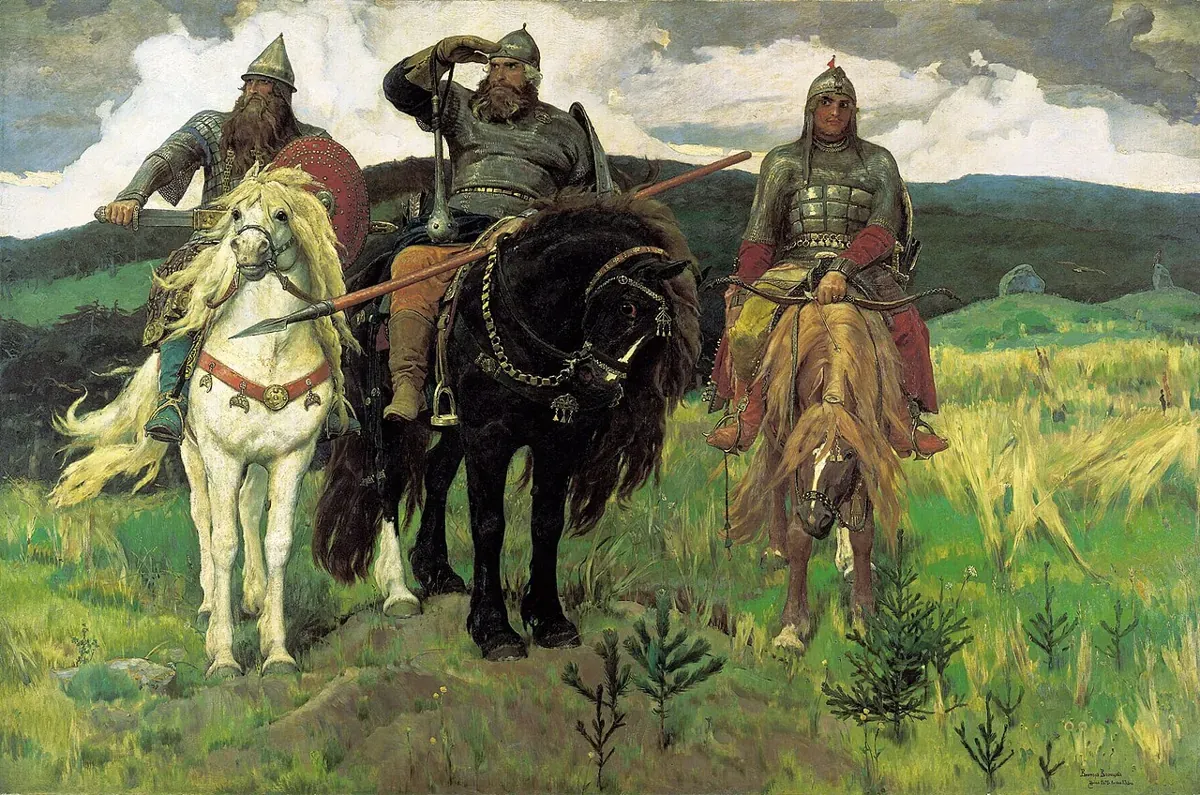
Viktor Vasnetsov, Bogatyrs, 1881 to 1898. State Tretyakov Gallery, Moscow. Image: Wikimedia Commons, public domain.
Viktor Vasnetsov, Bogatyrs, 1881 to 1898. At the Tretyakov Gallery in Moscow. The three heroes of Russian folk epics keep watch on the border. Vasnetsov worked on it for almost twenty years.
National Romanticism grew from Romanticism and Realism, shared its crafts with the Arts and Crafts movement and its curves with Art Nouveau, and in Finland overlapped with the mystery of Symbolism, as in Hugo Simberg’s work.
Try this
Read the short scene of the Sampo’s theft in any translation of the Kalevala, then look closely at The Defence of the Sampo. Find the moment Gallen-Kallela chose to paint. Write a few lines about what he left out and why you think he chose this second of the story.
What next
Before this: The Nabis.
After this: Art Nouveau.
Also worth reading alongside it: Symbolism, Arts and Crafts.
See every movement in order on the art movements timeline, or learn to look step by step in the free Art History for Beginners course.
If you want to carry this into tarot and practice, these pages connect to it: The Magician, Väinämöinen, the singer whose words make the world; Wheel of Fortune, the Sampo, the mill of plenty that everyone wants to own; The northern past the movement imagined; and Folk magic and the old songs.
Sources
- Elias Lönnrot, translated by Keith Bosley, The Kalevala (1989). Oxford World’s Classics; first published 1835 and 1849.
- Juha Y. Pentikäinen, Kalevala Mythology (1999). Expanded English edition.
- Kirk Varnedoe, Northern Light: Realism and Symbolism in Scandinavian Painting, 1880-1910 (1982).
- Turku Art Museum, The Defence of the Sampo. Visit the website
- The National Gallery, London, Lake Keitele. Open the record
- Wikimedia Commons, The Defence of the Sampo (hero image record). Open the record
- Kirk Varnedoe, Northern Light: Realism and Symbolism in Scandinavian Painting 1880 to 1910 (1982).

Questions
What is National Romanticism in art?
A movement of about 1880 to 1920 in which artists and architects used folk poetry, myths, costume and landscape to express a national identity, especially in Finland, Scandinavia and Eastern Europe.
What is the Sampo?
A magic mill in the Kalevala, forged by the smith Ilmarinen, that grinds out grain, salt and wealth. Its theft from Louhi and the battle over it are painted in The Defence of the Sampo.
Where can I see works of National Romanticism in person?
Good places to start are Helsinki (the Ateneum, the National Museum), Turku (Turku Art Museum), Espoo (the Gallen-Kallela Museum), Oslo, and London (The National Gallery). Museums change their displays, so check the collection page before you travel.
Where can I see National Romantic art in Finland?
The Ateneum in Helsinki holds the key paintings, the Gallen-Kallela Museum in Espoo shows the artist's studio home, and the National Museum of Finland and Hvitträsk in Kirkkonummi show the architecture of Saarinen, Gesellius and Lindgren.
What was the Finnish pavilion at the 1900 Paris World Exhibition?
A pavilion designed by Herman Gesellius, Armas Lindgren and Eliel Saarinen, with frescoes by Akseli Gallen-Kallela based on the Kalevala. It presented Finland as a nation with its own culture during the period of Russian rule.
Get the free Mini-Grimoire
A short printable starter guide to tarot and everyday witchcraft, plus my newsletter. Unsubscribe any time.
Opens Substack in a new tab to confirm. More about the newsletter · Privacy