


How to read the labels Historical what the old sources say. Later tradition what later writers added. Modern modern practice and my own notes.
The Vienna Secession was an association of artists founded in Vienna in 1897, when Gustav Klimt, Koloman Moser, Josef Hoffmann, Joseph Maria Olbrich and others broke away from the conservative Künstlerhaus. Its exhibition building by Olbrich, opened in 1898, bears the motto “To every age its art, to art its freedom”. Klimt’s gold paintings, such as The Kiss of 1907 to 1908 in the Belvedere, became its most famous works.
The rebels built a white temple for modern art with a dome of golden laurel leaves. For about ten years Vienna became one of the most exciting places in Europe, where painting, design and architecture were planned together as one total work of art.
Key dates
| When | What happened |
|---|---|
| April 1897 | Gustav Klimt and others leave the official artists’ association and found the Secession. |
| 1898 | The Secession Building by Joseph Maria Olbrich opens, and the magazine Ver Sacrum begins. |
| 1902 | The Beethoven exhibition, with Klimt’s Beethoven Frieze. |
| 1903 | Josef Hoffmann and Koloman Moser found the Wiener Werkstätte. |
| 1905 | Klimt and his circle leave the Secession. |
| 1918 | Klimt, Moser, Otto Wagner and Egon Schiele all die. |
What is the Vienna Secession?
The Vienna Secession was a breakaway artists’ group that brought modern design, Symbolism and international art to Vienna around 1900.
Throughout this page I mark three layers. Historical What buildings, objects and texts of the time show. Later tradition What later centuries read into them. Modern How people use these images today.
Historical Leaving the academy. In April 1897 Klimt and other artists, among them Koloman Moser, Josef Hoffmann and Joseph Maria Olbrich, founded the Secession, with Klimt as its first president.
Their magazine was called Ver Sacrum, “sacred spring”, after an ancient Italian custom in which a generation of young people was dedicated to the gods and sent out to found a new home.
Historical A temple of art. Olbrich’s Secession Building opened in 1898. It is a white block crowned with a gilded openwork dome of laurel leaves, the tree of Apollo, which the Viennese nicknamed the golden cabbage.
Above the door are three Gorgon heads and the motto “To every age its art, to art its freedom”, written by the critic Ludwig Hevesi.
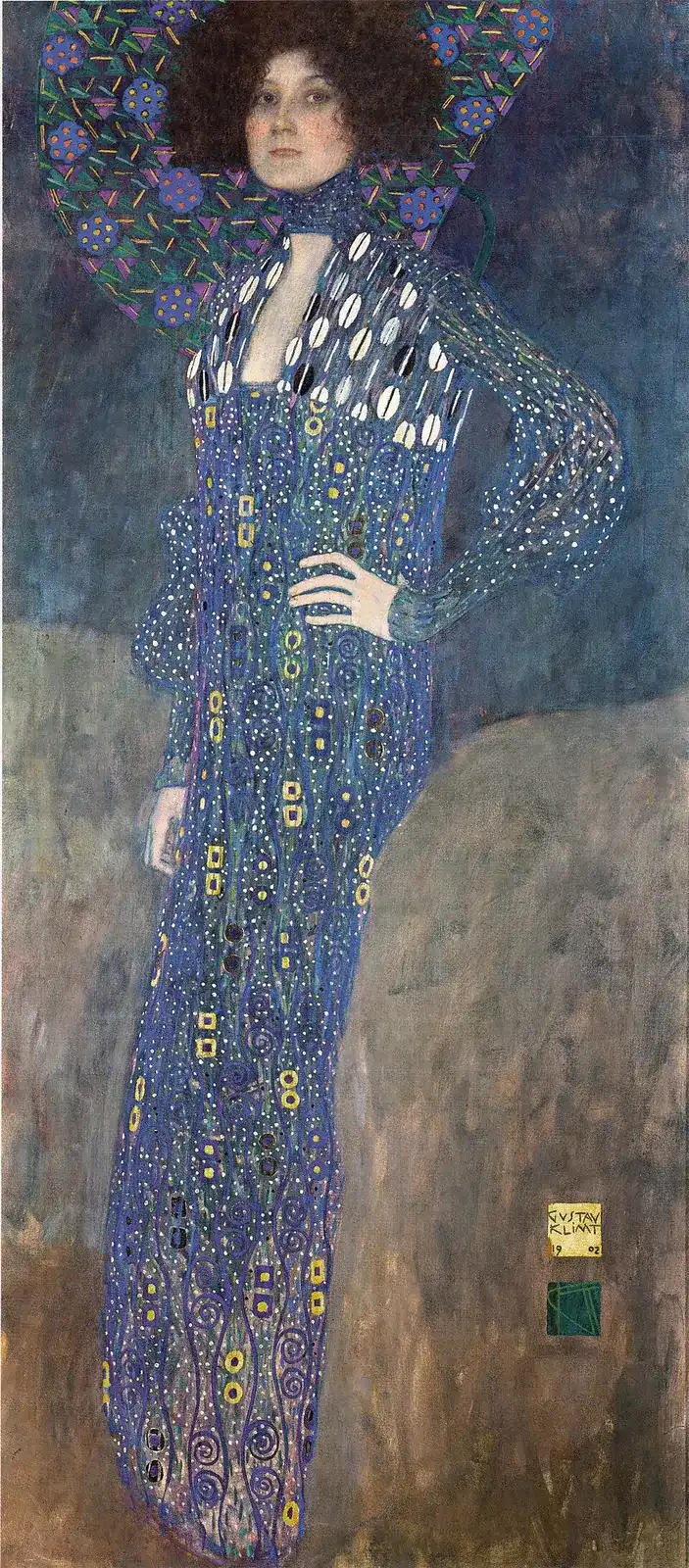
Historical Klimt’s golden women. Klimt’s portraits of women dissolve their dresses into mosaics of gold and pattern while their faces stay real. His Portrait of Emilie Flöge of 1902, shown above, is his partner and lifelong friend, a fashion designer who later ran a salon with her sisters.
His portrait of the young Mäda Primavesi, in the Met, shows a girl standing firmly in a white dress against a field of flowers.
Historical The Beethoven Frieze. For the fourteenth Secession exhibition in 1902, built around Max Klinger’s statue of Beethoven, Klimt painted a frieze inspired by Richard Wagner’s reading of the Ninth Symphony.
A knight in golden armor sets out to save suffering humanity, passes the Hostile Powers, a giant ape-like monster named Typhon with three Gorgons, and arrives at a choir of angels and a final embrace. It is still in the Secession Building.
Historical Design for living. In 1903 Hoffmann and Moser founded the Wiener Werkstätte, a workshop for furniture, silver, jewelry, textiles and books in clean geometric forms.
Their greatest commission, the Palais Stoclet in Brussels, was built from 1905 to 1911 with mosaics by Klimt. In 1905 Klimt and his circle left the Secession, and in 1918 Klimt, Moser, Otto Wagner and Egon Schiele all died.
Key artists
| Artist | Lived | Why they matter |
|---|---|---|
| Gustav Klimt | 1862 to 1918 | First president of the Secession, painter of gold and pattern. |
| Koloman Moser | 1868 to 1918 | Designer of posters, books, furniture and stamps. |
| Josef Hoffmann | 1870 to 1956 | Architect and co-founder of the Wiener Werkstätte. |
| Joseph Maria Olbrich | 1867 to 1908 | Architect of the Secession Building. |
| Otto Wagner | 1841 to 1918 | The architect of Vienna’s stations and Steinhof church. |
How do you recognise the Vienna Secession?
Look for squares, grids and gold beside the curves of Art Nouveau. Dresses dissolve into mosaics of pattern, while faces and hands stay realistic. Posters and magazine pages are designed as a whole, lettering included. Architecture turns white and geometric, crowned with gold.
Common misconceptions. One is that the Secession was only Klimt. He was its first president, but architects, designers and graphic artists were equally central, and the group led to the Wiener Werkstätte design workshops in 1903.
Another is that Klimt stayed with it. He and his circle left the Secession in 1905 after a dispute. A third is that women were absent. Broncia Koller-Pinell exhibited with the circle, the fashion designer Emilie Flöge worked closely with Klimt, and women such as Mileva Roller and Vally Wieselthier designed for Viennese workshops.
Esoteric themes
Historical The Secession treated art almost as a religion. The building was called a temple, its magazine borrowed an ancient sacred rite, and the Beethoven Frieze told a story of salvation through art.
Klimt’s ceiling paintings for the University of Vienna, Philosophy, Medicine and Jurisprudence (1900 to 1907), showed humanity drifting in a cosmic stream and caused a scandal; Medicine was dominated by Hygieia holding the snake of Asclepius. The paintings were destroyed by fire in 1945.
Later tradition You will sometimes read that Klimt was a secret occultist. There is no good evidence for this. His symbols come from classical myth, Byzantine mosaics, Egyptian art and the shared visual language of Symbolism.
Modern Klimt’s gold, spirals and eyes are everywhere in witchy design today. If you love them, look at their sources too: the Byzantine mosaics he saw in Ravenna in 1903.
Works to see
| Work | Artist | Date | Where to see it |
|---|---|---|---|
| Portrait of Emilie Flöge | Gustav Klimt | 1902 | Wien Museum, Vienna |
| Serena Pulitzer Lederer | Gustav Klimt | 1899 | The Metropolitan Museum of Art, New York |
| Secession Building | Joseph Maria Olbrich | 1898 | Friedrichstrasse, Vienna |
| Steinhof church (Church of Saint Leopold) | Otto Wagner | 1904 to 1907 | Vienna |
Every work in this list is free of nudity, so you can look them up with confidence. Works still in copyright are named but not shown here.
How to look at a Vienna Secession painting
Look at the contrast between flesh and pattern. Faces and hands are painted softly and realistically, while clothes and backgrounds become flat gold, spirals and squares. Then look at the shape of the canvas, often square, which Klimt loved.
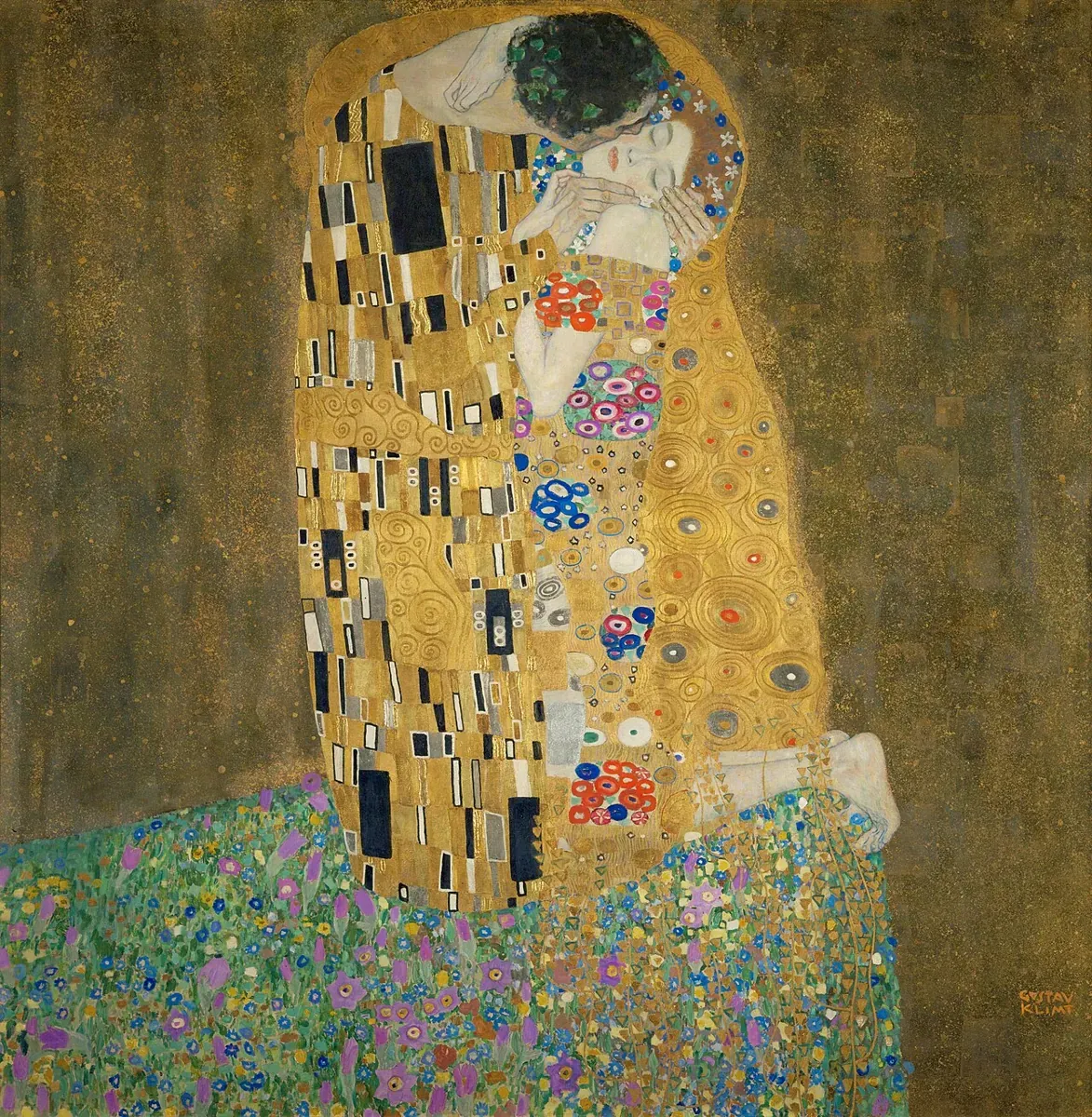
Gustav Klimt, The Kiss, 1907 to 1908. Belvedere, Vienna. Image: Wikimedia Commons, public domain.
Gustav Klimt, The Kiss, 1907 to 1908. At the Belvedere in Vienna, which bought it in 1908. Find the rectangles on his robe and the circles on hers. The real gold leaf glows differently as you move.
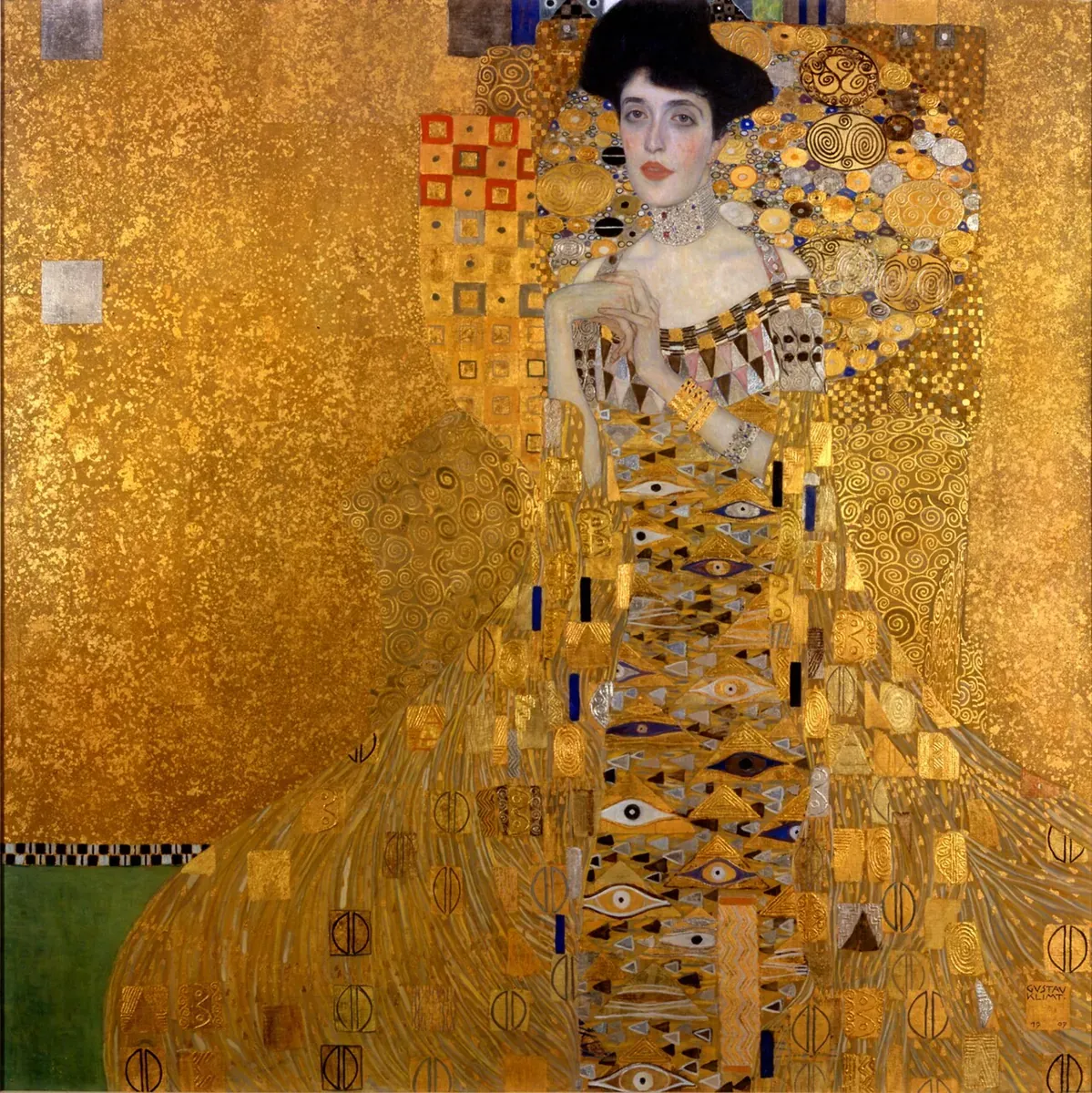
Gustav Klimt, Portrait of Adele Bloch-Bauer I, 1907. Neue Galerie, New York. Image: Wikimedia Commons, public domain.
Gustav Klimt, Portrait of Adele Bloch-Bauer I, 1907. At the Neue Galerie in New York. Seized after 1938, it was returned to Adele’s heirs in 2006 and bought by Ronald Lauder for the Neue Galerie.
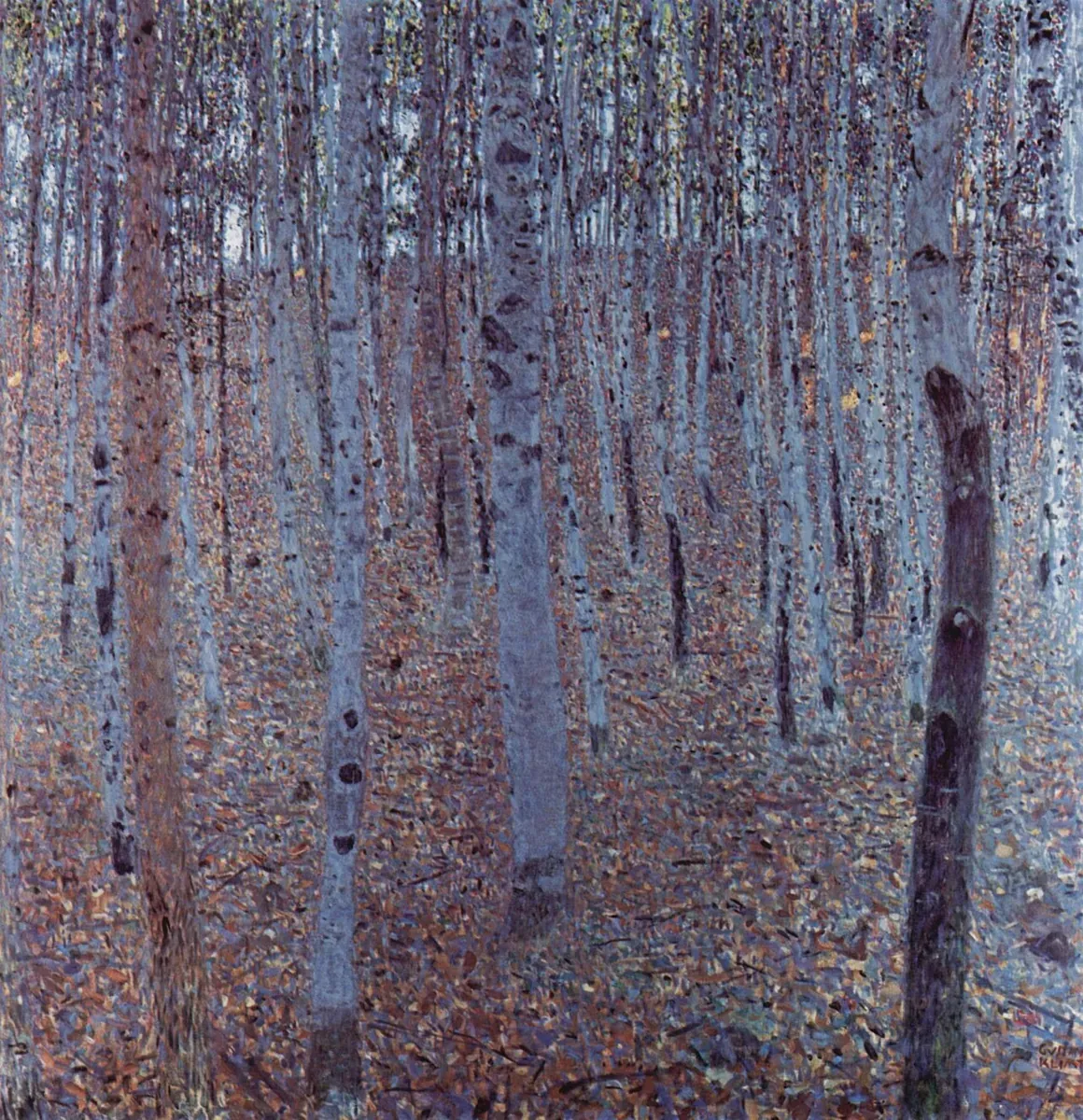
Gustav Klimt, Beech Grove I, about 1902. Galerie Neue Meister, Dresden. Image: Wikimedia Commons, public domain.
Gustav Klimt, Beech Grove I, about 1902. At the Galerie Neue Meister in Dresden. Klimt painted landscapes in summer at the Attersee. Without a horizon, the trees become a pattern.
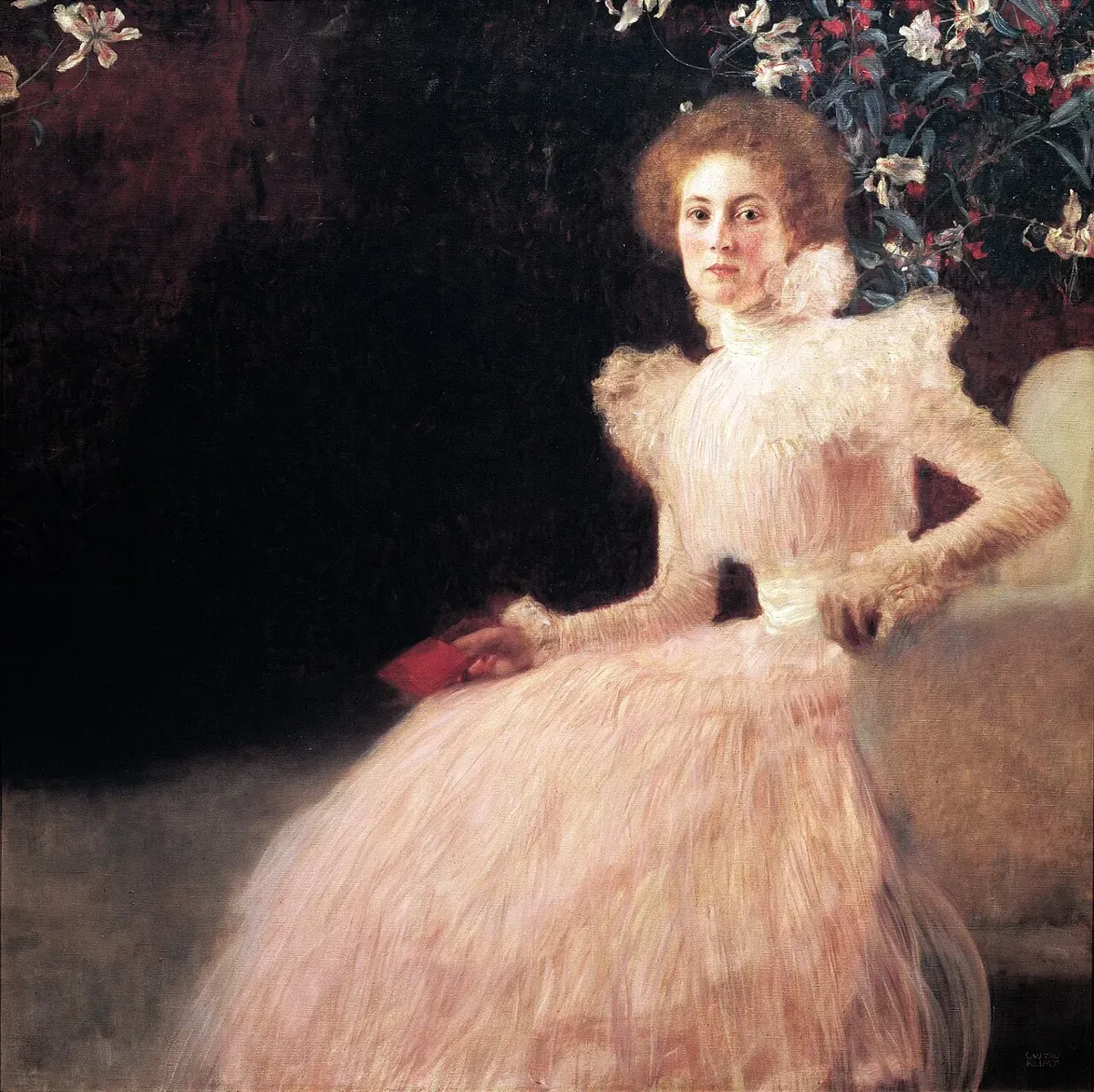
Gustav Klimt, Portrait of Sonja Knips, 1898. Belvedere, Vienna. Image: Wikimedia Commons, public domain.
Gustav Klimt, Portrait of Sonja Knips, 1898. At the Belvedere. An early Secession portrait, still without gold. Look at the dark space, which makes the pink dress glow.
The Secession was Vienna’s version of Art Nouveau, shared ideas with Symbolism and the Arts and Crafts movement, borrowed gold from Byzantine art, and was followed by Egon Schiele and Oskar Kokoschka in Expressionism.
Try this
Look closely at the Portrait of Emilie Flöge. List every shape you can find in her dress: squares, spirals, circles, eyes. Then draw a simple outline of a figure and fill the dress with your own set of three shapes that mean something to you, the way a sigil gathers meaning into a pattern.
What next
Before this: Art Nouveau.
After this: Arts and Crafts.
See every movement in order on the art movements timeline, or learn to look step by step in the free Art History for Beginners course.
If you want to carry this into tarot and practice, these pages connect to it: The Empress, abundance, gold and the woman as the center of the design; Temperance, the balance of curve and square, art and craft; How Vienna led into modern art; and The esoteric currents around 1900.
Sources
- Carl E. Schorske, Fin-de-siècle Vienna: Politics and Culture (1980).
- Ludwig Hevesi, Acht Jahre Sezession (1906).
- Tobias G. Natter (ed.), Gustav Klimt: The Complete Paintings (2012).
- The Metropolitan Museum of Art, Mäda Primavesi. Open the record
- Vereinigung bildender Künstlerinnen und Künstler Wiener Secession, The Secession Building. Visit the website
- Wikimedia Commons, Portrait of Emilie Flöge (hero image record). Open the record
- Carl E. Schorske, Fin-de-siècle Vienna: Politics and Culture (1980).

Questions
What was the Vienna Secession?
A group of artists, designers and architects who left Vienna's official artists' association in 1897 to promote modern art. Gustav Klimt was its first president.
What does the motto on the Secession Building say?
"Der Zeit ihre Kunst, der Kunst ihre Freiheit": to every age its art, to art its freedom. It was written by the critic Ludwig Hevesi.
Where can I see works of the Vienna Secession in person?
Good places to start are Vienna (the Secession Building, the Belvedere, the Leopold Museum, the Wien Museum, the MAK) and New York (the Met, the Neue Galerie). Museums change their displays, so check the collection page before you travel.
Where can I see Vienna Secession art?
The Belvedere for Klimt's paintings, the Secession building for the Beethoven Frieze of 1902, the Leopold Museum and the MAK for design, and the Neue Galerie in New York.
What is the Beethoven Frieze?
A painted frieze by Klimt for the 14th Secession exhibition in 1902, devoted to Beethoven. It shows humanity's longing for happiness and ends with an embrace inspired by Beethoven's Ninth Symphony.
Who founded the Vienna Secession?
Gustav Klimt, Koloman Moser, Josef Hoffmann, Joseph Maria Olbrich, Carl Moll and other artists founded it in 1897, with Klimt as its first president.
Get the free Mini-Grimoire
A short printable starter guide to tarot and everyday witchcraft, plus my newsletter. Unsubscribe any time.
Opens Substack in a new tab to confirm. More about the newsletter · Privacy