


| Arcana | Major Arcana |
|---|---|
| Number | XIV |
| Image | RWS 1909 (PD) |
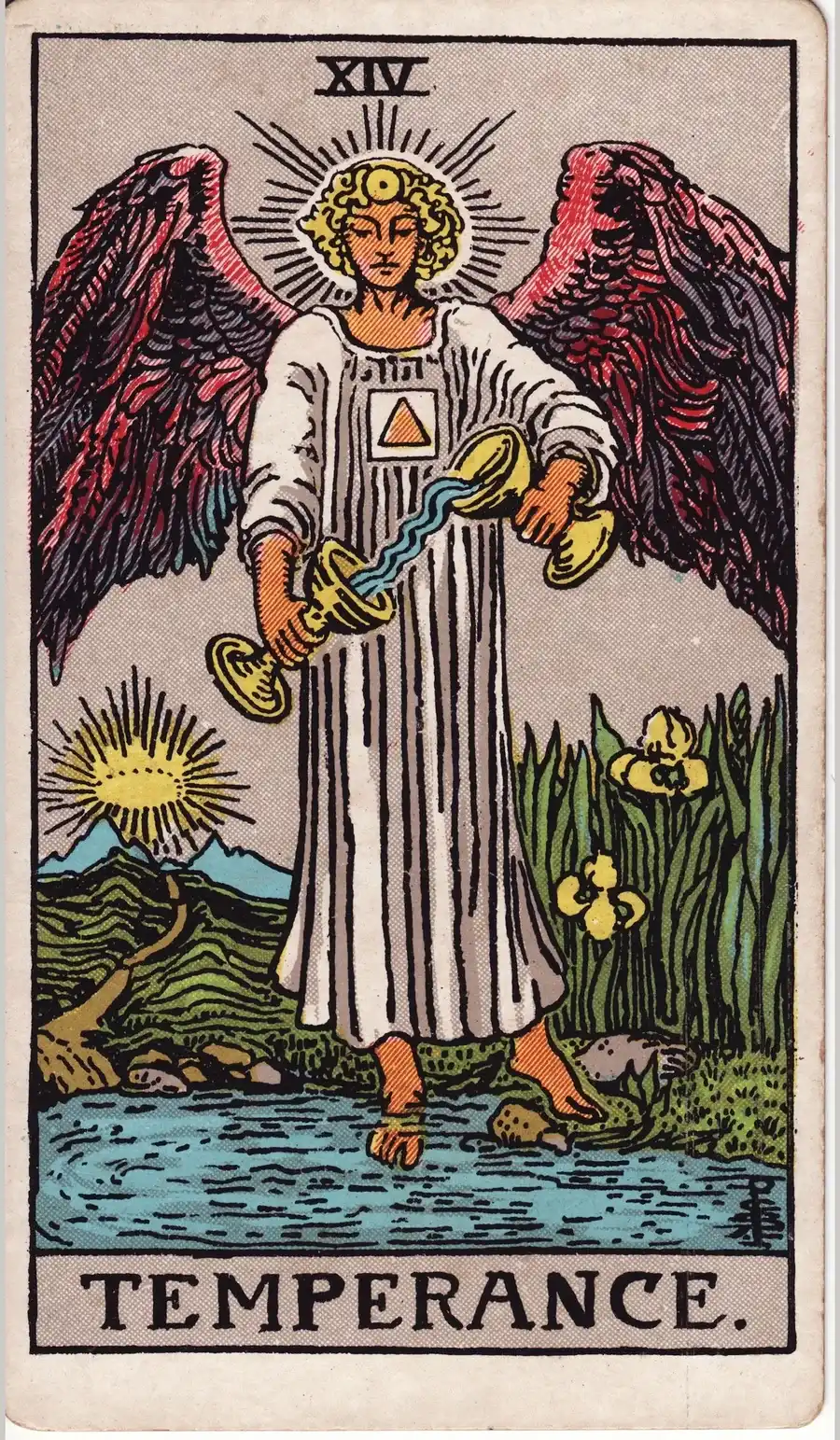
Temperance is card XIV of the Major Arcana, the calm after Death. An angel stands with one foot in water and one on land, pouring water from one cup into another. Nothing spills.
The card is about patience, moderation and the long art of mixing things until they are just right. Here is what Temperance means upright and reversed, the symbols in the 1909 card and its history as a virtue.
Here is Temperance at a glance.
| At a glance | This card |
|---|---|
| Upright keywords | balance, moderation, patience, blending |
| Reversed keywords | excess, impatience, swinging between extremes |
| Number | XIV (14) in the Major Arcana |
| Golden Dawn title | The Daughter of the Reconcilers; the Bringer-forth of Life Later tradition |
| Hebrew letter | Samekh (ס), “prop” or “support” Later tradition |
| Tree of Life path | 25, from Tiphareth to Yesod Later tradition |
| Astrology | Sagittarius Later tradition |
| Element | Fire Later tradition |
| Yes or no | Yes Modern |
The Golden Dawn gave Temperance the sign Sagittarius, the archer, and the letter Samekh, a “prop” or support. The path runs straight up the middle pillar of the Tree, which is why the Order linked the card with the arrow of aspiration shot upwards. Temperance is one of the four cardinal virtues, and early Italian decks drew it as a woman pouring water into wine, the classical image of moderation.
The card: what Pamela Colman Smith drew
Waite described “a winged angel, with the sign of the sun upon his forehead” who is “pouring the essences of life from chalice to chalice”, and noted that the figure “is neither male nor female”.
The two cups. The angel pours water between two cups at an angle that should not work, and yet the stream flows. Temperance blends opposites without erasing their difference. Change here is gradual, not a sudden fix.
One foot in water, one on land. One foot rests in a pool, the other on the bank. Water is feeling, land is the practical world. The angel balances both.
The path and the crown. A path leads from the pool to distant mountains, where a light shines with a faint crown inside it. Waite called it “some part of the Secret of Eternal Life”. For a beginner, it is the long road that patience makes walkable.
The irises and the triangle. Yellow irises grow by the pool, often linked to Iris, the Greek messenger goddess of the rainbow. On the angel’s robe is a square with a triangle inside, which Waite called “the square and triangle of the septenary”, the number seven.
Upright meaning
Upright, Temperance blends. An angel with red wings stands with one foot in a pool and one on the land, pouring water between two cups. A square with a triangle inside is marked on the robe, irises grow at the edge of the water, and a path leads to a crown of light in the distance. Nothing is rushed.
The card describes balance found through patience: the middle way, the right mixture, healing that comes step by step. It often follows hard change, especially Death, and says that the work now is integration. You take the pieces of what happened and combine them into something you can live with.
Temperance also speaks of moderation in everyday life: sleep, food, work, money and emotion in proportion. It favors cooperation, compromise and slow, steady progress towards a distant goal.
Reversed meaning
Reversed, the mixture goes wrong. The card can describe excess, such as overwork, overspending or overindulgence, or a life lived in extremes, swinging between too much and too little. It can also describe impatience: wanting the healing or the result before the process has had time to work.
In relationships or teams, the reversed card may point to imbalance, with one side giving and the other taking, or to a compromise that satisfies nobody.
Ask where you have lost proportion. Then make one small adjustment and keep it for a week. Temperance is the card of the long pour, not the sudden fix.
In love, work and spirituality
In love. Upright: Harmony, patience and a relationship that balances two different people well. Reversed: Imbalance, impatience or extremes; one partner giving too much.
At work. Upright: Cooperation, steady progress, a well-managed workload and good teamwork. Reversed: Overwork, poor balance between work and rest, or friction in a team.
With money. Upright: Moderation, a balanced budget and patient saving. Reversed: Excess spending or swinging between saving and splurging.
In spiritual practice. Upright: Integration, alchemy and the middle way; healing after a crisis. Reversed: Spiritual impatience, or chasing peak experiences.
As feelings. Calm, balanced affection. The person feels at peace with you.
As a person. Patient, moderate and diplomatic; a healer or mediator.
As advice. Find the right mixture and give it time.
Reading Temperance: positions, pairs and yes or no
In the past position: A time of healing or finding balance. In the present position: Go slowly and blend what you have.
In the future position: Steady progress and a calmer rhythm. As advice: Find the middle way and keep a pace you can sustain.
When Temperance shows up among mostly Minor cards, give it extra weight: the theme of balance runs under the whole question.
Pairs matter too. Next to The Star, it can mean deep healing and renewal. Next to The Chariot, it can mean steady progress with balance. Next to The Devil, it can mean a warning about excess: moderation is the cure.
In modern yes or no readings, Temperance leans yes. It leans yes, but slowly. Things will work out with patience and balance.
The history and art behind the card
In the Tarot de Marseille pattern the card is called Tempérance, Temperance. Temperance is one of the classical virtues, and medieval artists often showed her as a woman diluting wine with water, pouring from one jug into another. The early tarot cards kept that domestic image: a woman mixing drinks to keep them moderate.
The wings came later, and so did the deeper reading. Waite turned the figure into an angel and wrote that the card “tempers, combines and harmonizes the psychic and material natures”.
He said the old meanings, such as changes in the seasons, were renounced in his design. Many modern readers link the card with alchemy, the art of combining substances, which fits its blending theme.
In the Thoth deck, Aleister Crowley renamed the card Art, which shows how strongly later occultists saw it as a picture of alchemical mixing. Whichever name your deck uses, the cups are the key: two streams becoming one.
When A. E. Waite published The Pictorial Key to the Tarot in 1910, he listed these divinatory meanings for the card: “Economy, moderation, frugality, management, accommodation.” Reversed, he gave: “Things connected with churches, religions, sects, the priesthood, sometimes even the priest who will marry the Querent; also disunion, unfortunate combinations, competing interests.”
Waite himself called the fortune-telling meanings of the trumps “artificial and arbitrary”, and on this site I read the picture first and treat lists like this as history.
Temperance closes the second stage of the modern Fool’s Journey. After the ending in Death, the traveler learns to blend what is left into something new, slowly, one careful pour at a time.
Common questions
What does Temperance mean in love? Balance, patience and compromise. Upright, a calm and steady relationship. Reversed, extremes and impatience.
Is Temperance a yes or no? A slow yes. Things will work out with patience and moderation.
What does Temperance reversed mean? Imbalance, excess or impatience. Step back and find a gentler pace.
Try this
Try this small spread for Temperance. Use it when life feels out of balance.
| Card | Question | What it shows |
|---|---|---|
| 1 | What is too much? | What I need to reduce. |
| 2 | What is too little? | What I need to add. |
| 3 | What is my right pace? | How to blend them in a way I can keep up. |
Affirmation: I blend opposing needs with patience until a livable whole appears.
Reversed affirmation: I correct excess and stop forcing mixes that will not hold.
If you keep a tarot journal, take one of these questions to it: What two parts of my life need blending? Where am I doing too much, and where too little? What would a gentler pace look like this week?
What next
Cards that sit close to this one are Death (the card before: Temperance is the healing after an ending), The Star (calm water and hope again) and Strength (another card of patience and gentle control).
Temperance is part of the lesson Strength to Temperance in my free Tarot for Beginners course. To keep walking the Major Arcana, read the card before it, Death or the card after it, The Devil, or go back to all the card meanings.
For every card with keywords, affirmations and examples, see my book The Novice’s Guide to Tarot. If you would like a printable cheat sheet for all 78 cards, my 45-page Tarot Workbook is on Etsy.
Sources
- A. E. Waite, The Pictorial Key to the Tarot (London: Rider, 1910), Part II and Part III, section 3.
- Pamela Colman Smith and A. E. Waite, the Rider-Waite-Smith tarot (London: Rider, 1909).
- Nicolas Conver, Tarot de Marseille (Marseille, 1760).
- Eden Gray, A Complete Guide to the Tarot (New York: Crown, 1970), epilogue “The Fool’s Journey”.
- Lauri Mukkala, The Novice’s Guide to Tarot, entry for Temperance.
- Aleister Crowley, 777 (London: Walter Scott, 1909), columns of the Hebrew letters, paths and Tarot trumps.
- Israel Regardie, ed., The Golden Dawn (Chicago: Aries Press, 1937 to 1940), “Book T” and the titles of the trumps.
All 78 cards
Major Arcana
- The Fool
- The Magician
- The High Priestess
- The Empress
- The Emperor
- The Hierophant
- The Lovers
- The Chariot
- Strength
- The Hermit
- Wheel of Fortune
- Justice
- The Hanged Man
- Death
- Temperance
- The Devil
- The Tower
- The Star
- The Moon
- The Sun
- Judgement
- The World
Wands
- Ace of Wands
- Two of Wands
- Three of Wands
- Four of Wands
- Five of Wands
- Six of Wands
- Seven of Wands
- Eight of Wands
- Nine of Wands
- Ten of Wands
- Page of Wands
- Knight of Wands
- Queen of Wands
- King of Wands
Cups
- Ace of Cups
- Two of Cups
- Three of Cups
- Four of Cups
- Five of Cups
- Six of Cups
- Seven of Cups
- Eight of Cups
- Nine of Cups
- Ten of Cups
- Page of Cups
- Knight of Cups
- Queen of Cups
- King of Cups
Swords
- Ace of Swords
- Two of Swords
- Three of Swords
- Four of Swords
- Five of Swords
- Six of Swords
- Seven of Swords
- Eight of Swords
- Nine of Swords
- Ten of Swords
- Page of Swords
- Knight of Swords
- Queen of Swords
- King of Swords
Pentacles
Get the free Mini-Grimoire
A short printable starter guide to tarot and everyday witchcraft, plus my newsletter. Unsubscribe any time.
Opens Substack in a new tab to confirm. More about the newsletter · Privacy