


How to read the labels Historical what the old sources say. Later tradition what later writers added. Modern modern practice and my own notes.
Expressionism is the movement in which artists distorted colour and form to show feeling rather than outward appearance. It took shape in Germany between about 1905 and 1920, with the Die Brücke group, founded in Dresden in 1905, and the Blue Rider circle in Munich around 1911, building on the work of Edvard Munch. Its key artists include Ernst Ludwig Kirchner, Franz Marc, Wassily Kandinsky, Gabriele Münter, Marianne von Werefkin and Paula Modersohn-Becker.
Some art shows what the world looks like. Expressionism shows what the world feels like from inside: anxious, ecstatic, lonely, electric. Some of its painters were also seekers, and one of them wrote the most important book on spiritual art of the century.
Key dates
| When | What happened |
|---|---|
| 1893 | Edvard Munch paints The Scream. |
| 1905 | Kirchner, Heckel, Schmidt-Rottluff and Bleyl found Die Brücke in Dresden. |
| 1911 | Kandinsky and Franz Marc found Der Blaue Reiter in Munich; Kandinsky publishes On the Spiritual in Art. |
| 1916 | Franz Marc is killed at Verdun. |
| 1937 | The Nazi “Degenerate Art” exhibition mocks Expressionist works. |
What is Expressionism?
Expressionism is art that puts the inner life first, using strong colour, rough brushwork and distorted shapes to show anxiety, longing, joy or spiritual feeling.
Throughout this page I mark three layers. Historical What the works and records show. Later tradition The legends. Modern How we use these images now.
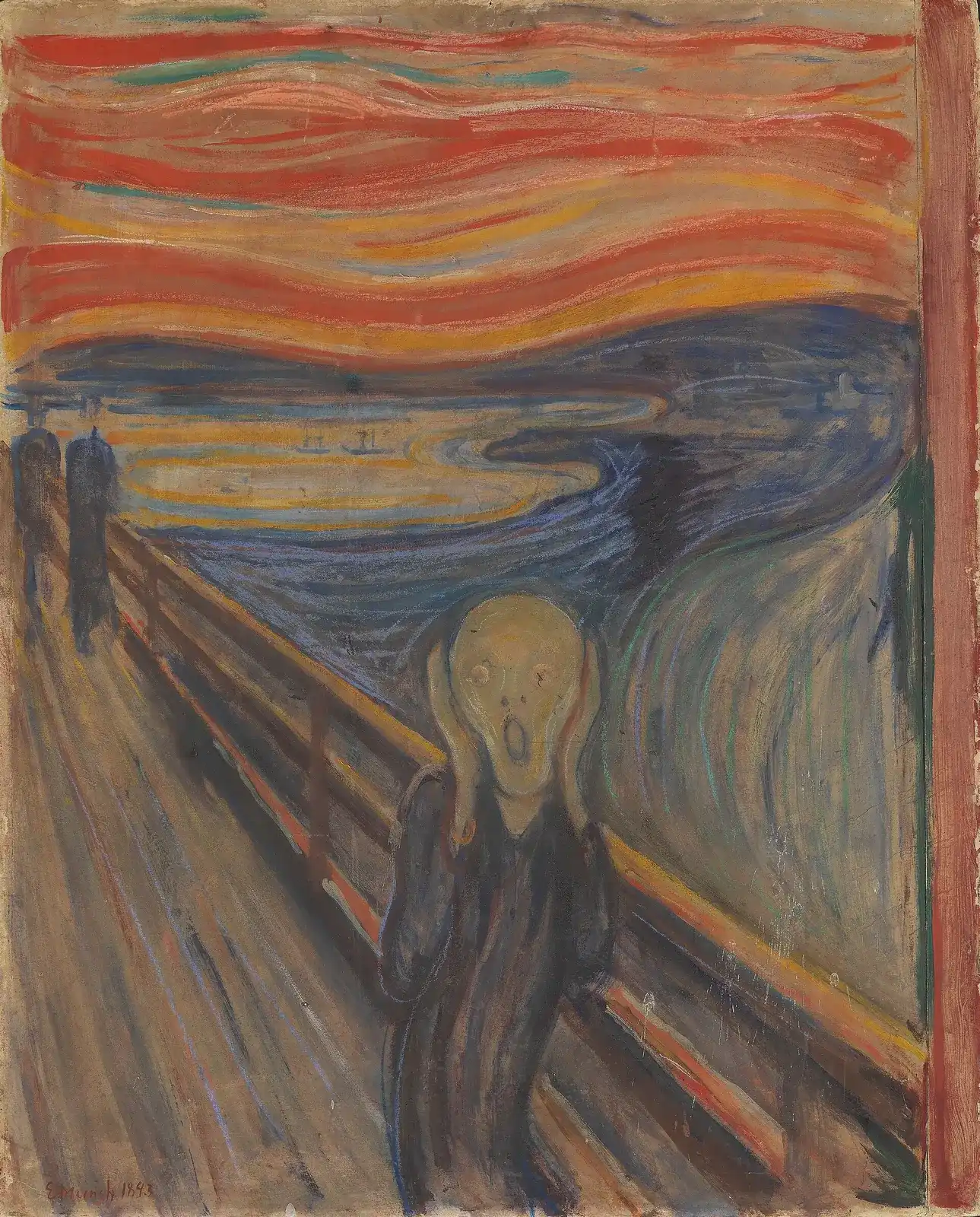
Historical Munch’s scream. The Norwegian painter Edvard Munch (1863 to 1944) painted The Scream in 1893; this version is in the National Museum in Oslo.
He described the moment in his notes: walking at sunset, the sky turned blood red, and he felt a great scream passing through nature. The figure is not screaming so much as hearing. Munch worked in Berlin in the 1890s, in a circle that included the Swedish writer August Strindberg.
Historical Die Brücke. In Dresden in 1905, Ernst Ludwig Kirchner and fellow students founded Die Brücke, “The Bridge”. They painted city streets, bathers and the tensions of modern life with jagged forms and acid colors, and revived the woodcut, inspired by medieval German prints and by African and Oceanic sculpture in ethnographic museums.
They admired that sculpture, but knew almost nothing about its makers or meanings. Paula Modersohn-Becker, working in the artists’ village of Worpswede, painted peasant women, children and many frank self-portraits in simplified, monumental forms before her early death in 1907.
The Blue Rider. 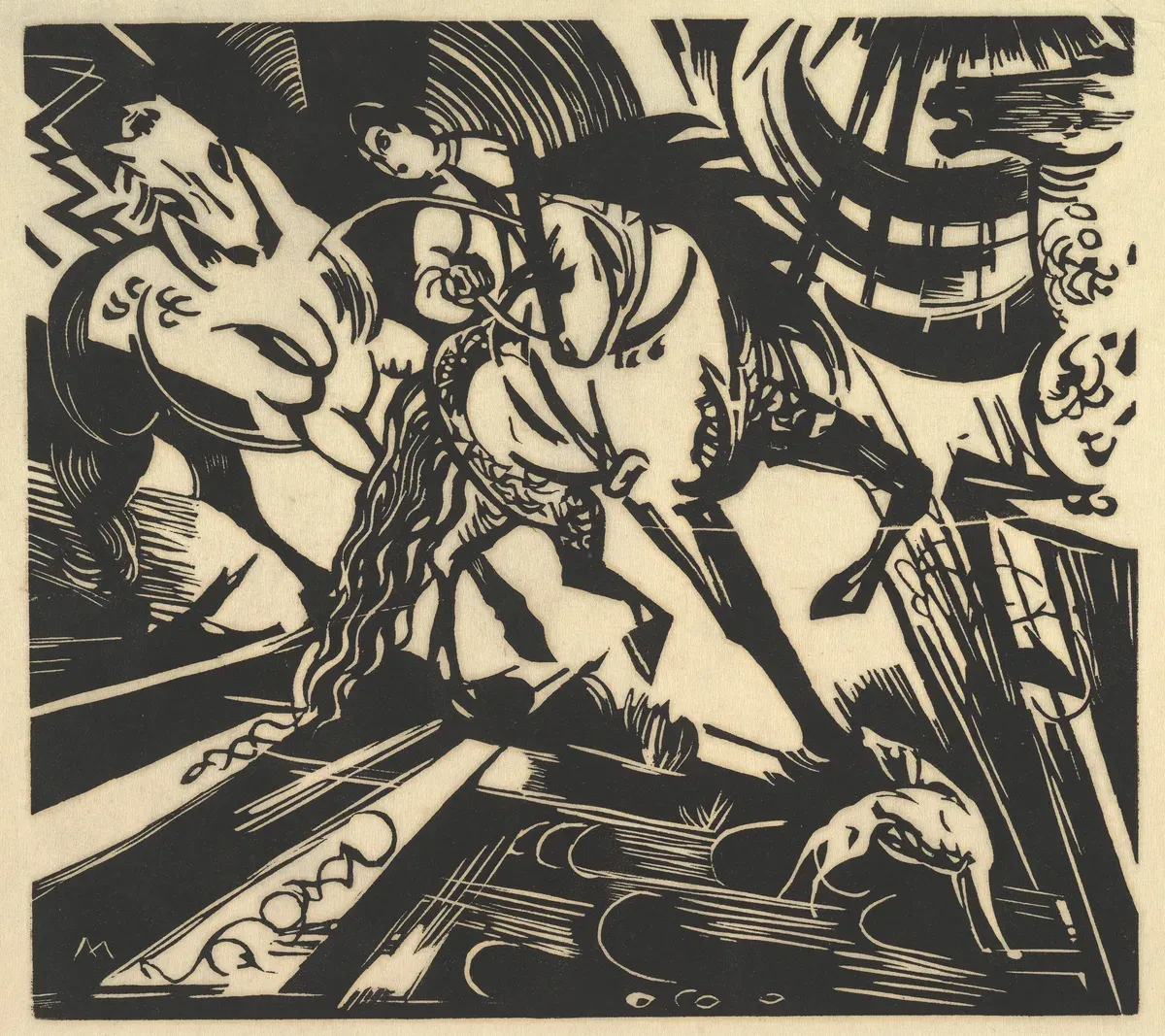
Franz Marc, The Riding School, 1913. The Metropolitan Museum of Art (1984.1203.85). Image: Open Access, public domain (CC0).
Historical In Munich, Wassily Kandinsky and Franz Marc formed Der Blaue Reiter, “The Blue Rider”, and in 1912 published an almanac under that name, mixing modern paintings with folk art, children’s drawings and Bavarian glass paintings. Gabriele Münter, Kandinsky’s partner, painted the village of Murnau in strong, simple color.
Marc painted animals, blue horses and red deer, believing they lived closer to the spirit of nature than people did. This woodcut of 1913 turns a riding school into a whirl of forms. Marc was killed at Verdun in 1916.
Key artists
| Artist | Lived | Why they matter |
|---|---|---|
| Edvard Munch | 1863 to 1944 | The Norwegian painter of anxiety, love and death. |
| Ernst Ludwig Kirchner | 1880 to 1938 | A founder of Die Brücke, painter of jagged city streets. |
| Franz Marc | 1880 to 1916 | The painter of blue horses and animals as spiritual beings. |
| Wassily Kandinsky | 1866 to 1944 | Co-founder of the Blue Rider and a pioneer of abstraction. |
| Gabriele Münter | 1877 to 1962 | Blue Rider painter of bold, simplified landscapes. |
| Paula Modersohn-Becker | 1876 to 1907 | The German painter of strong, simple figures. |
How do you recognise Expressionism?
Look for color and form bent to express feeling: green faces, red skies, jagged outlines and rough brushwork. Woodcuts are cut boldly with visible gouges. Subjects include city anxiety, nature as spirit, and the inner life of the artist.
Common misconceptions. One is that Expressionism means “angry painting”. Much of it is joyful or spiritual: Franz Marc’s blue horses were meant to express calm and spiritual strength, not rage.
Another is that it was a single group. Die Brücke in Dresden and Berlin and the Blue Rider in Munich had very different ideas, and many Expressionists, like Paula Modersohn-Becker in Worpswede, belonged to neither. A third is that it was purely German. Munch was Norwegian, Kandinsky and Werefkin were Russian, and in Finland Tyko Sallinen and the November Group of 1916 brought Expressionism to Helsinki.
Esoteric themes
Historical Kandinsky’s book Concerning the Spiritual in Art, dated 1912, argued that color and form act directly on the soul, like music. He named Madame Blavatsky and the Theosophical Society as signs of a spiritual turning point. In Paris in the 1890s Strindberg tried to make gold in alchemical experiments, and told the story in his book Inferno (1897).
Later tradition In 1937 the Nazi regime mocked Expressionism in the Degenerate Art exhibition in Munich. It drew around two million visitors. Many works were sold abroad or destroyed, and many artists fled.
History is not always simple: Emil Nolde, whose works hung in the exhibition, was himself a member of the Nazi party, a fact long hidden and examined openly in a Berlin exhibition in 2019. The persecution of modern art was part of the persecution of people.
Modern The Scream became an emoji. I find that funny and a little sad. I follow Kandinsky’s spiritual path in lesson 7 of the course.
Works to see
| Work | Artist | Date | Where to see it |
|---|---|---|---|
| The Scream | Edvard Munch | 1893 | National Museum, Oslo |
| The Sick Child | Edvard Munch | 1885 to 1886 | National Museum, Oslo |
| Street, Dresden | Ernst Ludwig Kirchner | 1908 | The Museum of Modern Art, New York |
| Blue Horse I | Franz Marc | 1911 | Lenbachhaus, Munich |
Every work in this list is free of nudity, so you can look them up with confidence. Works still in copyright are named but not shown here.
How to look at an Expressionist painting
Ask what the colour is doing instead of what it shows. A blue horse is not a mistake; it is a feeling. Then look at the brushwork, which is often fast and visible, and at the space, which tilts and pushes the figures toward you.
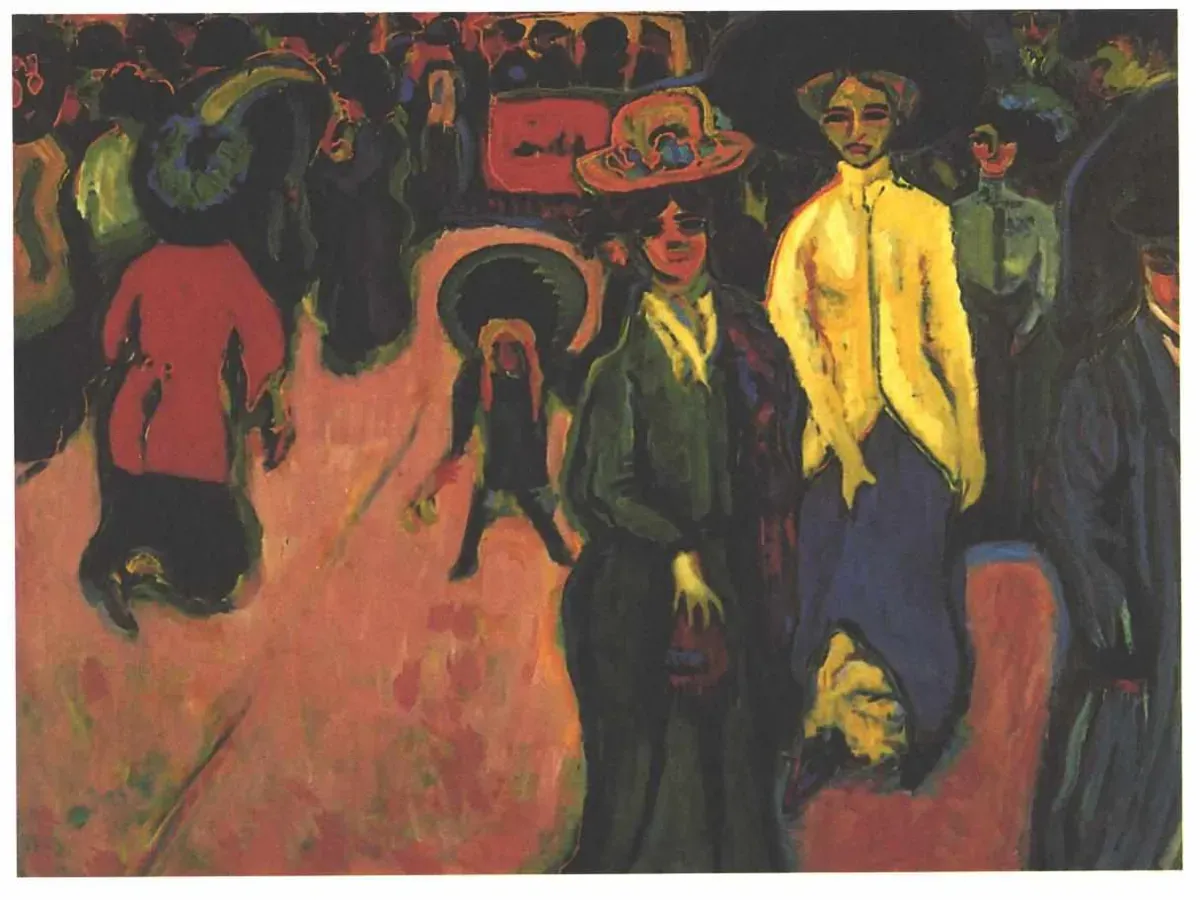
Ernst Ludwig Kirchner, Street, Dresden, 1908 (dated 1907). Museum of Modern Art, New York. Image: Wikimedia Commons, public domain.
Ernst Ludwig Kirchner, Street, Dresden, 1908 (dated 1907). At the Museum of Modern Art in New York. The pink pavement rises steeply, the faces are like masks, and nobody looks at anybody. Kirchner turned a city street into a picture of modern loneliness.
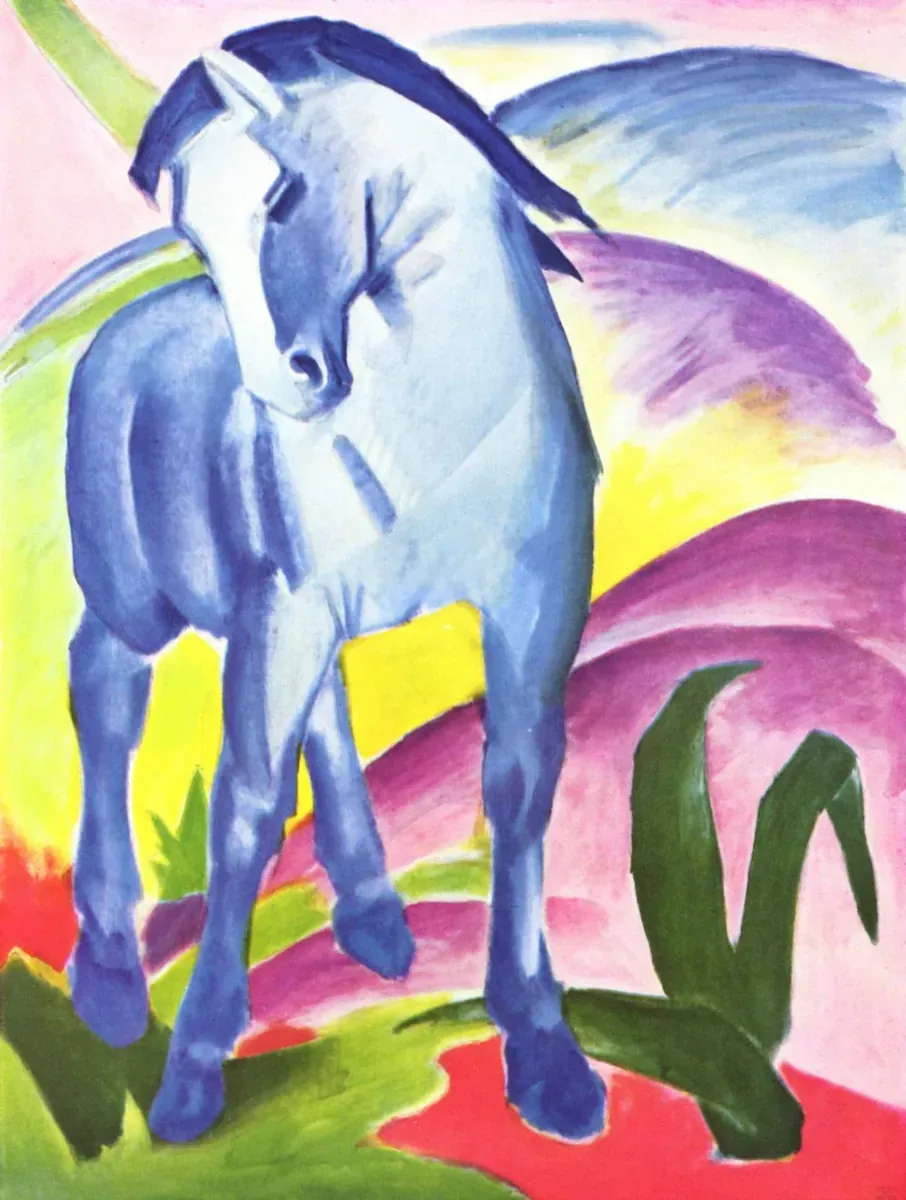
Franz Marc, Blue Horse I, 1911. Lenbachhaus, Munich. Image: Wikimedia Commons, public domain.
Franz Marc, Blue Horse I, 1911. At the Lenbachhaus in Munich. For Marc, blue was the colour of the masculine and the spiritual. The curves of the hills echo the curves of the horse, as if the animal and the landscape were one. Marc was killed at Verdun in 1916.
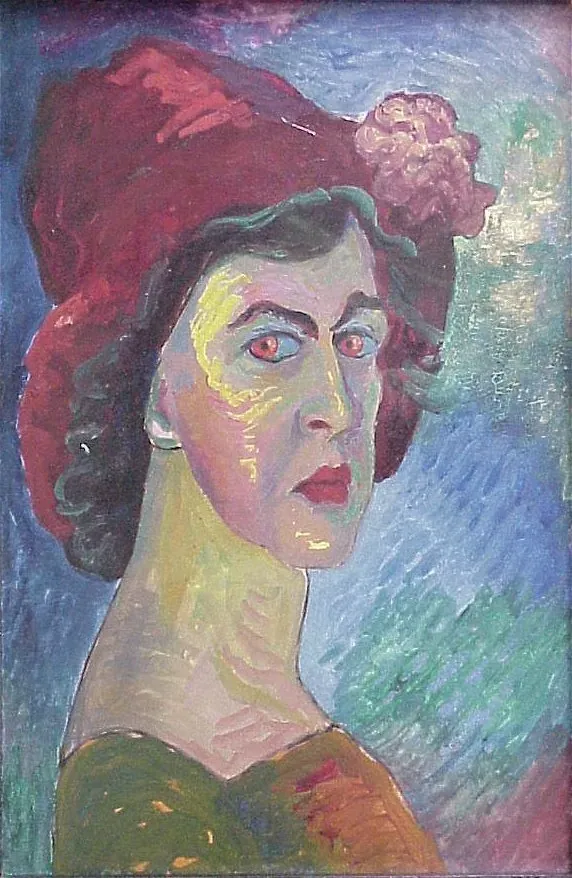
Marianne von Werefkin, Self-Portrait I, about 1910. Lenbachhaus, Munich. Image: Wikimedia Commons, public domain.
Marianne von Werefkin, Self-Portrait I, about 1910. Also at the Lenbachhaus. Werefkin was a trained painter in Russia before she came to Munich, and her salon was a meeting place for the circle that became the Blue Rider. Look at the burning red of the eyes. This is a woman seeing, not being seen.
Expressionism grew from Post-Impressionism, Symbolism and Fauvism, led into early abstraction and Dada, and its emotional brushwork returned after 1945 in Abstract Expressionism.
Try this
Look at The Scream on the National Museum website. Cover the figure with your hand. Does the sky alone still feel anxious? Then cover the sky. What does the figure say without it?
What next
Before this: Fauvism.
After this: Cubism.
Also worth reading alongside it: Symbolism.
See every movement in order on the art movements timeline, or learn to look step by step in the free Art History for Beginners course.
If you want to carry this into tarot and practice, these pages connect to it: The Tower, sudden shock and inner upheaval; Nine of Swords, anxiety in the night; Kandinsky and the spiritual in art; and Looking after yourself when images stir up strong feelings.
Sources
- Wassily Kandinsky, Concerning the Spiritual in Art (Munich: Piper, dated 1912; English trans. M. T. H. Sadler, The Art of Spiritual Harmony, 1914) (1911).
- Wassily Kandinsky and Franz Marc (eds.), Der Blaue Reiter (almanac) (1912).
- August Strindberg, Inferno (1897).
- The Metropolitan Museum of Art, The Riding School, 1984.1203.85. Open the record
- Nasjonalmuseet, Oslo, The Scream. Open the record
- E. H. Gombrich, The Story of Art (1950).
- Wikimedia Commons, The Scream (hero image record). Open the record
- Shulamith Behr, Expressionism (1999).

Questions
What is Expressionism?
Art that distorts form and color to show inner feeling rather than outer appearance. It was strongest in Germany and Austria from about 1905 to the 1920s, with Edvard Munch as an important forerunner.
What was the Degenerate Art exhibition?
A 1937 Nazi exhibition in Munich that mocked modern art confiscated from German museums, including Expressionist works and works by Jewish artists. Many works were later sold abroad or destroyed.
Where can I see works of Expressionism in person?
Good places to start are Oslo (the National Museum, the Munch Museum), Berlin, Munich (the Lenbachhaus), Vienna, and the Met. Museums change their displays, so check the collection page before you travel.
What is the difference between Die Brücke and the Blue Rider?
Die Brücke (The Bridge), founded in Dresden in 1905, painted raw, urban and erotic subjects in harsh colour. The Blue Rider (Der Blaue Reiter), named after the almanac of 1912 edited by Kandinsky and Marc in Munich, was more spiritual and moved toward abstraction.
Who were the women of Expressionism?
Gabriele Münter, Marianne von Werefkin, Paula Modersohn-Becker, Käthe Kollwitz and Else Lasker-Schüler are among the best known.
Is there Expressionism in Finnish art?
Yes. Tyko Sallinen brought an Expressionist style to Finland in the 1910s, and his Washerwomen (1911) is at the Ateneum in Helsinki. He was a leading member of the November Group, founded in 1916.
Get the free Mini-Grimoire
A short printable starter guide to tarot and everyday witchcraft, plus my newsletter. Unsubscribe any time.
Opens Substack in a new tab to confirm. More about the newsletter · Privacy