


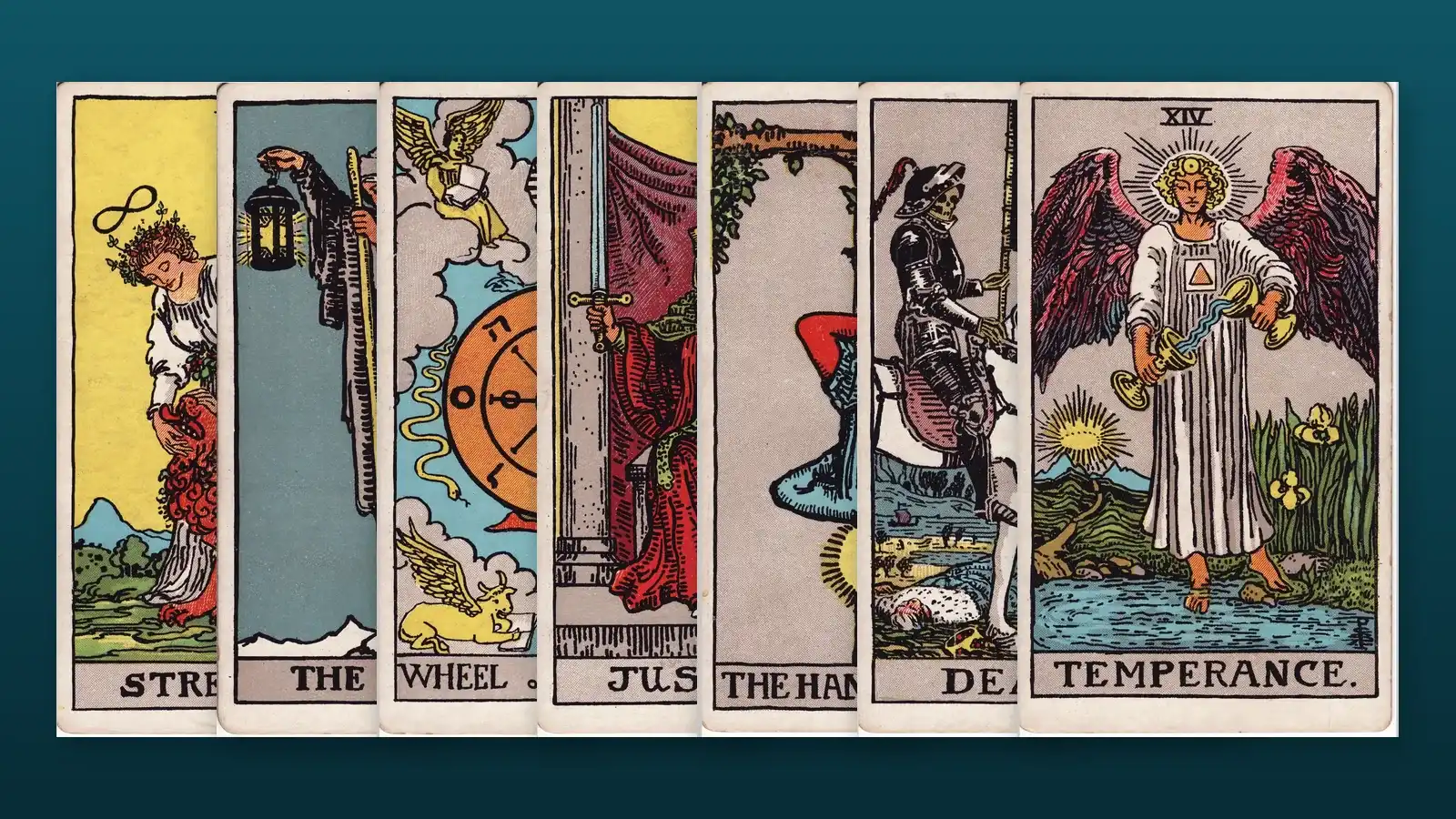
In this lesson: the middle Major Arcana cards, from Strength to Temperance, the cards of tests, limits and resilience.
Welcome to the middle of the journey. These seven cards are the world’s tests: courage, solitude, change, fairness, surrender, endings and balance. They include two cards that frighten many beginners, the Hanged Man and Death, and they turn up most often in readings about hard periods of life. By the end of this lesson I hope they feel like teachers rather than threats.
Courage and solitude: Strength and the Hermit
Strength, card VIII in the 1909 deck, is courage, compassion and patience. A woman gently closes a lion’s jaws, an infinity sign above her head. This is not the strength of force. It is gentle courage and patience: calm, kind and steady, the strength that soothes rather than conquers. Reversed, it can show self-doubt or insecurity.
The Hermit, card IX, is introspection, solitude and wisdom. An old man stands alone on a mountain peak, holding up a lantern with a star inside. He asks for time alone to find your own light. Reversed, healthy solitude may be turning into isolation.
Change and consequence: the Wheel of Fortune and Justice
The Wheel of Fortune, card X, is fate, cycles and change. A great wheel turns in the sky, with a sphinx on top and four winged creatures in the corners reading books. What goes up comes down, and the other way around. Reversed, someone may be resisting a turn of the wheel that has already happened.
Justice, card XI, is fairness, truth and law. A figure on a throne holds an upright sword and a set of scales. It speaks of cause and effect, honest choices and accountability. Reversed, look for unfairness or avoided responsibility.
Surrender, endings and healing: the Hanged Man, Death and Temperance
The Hanged Man, card XII, is about surrender, letting go and new perspectives. A man hangs upside down by one foot from a living tree. Look at his face: it is calm, and there is light around his head. This is a chosen pause and a new perspective, not a punishment. Reversed, the pause may have become stalling or indecision.
Death, card XIII, is transformation, endings and rebirth. A skeleton in armor rides a white horse while people of every rank stand before him, and on the horizon a sun rises between two towers. A chapter closes so that a new one can begin. It never predicts a physical death. Reversed, it shows fear of change or holding on to what is already over.
Temperance, card XIV, follows Death and brings balance. A winged angel pours water between two cups, one foot in a pool and one on land. It is blending, moderation and healing after an ending. Reversed, it can show excess or swinging between extremes.
The virtues and the missing one
Historical Three cards in this group, Strength, Justice and Temperance, are three of the four “cardinal virtues” of classical and medieval thought: fortitude, justice, temperance and prudence. Renaissance viewers would have recognized them at once, since the virtues were painted in churches, town halls and tombs. The fourth, prudence, is missing from the tarot, and historians have argued about why. Some suggest that the Hermit, with his lamp or hourglass, or the Star took its place. Nobody knows for certain.
Historical In early Italian decks the Hermit was often an old man holding an hourglass, sometimes called “the Old Man” or “the Hunchback”, and he may have stood for Time rather than for a spiritual seeker. The Hanged Man has a darker origin. In Renaissance Italy, traitors and fraudsters were sometimes painted on public walls hanging upside down by one foot, a punishment by shame called pittura infamante. Some early lists call the card “the Traitor”. The calm, haloed figure of the 1909 deck is a later, mystical reworking.
Fortune’s wheel in an old book
Historical The Wheel of Fortune was one of the best known images of the Middle Ages. In The Consolation of Philosophy, written around 524 by the Roman statesman Boethius while he awaited execution, Lady Philosophy reminds him that Fortune’s nature is to turn her wheel, raising the low and bringing down the high. Medieval artists often drew figures climbing, sitting on top of, falling from and lying under the wheel, sometimes with labels meaning “I shall reign”, “I reign”, “I have reigned” and “I am without reign”. Early tarot wheels often show those same four figures.
Seeing the pattern
After the Chariot’s victory, life tests the traveler. Strength asks for gentle courage. The Hermit sends you inward. The Wheel reminds you that nothing stays still, and Justice that choices have consequences. The Hanged Man asks you to let go, Death closes a chapter, and Temperance blends what is left into something new. Read these seven as one story and you will notice that it ends in balance, not in disaster. Smith put hope into the hardest images: the Hanged Man’s calm face, the sun rising behind Death. You can look for that hope too.
An example: reading Death with Temperance
Imagine someone asks, “What do I need to understand about the end of my friendship?” and draws Death followed by Temperance. Fear might fix on the skeleton. But read as a pair, the cards tell a gentle story: the friendship as it was has ended, and what follows is a slow mixing of old and new, healing at its own pace. The practical advice is patience, not drama. Sequence matters: Temperance after Death is the very order of the Major Arcana.
How to remember them
Choose one keyword and one picture detail for each card: the lion, the lantern, the wheel, the scales, the living tree, the rising sun and the two cups. Say them out loud while you look at each card. It feels silly the first time, and it works.
A variation: reading the virtues together
When Strength, Justice or Temperance appear in a reading, ask which virtue the situation calls for: courage, fairness or balance. If two appear together, notice how they relate. Strength with Justice might mean standing up for what is fair. Justice with Temperance might mean a fair compromise. This simple question often gives a clear, practical message.
Waite describes the middle cards
Historical Waite’s own descriptions in The Pictorial Key to the Tarot (1910) help with several cards in this group.
Strength. He notes that the woman’s “beneficent fortitude has already subdued the lion, which is being led by a chain of flowers.” The chain of flowers is the key to the card: gentle strength rather than force. About moving the card to number VIII he was famously brief: “For reasons which satisfy myself, this card has been interchanged with that of justice, which is usually numbered eight.”
The Hermit. Waite insisted that the Hermit holds up his light for others. “His beacon intimates that ‘where I am, you also may be.’” That turns a card often read as loneliness into a card of guidance.
The Hanged Man. He asked readers to notice that “the face expresses deep entrancement, not suffering”, and that the figure “suggests life in suspension, but life and not death.” This is the source of the modern reading of the card as a pause, a waiting that is not wasted.
Temperance. Of the angel he wrote: “I speak of him in the masculine sense, but the figure is neither male nor female.” The angel pours between two cups, with one foot on land and one in water, an image of blending and balance.
Practice variations
Look at the faces. Lay out the seven cards and study only the faces. Who looks calm, who looks serious, who is hidden? Waite’s note on the Hanged Man shows how much a face can change a meaning.
The pause week. Choose the Hanged Man as your card for a week. Each day, notice one moment when waiting rather than acting would help. Write it down. By the end of the week the card will feel like a friend rather than a warning.
Wheel and Justice side by side. Place the Wheel of Fortune and Justice next to each other. One shows events you cannot control, the other the results of choices you made. For one recent event in your life, ask how much belonged to each card. Most events have a little of both, and seeing that balance is a useful lesson in itself.
The middle cards in everyday life
These cards often turn up when life asks for endurance. A long project, a recovery, a difficult season at home: these are Strength, Hermit and Temperance times. They are rarely dramatic, and that is their gift. When several of them appear in a reading, the message is often to keep going steadily, rest when you need to, and trust slow progress.
A quick memory chain
Link the seven cards in one sentence: with gentle strength (VIII), I seek my own light (IX), accept that fortune turns (X), weigh my choices fairly (XI), pause to see anew (XII), let an old chapter end (XIII) and blend what remains into balance (XIV). Say it aloud a few times this week.
Questions beginners ask
Why are Strength and Justice numbered differently in some decks? Lesson 3 on the Fool’s Journey explains Waite’s swap; read the card by its name.
Is the Hanged Man a punishment card? In modern reading it is more often about pausing, letting go and seeing from a new angle.
Does Death in this group mean someone will die? No. It marks endings and change.
Myths to drop: The Hermit is not about loneliness only; he can be about chosen solitude and wisdom. The Wheel of Fortune is not always good luck. And Temperance is not about giving up alcohol, although moderation is one of its meanings.
Try this
Find the card from today’s seven that you would least like to draw. Look at it for a full minute and write one calm sentence about what it might teach you.
Recap
The middle Majors are life’s tests. Strength shows gentle courage and patience, the Hermit wise solitude, the Wheel the turning of cycles and Justice cause and effect. The Hanged Man is a chosen pause and a new perspective, Death is an ending that makes room for new life, and Temperance follows Death and brings balance and healing.
What next
Press “Mark as done” and continue with The Devil to the World. If any card here still feels heavy, revisit When a hard card appears.
Further reading: Boethius, The Consolation of Philosophy, book 2, in the public domain translation by H. R. James (1897).
Sources
- Lauri Mukkala, The Novice’s Guide to Tarot, “Major Arcana VIII to XIV”.
- A. E. Waite, The Pictorial Key to the Tarot (London: Rider, 1910).
Quick check
Go deeper: The Novice's Guide to Tarot: Major Arcana VIII to XIV
Get the free Mini-Grimoire
A short printable starter guide to tarot and everyday witchcraft, plus my newsletter. Unsubscribe any time.
Opens Substack in a new tab to confirm. More about the newsletter · Privacy
Comments
Questions and notes from readers. Anyone with a free account can comment, and I reply when I can. Please read the community guidelines.
Comments load from Google Firebase (EU) when you ask for them. Nothing is stored on your device. Privacy