


| Arcana | Major Arcana |
|---|---|
| Number | XX |
| Image | RWS 1909 (PD) |
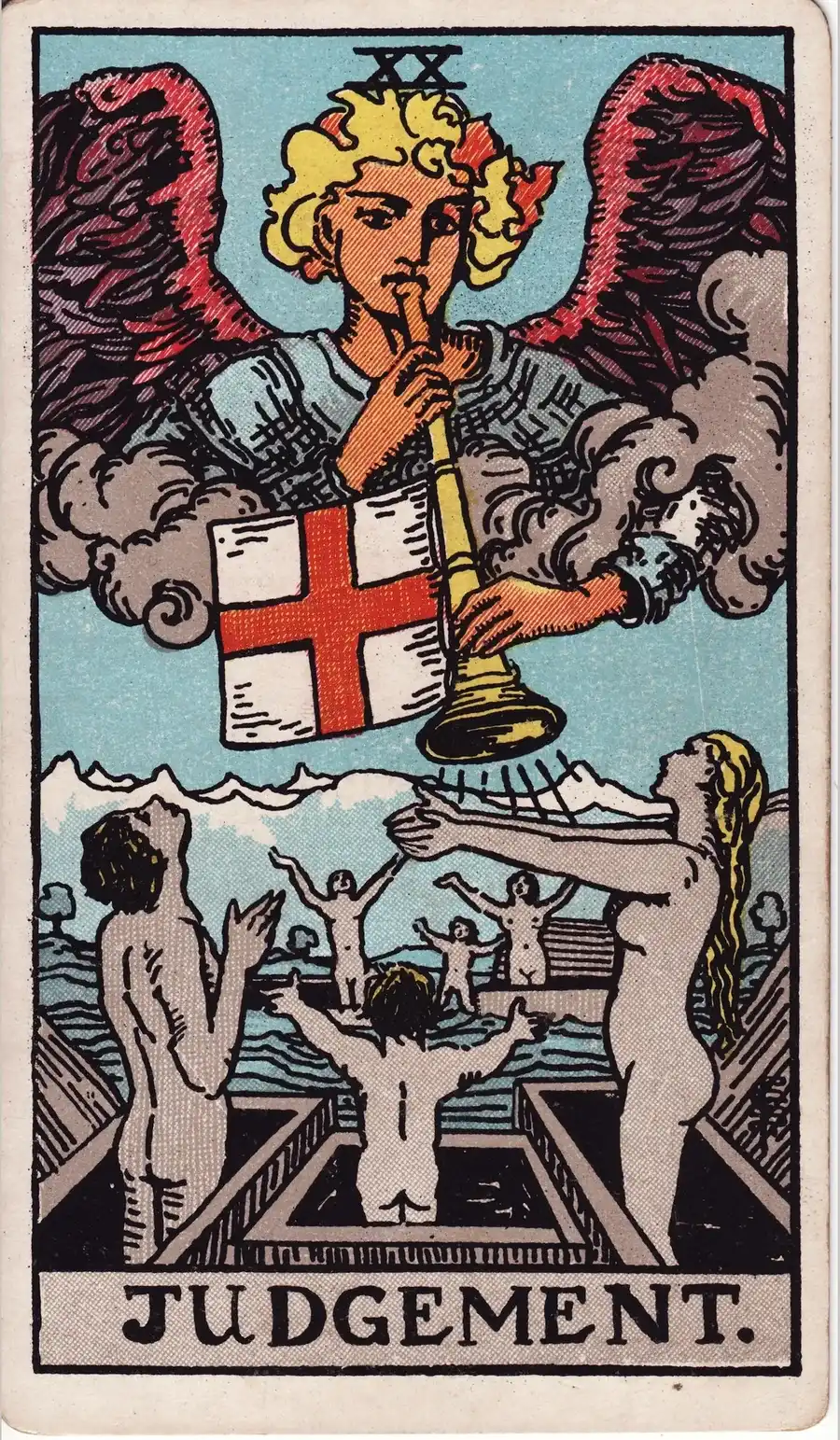
Judgement is card XX of the Major Arcana. An angel blows a trumpet from the clouds, and people rise from their graves with their arms open.
It is the card of the wake-up call: a moment when you hear something that asks you to rise, review your life and answer. Here is what Judgement means upright and reversed, the symbols in the 1909 card and its history.
Here is Judgement at a glance.
| At a glance | This card |
|---|---|
| Upright keywords | awakening, reckoning, a calling, renewal |
| Reversed keywords | self-doubt, a harsh inner critic, ignoring the call |
| Number | XX (20) in the Major Arcana |
| Golden Dawn title | The Spirit of the Primal Fire Later tradition |
| Hebrew letter | Shin (ש), “tooth” Later tradition |
| Tree of Life path | 31, from Hod to Malkuth Later tradition |
| Astrology | Fire (Golden Dawn); Pluto is a twentieth-century addition Later tradition |
| Element | Fire Later tradition |
| Yes or no | Yes Modern |
The Golden Dawn gave Judgement the element of fire and the letter Shin, the third “mother letter” with Aleph and Mem, whose three flames the Order also linked with spirit. Pluto, found in many modern books, was only discovered in 1930 and was added to the card afterwards. The image is the Last Judgement of Christian art: the angel’s trumpet and the dead rising from their tombs.
The card: what Pamela Colman Smith drew
The 1909 card shows an angel in the clouds blowing a trumpet, while unclothed figures rise from their tombs below with their arms raised. Waite described how “the great angel is here encompassed by clouds, but he blows his bannered trumpet, and the cross as usual is displayed on the banner”.
The angel and the trumpet. A great angel, often named as Gabriel, sounds a trumpet from the clouds. It is a call that cannot be ignored. Waite asked: “What is that within us which does sound a trumpet and all that is lower in our nature rises in response?”
The banner with the cross. A flag with a red cross on white hangs from the trumpet. The equal-armed cross is a sign of balance, the meeting of opposites.
The rising figures. A man, a woman and a child rise from their tombs with their arms open. Waite pointed out that all the figures are “as one in the wonder, adoration and ecstasy expressed by their attitudes”. They answer the call together.
The mountains and the water. Behind them are icy mountains and the coffins float on water. The old life is cold and finished. Something new is waking.
Upright meaning
Upright, Judgement is the call you cannot ignore. An angel, usually identified as Gabriel, blows a trumpet with a cross-marked banner from the clouds. Below, men, women and children rise from coffins floating on water, arms raised towards the sound. Behind them are snow-covered mountains.
The card describes awakening, reckoning and renewal. It often appears when someone realizes what their life has been asking of them: a vocation, a change of direction or a truth about the past that can finally be faced. It is about rising to meet that call, not about being judged by someone else.
Judgement also speaks of forgiveness and of honest review. Look back at what has happened, accept what was, and let it lift you into the next stage.
Reversed meaning
Reversed, the call goes unheard, or it is heard and refused. The card can describe self-doubt, harsh self-judgment, or a decision put off because you are afraid of being wrong. It can also describe holding on to guilt or regret long after it has stopped teaching anything.
Ask what you keep hearing and pretending not to. Then ask whether you are judging yourself more harshly than the situation deserves. The reversed card often asks for self-forgiveness before any change can happen.
In love, work and spirituality
In love. Upright: A second chance, a reconciliation or a clear decision about the future of a relationship. Reversed: Old hurts still blocking the way; reluctance to forgive or decide.
At work. Upright: A calling, a career change or a decision that shapes your direction for years. Reversed: Ignoring a vocation, or self-doubt holding you back.
With money. Upright: Reviewing past choices and making a clear plan. Reversed: Repeating old money mistakes without learning from them.
In spiritual practice. Upright: Awakening, rebirth and answering a calling. Reversed: Guilt, fear of judgment, or ignoring an inner call.
As feelings. Clarity and a wish to move forward together, or to resolve the past.
As a person. Reflective, decisive and responsive to a sense of purpose.
As advice. Answer the call; review, forgive and rise.
Reading Judgement: positions, pairs and yes or no
In the past position: A wake-up call that changed your path. In the present position: Something is calling you to review and rise.
In the future position: A second chance or a big decision. As advice: Answer the call honestly, and forgive what can be forgiven.
When Judgement shows up among mostly Minor cards, give it extra weight: the theme of awakening runs under the whole question.
Pairs matter too. Next to Death, it can mean an ending followed by a new calling. Next to The World, it can mean a cycle completed after honest review. Next to The Hermit, it can mean reflection that leads to awakening.
In modern yes or no readings, Judgement leans yes. It is a call to rise and act, so it leans yes, especially for second chances.
The history and art behind the card
In the Tarot de Marseille pattern the card is called Le Jugement, the Judgement. Judgement is one of the most stable images in tarot. Waite noted that “this symbol is essentially invariable in all Tarot sets”.
From the earliest Italian cards on, it shows angels with trumpets and the dead rising from their graves, based on Christian pictures of the Last Judgment.
Waite himself called the card The Last Judgment, and the Marseille name is Le Jugement. Many English decks use the spelling Judgement, which is also used on this site. Smith made one change: there are more than three figures rising, which Waite said illustrated “the insufficiency of current explanations”.
Waite said the card should stay the Last Judgment “for those who can see no further”, but that people with “inward eyes” would see a card of inner transformation. Modern readers follow that inner reading. The Golden Dawn linked it to the element of fire, and some modern writers add Pluto.
When A. E. Waite published The Pictorial Key to the Tarot in 1910, he listed these divinatory meanings for the card: “Change of position, renewal, outcome. Another account specifies total loss through lawsuit.”
Reversed, he gave: “Weakness, pusillanimity, simplicity; also deliberation, decision, sentence.” Waite himself called the fortune-telling meanings of the trumps “artificial and arbitrary”, and on this site I read the picture first and treat lists like this as history.
Late in the modern Fool’s Journey, Judgement is the call that the traveler answers by rising. Everything learned so far is gathered up and reviewed, and the person who stands up from it is ready for the last card.
Common questions
Is it Judgement or Judgment? Both spellings are used. The 1909 deck says Judgement on the card. Waite’s book called it The Last Judgment.
What does Judgement mean in love? A second chance, honest reflection or a new stage. Reversed, guilt or refusing to repair things.
Try this
Try this small spread for Judgement. Use it when you feel a call to change your life.
| Card | Question | What it shows |
|---|---|---|
| 1 | What is calling me? | The summons I keep hearing. |
| 2 | What must I review? | What in my past needs honest attention. |
| 3 | How do I rise? | The first step in answering. |
Affirmation: I answer the call to reckon honestly and rise into what follows.
Reversed affirmation: I quiet the punishing critic and face the reckoning that frees me.
If you keep a tarot journal, take one of these questions to it: What is calling me right now? What part of my past do I need to forgive? If I answered the call, what would change?
What next
Cards that sit close to this one are Death (the ending that comes before the rising), The World (the next and final card: completion) and Justice (fairness, where Judgement is awakening).
Judgement is part of the lesson The Devil to the World in my free Tarot for Beginners course. To keep walking the Major Arcana, read the card before it, The Sun or the card after it, The World, or go back to all the card meanings.
For every card with keywords, affirmations and examples, see my book The Novice’s Guide to Tarot. If you would like a printable cheat sheet for all 78 cards, my 45-page Tarot Workbook is on Etsy.
Sources
- A. E. Waite, The Pictorial Key to the Tarot (London: Rider, 1910), Part II and Part III, section 3.
- Pamela Colman Smith and A. E. Waite, the Rider-Waite-Smith tarot (London: Rider, 1909).
- Nicolas Conver, Tarot de Marseille (Marseille, 1760).
- Eden Gray, A Complete Guide to the Tarot (New York: Crown, 1970), epilogue “The Fool’s Journey”.
- Lauri Mukkala, The Novice’s Guide to Tarot, entry for Judgement.
- Aleister Crowley, 777 (London: Walter Scott, 1909), columns of the Hebrew letters, paths and Tarot trumps.
- Israel Regardie, ed., The Golden Dawn (Chicago: Aries Press, 1937 to 1940), “Book T” and the titles of the trumps.
All 78 cards
Major Arcana
- The Fool
- The Magician
- The High Priestess
- The Empress
- The Emperor
- The Hierophant
- The Lovers
- The Chariot
- Strength
- The Hermit
- Wheel of Fortune
- Justice
- The Hanged Man
- Death
- Temperance
- The Devil
- The Tower
- The Star
- The Moon
- The Sun
- Judgement
- The World
Wands
- Ace of Wands
- Two of Wands
- Three of Wands
- Four of Wands
- Five of Wands
- Six of Wands
- Seven of Wands
- Eight of Wands
- Nine of Wands
- Ten of Wands
- Page of Wands
- Knight of Wands
- Queen of Wands
- King of Wands
Cups
- Ace of Cups
- Two of Cups
- Three of Cups
- Four of Cups
- Five of Cups
- Six of Cups
- Seven of Cups
- Eight of Cups
- Nine of Cups
- Ten of Cups
- Page of Cups
- Knight of Cups
- Queen of Cups
- King of Cups
Swords
- Ace of Swords
- Two of Swords
- Three of Swords
- Four of Swords
- Five of Swords
- Six of Swords
- Seven of Swords
- Eight of Swords
- Nine of Swords
- Ten of Swords
- Page of Swords
- Knight of Swords
- Queen of Swords
- King of Swords
Pentacles
Get the free Mini-Grimoire
A short printable starter guide to tarot and everyday witchcraft, plus my newsletter. Unsubscribe any time.
Opens Substack in a new tab to confirm. More about the newsletter · Privacy