


| Arcana | Major Arcana |
|---|---|
| Number | IV |
| Image | RWS 1909 (PD) |
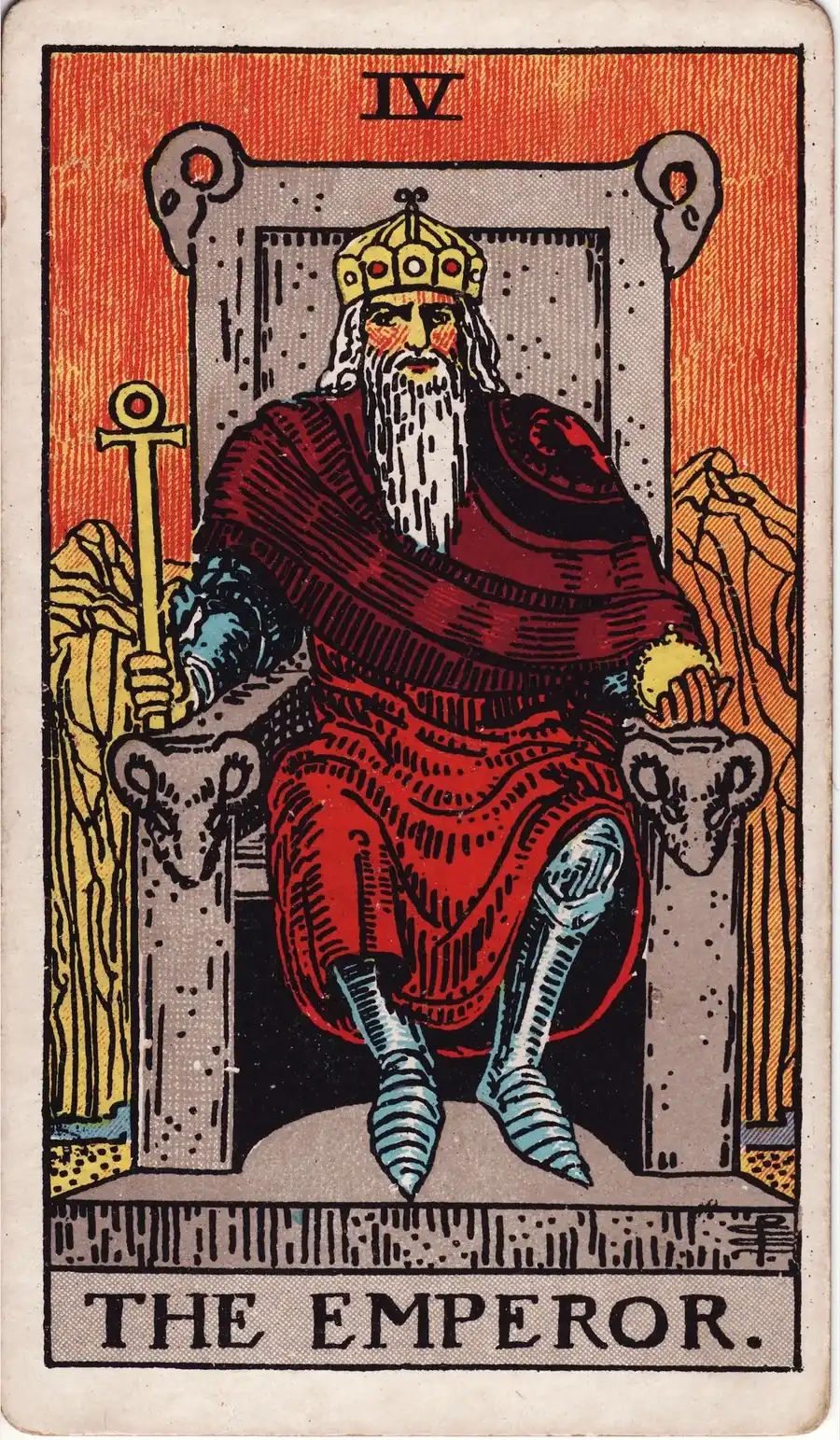
The Emperor is card IV of the Major Arcana, the builder of order. An older ruler sits on a stone throne in front of bare red mountains, holding a scepter and an orb.
Where the Empress grows, the Emperor builds the walls that protect what grows. Here is what the Emperor means upright and reversed, the symbols in the 1909 card and the history of the throne he sits on.
Here is the Emperor at a glance.
| At a glance | This card |
|---|---|
| Upright keywords | structure, authority, stability, protection |
| Reversed keywords | domination, rigidity, chaos |
| Number | IV (4) in the Major Arcana |
| Golden Dawn title | Son of the Morning, Chief among the Mighty Later tradition |
| Hebrew letter | Heh (ה), “window” (Golden Dawn); Tzaddi in Crowley’s later Thoth system Later tradition |
| Tree of Life path | 15, from Chokmah to Tiphareth Later tradition |
| Astrology | Aries Later tradition |
| Element | Fire Later tradition |
| Yes or no | Yes Modern |
The Golden Dawn gave the Emperor the sign Aries and the letter Heh. Smith painted rams’ heads on his throne, so the attribution is visible in the 1909 card. Aleister Crowley later swapped the letters of the Emperor and the Star, giving the Emperor Tzaddi, after a line in his Book of the Law (1904). Both versions exist in modern books, and this site follows the Golden Dawn, which is the system Waite and Smith used.
The card: what Pamela Colman Smith drew
Smith drew a stern, steady figure. Waite described a “crowned monarch” seated on “a throne, the arms of which are fronted by rams’ heads”. He called the card “executive and realization, the power of this world”.
The stone throne and the rams. His throne is a heavy stone block carved with rams’ heads. Rams are the sign of Aries, the first sign of the zodiac in later astrology. Stone says permanence: he builds to last.
The ankh and the orb. In one hand he holds a scepter shaped like an ankh, an Egyptian sign of life, and in the other a golden orb, a sign of rule over the world. These are symbols of responsibility, not only of power.
The armor. Under his red robe you can see armor on his legs. He is ready to protect what he rules. The card is about boundaries, not only rules.
The bare mountains. Behind him rise steep red mountains with a thin river at their foot. It is a hard landscape. Structure is what makes such a place livable.
Upright meaning
Upright, the Emperor is structure that protects. He sits on a stone throne carved with rams’ heads, in armor under his red robe, against bare orange mountains. Nothing in the picture grows; everything has been built or held. Where the Empress lets life flourish, the Emperor gives it walls, roads and rules so it can last.
In a reading he points to order, responsibility and leadership. He often appears when a situation needs a plan, a boundary or someone willing to make a decision and carry it. He can describe a father, a boss, an institution or the law, and he can also describe the part of you that keeps promises and finishes what it starts.
The Emperor’s strength is reliability. His question is simple: what needs a framework, and who is willing to build and keep it?
Reversed meaning
Reversed, structure turns into control. The throne becomes a fortress: rules kept for their own sake, a leader who cannot hear criticism, or a parent or partner who decides everything. The card can also describe a personal rigidity, such as a schedule so strict that it crushes joy, or an inability to delegate.
The other reversed meaning is a lack of structure where it is needed. There is no plan, no boundary, nobody in charge, and everyone waits for someone else to decide.
Ask whether the problem is too much order or too little. Then make one change in the other direction: loosen one rule, or set one.
In love, work and spirituality
In love. Upright: Stability and commitment; a partner who shows love through reliability. Good for practical decisions together. Reversed: Control, jealousy or rigid roles; one partner making all the decisions.
At work. Upright: Leadership, promotion, clear processes and authority. Good for formal applications and contracts. Reversed: A domineering boss, bureaucracy, or a team with nobody steering.
With money. Upright: Budgets, long-term planning and secure investments. Build the structure first. Reversed: Financial control used as power, or no budget at all.
In spiritual practice. Upright: Discipline: a regular practice, a set time and place, and keeping your word to yourself. Reversed: Dogma, or a practice followed out of fear of breaking the rules.
As feelings. Protective, serious interest. The person wants to provide and to be relied on.
As a person. Steady, decisive and responsible; a natural organizer who can become controlling.
As advice. Build the framework, then let it serve life rather than replace it.
Reading the Emperor: positions and yes or no
In the past position: A structure, a rule or a person who gave you stability. In the present position: This situation needs a plan, a boundary or someone to take charge.
In the future position: Steady results that come from discipline and clear roles. As advice: Make a plan, set one boundary and keep it fairly.
When the Emperor shows up among mostly Minor cards, give it extra weight: the theme of structure runs under the whole question.
In modern yes or no readings, the Emperor leans yes. He builds things that last, so he usually says yes when you are willing to plan and take responsibility.
The history and art behind the card
In the Tarot de Marseille pattern the card is called L’Empereur, the Emperor. In the fifteenth century the Emperor was a real political figure, the Holy Roman Emperor, and early cards show him with the imperial eagle. The pairing of Empress and Emperor reflected the ranks of the world that played the game.
The rams and the link to Aries come from the Golden Dawn’s astrology, and the ankh reflects the nineteenth century fashion for Egyptian imagery. That fashion grew from Court de Gébelin’s claim in 1781 that tarot came from Egypt, a claim historians reject.
For a modern reader the Emperor is easier to like once you see him as a role rather than a man.
Anyone can sit on that throne: the parent who keeps a household running, the friend who makes the plan, the part of you that says no so that something else can grow. Read him as responsibility first and power second.
When A. E. Waite published The Pictorial Key to the Tarot in 1910, he listed these divinatory meanings for the card: “Stability, power, protection, realization; a great person; aid, reason, conviction; also authority and will.”
Reversed, he gave: “Benevolence, compassion, credit; also confusion to enemies, obstruction, immaturity.” Waite himself called the fortune-telling meanings of the trumps “artificial and arbitrary”, and on this site I read the picture first and treat lists like this as history.
In the Fool’s Journey, the modern teaching story that walks through the trumps in order, the Emperor comes right after the Empress and gives her abundance a frame. The traveler meets rules, boundaries and the first idea of being responsible for a territory.
Common questions
Is the Emperor a good card? Yes, in most readings. It means stability, protection and responsible leadership. Reversed, it warns about too much or too little control.
Does the Emperor represent a man? It can represent anyone in a role of authority, or your own ability to lead and set boundaries.
What does the Emperor mean in a love reading? A steady, protective partner and a relationship built to last. Reversed, look for control dressed up as care.
Try this
Try this small spread for the Emperor. Use it when you need to bring order to a messy situation.
| Card | Question | What it shows |
|---|---|---|
| 1 | Where do I need structure? | The area that is crying out for a frame. |
| 2 | What rule or boundary would help? | One practical change to make. |
| 3 | Where should I loosen my grip? | Where control has become rigid. |
Affirmation: I build structure that protects what matters without crushing it.
Reversed affirmation: I release domination and restore fair, living order.
If you keep a tarot journal, take one of these questions to it: Which part of my life needs a firmer frame? Who holds authority over me, and is it fair? Where am I controlling instead of leading?
What next
Cards that sit close to this one are The Empress (growth and nurture, his partner card), The Hierophant (authority again, in tradition and teaching) and Justice (fair rules and the balance that keeps power honest).
The Emperor is part of the lesson The Fool to the Chariot in my free Tarot for Beginners course. To keep walking the Major Arcana, read the card before it, The Empress or the card after it, The Hierophant, or go back to all the card meanings.
For every card with keywords, affirmations and examples, see my book The Novice’s Guide to Tarot. If you would like a printable cheat sheet for all 78 cards, my 45-page Tarot Workbook is on Etsy.
Sources
- A. E. Waite, The Pictorial Key to the Tarot (London: Rider, 1910), Part II and Part III, section 3.
- Pamela Colman Smith and A. E. Waite, the Rider-Waite-Smith tarot (London: Rider, 1909).
- Nicolas Conver, Tarot de Marseille (Marseille, 1760).
- Eden Gray, A Complete Guide to the Tarot (New York: Crown, 1970), epilogue “The Fool’s Journey”.
- Lauri Mukkala, The Novice’s Guide to Tarot, entry for The Emperor.
- Aleister Crowley, 777 (London: Walter Scott, 1909), columns of the Hebrew letters, paths and Tarot trumps.
- Israel Regardie, ed., The Golden Dawn (Chicago: Aries Press, 1937 to 1940), “Book T” and the titles of the trumps.
All 78 cards
Major Arcana
- The Fool
- The Magician
- The High Priestess
- The Empress
- The Emperor
- The Hierophant
- The Lovers
- The Chariot
- Strength
- The Hermit
- Wheel of Fortune
- Justice
- The Hanged Man
- Death
- Temperance
- The Devil
- The Tower
- The Star
- The Moon
- The Sun
- Judgement
- The World
Wands
- Ace of Wands
- Two of Wands
- Three of Wands
- Four of Wands
- Five of Wands
- Six of Wands
- Seven of Wands
- Eight of Wands
- Nine of Wands
- Ten of Wands
- Page of Wands
- Knight of Wands
- Queen of Wands
- King of Wands
Cups
- Ace of Cups
- Two of Cups
- Three of Cups
- Four of Cups
- Five of Cups
- Six of Cups
- Seven of Cups
- Eight of Cups
- Nine of Cups
- Ten of Cups
- Page of Cups
- Knight of Cups
- Queen of Cups
- King of Cups
Swords
- Ace of Swords
- Two of Swords
- Three of Swords
- Four of Swords
- Five of Swords
- Six of Swords
- Seven of Swords
- Eight of Swords
- Nine of Swords
- Ten of Swords
- Page of Swords
- Knight of Swords
- Queen of Swords
- King of Swords
Pentacles
Get the free Mini-Grimoire
A short printable starter guide to tarot and everyday witchcraft, plus my newsletter. Unsubscribe any time.
Opens Substack in a new tab to confirm. More about the newsletter · Privacy