


| Arcana | Major Arcana |
|---|---|
| Number | XII |
| Image | RWS 1909 (PD) |
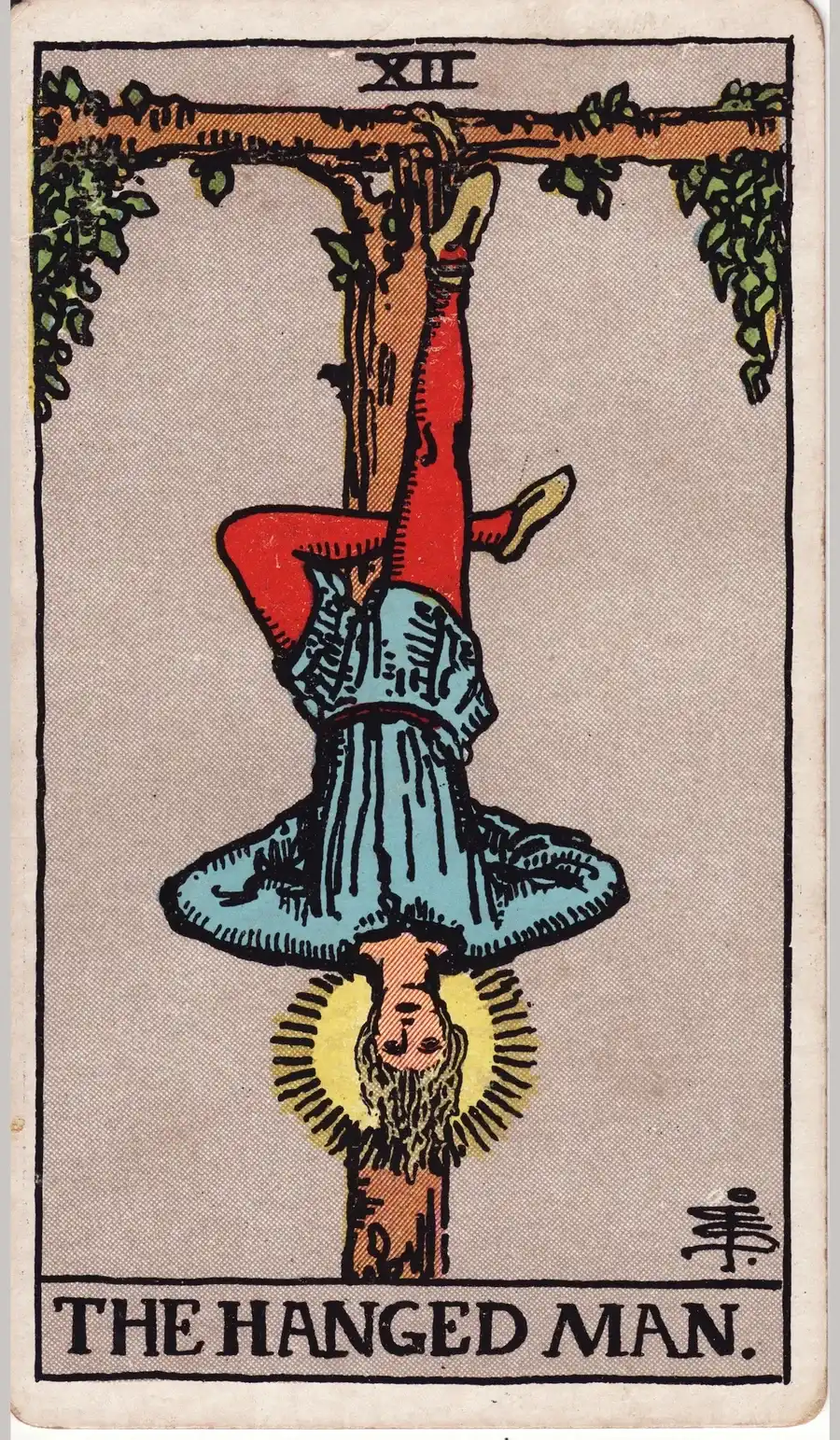
The Hanged Man is card XII of the Major Arcana, and it looks much worse than it is. A man hangs upside down by one foot from a living tree, and his face is calm.
Nothing is being done to him that he has not accepted. The card is about the pause that lets you see things differently. Here is what the Hanged Man means upright and reversed, the symbols in the 1909 card and the dark history behind the image.
Here is the Hanged Man at a glance.
| At a glance | This card |
|---|---|
| Upright keywords | pause, surrender, a new perspective, letting go |
| Reversed keywords | stalling, resisting a needed pause, endless waiting |
| Number | XII (12) in the Major Arcana |
| Golden Dawn title | The Spirit of the Mighty Waters Later tradition |
| Hebrew letter | Mem (מ), “water” Later tradition |
| Tree of Life path | 23, from Geburah to Hod Later tradition |
| Astrology | Water (Golden Dawn); Neptune is a twentieth-century addition Later tradition |
| Element | Water Later tradition |
| Yes or no | No Modern |
The Golden Dawn gave the Hanged Man the element of water and the letter Mem, one of the three “mother letters” of the Sefer Yetzirah, alongside Aleph for air and Shin for fire. Neptune, which many modern books list, was added later by astrologers who wanted a planet for every trump. In fifteenth-century Italy the card was il Traditore, the Traitor: hanging upside down was a shaming punishment painted on public walls for traitors and debtors.
The card: what Pamela Colman Smith drew
Waite was firm about how to look at this card. He wrote that “the face expresses deep entrancement, not suffering”, that the tree is “living wood, with leaves thereon”, and that the figure “suggests life in suspension, but life and not death”.
Upside down. The man sees the world the other way up. That is the heart of the card: a change of view. Something you could not solve standing up may make sense from a new angle.
The living tree. The tree is a T-shaped cross of living wood with green leaves. This is not a gallows of dead timber. The pause is alive and something is still growing.
The halo. A ring of light shines around his head. Insight is arriving. Many readers say this is the moment the penny drops.
The crossed leg. His free leg is bent behind the other, making the shape of a number 4 or a cross. His hands are behind his back. He is not struggling. He has stopped fighting the moment.
Upright meaning
Upright, the Hanged Man hangs by choice. A man is suspended upside down from a living, T-shaped tree, one foot tied, the other leg crossed behind the knee, his hands behind his back. His face is calm and there is a halo around his head. Waite noted that the figure is not suffering. This is a pause, not a punishment.
The card describes a time when acting would not help, and seeing differently would. It often appears when a situation is stuck and every push has failed. It suggests stopping, letting go of the need to control the outcome and looking at the problem from an entirely different angle. Sometimes a sacrifice is involved, a small loss accepted for a larger understanding.
The Hanged Man also speaks of surrender in the spiritual sense: trust, patience and the insight that comes only when you stop insisting.
Reversed meaning
Reversed, the pause becomes a stall. You may be waiting for something to change without doing the inner work the waiting was meant for, or making sacrifices that nobody asked for and that change nothing. The card can also describe martyrdom: giving up so much for others that resentment builds.
The other reversed reading is impatience. You may be refusing to pause at all, cutting the rope and rushing into action because stillness feels unbearable.
Ask what you are waiting for and why. If the waiting has a purpose, keep it. If it has none, it is time to choose and move.
In love, work and spirituality
In love. Upright: A pause in a relationship; seeing your partner from a new angle; letting go of control. Reversed: Sacrifice without reward, or a relationship stuck in limbo.
At work. Upright: A delay that gives perspective; rethinking a project before continuing. Reversed: Wasted time, indecision, or working hard for no clear return.
With money. Upright: Hold off on big decisions; review rather than act. Reversed: Money tied up or stuck; unnecessary sacrifice.
In spiritual practice. Upright: Surrender, meditation and seeing the world turned around. Reversed: Spiritual bypassing: waiting for insight instead of living.
As feelings. Uncertainty. The person is suspended between options and not ready to act.
As a person. Patient, unconventional and willing to see things differently.
As advice. Stop pushing. Change your angle before you change your plan.
Reading the Hanged Man: positions, pairs and yes or no
In the past position: A pause or a sacrifice that changed how you see things. In the present position: Wait. A new perspective is forming.
In the future position: A delay that turns out to be useful. As advice: Let go of the old angle and look again before you act.
When the Hanged Man shows up among mostly Minor cards, give it extra weight: the theme of pause runs under the whole question.
Pairs matter too. Next to Death, it can mean a pause before an ending. Let go, then let it close. Next to The Hermit, it can mean a long, quiet time of reflection. Next to The Chariot, it can mean the end of the waiting: time to move.
In modern yes or no readings, the Hanged Man leans no. It is a card of waiting, so the honest answer is usually not now.
The history and art behind the card
In the Tarot de Marseille pattern the card is called Le Pendu, the Hanged One. The image has a grim origin.
In fifteenth century Italy, traitors and debtors were shamed by being painted hanging upside down by one foot on public walls, the so-called shame paintings, or pitture infamanti. Early tarot cards often called this trump the Traitor. The card was a picture of disgrace.
Occult writers turned the meaning around. Waite listed earlier readings of it, as “a card of martyrdom, a card of prudence, a card of the Great Work, a card of duty”, and said all of them were wrong.
In his own words it “expresses the relation, in one of its aspects, between the Divine and the Universe”. Modern readers usually simplify that to surrender and a new perspective.
Some modern writers also compare the card to the Norse god Odin, who in the poem Hávamál hangs on a tree for nine nights to win the runes. That link is a modern comparison, not something the card’s makers intended, but it fits the idea of a sacrifice that brings knowledge.
When A. E. Waite published The Pictorial Key to the Tarot in 1910, he listed these divinatory meanings for the card: “Wisdom, circumspection, discernment, trials, sacrifice, intuition, divination, prophecy.”
Reversed, he gave: “Selfishness, the crowd, body politic.” Waite himself called the fortune-telling meanings of the trumps “artificial and arbitrary”, and on this site I read the picture first and treat lists like this as history.
In the modern Fool’s Journey, the Hanged Man is the traveler’s pause upside down. After Justice settles accounts, he learns that some things are gained only by letting go of the usual way of seeing them.
Common questions
Is the Hanged Man a bad card? No. It looks frightening, but it is about a pause, a new perspective and letting go, not about harm.
Is the Hanged Man a yes or no? Usually a no, or a not yet. It asks you to wait and see differently before you act.
Why is the Hanged Man upside down? The image comes from Renaissance shame paintings of traitors. Later readers turned it into a symbol of seeing the world from a new angle.
Try this
Try this small spread for the Hanged Man. Use it when you feel stuck and want to see the situation differently.
| Card | Question | What it shows |
|---|---|---|
| 1 | What am I holding on to? | The plan or position that keeps me stuck. |
| 2 | What do I see from a new angle? | The insight the pause offers. |
| 3 | When is it time to move? | The sign that the waiting is done. |
Affirmation: I pause long enough to see clearly, then I release what blocks me.
Reversed affirmation: I end empty waiting and act on the perspective I have.
If you keep a tarot journal, take one of these questions to it: What would this problem look like upside down? What am I trying to force that I could let go of? Is my waiting helping me see, or helping me avoid?
What next
Cards that sit close to this one are Death (the next card: the ending that follows the pause), The Hermit (another quiet card of reflection) and Temperance (patience and balance after letting go).
The Hanged Man is part of the lesson Strength to Temperance in my free Tarot for Beginners course. To keep walking the Major Arcana, read the card before it, Justice or the card after it, Death, or go back to all the card meanings.
For every card with keywords, affirmations and examples, see my book The Novice’s Guide to Tarot. If you would like a printable cheat sheet for all 78 cards, my 45-page Tarot Workbook is on Etsy.
Sources
- A. E. Waite, The Pictorial Key to the Tarot (London: Rider, 1910), Part II and Part III, section 3.
- Pamela Colman Smith and A. E. Waite, the Rider-Waite-Smith tarot (London: Rider, 1909).
- Nicolas Conver, Tarot de Marseille (Marseille, 1760).
- Eden Gray, A Complete Guide to the Tarot (New York: Crown, 1970), epilogue “The Fool’s Journey”.
- Lauri Mukkala, The Novice’s Guide to Tarot, entry for The Hanged Man.
- Aleister Crowley, 777 (London: Walter Scott, 1909), columns of the Hebrew letters, paths and Tarot trumps.
- Israel Regardie, ed., The Golden Dawn (Chicago: Aries Press, 1937 to 1940), “Book T” and the titles of the trumps.
All 78 cards
Major Arcana
- The Fool
- The Magician
- The High Priestess
- The Empress
- The Emperor
- The Hierophant
- The Lovers
- The Chariot
- Strength
- The Hermit
- Wheel of Fortune
- Justice
- The Hanged Man
- Death
- Temperance
- The Devil
- The Tower
- The Star
- The Moon
- The Sun
- Judgement
- The World
Wands
- Ace of Wands
- Two of Wands
- Three of Wands
- Four of Wands
- Five of Wands
- Six of Wands
- Seven of Wands
- Eight of Wands
- Nine of Wands
- Ten of Wands
- Page of Wands
- Knight of Wands
- Queen of Wands
- King of Wands
Cups
- Ace of Cups
- Two of Cups
- Three of Cups
- Four of Cups
- Five of Cups
- Six of Cups
- Seven of Cups
- Eight of Cups
- Nine of Cups
- Ten of Cups
- Page of Cups
- Knight of Cups
- Queen of Cups
- King of Cups
Swords
- Ace of Swords
- Two of Swords
- Three of Swords
- Four of Swords
- Five of Swords
- Six of Swords
- Seven of Swords
- Eight of Swords
- Nine of Swords
- Ten of Swords
- Page of Swords
- Knight of Swords
- Queen of Swords
- King of Swords
Pentacles
Get the free Mini-Grimoire
A short printable starter guide to tarot and everyday witchcraft, plus my newsletter. Unsubscribe any time.
Opens Substack in a new tab to confirm. More about the newsletter · Privacy