


How to read the labels Historical what the old sources say. Later tradition what later writers added. Modern modern practice and my own notes.
Gothic art is the art of Western Europe from about 1140, when Abbot Suger rebuilt the choir of Saint-Denis near Paris, to around 1400 and later in many places. It is famous for soaring cathedrals with pointed arches and stained glass, for graceful sculpture and for the painting of Giotto and Duccio in Italy. Its central idea was light, understood as an image of God.
In the twelfth century, builders in France learned to raise stone walls so high and so thin that they could fill them with coloured glass. The cathedral became a frame for light, and that idea spread into books, tapestries and the first paintings of real human feeling.
“Gothic” was first an insult. Renaissance Italian writers used it to mean barbaric, as if the style had been brought by the Goths who sacked Rome. The name stayed; the insult did not.
Key dates
| When | What happened |
|---|---|
| 1144 | Abbot Suger dedicates the new choir of Saint-Denis, filled with colored light. |
| About 1194 to 1220 | Chartres Cathedral is rebuilt, with most of its glass. |
| 1248 | The Sainte-Chapelle in Paris is consecrated. |
| About 1305 | Giotto paints the Arena Chapel in Padua. |
| 1308 to 1311 | Duccio paints the Maestà for Siena. |
| 1495 to 1505 | The Unicorn Tapestries are woven. |
What is Gothic art?
Gothic art is the architecture, sculpture, stained glass, painting and manuscripts of the high and late Middle Ages, which aimed at height, light and a more human, emotional kind of religious image.
Throughout this page I mark three layers. Historical What buildings, objects and texts of the time show. Later tradition What later centuries read into them. Modern How people use these images today.
Historical A new light at Saint-Denis. The Gothic style began at the royal abbey church of Saint-Denis, just north of Paris, where Abbot Suger rebuilt the choir. It was consecrated in 1144.
Suger wrote about his project and described the “wonderful and uninterrupted light” of the new windows. The art historian Erwin Panofsky translated Suger’s writings in 1946 and linked his love of light to medieval theology of divine light, a reading that later scholars have debated but not abandoned.
How the buildings stand up. Gothic builders combined three features. The pointed arch carries weight downward better than a round arch and can be stretched to many heights. The rib vault is a framework of stone ribs that carries the weight of the ceiling to a few points.
The flying buttress is an outside arch that pushes back against the vault from tall piers beyond the side aisles. Together they let walls become thinner and higher and open into huge windows.
Stained glass. 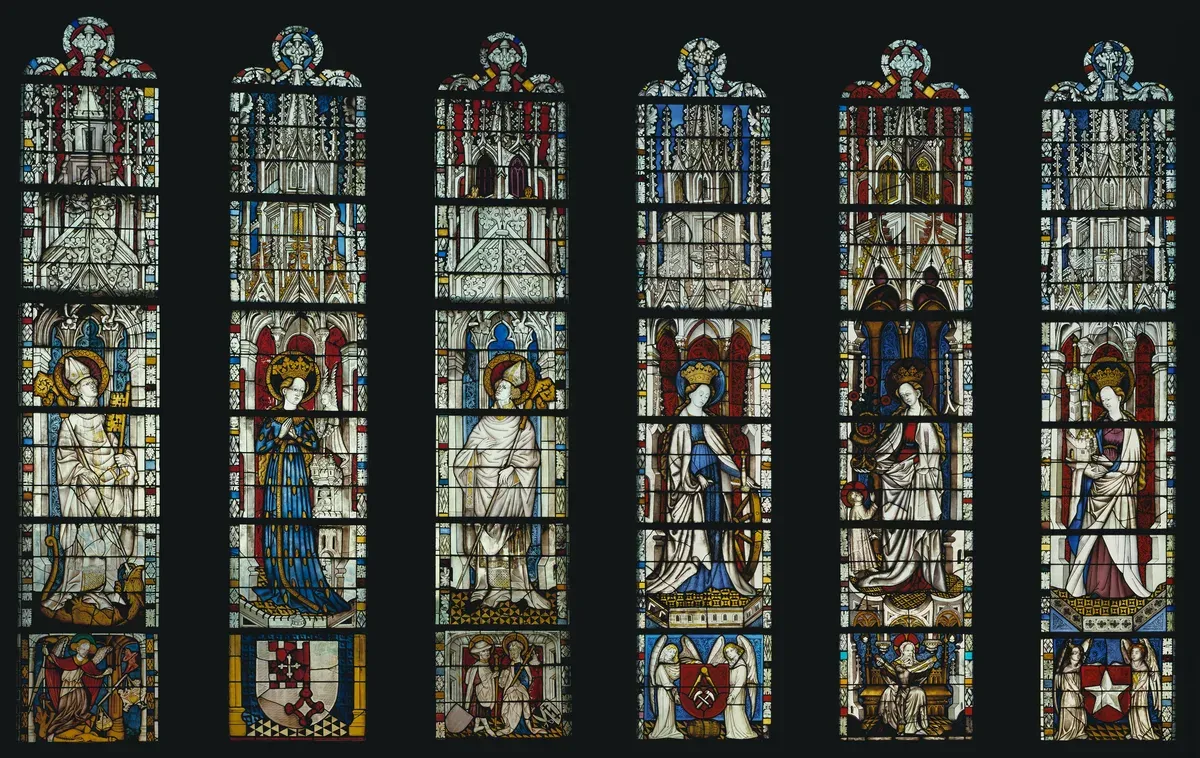
The Virgin Mary and Five Standing Saints above Predella Panels, 1440 to 1446. The Metropolitan Museum of Art (37.52.1 to .6). Image: Open Access, public domain (CC0).
Historical Stained glass is made from colored glass pieces held in lead strips, with details painted on and fired. These panels at the Met come from the Carmelite church at Boppard on the Rhine, made about 1440 to 1446. Notice how the saints stand under painted Gothic canopies, a building inside the building.
Historical Books of hours and tapestries. Wealthy laypeople commissioned personal prayer books called books of hours, organized around the hours of the day. The tiny Hours of Jeanne d’Évreux, painted around 1324 to 1328 by Jean Pucelle for the queen of France, is at the Met Cloisters, its margins alive with musicians and comic figures.
The Limbourg brothers’ Très Riches Heures, about 1411 to 1416, left unfinished when the brothers and their patron died, apparently of plague, in 1416, is at the Musée Condé in Chantilly. Its calendar pages pair the work of each month with the zodiac above.
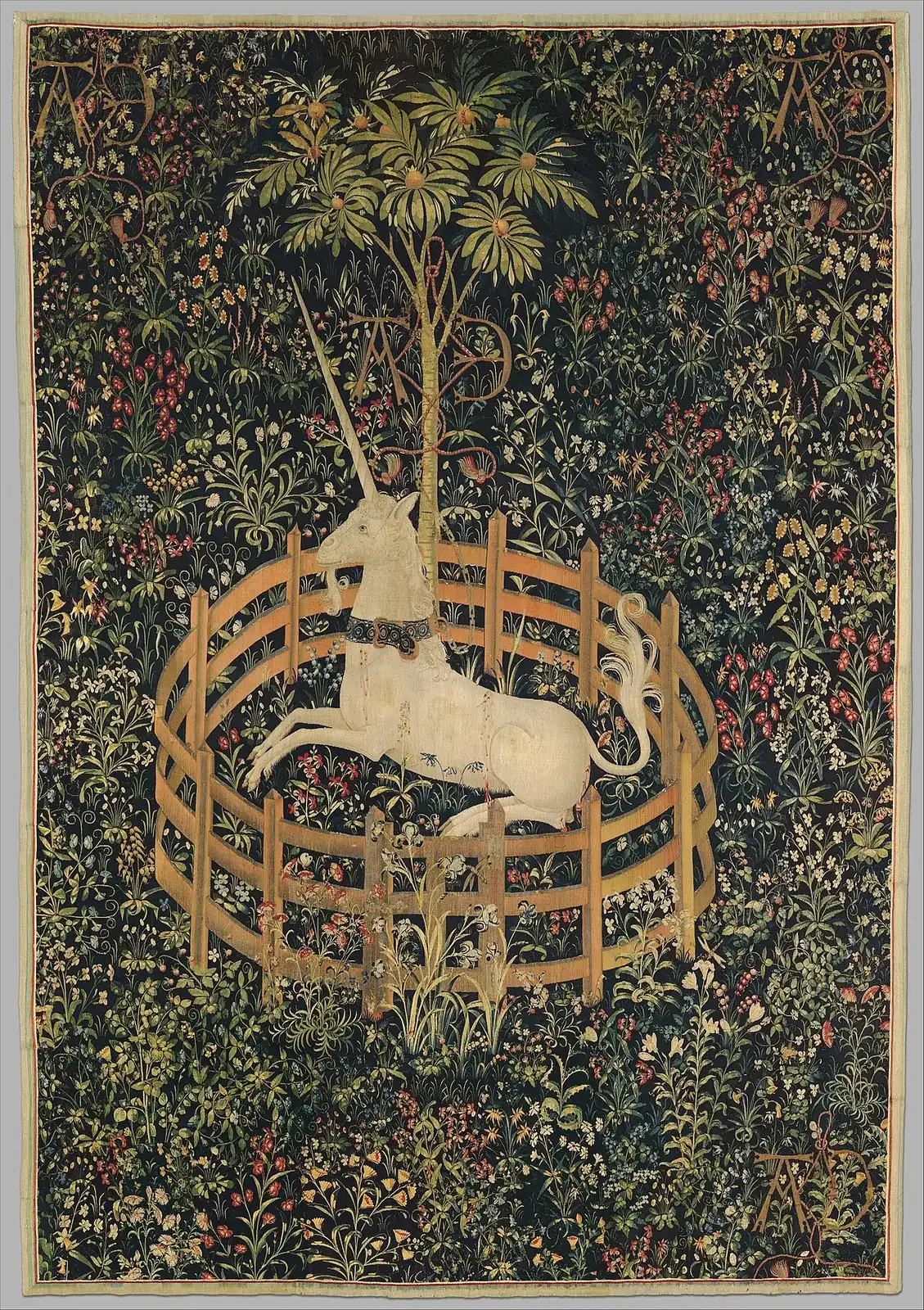
The Unicorn Tapestries at the Met Cloisters, woven in the Southern Netherlands about 1495 to 1505, show the hunt and capture of a unicorn.
In the most famous panel it rests, collared, inside a round fence under a pomegranate tree. Scholars read it both as Christ risen and as a lover bound in marriage, and the meaning may well be both.
Toward real feeling: Duccio and Giotto. 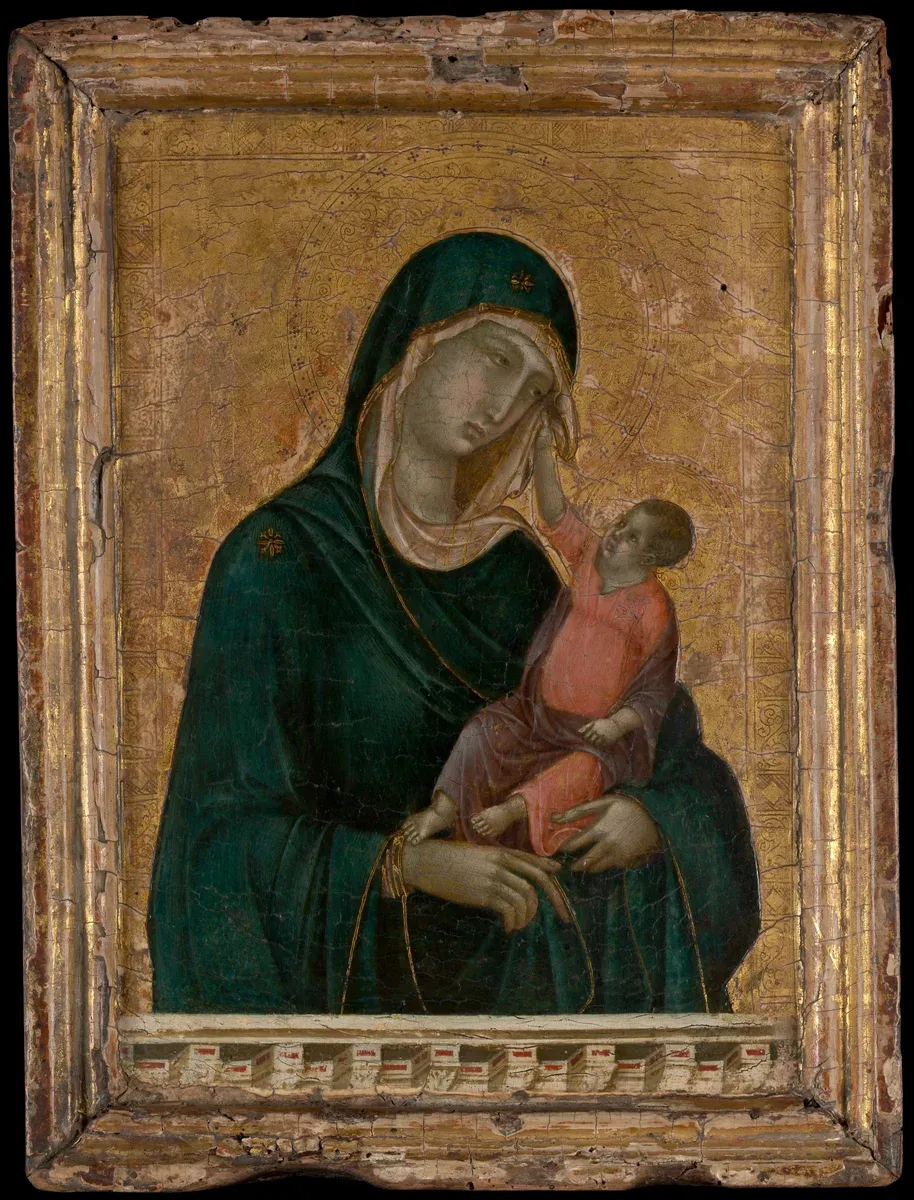
Duccio di Buoninsegna, Madonna and Child, about 1290 to 1300. The Metropolitan Museum of Art (2004.442). Image: Open Access, public domain (CC0).
Historical In thirteenth-century Italy, painting followed Byzantine models. Toward 1300, painters in Tuscany began to give figures weight and emotion. In this small panel by Duccio of Siena, about 1290 to 1300, the Child reaches up to touch his mother’s veil, and the painted parapet at the bottom edge steps into our space.
Giotto, painting the Arena Chapel in Padua in the early 1300s, gave his figures solid bodies and real grief. Vasari later wrote that Giotto “by the gift of God revived that art”, the start of the Renaissance story.
Key artists
| Artist | Lived | Why they matter |
|---|---|---|
| Abbot Suger | about 1081 to 1151 | The patron who wanted his church to lift the mind through light. |
| Villard de Honnecourt | active about 1220 to 1240 | A traveling artist whose sketchbook of buildings, machines and figures survives. |
| Duccio | about 1255 to 1319 | The Sienese painter of the Maestà. |
| Giotto | about 1267 to 1337 | The Florentine painter who gave figures weight and feeling. |
| Jean Pucelle | about 1300 to 1355 | The Parisian illuminator of the tiny Hours of Jeanne d’Évreux. |
How do you recognise Gothic art?
Look for pointed arches, ribbed vaults, flying buttresses and walls dissolved into stained glass. Sculpted figures sway in an S curve and begin to smile. In painting, gold grounds remain, but faces show grief and tenderness. Books of hours bring tiny, jewel-like pictures into private homes.
Common misconceptions. “Gothic” did not mean anything to the people who built the cathedrals; they called it the French work, opus francigenum. Renaissance writers used “Gothic” as an insult, meaning barbarian.
Another is that Gothic means dark and gloomy. The whole point of the style was more light, with walls opened up into glass. That gloomy image comes from the Gothic novel and the Gothic Revival of the 18th and 19th centuries. A third is that medieval women had no part in it. Queen Blanche of Castile is linked with the north rose window at Chartres, and a woman named Claricia painted herself swinging from a letter Q in a German psalter around 1200, now at the Walters Art Museum in Baltimore.
Esoteric themes
Historical Medieval cathedrals carried the whole cosmos: zodiac signs and labors of the months on portals, the virtues and vices, and the liberal arts. Astrology was part of learned medieval culture, and you can see it carved in stone at Chartres and painted in the Très Riches Heures.
Later tradition In the twentieth century, writers such as the mysterious “Fulcanelli” read cathedrals as hidden alchemical books. That is a later esoteric reading, not medieval evidence, though it is fun to know.
Modern Gargoyles are often said to scare off evil spirits. Their documented job was to throw rainwater away from the walls. The protective meaning is a modern one, and lovely in its own way.
Works to see
| Work | Artist | Date | Where to see it |
|---|---|---|---|
| The Unicorn Rests in a Garden | South Netherlandish | 1495 to 1505 | The Met Cloisters, New York |
| The Hours of Jeanne d’Évreux | Jean Pucelle | about 1324 to 1328 | The Met Cloisters, New York |
| Maestà | Duccio | 1308 to 1311 | Museo dell’Opera del Duomo, Siena |
| Arena Chapel frescoes | Giotto | about 1305 | Scrovegni Chapel, Padua |
Every work in this list is free of nudity, so you can look them up with confidence. Works still in copyright are named but not shown here.
How to look at a Gothic cathedral or painting
In a cathedral, stand at the west end and look up, then down the nave toward the light. Gothic builders used pointed arches, rib vaults and flying buttresses so the walls could become windows. In a painting, look at faces and hands: Gothic artists began to show grief, tenderness and surprise.
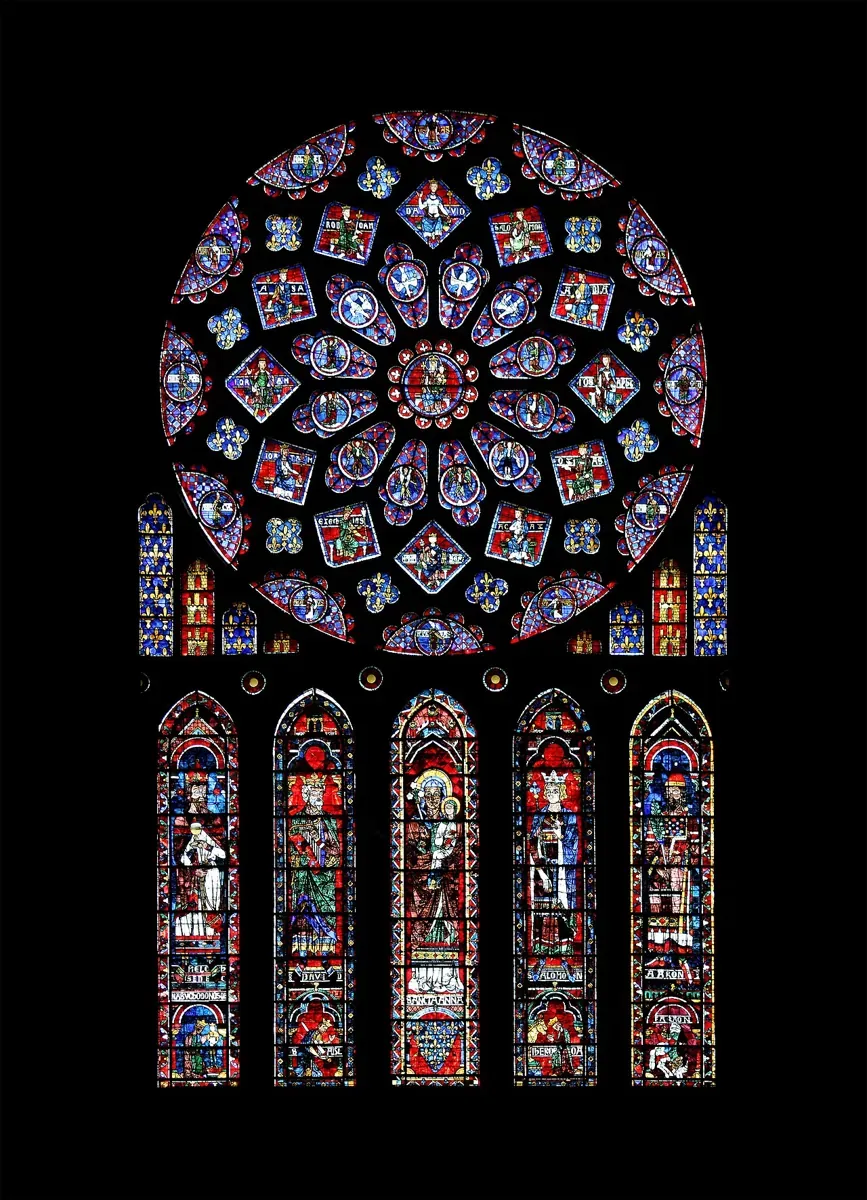
Unknown Gothic glaziers, North rose window, about 1230s. Chartres Cathedral. Image: Wikimedia Commons, public domain.
North rose window, Chartres Cathedral, about 1230s. The Virgin and Child sit at the centre, surrounded by doves, angels, kings of Judah and prophets. Sit and watch for a while: as clouds pass, the blues and reds change. Chartres still has most of its original medieval glass.
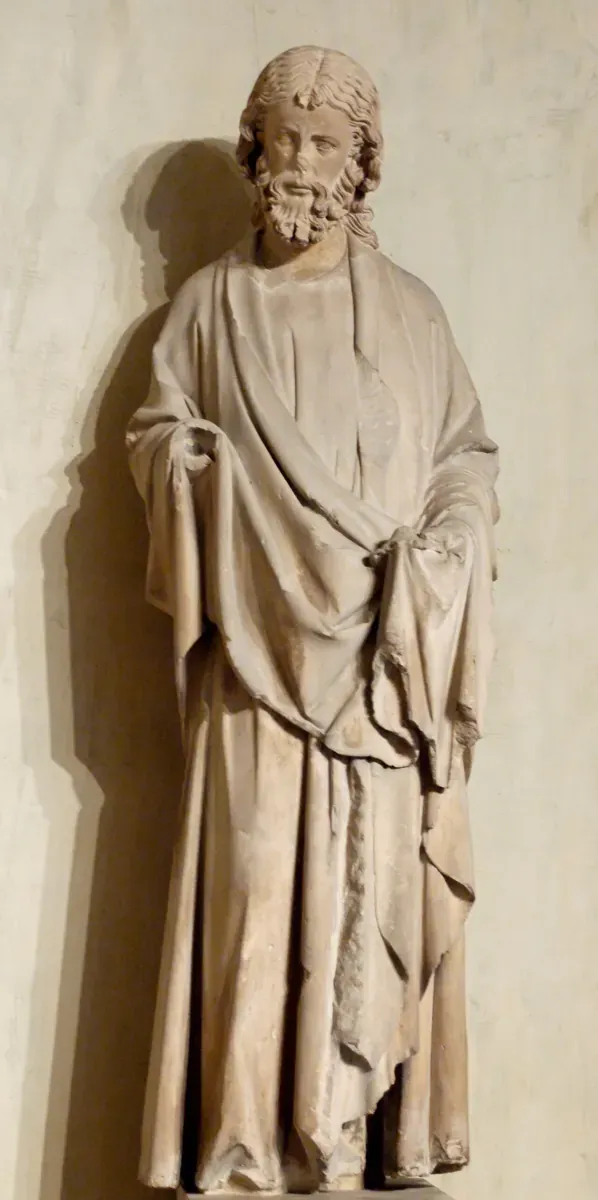
Unknown Parisian sculptor, Statue of an apostle from the Sainte-Chapelle, about 1241 to 1248. Musée de Cluny, Paris. Image: Wikimedia Commons, public domain.
Statue of an apostle from the Sainte-Chapelle, about 1241 to 1248. Now at the Musée de Cluny in Paris. The Sainte-Chapelle was built for King Louis IX to hold the Crown of Thorns and consecrated in 1248. Look at the deep folds of the robe, which fall like the ribs of the building itself.
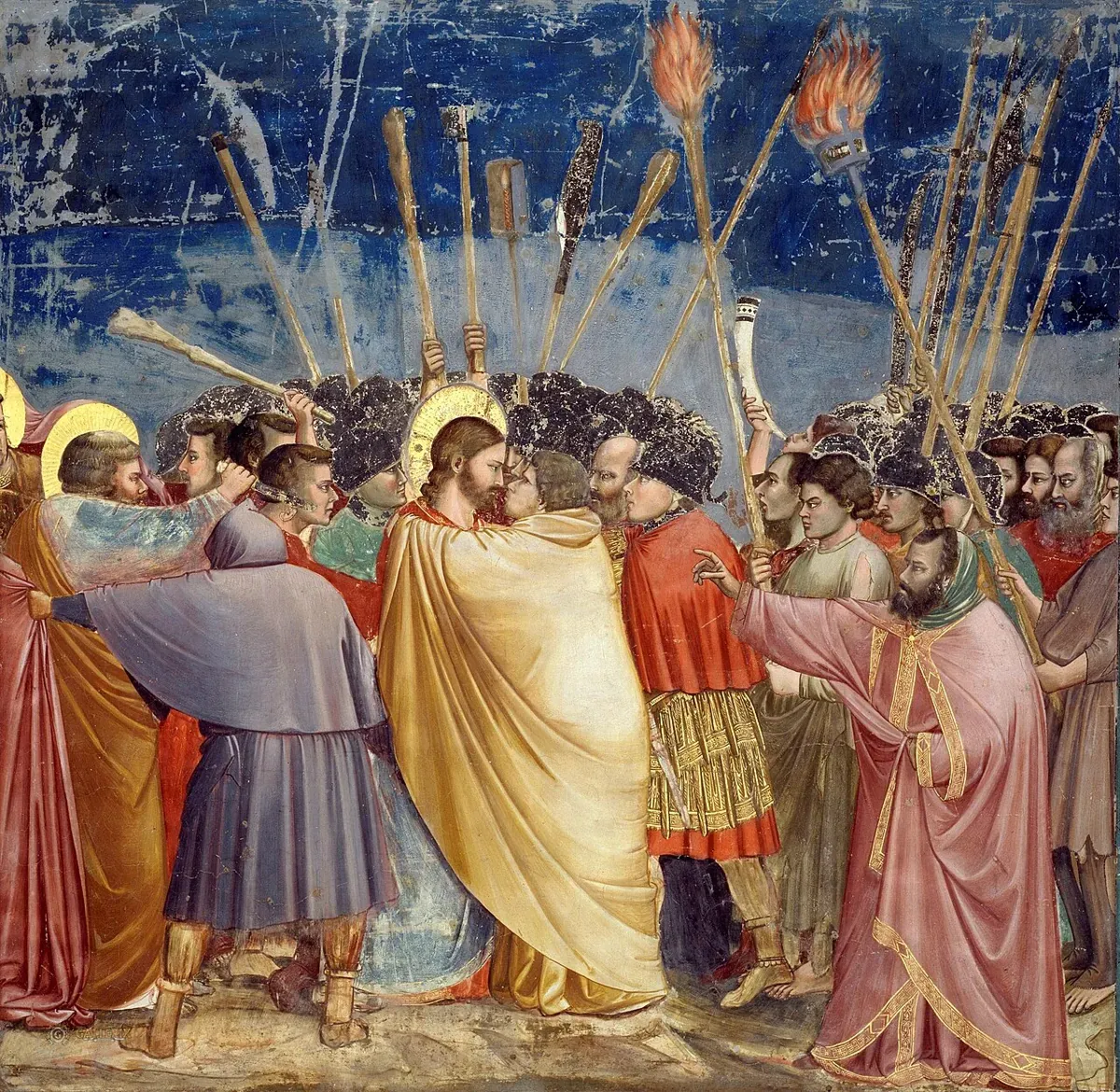
Giotto, The Kiss of Judas, about 1305. Scrovegni Chapel, Padua. Image: Wikimedia Commons, public domain.
Giotto, The Kiss of Judas, about 1305. In the Scrovegni Chapel in Padua. Look at the two faces almost touching: Christ calm, Judas ugly with betrayal. Then look at the yellow cloak that swallows Christ. Giotto gave Gothic painting weight and drama, and opened the door to the Early Renaissance.
Gothic grew out of Romanesque building and was refined at the courts of Europe into International Gothic. Its books are part of the story of illuminated manuscripts, and its revival inspired the Pre-Raphaelites and the Arts and Crafts movement.
Try this
Find the calendar pages of the Très Riches Heures online. Choose one summer and one winter month. Describe the work, clothes, buildings and sky, then look at the zodiac above. Write one sentence on how the page joins human work to the heavens.
What next
Before this: Romanesque.
After this: International Gothic.
Also worth reading alongside it: Illuminated manuscripts.
See every movement in order on the art movements timeline, or learn to look step by step in the free Art History for Beginners course.
If you want to carry this into tarot and practice, these pages connect to it: The Star, the unicorn, the garden and hope after trial; Temperance, the angel in the luminous calm of Gothic glass; Light as a picture of the divine; and Medieval magic in the same centuries.
Sources
- Erwin Panofsky (ed. and trans.), Abbot Suger on the Abbey Church of St.-Denis and Its Art Treasures (1946).
- Giorgio Vasari, trans. Gaston du C. de Vere, Lives of the Most Eminent Painters, Sculptors and Architects (1912).
- The Metropolitan Museum of Art, The Unicorn Rests in a Garden, 37.80.6. Open the record
- The Metropolitan Museum of Art, The Virgin Mary and Five Standing Saints above Predella Panels, 37.52.1 to .6. Open the record
- The Metropolitan Museum of Art, Madonna and Child, Duccio, 2004.442. Open the record
- E. H. Gombrich, The Story of Art (1950).
- Wikimedia Commons, The Unicorn Rests in a Garden (The Unicorn in Captivity) (hero image record). Open the record
- Michael Camille, Gothic Art: Glorious Visions (1996).

Questions
Where did Gothic architecture begin?
At the royal abbey church of Saint-Denis, just north of Paris, where Abbot Suger rebuilt the choir. It was consecrated in 1144, and Suger wrote about the "wonderful and uninterrupted light" of its new windows.
Why was it called Gothic?
Renaissance Italian writers used the word as an insult, meaning barbaric, as if the style had come with the Goths who sacked Rome. The name stuck long after the insult was forgotten.
Where can I see works of Gothic art in person?
Good places to start are Chartres, Paris, Reims, the Met Cloisters, the Musée de Cluny in Paris, and Siena and Padua. Museums change their displays, so check the collection page before you travel.
What is the difference between Romanesque and Gothic?
Romanesque buildings have round arches, thick walls and small windows. Gothic buildings have pointed arches, rib vaults, flying buttresses and large stained glass windows, which make them taller and lighter.
What are the most famous Gothic cathedrals?
Chartres, Notre-Dame de Paris, Reims and Amiens in France, Cologne in Germany, and Salisbury and Lincoln in England are among the best known.
Get the free Mini-Grimoire
A short printable starter guide to tarot and everyday witchcraft, plus my newsletter. Unsubscribe any time.
Opens Substack in a new tab to confirm. More about the newsletter · Privacy