


How to read the labels Historical what the old sources say. Later tradition what later writers added. Modern modern practice and my own notes.
International Gothic is the elegant, courtly style that spread across Europe from about 1375 to 1425, linking the courts of Paris, Prague, Burgundy, London, Milan, Siena and Florence. It is known for graceful swaying figures, rich gold, brilliant colours, flowing drapery and close observation of animals and flowers. Key works include the Wilton Diptych, the Très Riches Heures of the Limbourg brothers and Gentile da Fabriano’s Adoration of the Magi of 1423.
Art historians later called it International Gothic, because you can find the same elegance in many countries at once. It is the last bloom of Gothic art, just before the Renaissance.
Key dates
| When | What happened |
|---|---|
| 1377 | Richard II becomes king of England. |
| About 1393 to 1399 | Melchior Broederlam paints altarpiece wings for Champmol near Dijon. |
| About 1395 to 1399 | The Wilton Diptych is painted for Richard II. |
| About 1395 to 1405 | Claus Sluter carves the Well of Moses at Champmol. |
| About 1400 | Christine de Pizan writes the Letter of Othea. |
| 1416 | The three Limbourg brothers and the Duke of Berry die. |
| 1423 | Gentile da Fabriano paints the Adoration of the Magi in Florence. |
What is International Gothic?
International Gothic is a shared late medieval court style, in which artists and luxury objects moved between countries so freely that it can be hard to tell where a work was made.
Throughout this page I mark three layers. Historical What buildings, objects and texts of the time show. Later tradition What later centuries read into them. Modern How people use these images today.
Historical Courts that traded artists. The style spread because the courts were linked by marriage, diplomacy and trade, and artists moved with them.
The French dukes of Berry and Burgundy, Emperor Charles IV in Prague and Richard II in England all collected jewelled objects, books and paintings. The French scholar Louis Courajod gave the style its modern name in the 1890s.
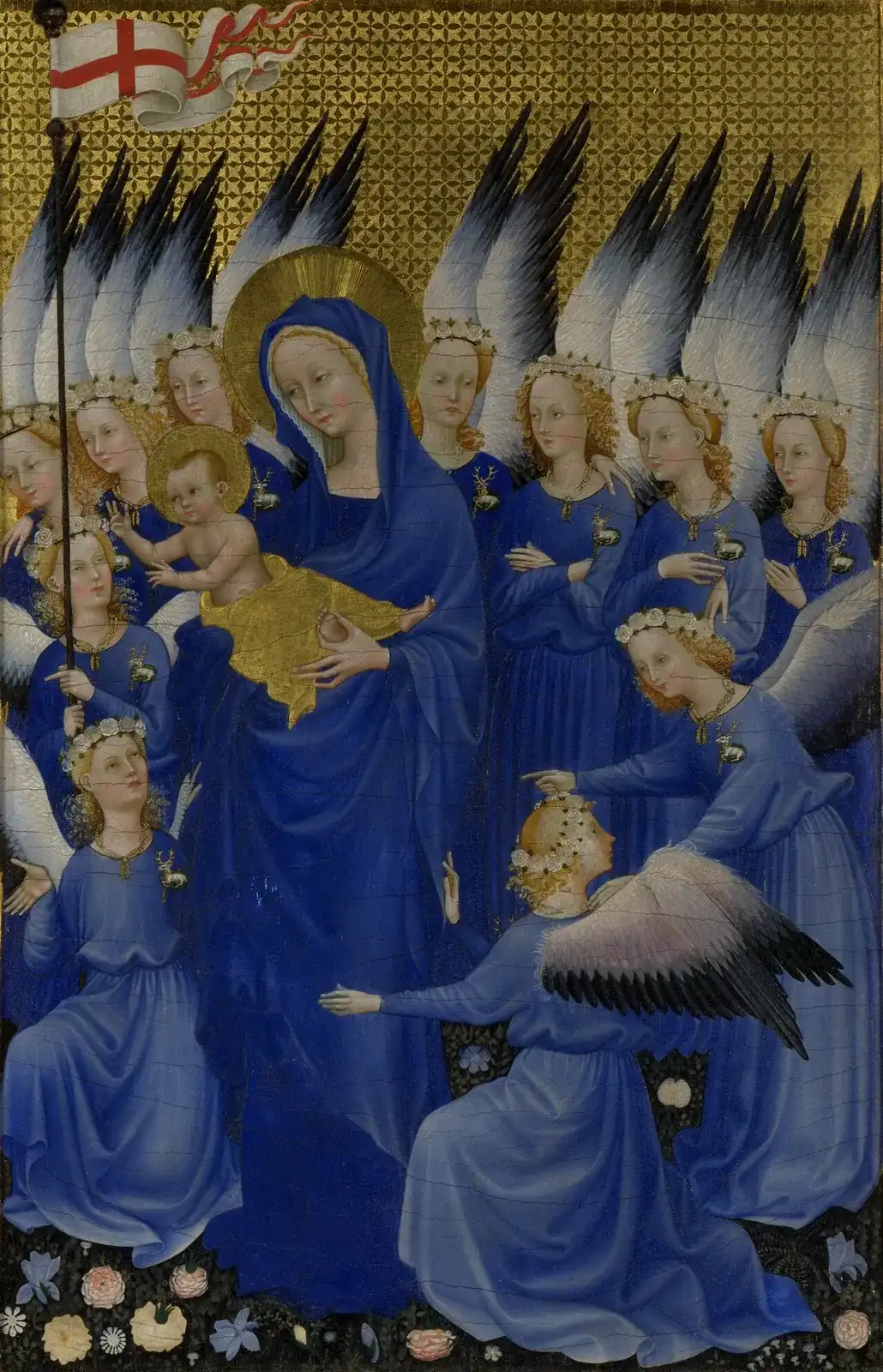
Historical The Wilton Diptych. The Wilton Diptych, painted about 1395 to 1399 and now in the National Gallery in London, is a small folding altarpiece for Richard II. On the left the king kneels, presented by John the Baptist and two English royal saints.
On the right, shown above, the Virgin and Child stand among eleven angels in a field of flowers, every angel wearing Richard’s own badge of a white hart. Heaven itself wears the king’s livery. The blue is real ultramarine and the gold is punched with tiny patterns that sparkle in candlelight.
Historical Burgundy and the Limbourgs. For the dukes of Burgundy at the monastery of Champmol near Dijon, the sculptor Claus Sluter carved the Well of Moses, with prophets so real they seem about to speak, and Melchior Broederlam painted altarpiece wings full of tiny landscapes.
For the Duke of Berry, the three Limbourg brothers painted the Belles Heures and the Très Riches Heures, with castles, peasants and snow scenes that are among the first true landscapes in European art.
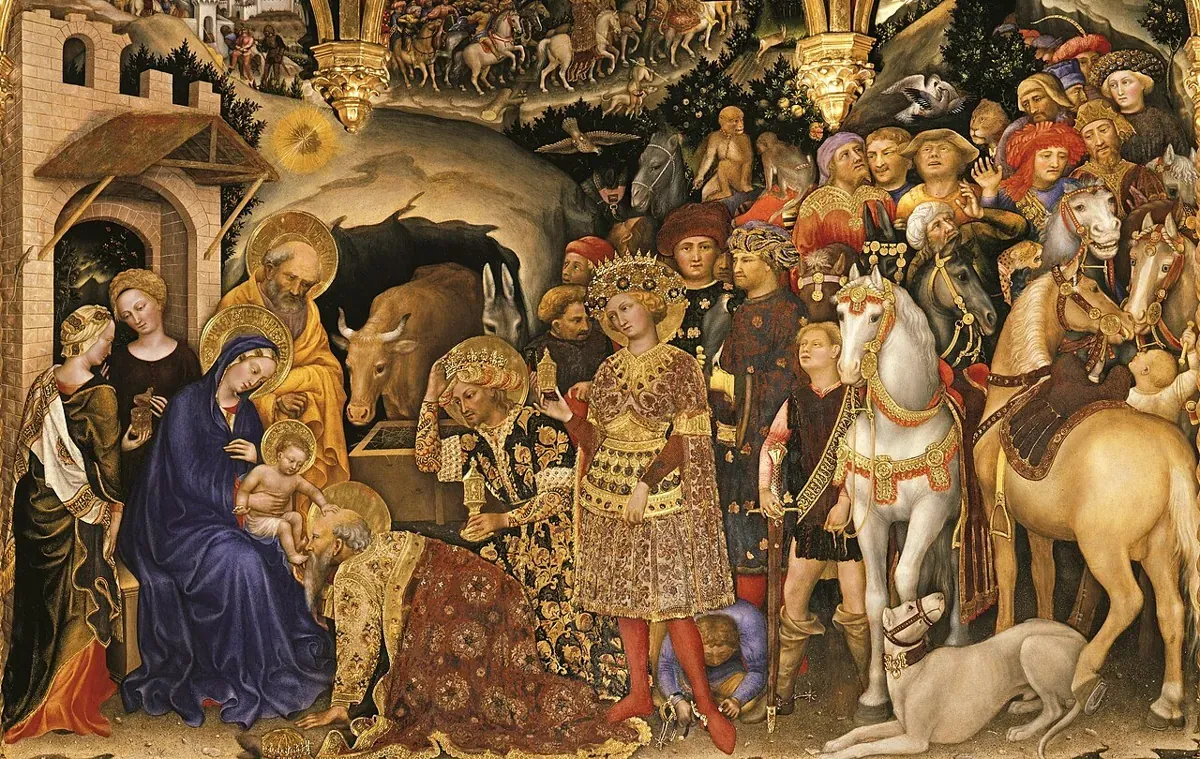
Historical Italy: Gentile and Lorenzo Monaco. In Italy the style meets Florence. Gentile da Fabriano’s Adoration of the Magi of 1423, in the Uffizi, is a parade of horses, hunting leopards and gold brocade.
Lorenzo Monaco, a monk, painted saints in sweeping curves of pink and blue. Within a few years, Masaccio’s heavier, more solid figures would point art in a new direction.
Key artists
| Artist | Lived | Why they matter |
|---|---|---|
| The Limbourg brothers | active about 1400 to 1416 | Painters of the Belles Heures and the Très Riches Heures. |
| Gentile da Fabriano | about 1370 to 1427 | The Italian master of gold brocade and courtly parade. |
| Lorenzo Monaco | about 1370 to 1425 | A Florentine monk who painted saints in sweeping curves of color. |
| Claus Sluter | about 1340 to 1406 | Sculptor of the dukes of Burgundy, whose prophets seem to breathe. |
| Melchior Broederlam | active 1381 to 1409 | Painter to the duke of Burgundy, with tiny, detailed landscapes. |
How do you recognise International Gothic?
Look for slender, swaying figures in long robes that fall in soft folds, sweet faces, and lots of gold and ultramarine. Flowers, birds, dogs and horses are painted with close observation. Courtly fashion and heraldic badges appear even in religious scenes.
Common misconceptions. One is that the name is medieval. The term was coined by the French art historian Louis Courajod in the 1890s; no one at the time called it that.
Another is that it was simply old-fashioned when the Renaissance arrived. Gentile’s Adoration of 1423 was painted in Florence at the same moment Masaccio was beginning his work, and patrons happily bought both. A third is that women played no part. Christine de Pizan, the court writer of Paris, directed the illumination of her own books around 1400 to 1415, and her manuscripts are among the finest of the style.
Esoteric themes
Historical Court culture around 1400 took astrology seriously.
King Charles V of France built a great library that included astrological books, and the writer Christine de Pizan was the daughter of his court astrologer, Tommaso da Pizzano. Her Letter of Othea, written about 1400, opens with the goddess of prudence and gives advice through the gods and planets, and its manuscripts were richly illustrated.
The Très Riches Heures includes a zodiac figure that matches each sign to a part of the body.
Later tradition The hart and the unicorn, the enclosed garden and the angel became favorite images for later writers on courtly love and magic, often with meanings the original makers never intended.
Modern The soft gold and blue of this period turn up in many modern tarot and oracle decks. When you see them, you are looking at a style that is more than six hundred years old.
Works to see
| Work | Artist | Date | Where to see it |
|---|---|---|---|
| The Wilton Diptych | Unknown English or French painter | about 1395 to 1399 | The National Gallery, London |
| The Belles Heures of Jean de France, Duc de Berry | The Limbourg brothers | 1405 to 1409 | The Met Cloisters, New York |
| Adoration of the Magi | Gentile da Fabriano | 1423 | Gallerie degli Uffizi, Florence |
| Coronation of the Virgin | Lorenzo Monaco | 1414 | Gallerie degli Uffizi, Florence |
| The Well of Moses | Claus Sluter | about 1395 to 1405 | Chartreuse de Champmol, Dijon |
Every work in this list is free of nudity, so you can look them up with confidence. Works still in copyright are named but not shown here.
How to look at an International Gothic painting
Look at the curves first: the long S-shaped bodies and the sweeping hems of robes. Then look at the surface, the gold, punched patterns and brocades. Finally, hunt for the animals and plants, which are often painted with startling accuracy even when the space around them makes no sense.
Simone Martini and Lippo Memmi, Annunciation with Saint Margaret and Saint Ansanus, 1333. Uffizi Gallery, Florence. Image: Wikimedia Commons, public domain.
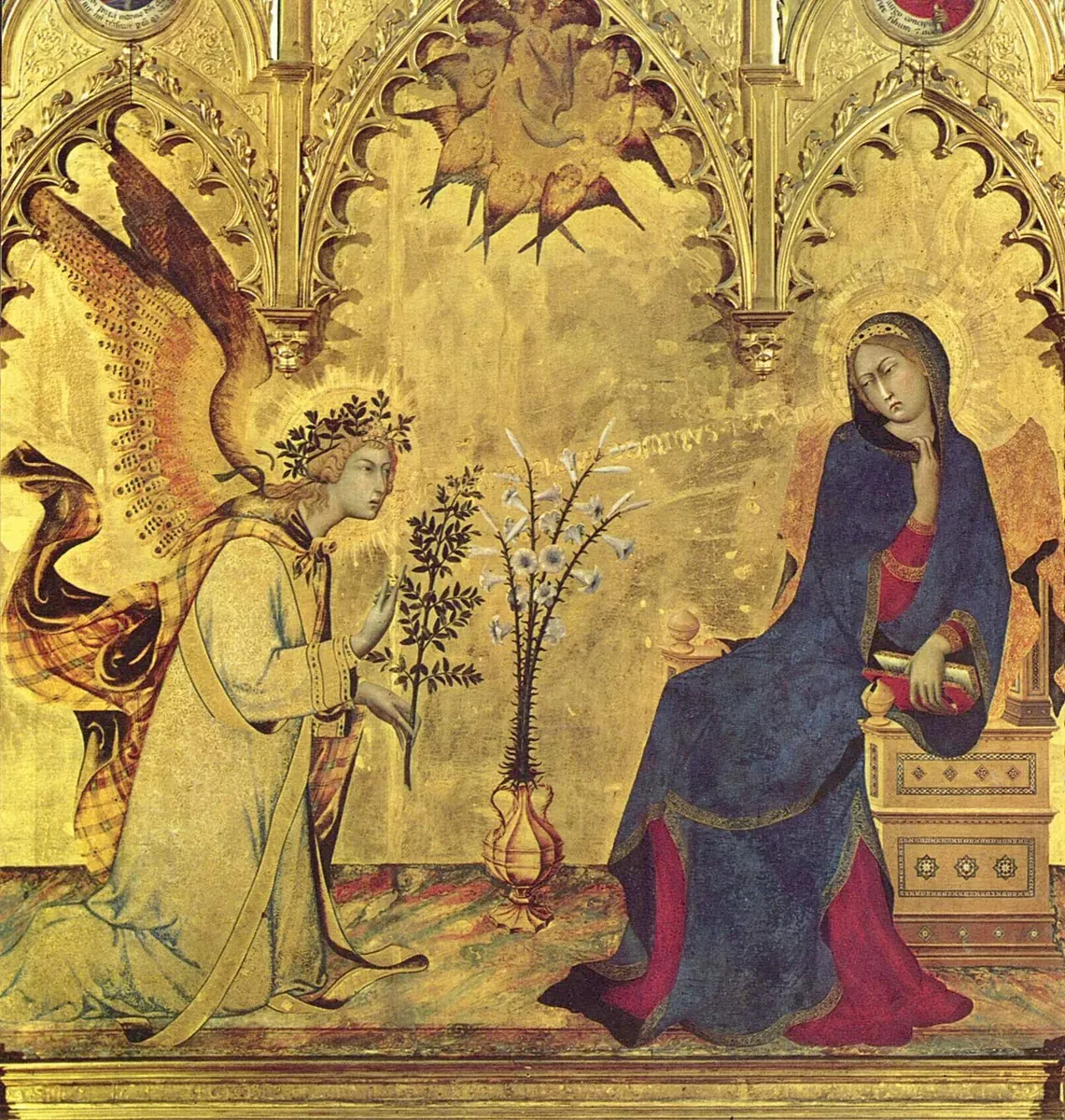
Simone Martini and Lippo Memmi, Annunciation, 1333. At the Uffizi in Florence, made for Siena Cathedral. A forerunner of the style. The angel’s words are written in raised gold letters running across to Mary. Look at her twisting, shrinking pose: the elegance and emotion of International Gothic begin here.
Gentile da Fabriano, Adoration of the Magi (Strozzi Altarpiece), 1423. Uffizi Gallery, Florence. Image: Wikimedia Commons, public domain.
Gentile da Fabriano, Adoration of the Magi, 1423. At the Uffizi. Painted for the banker Palla Strozzi. Follow the procession from the hills at the top down to the Holy Family. Then count the animals: horses, dogs, monkeys, a leopard. Gold is raised in relief on crowns and harnesses so it catches the light.
Pisanello, The Vision of Saint Eustace, about 1438 to 1442. National Gallery, London. Image: Wikimedia Commons, public domain.
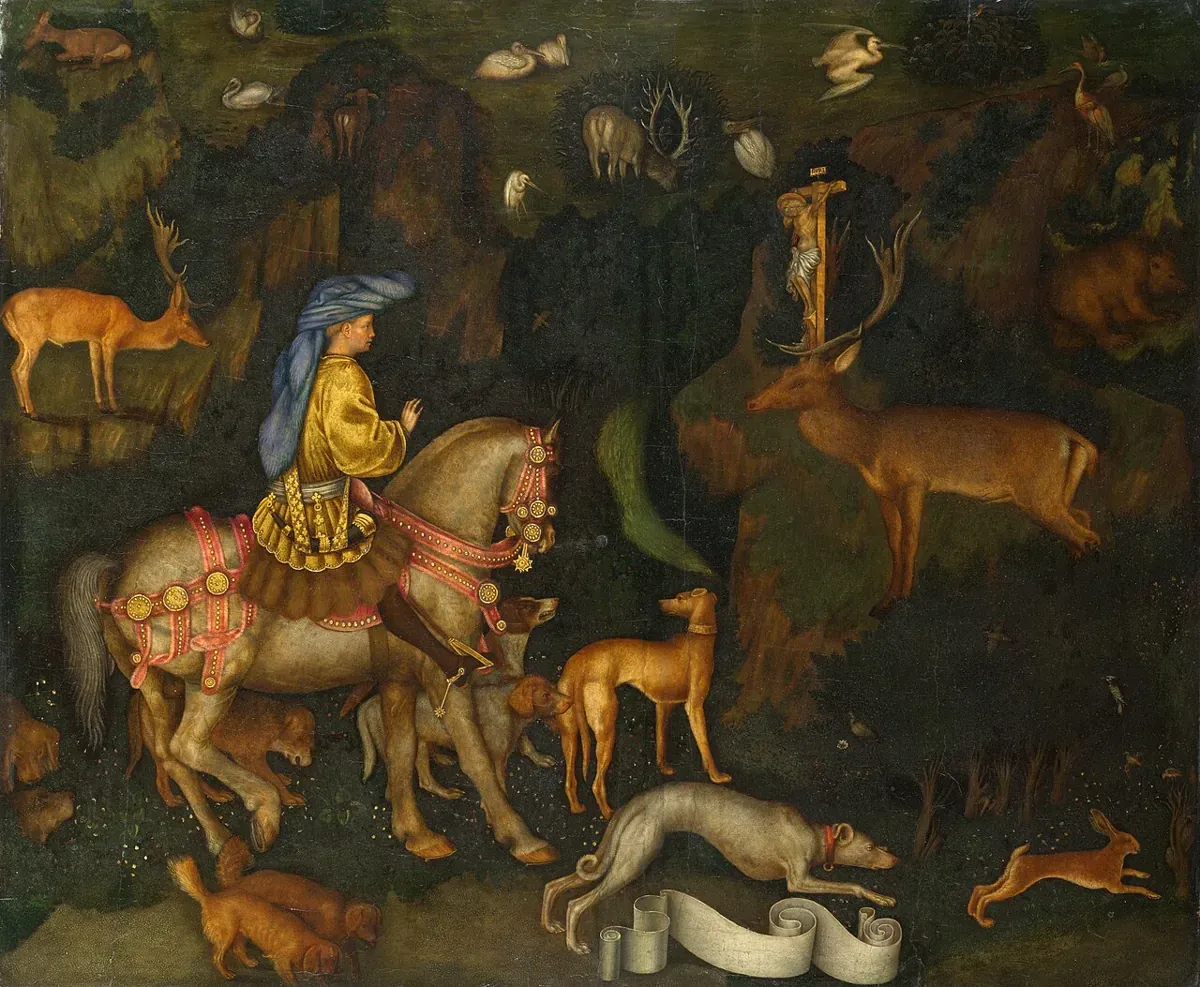
Pisanello, The Vision of Saint Eustace, about 1438 to 1442. At the National Gallery in London. The hunter Eustace sees Christ on the cross between a stag’s antlers. Pisanello was famous for his drawings of animals, and here they are everywhere, each studied from life.
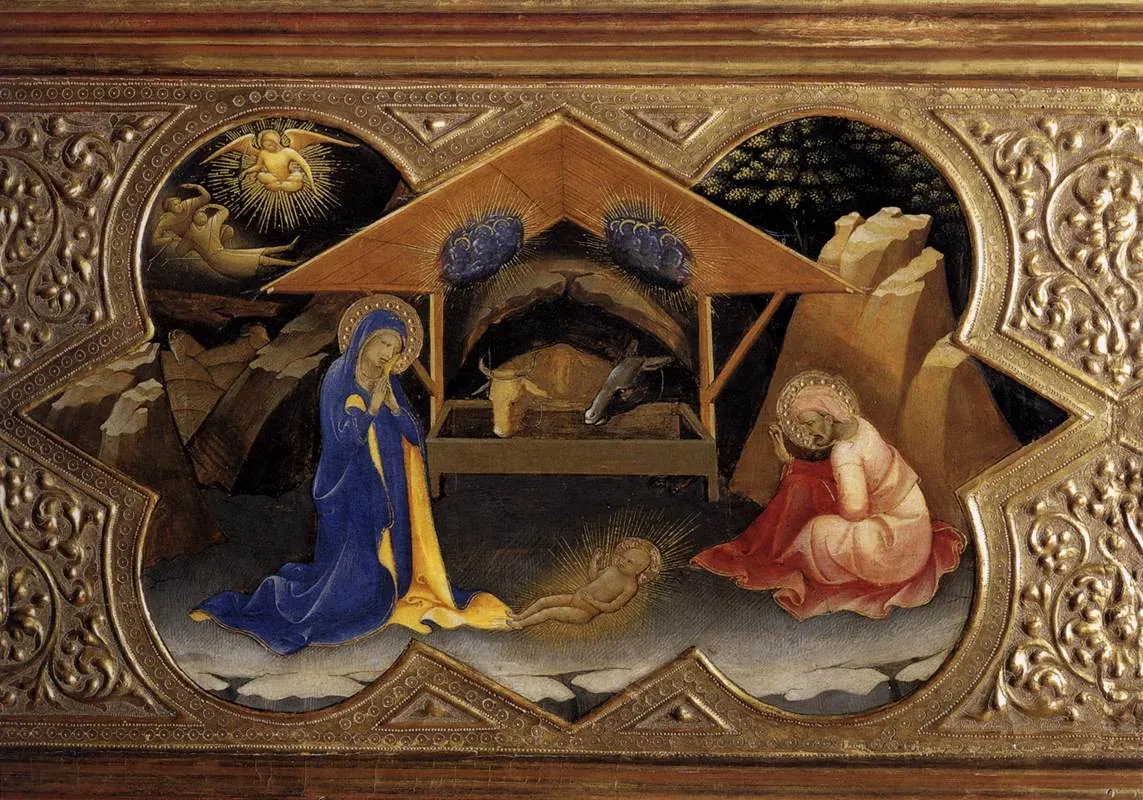
Lorenzo Monaco, Nativity, predella panel of the Coronation of the Virgin altarpiece, 1414. Uffizi Gallery, Florence. Image: Wikimedia Commons, public domain.
Lorenzo Monaco, Nativity, predella of the Coronation of the Virgin, 1414. At the Uffizi. Lorenzo was a monk in Florence. Look at the flowing blue robe of the Virgin and the soft, glowing colour that he loved.
International Gothic grew from Gothic art and from Sienese painting, flourished in illuminated manuscripts, and gave way to the Early Renaissance in Italy and the Northern Renaissance of van Eyck. The Pre-Raphaelites loved its colour and detail.
Try this
Look at the right wing of the Wilton Diptych on the National Gallery’s website and count the angels. Find the white hart badges, the flowers on the ground and the tiny orb on top of the banner. Write down one thing that tells you this is a painting about a king as much as about heaven.
What next
Before this: Gothic.
After this: Early Renaissance.
Also worth reading alongside it: Illuminated manuscripts.
See every movement in order on the art movements timeline, or learn to look step by step in the free Art History for Beginners course.
If you want to carry this into tarot and practice, these pages connect to it: The Emperor, a king presenting himself to heaven, power and its badges; The World, heaven as a garden full of angels and flowers; Courtly and religious symbols around 1400; and Astrology and magic at the medieval courts.
Sources
- The National Gallery, London, The Wilton Diptych. Open the record
- The Metropolitan Museum of Art, The Belles Heures of Jean de France, duc de Berry. Open the record
- E. H. Gombrich, The Story of Art (1950).
- Christopher de Hamel, Meetings with Remarkable Manuscripts (2016).
- Christine de Pizan, The Book of the City of Ladies (1405).
- Wikimedia Commons, The Wilton Diptych, right-hand panel (hero image record). Open the record
- Raymond Cazelles and Johannes Rathofer, Illuminations of Heaven and Earth: The Glories of the Très Riches Heures du Duc de Berry (1988).

Questions
Why is it called International Gothic?
Because very similar courtly styles appeared at the same time in France, Burgundy, Bohemia, Italy and England around 1400. The name was given in the nineteenth century, not at the time.
What is the Wilton Diptych?
A small portable altarpiece painted about 1395 to 1399 for King Richard II of England. It is in the National Gallery, London.
Where can I see works of International Gothic in person?
Good places to start are London (The National Gallery), Florence (the Uffizi), Dijon, Prague, Chantilly, and New York (The Met Cloisters). Museums change their displays, so check the collection page before you travel.
Who are the main International Gothic artists?
The Limbourg brothers, Gentile da Fabriano, Pisanello, Lorenzo Monaco, Master Theodoric of Prague, Melchior Broederlam and the unknown painter of the Wilton Diptych.
What is the difference between Gothic and International Gothic?
International Gothic is the late, courtly phase of Gothic, about 1375 to 1425. It is more decorative, more elegant and more interested in luxury, fashion and nature.
Get the free Mini-Grimoire
A short printable starter guide to tarot and everyday witchcraft, plus my newsletter. Unsubscribe any time.
Opens Substack in a new tab to confirm. More about the newsletter · Privacy