


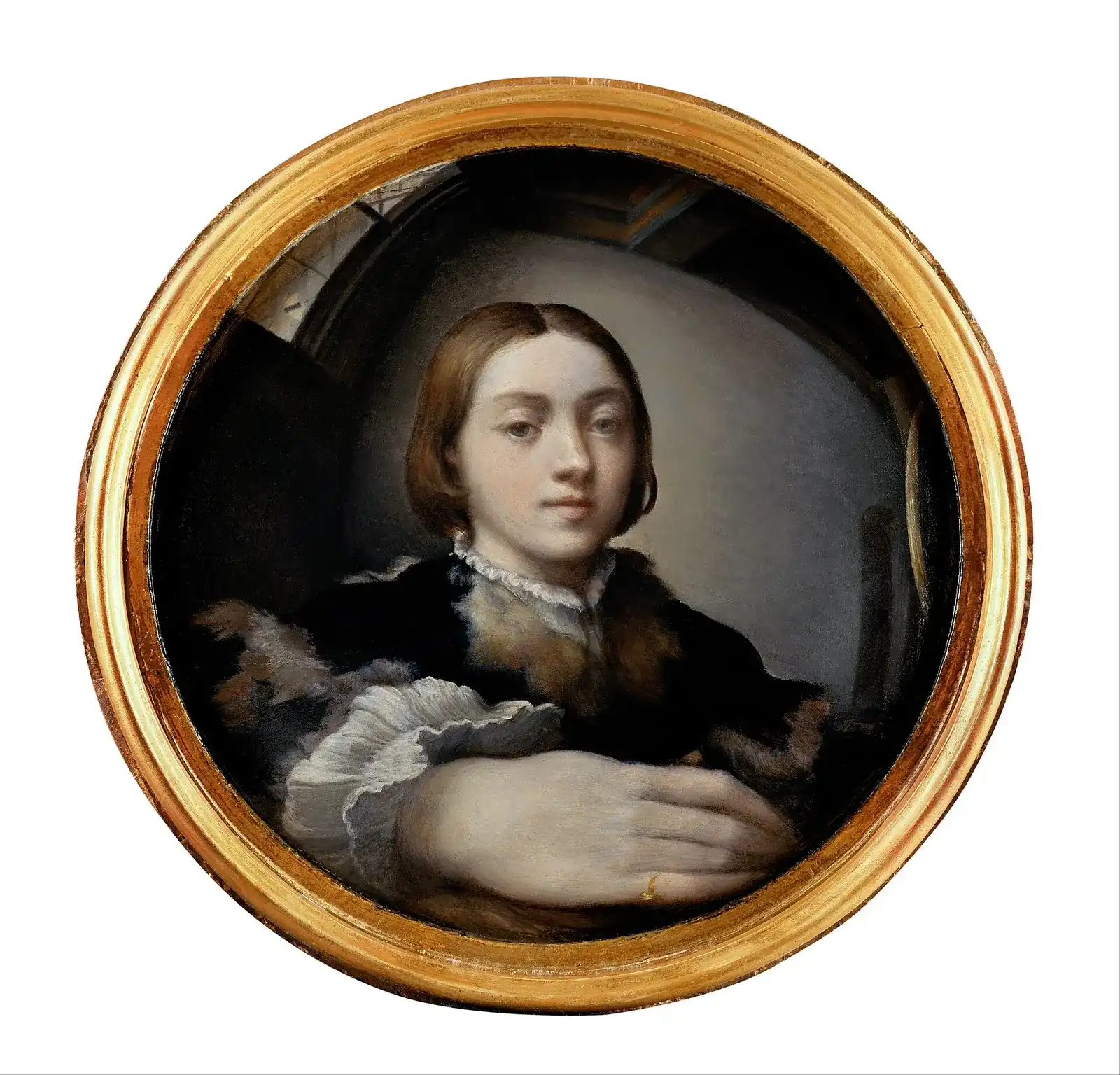
How to read the labels Historical what the old sources say. Later tradition what later writers added. Modern modern practice and my own notes.
Mannerism is the style of Italian and European art from about 1520 to 1600, between the High Renaissance and the Baroque. Painters such as Pontormo, Parmigianino, Bronzino, Sofonisba Anguissola and El Greco stretched bodies, crowded spaces and used unexpected colour to create elegance, tension and surprise. The word comes from the Italian maniera, meaning style or manner.
What do you do after perfection? After Leonardo, Michelangelo and Raphael, younger painters felt they could not simply repeat the masters. For a long time their answer was treated as a decline. Today many people, me included, love its nervous elegance.
Key dates
| When | What happened |
|---|---|
| 1520 | Raphael dies. |
| About 1524 | Parmigianino paints his Self-Portrait in a Convex Mirror. |
| 1527 | The Sack of Rome scatters artists across Europe. |
| 1545 to 1563 | The Council of Trent sets new rules for religious images. |
| About 1600 | Caravaggio and the Carracci move painting toward the Baroque. |
What is Mannerism?
Mannerism is art that knowingly bends the rules of the High Renaissance, valuing grace, complexity and invention over natural balance.
Throughout this page I mark three layers. Historical What the works and the period show. Later tradition How critics judged the style. Modern Why it speaks to us now.
Historical A time of crisis. The 1520s were frightening. Luther’s Reformation split the Church, and in 1527 imperial troops sacked Rome. Some historians have linked Mannerism’s unease to these events. It is a tempting story, but courts also loved the style simply because it was refined and difficult.
Historical Stretched and twisted. Pontormo’s Deposition in Santa Felicita, Florence, painted in the 1520s, has figures in pale pinks and blues floating with no clear ground. Parmigianino’s Madonna of the Long Neck, begun in 1534 and left unfinished at his death in 1540, gives the Virgin an impossibly elongated neck and hands. Rosso Fiorentino painted sharp, angular faces.
The aim was grace, not realism. Giorgio Vasari, himself a painter of this generation, praised a quality he called grazia, an effortless beauty beyond rules.
Sculptors joined in: Giambologna’s bronzes spiral upward so that you have to walk around them to see the whole figure, and Benvenuto Cellini, goldsmith and sculptor, wrote a boastful autobiography that still reads like an adventure novel.
The cool portrait. 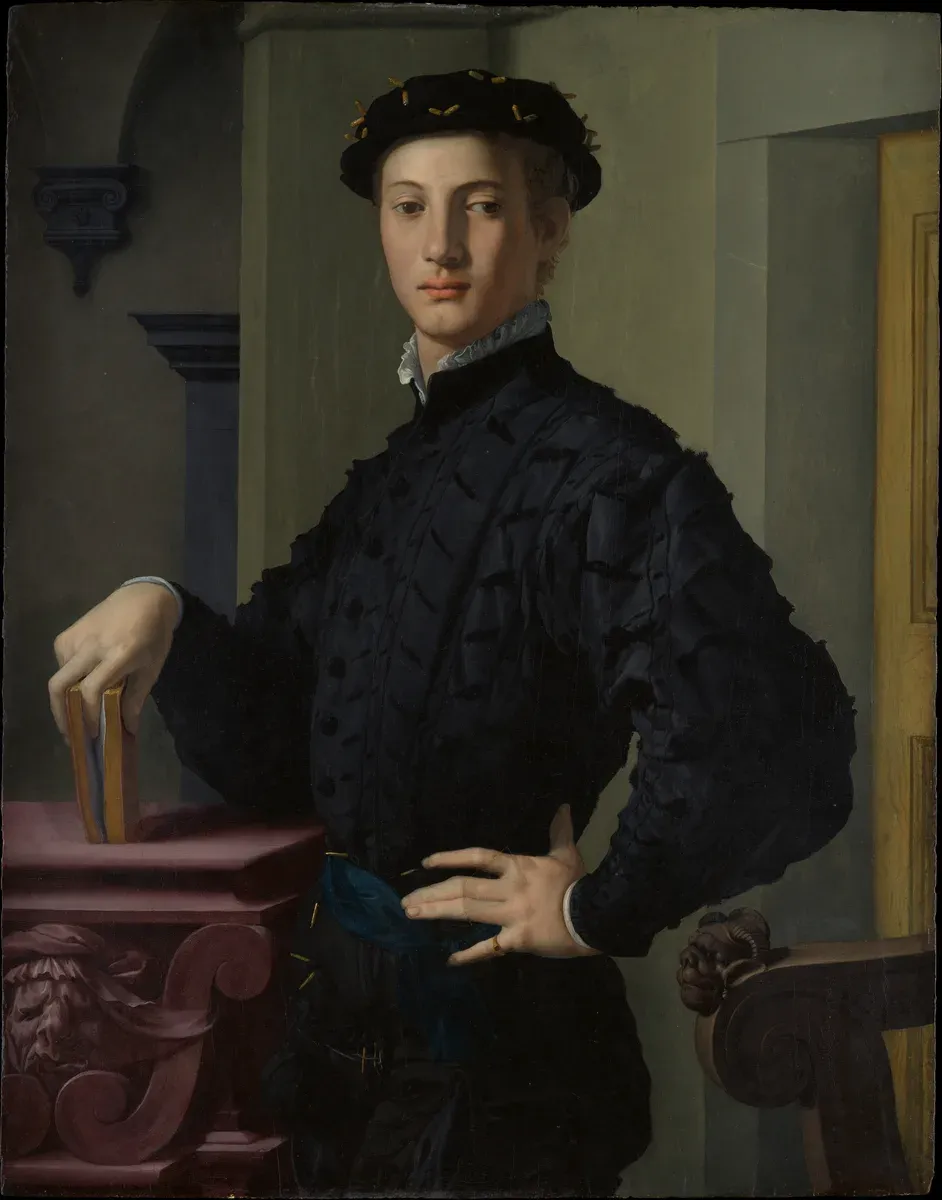
Bronzino, Portrait of a Young Man, 1530s. The Metropolitan Museum of Art (29.100.16). Image: Open Access, public domain (CC0).
Historical Agnolo Bronzino, court painter to the Medici dukes, painted the elite of Florence in the 1530s and after. His sitters are cool, polished and unreadable, dressed in black silk, with hands that look carved.
This young man at the Met holds a book and gives nothing away. Bronzino was also a poet, and the portrait feels like a poem about self-control.
Women at the easel. 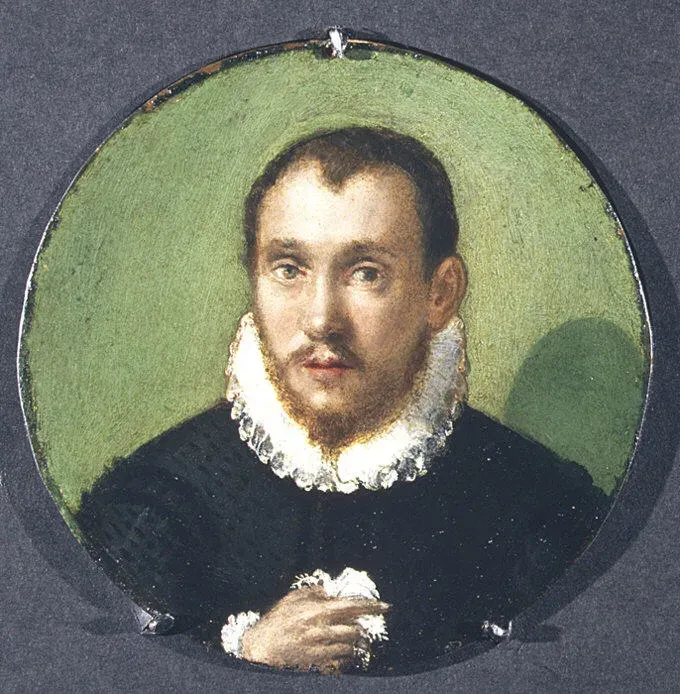
Lucia Anguissola, Portrait of a Man, about 1560. The Metropolitan Museum of Art (32.100.101). Image: Open Access, public domain (CC0).
Historical Sofonisba Anguissola of Cremona was trained with her sisters by a father who believed in educating daughters. She became a court painter to Philip II of Spain and lived into her nineties.
Her sister Lucia Anguissola painted this portrait of a man around 1560, one of only a handful of paintings attributed to her; she died young, in the 1560s.
Lavinia Fontana of Bologna ran a workshop, painted altarpieces and supported her family. In 1971 Linda Nochlin asked why there had been “no great women artists”, and her answer was about access to training and institutions, not talent.
Key artists
| Artist | Lived | Why they matter |
|---|---|---|
| Jacopo Pontormo | 1494 to 1557 | The Florentine painter of pale, weightless figures and acid colors. |
| Parmigianino | 1503 to 1540 | The painter of elegant, stretched figures, who also experimented with alchemy. |
| Agnolo Bronzino | 1503 to 1572 | The court portraitist of the Medici, cool and polished. |
| Sofonisba Anguissola | about 1532 to 1625 | A noblewoman who became court painter in Spain. |
| El Greco | 1541 to 1614 | The Cretan-born painter of flickering, visionary saints in Toledo. |
How do you recognise Mannerism?
Look for long necks, small heads, twisted poses and crowded space with no clear ground. Colors are cold or shocking. Portraits are elegant and guarded. The rules of the High Renaissance are known perfectly and bent on purpose.
Common misconceptions. One is that Mannerism was a decline. Older art history treated it as a failure after Raphael and Michelangelo. Today it is seen as a deliberate, sophisticated style for expert viewers.
Another is that it was a single school. Florentine court portraits by Bronzino, the visionary religious painting of El Greco in Toledo and the playful heads of Arcimboldo in Prague are all called Mannerist. A third is that women were absent. Sofonisba Anguissola became a court painter to Philip II of Spain in 1559, and Lavinia Fontana of Bologna ran one of the most successful workshops of her city.
Esoteric themes
Historical Mannerist courts were full of collectors of the strange: cabinets of curiosities with coral, crystals, automata and “unicorn horns”, which were narwhal tusks. The Habsburg emperor Rudolf II in Prague, from 1583, gathered alchemists, astrologers and painters like Giuseppe Arcimboldo, who made faces from fruit and vegetables.
Arcimboldo had begun with series of the Four Seasons and the Four Elements for Rudolf’s father, Maximilian II, in the 1560s: heads made of flowers, fish, birds and flames, a playful picture of the old idea that a human being is a small world.
Later tradition Rudolf’s Prague became a legend of magic, with stories about John Dee, Edward Kelley and the Golem. Dee and Kelley did visit Rudolf’s court in the 1580s; the Golem tales come from later Jewish folklore.
Modern The cabinet of curiosities is alive on many witches’ shelves today.
Works to see
| Work | Artist | Date | Where to see it |
|---|---|---|---|
| Self-Portrait in a Convex Mirror | Parmigianino | about 1524 | Kunsthistorisches Museum, Vienna |
| Portrait of a Young Man | Bronzino | 1530s | The Metropolitan Museum of Art, New York |
| The Chess Game | Sofonisba Anguissola | 1555 | National Museum, Poznań |
| View of Toledo | El Greco | about 1599 to 1600 | The Metropolitan Museum of Art, New York |
Every work in this list is free of nudity, so you can look them up with confidence. Works still in copyright are named but not shown here.
How to look at a Mannerist painting
Look for the impossible. Necks too long, a body twisting in a spiral, figures standing on no visible ground, colours that seem lit by a different sun. Then ask what the artist gains from breaking the rule: grace, unease, wonder?
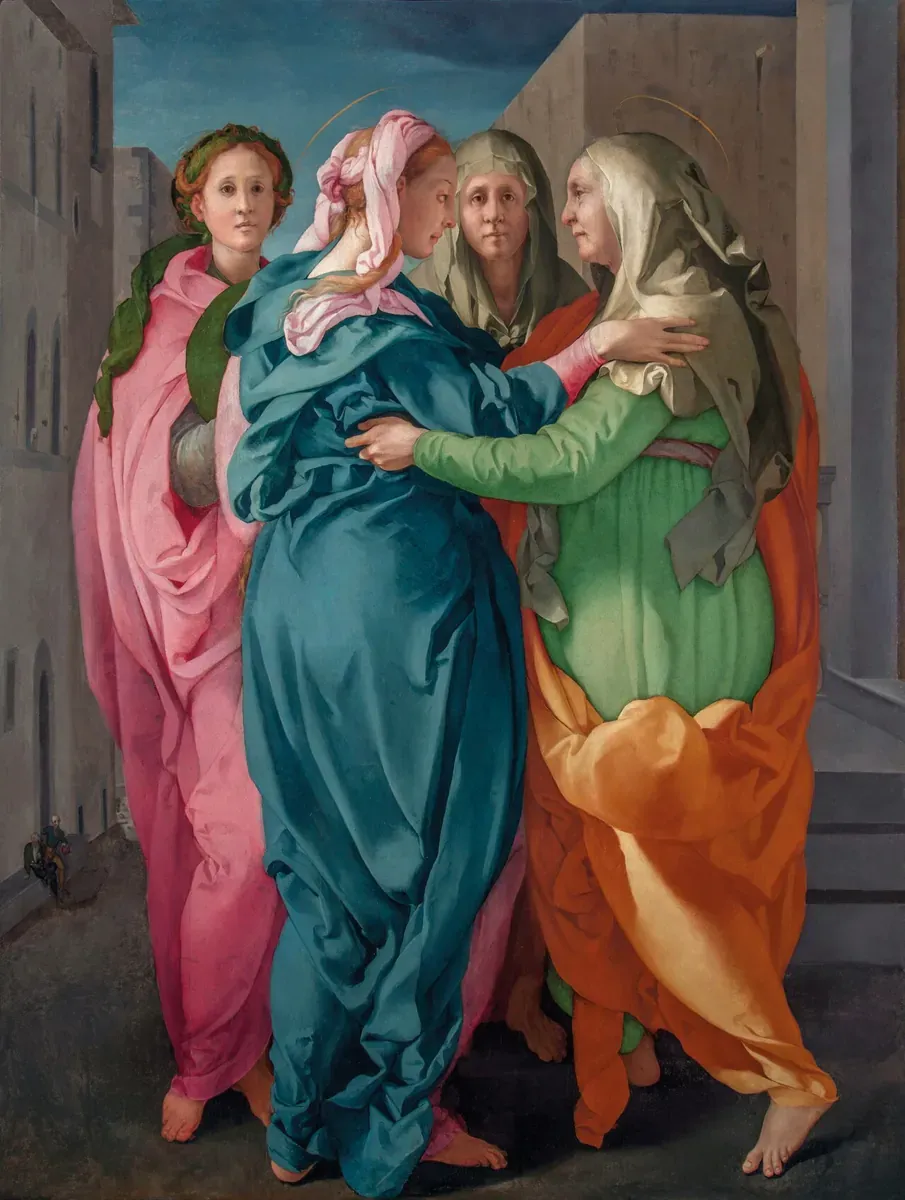
Pontormo, The Visitation, about 1528 to 1529. Pieve di San Michele, Carmignano. Image: Wikimedia Commons, public domain.
Pontormo, The Visitation, about 1528 to 1529. In the parish church of San Michele in Carmignano, near Florence. Mary meets her cousin Elizabeth. Look at the colours, sharp pink, acid green and orange, and at the two women behind them, who stare at you as if they were their own doubles. The ground under their feet hardly exists.
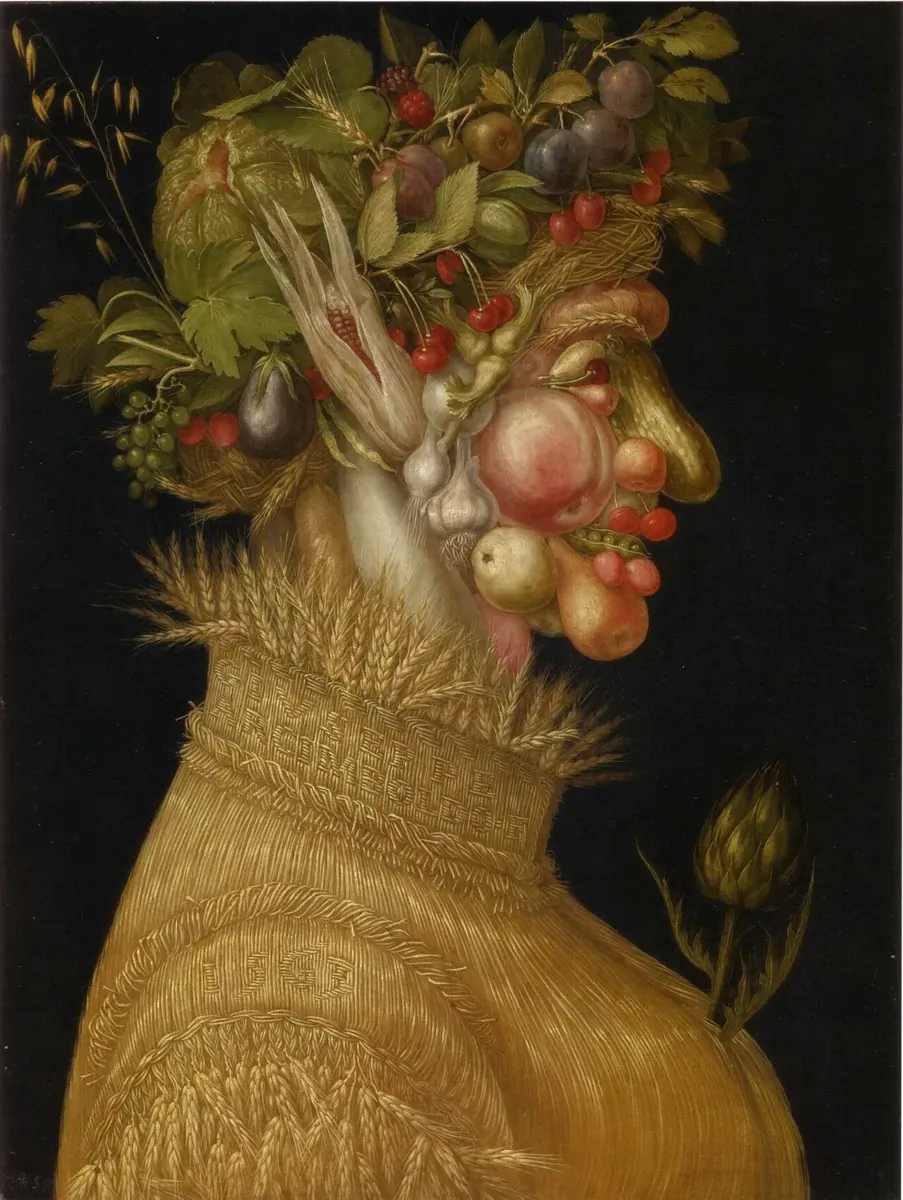
Giuseppe Arcimboldo, Summer, 1563. Kunsthistorisches Museum, Vienna. Image: Wikimedia Commons, public domain.
Giuseppe Arcimboldo, Summer, 1563. At the Kunsthistorisches Museum in Vienna. Painted for the Habsburg emperor. Find the cucumber nose, the cherries, the artichoke on the chest. The artist’s name and the date are woven into the straw collar. It is a joke, a puzzle and an imperial allegory at once.
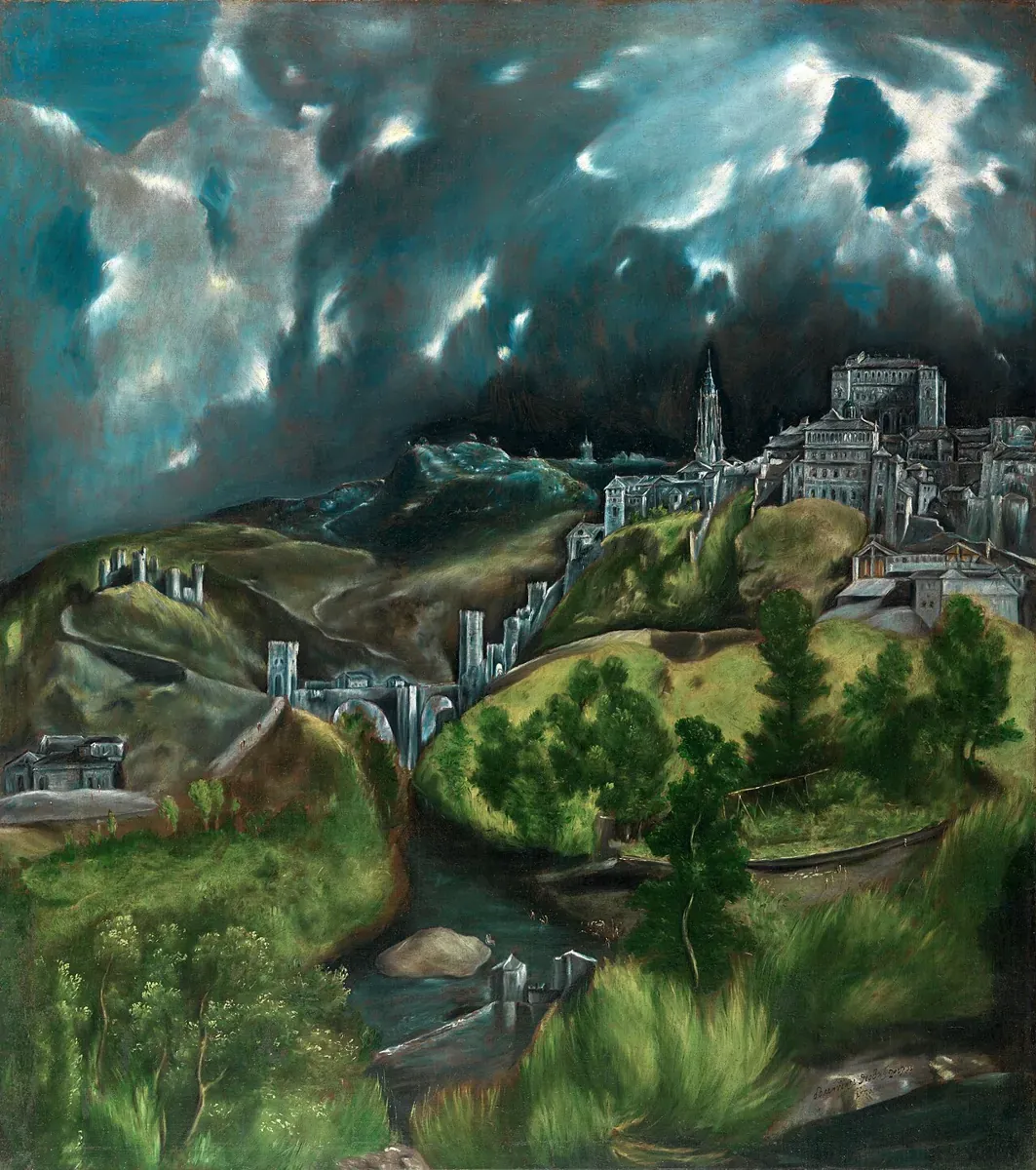
El Greco, View of Toledo, about 1599 to 1600. The Metropolitan Museum of Art, New York. Image: Wikimedia Commons, public domain.
El Greco, View of Toledo, about 1599 to 1600. At the Metropolitan Museum of Art. El Greco moved buildings around and painted the sky like a vision. Look at the green of the hills and the black sky: a city seen with the eyes of the spirit.
Mannerism came after the High Renaissance and before the Baroque. In the 20th century its strangeness fascinated the Surrealists, who rediscovered Arcimboldo, and it shaped the dream images of Symbolism.
Try this
Find an image of Parmigianino’s Madonna of the Long Neck in the Uffizi online. Measure, roughly, how many heads tall the figures are compared with a real person (about seven and a half). Why do you think the painter made them so long?
What next
Before this: Northern Renaissance.
After this: Baroque.
Also worth reading alongside it: High Renaissance.
See every movement in order on the art movements timeline, or learn to look step by step in the free Art History for Beginners course.
If you want to carry this into tarot and practice, these pages connect to it: The Hanged Man, a world turned sideways, seen from an unusual angle; The Moon, distortion, reflection and uncertain light; Alchemy, which Vasari said Parmigianino neglected his painting for; and The end of Renaissance harmony.
Sources
- John Shearman, Mannerism (1967).
- Linda Nochlin, Why Have There Been No Great Women Artists? (1971).
- The Metropolitan Museum of Art, Portrait of a Young Man, 29.100.16. Open the record
- The Metropolitan Museum of Art, Portrait of a Man, 32.100.101. Open the record
- E. H. Gombrich, The Story of Art (1950).
- Wikimedia Commons, Self-Portrait in a Convex Mirror (hero image record). Open the record
- John Shearman, Mannerism (1967).

Questions
What does Mannerism mean?
It comes from the Italian maniera, style or manner. Artists after about 1520 worked in a self-conscious stylish way, with elongated bodies, twisting poses and unusual colors.
Were there women painters in the Renaissance?
Yes. Sofonisba Anguissola became a court painter in Spain, and Lavinia Fontana of Bologna ran a busy workshop and is often called the first professional woman painter outside a convent or court.
Where can I see works of Mannerism in person?
Good places to start are Florence (the Uffizi, Santa Felicita), Parma, Vienna, the Met, and the Prado. Museums change their displays, so check the collection page before you travel.
Who are the main Mannerist artists?
Pontormo, Rosso Fiorentino, Parmigianino, Bronzino, Sofonisba Anguissola, Lavinia Fontana, Giambologna, Arcimboldo and El Greco.
Is El Greco a Mannerist?
Usually yes. He trained in Crete, Venice and Rome and settled in Toledo in 1577. His long figures and unreal colour come from Mannerism, though his style is so personal that some historians keep him separate.
Get the free Mini-Grimoire
A short printable starter guide to tarot and everyday witchcraft, plus my newsletter. Unsubscribe any time.
Opens Substack in a new tab to confirm. More about the newsletter · Privacy